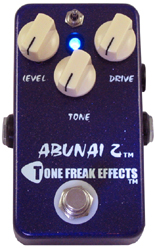
When I stumbled upon Tone Freak Effects as I described in a recent article, I didn’t let on that with the Abunai 2, there might be a Tube Screamer killer in my midst. As you may know if you’re a regular reader here at GuitarGear.org, I love my Tube Screamer. It is the one overdrive pedal that has stayed on my board for years. That creamy-smooth distortion with the mid-range bump just stirs me to the core. I use it all the time, even though I’ve been playing GREAT amps that break up beautifully.
So it is with incredible excitement and anticipation that Dereck over at Tone Freak Effects is sending me an Abunai 2 to evaluate. I’m always a bit dubious about overdrive pedals, and always make the comparison to my beloved Tube Screamer when I run across new ones. But the more I listen to the sound clips, and read reviews on the web about the Abunai 2, the more I’m thinking that if this pedal performs as well as the clips suggest, my Tube Screamer may have some serious competition.
Here are a couple of clips, both through a Suhr Badger:
Clean
Pushed
Impressive, huh?
The thing that REALLY turns me on about this pedal is that it has three switchable clipping configurations in addition to the gain, drive and tone knobs. That kind of versatility is extremely intriguing to me. We shall soon find out in the next couple of weeks.
…was the question my wife recently asked me, to which she added, “You already have a bunch of guitars, and amps are sometimes stacked like a wall in the garage, and you’ve got pedals on the floor that aren’t even on the board that you gig with. It’s not that I want to you to get rid of anything, I’m just trying to understand your obsession with gear.”
I replied, “I’ve been trying to understand that myself, and for years. Just when I think I’ve found the perfect tone, I come across some piece of gear that really turns me on, and well, I just have to get it.”
That brief conversation led me to into a bit of introspection, and I asked myself, “Is there a perfect tone out there?” And the answer I came up with is: Yes and No.
“Yes” from the perspective that for certain periods of time, I totally dig my tone. But “No” from the perspective that that satisfaction is fleeting. It’s not that I get tired of my tone, it’s just that I periodically want to enhance it; add a different kind of distortion color, try out a British-style amp. Fundamentally, it still sounds like me, but just different. Sometimes the changes I make are good, and they become permanent, other times, I tire of them. And there are times where I go practically bare-bones, and strip back to the basics.
So I guess it’s not really about searching for the perfect tone, but exploring the different types of tones that may tickle my fancy from time to time. Sometimes it involves buying gear. But the kicker is that I won’t get rid of anything because I never know when I might return to a different tone from days gone by. Besides, who doesn’t like a bit of change from time to time?
I love serendipitous moments, when I stumble upon something new when I’m doing something else entirely. Such was the case of me stumbling upon Tone Freak pedals. I was seeing if the domain name “tonefreak.com” was taken, and at the top of the search results was Tone Freak Effects. You know me and overdrive and distortion pedals. I LOVE ‘EM! And Tone Freak Effects specializes in two kinds of overdrive, two kinds of distortion pedals, plus a buffer/booster and a really nice trem pedal.
The OD and distortion pedal clips I listened to demonstrate a very diverse set of pedals that have a classic character, but also sound fairly unique as well. For instance the Abunai 2 clips sounded a lot like a classic Tube Screamer – nice and open – but with a bit more low-end while maintaining that openness. In fact, all the pedal clips I listened to portrayed familiar OD and distortion sounds, but were also wonderfully different in very good ways. This could likely be because almost all the pedals are the result of collaborations with various guitarists.
No matter, these pedals sound awesome!
I’m particularly interested in the Buff Puff, a signal buffer, plus a clean boost. The buffer is on all the time, and helps restore the signal loss that can occur in a long effects chain. When you switch the pedal on, you get some clean boost. Not sure how many dB, but that is something that I find totally cool. In addition to my love for OD pedals, I’ve really started getting into clean boost – not just to up my volume, but to also slam the front-end of an amp. It’s wonderful!
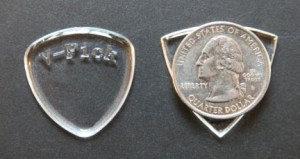
Summary: Super-fast, super-responsive plectrums that will take your guitar playing to another level!
Pros: Whether you play with pointy or rounded corners, these picks will give you more technical accuracy, and sweeter tone than you can imagine!
Cons: None.
Price: $4.00 ea
Specs:
Hand-ground and hand-buffed
Various thicknesses available
Tone Bone Rating: 5.0 – Like Red Bear picks, once you play with picks like these, you’ll never go back to your old picks.
Okay, I’m sold. V-Picks are absolutely awesome! Yeah, I’m a Red Bear lover, but I love these equally, but for kind of different reasons and applications. For acoustic, my Red Bears absolutely rule. I couldn’t wait to get home to do yet another comparison test, and for flatpicking and strumming on an acoustic, my Red Bears (Style B Medium and Heavy), completely did it for me. They produce rich and warm tones, and chime like I’ve never heard from my guitar. They really are a strummer’s dream come true. But for all-around electric playing, V-Picks, especially the medium sized pointed and rounded picks, just make my heart sing! Not that the Red Bears sound bad on electric- they don’t. But there’s something about the brighter tones the V-Picks produce compared to the natural, warm tone of the Red Bears, that sound much more pleasing to me on electric guitar. Of course, this all boils down to personal preference as I mentioned in my previous article from earlier today.
So what’s the big deal? It’s all in the sound, baby! And to demonstrate, I created a sound sample. In the sample, I play a scale in E major starting on the 3rd string on the 9th fret. The first clip is with the Dunlop Tortex Medium (Orange), to provide a reference point. The second clip is played with the V-Picks Medium Rounded, and the third clip is played with V-Picks Medium Pointed.
If you listen carefully, the difference in how the clips sound is subtle, but important. With the Tortex, there is actually a very slight delay between when a string is struck and when sound is produced. It kind of screwed me up when I moved to the medium rounded, but the thing to notice there is that the tone is thicker and much more well-rounded. In the third clip, I moved to the pointed pick. I got the same bright tone that the Tortex produced, but the tone is much smoother and more refined and defined.
Another huge difference in playing the three scales was that with the Tortex, I didn’t feel like I had much control. Even though I stayed on tempo (I had a metronome set at 120bps that I was playing to), I no longer felt confident with that pick. On the other hand, with the V-Picks picks, I felt like I was in total control, and in fact, felt like I could go A LOT faster!
I could write more, but why? The sound bite says it all! And no, I didn’t purposely play bad with the Tortex. In fact, if anything, I tried to be as accurate as possible with the Tortex so I could give a fair representation. I was even a bit sloppy with the second clip, using the medium rounded, but the tone was so much smoother than the Tortex, despite my technical mistakes.
My days of buying bags of cheap-ass picks are over, folks! With my V-Picks and Red Bears, I’m now in tonal heaven! I can’t say enough about these picks, folks! You gotta go out and try them!
Summary: A great take on the classic Marshall JTM45, with some extra goodies like tube-driven spring reverb, a fantastic master volume (post phase inverter), half power switch (40 to 20 Watts), and bright and bite switches to add hi and hi-mid EQ bumps for more tonal contouring.
Pros: Very versatile amp with a tonal palette that can serve up gorgeous clean tones to thick, super-compressed power tube distortion.
Cons: Heavy – weighs in at 60lbs.
Price: $2195 street (as tested with 1 X 12 Combo)
Specs:
Pre-amp tubes: (3) 12AX7, (1) 6BM8
Power Amp Tubes: (2) 6L6GC or KT66 (as tested)
Rectifier: (1) GZ34 (5AR4)
Reverb Tank: Accutronics Long TankHi/Low B+ voltage switch (40/20 watts)
On/Off Switch
Standby Switch
Indicator Lamp
Custom Heavy Duty Aluminum Chassis
Custom Wound Transformers
Impedance Switch: 4, 8, 16 ohm
(2) Speaker Jacks
Custom Handcrafted Turret Board
Handwired
Tone Bone Rating: 4.75 – Sweet amp with lots of tonal variety, but very heavy at 60 lbs. in a 1 X 12 combo! I would definitely get casters for this amp.
One thing I’ve learned about reviewing gear is to never have preconceptions about what something might sound like, especially with guitars and amps, regardless of what the manufacturer might say. When Jeff Aragaki of Aracom Amps dropped his latest amp off at my house, then explained that it was modeled off a Marshall JTM45, but with a few enhancements, despite my normal resistance to those suggestions, I still made a few assumptions about what the amp would sound like. Mistake. I was expecting a Marshall tone; it’s there, but it’s also different. But let’s get into some detail, shall we?
Fit and Finish
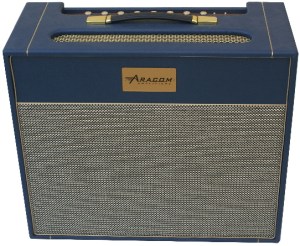
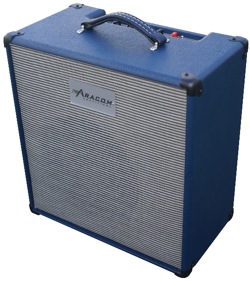
All Aracom amps are very well built and constructed. The amp I tested uses the cabinet shown above, but is covered in green tolex, and the same acoutrements as the cabinet above. The cabinet itself is very sturdy and very resonant. The metal grille at the top of the amp is a nice touch, as you can see into the chassis and see the tubes all lit up. I dig that kind of stuff. Jeff uses all high-quality material from the chassis to the knobs, and everything is well laid out.
How It Sounds
This is one awesome-sounding amp! I was actually expecting a real scooped tone, but was very surprised that the amp is actually voiced quite evenly through the EQ range, with just a tad bit of lower-mid range. This gives the tone a darker, almost fatter feel. But still, the cleans are rich and crisp, not chimey like an EL-84 would sound. The huge KT-66’s this amp packs probably account for that.
The reverb is subtle – very subtle – but I really like the effect it has. It definitely won’t do surf. It was as if Jeff wanted to add the reverb as a nice decoration for the amp’s tone. If you’re looking for a deep ‘verb, this won’t do it, but the reverb it does give you, for lack of a better word, just “fits.” Here’s a sound sample that I recorded with my Strat playing the amp clean in the Normal channel with all the EQ’s set to their midpoints:
By the way, the clip is the raw recording, with no EQ or mastering or level adjustments (which accounts for a bit of the distortion as I didn’t apply a limiter). As you can tell, the clean tone is sweet and well, clean. And it has TONS of clean headroom in the Normal channel.
As far as distortion is concerned, before this, I had never played with a KT-66-based amp, so I didn’t quite know what to expect, but this amp can produce some serious distortion. When saturated, the KT-66’s really compress the tone, and the compression comes on with even just a bit of breakup. It’s a great sound, but it’s difficult to cut through a mix with that amount of compression. But hitting the bite switch adds a bit of high-mid-frequency gain, so that compensates for the compression by sort of shifting the EQ up a bit.
The bite switch works with both channels, but the bright switch only works on the Normal Channel. This switch boosts the upper-mids and highs. Don’t expect a ringy sound out of this – it’s more like an instance presence control, though the amp sports a sweepable presence knob as well.
I wish I had a sound sample for my test with a Saint Guitars Baritone Messenger. Even though it’s a baritone, the walnut gives it a fairly bright tone, and that is really complimented by the Custom 45R. I was enjoying myself so much with the baritone, I totally forgot to record a clip! Maybe later… In any case, this amp just LOVED the Baritone! The Messenger also sports two Duncan active ‘buckers, and the drive they produce really made the amp growl with a real savage tone. It was very heavy, and I was just diggin’ it! Yowza!
Overall Impressions
While I really like the tone of this amp, and am having a lot of fun playing with it, admittedly I still lean towards that chimey EL-84 tone or that “Fender” tone that 6L6’s produce. The Marshall-esque tone never has been for me, but if I were to be on the lookout for an amp with that type of tone, I’d definitely give this amp some serious consideration.
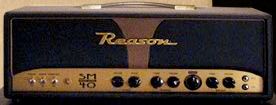
Reason Amps SM40 HeadSummary: Deep, lush cleans, with bright, ballsy and aggressive overdrive. The SM40 is a classic rocker’s wet dream come true.Pros: Touch-sensitive and expressive. The voltage sag in the 5U4 is just enough to create almost a reverb quality as the signal fades. Truly lovely sound!
Cons: None.
Price: $2195
Specs:
• Output: 40 watts RMS @ 10% THD
• (4) EL84 output tubes, in Class A Cathode Biased configuration
• (2) 12ax7 preamp tubes
• 5U4 Rectifier tube
• 3 way Stack switch – Normal, Stack, Bright
• Normal channel – Volume, Tone
• Bright channel – Volume, Tone
• StackMode™ – Bright & Normal channel controls are active, Stack Volume & Hi-Cut
• Oversized extra capacity power supply
• Harmonics Switch – works in the final output stage to change the harmonic structure of the
overdrive.
• Power Switch
• Standby Switch
• Half-power switch
• Independent output jacks for 4,8, 16-Ohm operation
• Footswitch access to all three channels/modes
Tone Bone Rating: 5 – This is a blues and classic rock machine!!!
This review is a long time in coming as I evaluated the SM40 over a month ago, but as they say, better late than never. As many may know, I’ve had a love affair with the SM25 that the Reason guys sent me to review, and that amp will be in my rig (see my review here). In my view, very few amps can match it in versatility. It is an extremely expressive amp that is capable of producing lush, ringing cleans, to searing overdrive. And according to both Anthony Bonadio and Obeid Kahn, the founders of Reason Amps, the SM25 Combo was built specifically with versatility in mind. It is very pedal-friendly, and StackModeTM is the greatest thing since sliced bread!
But sometimes, you just don’t want or need that kind of versatility because with versatility comes compromises. For instance, the SM25’s Normal or clean channel breaks up a little earlier than you’d expect though I actually rarely if ever play at the volume so it’s a none-issue for me. Since I play a variety of styles, versatility is a key factor in my decision on an amp. But that versatility is lost on those who just don’t need it. And mind you, that’s not a bad thing. It’s merely a matter of choice, which is why you have a number of amp options to choose from with Reason Amps. Premier Guitar already covered the SM50, which gives a fair picture of the SM50’s capabilities – though I do have to take issue with Premier Guitar giving it the “Loud As Hell” award. It’s not just a noise-maker. It’s just that you’d swear the SM50 is 100 Watts as opposed to 50 Watts. It’s an extremely powerful and expressive amp with classic EL-34 goodness.
The SM40, on the other hand is a very interesting take based upon EL-84 output tubes. Where the SM25 and SM50 are based on EL-34’s in Class AB fixed-bias configuration, the SM-40 is built around two EL-84’s operating in Class A Cathode Bias configuration. Like the other Reason Amps, the SM40 has two independent channels with the trademark StackModeTM “channel,” that combines the fully amplified signals from both Normal and Bright Channels in a series with an extra gain stage, while retaining both the volume and EQ control that each channel contributes to the combination.
The Story Behind the SM40
I called the Reason guys up to shoot the breeze a bit yesterday, but to also pick their brains about the SM40, Obeid Kahn (Reason’s amp designer) and I had a great conversation about the story behind the SM40. For all intents, and purposes, the SM40 was Reason’s first production amp. Obeid had gone through several prototypes before he finally produced the SM40 which included StackMode. Previous versions had completely independent channels with separate inputs, then evolved into switching between the two, then finally evolved into connecting the two channels in a series. So the SM40 could be considered the eldest sibling in the Reason amp line and the first successful incarnation of StackMode.
How It Sounds
The SM40 is targeted at blues and classic rock players, and it definitely shows that in the way it’s voiced. Moreover, there’s something really special about the clean tone of an EL-84-based amp. It’s naturally chimey and glassy, and guitars that have that natural quality bring that tone out even more. On the Normal channel, the kind of voicing is beautiful; chimey with lots of mid-range, but not overdone. And there’s TONS of clean headroom in this channel, which makes it ideal for use with pedals. Put a booster in front of this channel, and you get that AC-30-like breakup, which is subtle and smooth. Very nice.
The Bright channel, on the other hand, is actually not that much brighter than the Normal channel. In fact, the tonal differences between Normal and Bright are so subtle that you’d think there’s no difference at all. But that’s by design. Unlike the SM25 which was built around versatility, the SM40 is a much more focused machine, which is why you only get volume and tone on any channel or mode, as opposed to the SM25 which includes a 3-band EQ on the Normal channel. The idea behind that makes sense: Players who buy this amp will mostly play a certain style of music and don’t want to be bothered tweaking knobs to dial in their sound. Not that the amp can’t be used in a variety of genres, but players who play this won’t want to stray from the general tone the SM40 produces.
Similarities between the channels aside, the real kicker for me is the StackMode “channel,” which combines Normal and Bright channels in a series, while retaining both volume and tone shaping in both channels. This really opens up a whole new pallette of tones you can produce. It’s super-expressive, and because you’re essentially working with three gain stages in a series, this mode makes the amp incredibly responsive to volume knob and attack. Dime the volume on your guitar, and you can get tons of overdrive. Back it down and pick lighter, and the tone cleans right up. In my tests of both Reason amps, StackMode was pretty much all I used, unless I was playing something where I needed a pure, glassy clean tone for which the Normal channel excels.
An interesting switch labeled Odd/Even resides on the control panel. This is a harmonics switch that works with the phase splitter in the final gain stage. The idea behind it is that at super-high gain, you start getting a “notch” type of distortion. Flipping the switch smooths that out. I actually didn’t notice that much of a difference with the switch in either Odd or Even positions, but maybe that was because I was only 3 feet from the amp, and it was cranked! 🙂 For the most part though, the switch won’t have too much of an effect until you get into really thick overdrive.
Playing It
The SM40 was tested with a Strat copy and a Saint Guitars Benchmark with humbuckers. With the Strat copy, you’re immediately taken to the roots of blues. The chimey vibe really comes out with single coils, and I found myself closing my eyes to take in the sweetness. With the Benchmark, the SM40 grew big balls of steel. Not that you’d do metal with this amp, but humbuckers make the SM40 want to growl. It’s really nice.
Overall Impressions
The SM40 is a sweet amp, and like its sibling, the SM50, it’s really made for the stage. It’s expressive and ballsy, and is meant to be played hard. As both Anthony and Obeid have both told me, this amp is made for active musicians. And while I wouldn’t want to keep people from buying it because it sounds so good, by the same token, I wouldn’t recommend it for bedroom use. You wouldn’t be able to take advantage of its full range of tones.
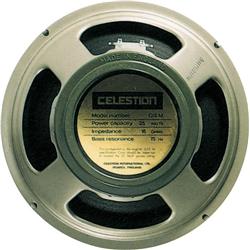
My good friend Phil of Phil ‘N The Blanks has been bugging me to write about speakers for the last couple of weeks. I’d talk about this speaker or that in some amp or cab, and he’d say, “There’s your next article, dude. You gotta write about speakers.” Admittedly, I’ve been a bit reticent about the subject because of all guitar parts, what makes a speaker sound good is purely a subjective thing; that is, someone’s assessment of a speaker’s tonal quality is entirely personal.
Oh yeah, you can argue the case of alnico vs. ceramic. You can argue vintage vs. modern voicing. You can argue about the materials used in a particular speaker. But in the end, none of that matters unless it sounds good to… well… you.
Phil has been trying to get me to write about certain speakers, but that’s something I just won’t do because again, it’s personal preference. For instance, Jeff Aragaki of Aracom Amps came over to my house today and we talked at length about his RoxBox 18 Watt Combo. I love the amp, but really wasn’t moved by the Eminence Red Coat Red Fang, which uses an alnico driver. On the other hand, I love the RoxBox head plugged into the Reason SM25 speaker cabinet that sports a Red Coat “The Governor,” which uses a ceramic driver. To me, it has a deeper sound. I kind of lean towards the “woman tone,” and “The Governor” is voiced a lot like a Celestion Greenback, which is known for its rich tones. Combined with my Strat I can get that tone. It just wasn’t happening for me with the Red Fang, though for really heavy rock stuff, the Red Fang really shines when it’s pumped up, as it compresses very nicely at high gain output. But that’s not the style I play, so it was hard for me to truly appreciate its virtues.
That said, Jeff mentioned another guitarist who just loves that setup. He’s more of a pure rock player, and loves the warmth and brightness that the Red Fang produces. See what I mean? To talk about this speaker or that is akin to starting a holy war. And you can’t tell anyone a particular speaker is bad or good because that’s just an opinion.
So here’s my advice if you want to switch to a different speaker: Go to a place where you can try speakers out and pick the one YOU like. Use reviews and sound bites as guides only. They’ll generally get you into the ballpark of the tone you want to achieve. And don’t be surprised if you get a speaker for cheap. Remember, as far as gear is concerned, something that costs more a lot of times just costs more – it may not sound any better to you. A good comparison to make is with the speakers I mentioned above. The Red Fang costs about $129, while The Governor costs $89. But I like the sound The Governor produces. If the prices were switched, I’d still go with The Governor.
So don’t be fooled by any marketing mumbo-jumbo. Go out and test for yourself! 🙂
What? Less gear? I must be speaking blasphemy, especially considering I’m such a gear freak – especially with my proclivity for pedals. But there’s also a practical side to this, as I am also a gigging musician. And especially when I do solo gigs, having less gear means less trips to the car. So as much as I can consolidate, I do. I was thinking about this because Christmas time through the New Year is usually a very busy time for me as far as gigs are concerned. For the past month, I’ve had at least three gigs each weekend, playing parties and other events. So you can see that I’m fairly sensitive to lugging gear.
So here I am in a coffee shop this morning, having put the finishing touches on my latest gear review on Aracom Amps RoxBox. In the article I mentioned that Channel 2 suffered from being flat at lower volumes, and that I ultimately solved the problem by running the amp through an attenuator between he power amp and speaker. I’ve had to do that practically every tube amp I’ve tested, so it got me to thinking: Why don’t more manufacturers just add these to their amps? I suppose production cost has a lot to do with it, but amp makers such as Faustine Amps have a -18db reactive attenuator built into their Harlequin line of amps and the Fender Princeton Studio also has a built-in attenuator as well. It’s a cool feature, and one that will allow you to get power tube saturation at lower output volumes.
Let me explain what I mean by way of a diagram:
As you can see, the traditional master volume circuit contains an attenuator between the pre-amp and the power amp. This means that you can crank the pre-amp and get pre-amp distortion, while limiting power to the power amp; thus limiting output volume. But it also means that in many cases, you won’t get power amp distortion unless you crank the master, which tends to be too loud, especially in small clubs and restaurants. But in the second illustration, with a second attenuator between the power amp and the speaker, it is now possible to crank the master volume to get power tube saturation while limiting overall output. I currently do this with the use of a Dr. Z Air Brake. But going back to the topic of this article, it’s just another piece of gear that I have to bring with me to a gig. Ugh!
In addition to production cost, there is a danger of possibly burning out the power tubes if you really overdrive them. I’ve done it to my Fender Hot Rod, by turning the attenuator to maximum attenuation, and diming the Drive knob for too long a time. Not good.
As I mentioned above, Faustine does this with their Harlequin line of amps (not sure about the others), and while -18db of attenuation may seem like a lot, it’s actually not that much – it takes the edge off. There must be a happy medium, say -24db or maybe -30db? Who knows? But whatever… this is a case where less gear is much better!
Just wanted to share some initial sound bites that I created with a couple of new pieces of gear. The first is a Saint Guitars Messenger Baritone. Before now, I had never played a baritone, and really didn’t know what to expect. But after playing around with it for a few days, I have to say that I just love how this thing sounds. Baritones have been getting more and more popular as of late due to their very low, natural tone, and several metal players have started using them because of this. But I truly believe that a good test of a guitar or an amp is how it sounds clean. Played clean, you can’t hide mistakes. So here’s a clip that I created this morning to demonstrate the beautiful, clear tone the Messenger Baritone creates.
The guitar was played through the Normal channel of a Reason SM25 amp. As you can hear, the tone is deep, but surprisingly chimey due to the bright-sounding walnut body and neck, Adam Hernandez’ tone wood of choice. It took awhile to get used to playing the wider frets, but once I got a handle on it, I just started loving how this guitar plays and sounds!
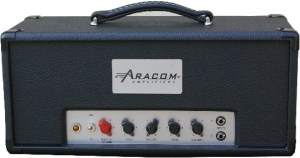
Aracom Amps RoxBox 18 Watt Head
Aracom Amps RoxBox 18 Watt Head
You know me, in addition to just digging on overdrive pedals, I love low-power amps! When Jeff at Aracom initially contacted me, I had never even heard of Aracom amps! And I pride myself on knowing about these things! Yikes! So when I perused his site, I was immediately taken by the RoxBox. And after just a day of using it, I have to say that I LOVE THIS LITTLE AMP!!! First, because it’s a low-wattage amp, which makes it very versatile, and secondly because it comes equipped with EL-84 power tubes! There’s a brightness in the EL-84 tubes that just makes my soul reverberate, and I just dig the sounds that this amp can produce. But just as with the Messenger above, the big test for me is how the amp sounds clean. And baby, it sounds great clean! The sound bite I have here uses the same clip above, but layers on a lead part using just my Strat played through Channel 1 of the RoxBox. Channel 1 has TONS of clean headroom, and even ‘buckers have a hard time making this channel grind. This will definitely score well with the pedal freaks like myself. Anyway give it a listen:
This little amp is nothing short of impressive, and priced at $895 for the head, it’s also an incredible value!!! Kudos to Jeff at Aracom for creating an attainable hand-wired amp! Looks like I’m going to be shelling out bucks for both the Reason SM25 AND the Aracom RoxBox.
I love writing this blog. Not only do I get to share my passion for guitar and guitar gear, in the couple of years since I started this blog, I’ve met and encountered some really great folks who also share the same passion. After all, it’s why you visit, and I thank you for all the support you’ve given me! When I started GuitarGear.org, I didn’t have any idea of where I’d go with it. I just started writing; not very often at first, but then it just kind of took on a life of its own as I found other great gear blog sites, and started interacting with the general blogging community, and the people I’d meet on other sites would visit my site. That’s what has kept me going, and it’s just an amazing thing!
Of course, it’s really cool to review gear, whether I own it or test it, then share my findings with folks. And speaking of reviewing gear, in this article, I’m introducing what looks to be a real promising, new amp company, called Aracom Amps! They have a whole line of reasonably affordable, hand-wired amps modeled mostly after classic Marshal amps. From what I could tell from the sound samples, these are very nice sounding amps, and the few reviews I’ve been able to find have all been exceedingly favorable. So like I said, there’s a lot of promise in this relative newcomer to the custom, hand-wired amp space.
Jeff from Aracom contacted me the other day to see if he could buy some ad space on my site. I replied that I had never even considered doing that because I didn’t want to commercialize the site. The most commercial thing I’ve done to this point is to put “click-throughs” to Musicians Friend on some of my review pages so people could buy gear directly, but I never actually expected to make any serious money from the site. However, I did tell him that at the very least, I’d review some gear for him, and if I really loved it, like I do with Reason Amps and Saint Guitars (by the way, I just got a new baritone yesterday to test, and IT ROCKS!!!), I’d make a banner for him and put it on my site.
So I am now awaiting delivery of what I think is a very, very cool EL-84 based 18 Watt amp called the RoxBox. It’s completely hand-wired on turret board, and it comes in a head version (which is what I’ll be initially reviewing), and in two different combos: A 1 X10 and a 1 X 12. Nice. It has two individually voiced channels with independent volume and tone control, and is also switchable down to 9 Watts. So this promises to be a very versatile little amp. To say I’m extremely excited about receiving this amp is putting it mildly. The reason why I’m so excited is because the most you’ll pay for one of these is $995.00!!! Imagine that! A hand-wired amp for less than a grand! It’s unheard of! And all Jeff’s amps are very reasonably priced.
Head Cabinet
Standard Tolex: Black Levant. See options below for other colors.
– Dimensions: 19″w x 8h x 8.25″d
– Weight: 23 lbs
Combo Cabinets
Standard Tolex: Black Levant. See options below for other colors.
– Dimensions
1×10 Combo: 18″w x 19h x 10″d
1×12 Combo: 18″w x 19h x 10″d
– Weight
1×10 Combo: 36 lbs
1×12 Combo: 39 lbs
Introductory pricing:
Rox Box Head $895
Rox Box Combo with 10″ Jensen ALNICO Speaker $995
Rox Box Combo with 12″ Jensen Ceramic Speaker $995
Pretty impressive!
I had a great conversation with Jeff this morning about his amps’ price points, and he said that considering today’s economy, he wanted people to be able to buy his amps, and since he does all the work himself, and has done a tremendous job with planning his manufacturing (for example, all his amps use the exact same chassis template), he can keep the price down. With the RoxBox, he was able to keep the price point down further by using a solid-state rectifier that simulates a rectifier tube’s voltage sag rather than using a tube rectifier. Now before you dismiss this, remember that the venerable Fender company has been using solid state rectifiers in their amps for decades, and no one complains about their gorgeous sound! But besides that single piece of solid state componentry, everything else is hand-wired and tube-based.
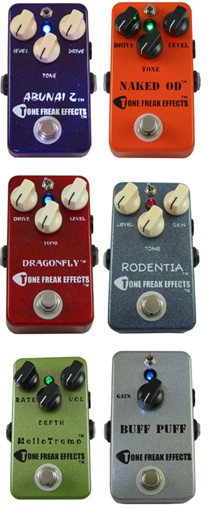 I love serendipitous moments, when I stumble upon something new when I’m doing something else entirely. Such was the case of me stumbling upon Tone Freak pedals. I was seeing if the domain name “tonefreak.com” was taken, and at the top of the search results was Tone Freak Effects. You know me and overdrive and distortion pedals. I LOVE ‘EM! And Tone Freak Effects specializes in two kinds of overdrive, two kinds of distortion pedals, plus a buffer/booster and a really nice trem pedal.

 My good friend Phil of
 Guitar Gear