…to give up on a dream, or perhaps, maybe an illusion. I wrote a new song yesterday for Mass based on Psalm 32, called “I Turn to You.” Give it a listen:
Anyway, when I uploaded it to iCompositions, and wrote the song summary, I included that the song and lyrics were free for the taking. I was just going to put it out there, and let whatever church musicians who come across it use it to their hearts’ content. As I said, “This was a gift to me, and I want to pay it forward.”
Let me qualify about “giving it up.” It’s more like giving up an offering to the universe. I’m not going to stop putting my music out there to get it heard. It’s just that I’m not going to be attached to a particular style or genre of music as a vehicle. I’m going to write what I write, and if happens to be religous, fine. If it’s not, also fine. I’ll basically take whatever inspiration I can get, and let that inspiration dictate the direction I go in.
The new song is the result of just giving it up to the universe. I looked at the verses of the Psalm in the Bible, and suddenly the music came to me. Likewise, I was re-listening to an instrumental I came up with to demonstrate how “Goldie” the Saint Guitars Goldtop Benchmark sounds, and got the idea for an entire song built around that phrase. I’m writing this entry as a break from tracking right now. 🙂
I guess the point to all this is that I released my emotional attachments to the direction I’m taking my music, and letting it just be what it is: Music; irrespective of religion or philosophy. I’m just going to write about things I’m compelled to write about, and share the story.
You ever pick up a guitar and just can’t seem to put it down? For the past few years, that has been “Pearl” my Blizzard Pearl Strat. I just love the way she sings, and she sings oh so sweetly. But ever since I got “Goldie,” a Saint Guitars Goldtop Benchmark to test out, I just can’t seem to put her down. It’s tough because ever since she arrived, I’ve been splitting my time between the two… Wish I had the problem with women when I was single. 🙂 <sigh> Oh well…
“Goldie” is a very special guitar, with a mahogany body, maple top, and solid rosewood neck. I know, I’ve already reviewed her, but she’s absolutely the perfect guitar – at least to me. The tone from the woods are so balanced and warm that when you play her, you have to just close your eyes and let her take you for a ride. And her neck… ah, her neck! What a thing of grace and beauty. The open-pore finish of the rosewood is so wonderful to the touch, you just want to run your hands up and down the fretboard and feel the sensuousness of her gentle curves. I know, I’m sounding kind of weird, but it’s the best I can come up with to draw a metaphor of how it feels to play this guitar!
Tonight, after I returned home from a quiet date for a cup of tea with the love of my life for Valentine’s Day, I retired to my studio to play around with Goldie. I was just noodling when I played a phrase that just begged to be laid down. So I figured out the chord progression that would go with the phrase, and here’s what I came up with:
Goldie has a bright, big voice, and true to all Saint guitars that I’ve had the priviledge to play, she has an even, dynamic range in all strings, up and down the fretboard. Unlike other guitars where you pluck the top two strings, and you get a loss in volume, forcing you to dig in when you play those strings, especially about the 12th fret, not so with any Saint guitar – it’s uncanny, and a mark of the care Adam Hernandez has put into his designs to ensure his guitars are resonant in any frequency!
Having a great amp to bring out the best in a guitar doesn’t hurt either. The amp I used is a soon-to-be-released prototype Aracom Amp, based upon the RoxBox 18 Watt, but with different tubes, and slightly different power handling. Sorry, I can’t be more descriptive at Jeff Aragaki’s request. You can be assured that once Jeff gives me the go-ahead, I’ll be writing a review of it, and it will be good. 🙂 This amp in particular is very pedal friendly, and I used a Tube Screamer to give me some grit on the lead, plus my new Hardwire Reverb.
In any case, I just wanted to share my excitement about this guitar. It simpy kicks ass, and paired with a dynamite amp, I’ve got a winning combination on my hands!!!
When my son Bennie was tested and diagnosed with a form of Attention Deficit Disorder – the attention kind, not the hyperactivity kind – I realized that I had grown up with the same problem. Parents and teachers used to just call it “getting easily distracted.” I’d be doing something then someone or something would distract me, and I’d point my attention on the new thing. It was difficult, but I was able to compensate for it, and my attention deficit hasn’t really affected me too much. In fact, it has probably helped because my over-active mind switches gears – a lot – probably a huge reason I keep this blog up to date with new stuff at least five or six times a week. I’ll be doing some coding, then I’ll take a break to sniff around the web for new gear, and voila! A new article appears on the site! 🙂
Such was the case with this new Jam Track. I got the inspiration for a new song this morning, and laid down the main riff to a metronome. While experimenting with different rhythm parts, I ran across a really funky bassline, and it turned out to be perfect. Then I added some funky drums, layered on a walking double-stop run, pulled out the Goldtop and started to JAM!!! So here it is. You have about 6 and a half minutes to play! As with all my Jam Tracks, it’s best to loop the song so you can play ad infinitum.
Gear Used
Aracom 22 Watt Prototype with 6V6’s – freakin’ awesome amp! (Sorry, can’t say any more at this time.)
Summary: Super-fast, super-responsive plectrums that will take your guitar playing to another level!
Pros: Whether you play with pointy or rounded corners, these picks will give you more technical accuracy, and sweeter tone than you can imagine!
Cons: None.
Price: $4.00 ea
Specs:
Hand-ground and hand-buffed
Various thicknesses available
Tone Bone Rating: 5.0 – Like Red Bear picks, once you play with picks like these, you’ll never go back to your old picks.
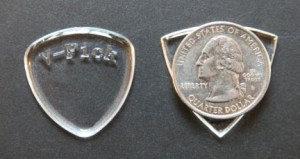
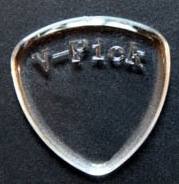
Okay, I’m sold. V-Picks are absolutely awesome! Yeah, I’m a Red Bear lover, but I love these equally, but for kind of different reasons and applications. For acoustic, my Red Bears absolutely rule. I couldn’t wait to get home to do yet another comparison test, and for flatpicking and strumming on an acoustic, my Red Bears (Style B Medium and Heavy), completely did it for me. They produce rich and warm tones, and chime like I’ve never heard from my guitar. They really are a strummer’s dream come true. But for all-around electric playing, V-Picks, especially the medium sized pointed and rounded picks, just make my heart sing! Not that the Red Bears sound bad on electric- they don’t. But there’s something about the brighter tones the V-Picks produce compared to the natural, warm tone of the Red Bears, that sound much more pleasing to me on electric guitar. Of course, this all boils down to personal preference as I mentioned in my previous article from earlier today.
So what’s the big deal? It’s all in the sound, baby! And to demonstrate, I created a sound sample. In the sample, I play a scale in E major starting on the 3rd string on the 9th fret. The first clip is with the Dunlop Tortex Medium (Orange), to provide a reference point. The second clip is played with the V-Picks Medium Rounded, and the third clip is played with V-Picks Medium Pointed.
If you listen carefully, the difference in how the clips sound is subtle, but important. With the Tortex, there is actually a very slight delay between when a string is struck and when sound is produced. It kind of screwed me up when I moved to the medium rounded, but the thing to notice there is that the tone is thicker and much more well-rounded. In the third clip, I moved to the pointed pick. I got the same bright tone that the Tortex produced, but the tone is much smoother and more refined and defined.
Another huge difference in playing the three scales was that with the Tortex, I didn’t feel like I had much control. Even though I stayed on tempo (I had a metronome set at 120bps that I was playing to), I no longer felt confident with that pick. On the other hand, with the V-Picks picks, I felt like I was in total control, and in fact, felt like I could go A LOT faster!
I could write more, but why? The sound bite says it all! And no, I didn’t purposely play bad with the Tortex. In fact, if anything, I tried to be as accurate as possible with the Tortex so I could give a fair representation. I was even a bit sloppy with the second clip, using the medium rounded, but the tone was so much smoother than the Tortex, despite my technical mistakes.
My days of buying bags of cheap-ass picks are over, folks! With my V-Picks and Red Bears, I’m now in tonal heaven! I can’t say enough about these picks, folks! You gotta go out and try them!
As many may know, after 35+ years of playing, I switched from my favorite picks, medium Dunlop Tortex, to Red Bear picks. Since then, my playing has really taken on a different dimension. I feel a lot more confident with my playing as these thick, natural feeling picks have made me much more accurate, and really bring out the tone of my guitars. It’s truly amazing!
But over the past weekend, my friend Adam Hernandez of Saint Guitar Company, called me up and told me about his friend Vinni Smith, creator of the V-Pick, another high-end pick. In our conversation, he shared that he had told Vinni about my site, and told him to contact me to see if I’d review his picks.
I had heard of V-Picks from people on the various forums I either lurk or participate in, and I was very curious about them, and wondered how they’d compare to my beloved Red Bears. So I beat Vinni to the punch, and contact him, at which point he said he’d send me a few to check out.
I finally got them yesterday. I guess Vinni’s idea of “sending a few” is much different than mine. I was thinking he’d send maybe three or four; instead, he sent me pretty much the spectrum of the picks he makes! What a guy!
Anyway, I was too tired to test them out last night, so I decided to try a few out at a church service I did this morning. I also took my Red Bears to do a head-to-head comparison. Just as expected, these picks had the same effect on me that the Red Bears have. When you’re playing effortlessly, and the strings chime like they’ve never chimed before, it evokes a visceral, almost primitive feeling that takes you to another dimension. That’s what playing with a great pick does for me, at least.
So considering how V-Picks also evoke the same type of emotions in me as my Red Bears, how do I rate them? Well, of course, I have to give them a 5 Tone Bones score. But if you were ask me which are better, I’m going to be completely non-committal and say that it really boils down to personal preference. To me, they both kick ass! But let me take some time to share some of my insights on how they stack up against each other:
Feel
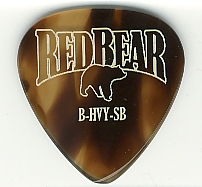
With respect to feel in my hand, both Red Bear and V-Picks feel great. But the big difference for me is that the Red Bears feel – for lack of a better word – natural. They really do feel like natural tortoise shell. Please don’t read this as a negative with respect to a V-Pick. It also feels great. It’s just different.
Tone
For this test, I chose a similarly sized and pointed V-Pick to compare against a Red Bear Style B Heavy pick. With strumming, both picks produced gorgeous, warm and ringing tone. But I could detect a bit more highs out of the V-Pick, which made the tone sound just a tad bit more lively, while a strum with the Red Bear was much more balanced. Both tones were fantastic, though, so no clear winner in this department. However, I did also test out a couple of the really pointy V-Picks that Vinni sent to me, and whoa! These sounded awesome for picking individual strings. They also produced a very bright, almost jangly tone during strumming. Since I didn’t have anything equivalent with a Red Bear, I couldn’t make a comparison, though I imagine the response would be similar.
But here’s a very interesting thing that I found myself inadvertently doing during my little gig this morning. Depending upon the song, I’d use a different pick to elicit different sounds from my acoustic. When I wanted a really bright sound, I’d use the V-Picks pointy. When I wanted a warm, rich strum, I’d use the Red Bear. Something in the middle, I’d use a rounded V-Pick. I don’t know how practical that is with a full band, but it sure worked for me working solo, where it was just me and my acoustic.
And the winner is…
Neither or Both. Er… There is no winner. For me what it boils down to is personal preference. Both picks are awesome-sounding. And based upon my experience this morning, I’m going to start buying both kinds because of the different shades of tones I can get out each. I’ve read some lively discussions comparing these, but frankly, most of the people who contributed to these discussions had played only one kind of either. I’ve had the fortune to play a few styles of both, which explains while I’m very non-committal about declaring a clear winner; because from my point of view, there simply isn’t one with respect to feel and tone.
So I’m going to endorse both picks because they’re both great. But if you’re after advice on which to choose, then choose one based on how it feels. I love the feel of the Red Bear, maybe a tad bit better than the V-Pick. But that doesn’t necessarily make it a better pick, which is why I recommend you play both kinds and make a decision on what feels best for you. I will add that Red Bear doesn’t have a super pointy pick, so if you’re after something like that, then V-Picks is what you’re looking for!
Notice I didn’t mention anything about price. If it boiled down to that, then V-Picks wins hands-down. Most V-Picks cost $4.00, while Red Bears cost $20.00. But be aware that Red Bear picks are rough-cut, then hand shaped, so there’s lot of labor that goes into them, plus you’re dealing with a polymer made from a natural source. On the other hand, V-Picks are molded, then buffed, so the labor is a lot less.
CORRECTION: (2/11/09 )Vinni contacted me about how he makes his picks. Actually only a few are molded, the rest are cut and hand ground. So my bad…
Personally, price of the picks is one topic on this blog where I’ll say that is less important a factor in the decision-making process, which kind of goes against the grain of what GuitarGear.org is all about. The reason I’m de-emphasizing price is because on the grand scale of things, once you’ve spent a few grand on guitars and amps, whether you spend $4 or $20 on a pick is pretty inconsequential. So the decision should rest on how the pick feels and sounds to you.
Finally…
The one thing that V-Picks does have over Red Bear picks, is that because the picks are made from acrylic, Vinni can offer a much greater range of thicknesses with his picks. For instance, he can go all the way down to .5mm. I have one of these and while it flexes like my Dunlop Tortex, it still beats the shit out of it. On the other hand, because of the material, Red Bear picks start at 1.0 mm. But I do have to say that I don’t know for sure if there is a lower limit. It could be there is, but perhaps there’s just not demand for picks thinner than a millimeter. Be that as it may, with either V-Picks are Red Bear, you have a variety of styles to choose from.
Another thing you might consider is durability. V-Picks are acrylic, and that is a VERY hard material. It’s tough to scratch, and from what I could tell, these picks will not wear down very quickly. Red Bear picks on the other hand, do wear down, and as they are made from a natural material, need some special care. You occasionally have to rebuff them. But frankly, it’s something I’d expect from a more expensive pick made from natural material. But if you don’t want to fuss with that kind of stuff, then V-Picks is the answer.
As a special treat, I found a video of Vinni Smith giving a lesson on YouTube. This dude is a BAD-ASS guitar player! Rock on, Vinni!
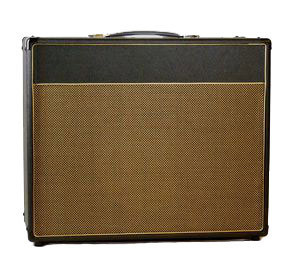
Recognize the cabinet? It looks an aweful lot like a Reason Amps cabinet, doesn’t it? That’s because the one of the founders of Reason Amp, Anthony Bonadio, also owns a cabinet making company called Stage Craft Gear, a not very widely known cabinet maker – at least among consumers. They’ve actually made their start as an OEM cabinet supplier for a lot of amp companies through their parent company, Rhyme Musical Enclosures LLC. But as an OEM, they don’t get their logo on the cabs, and believe me, there are some heavy hitters who use their stuff.
In any case, they’re launching a brand new site at http://www.stagecraftgear.com – very soon – like today or the next! I’ve seen the look of the new site, and it totally kicks the shit out of the old one! Their designers did a great job!
Get a Free Cabinet!!!
I don’t have all the details around this, but Anthony did tell me about a cabinet giveaway that they’re having. You’ll have to go to the site and sign up. I only saw some sub-pages when I went to the site that have the new look, and the home page hadn’t been updated yet – I imagine the giveaway ad will be there.
Okay, let’s get down to business…
Yeah, it’s great that Stage Craft Gear has a new site, and even better that they’re giving one away (I hope I’m the lucky winner 🙂 ), but that’s just airy-fairy stuff, in my opinion. What’s really important about Stage Craft Gear is the fact that they make the cabs for Reason Amps. It’s amazing how you read a lot about amps, but IMO, there’s just not enough attention paid to the cabinet. It’s the resonance chamber for the speaker, for chrissake! And it can make or break an amps’s sound!
My personal experience with the SM25 112 Combo is that it’s sound is “open.” It’s not a tight-sounding amp at all, which is a really good thing when you’re on stage, and a lot of that has to do with the cabinet. It’s tall, and not very deep, but it projects a gorgeous, bright tone that really complements the big sound that comes out of the standard Eminence Governor that’s installed in the cab. The Governor works AWESOME in that cabinet. On the other hand, I used a Governor in a deeper, heftier cabinet (made by another manufacturer), and it sounded like shit! Way too tight, and high-mid to high-freq tones were really subdued.
The point to this is that my experience with a single Stage Craft cabinet leads me to believe that these guys make very special cabinets. It’s no surprise that several boutique amp manufacturers use them. They kick ass!
Ensuing Cab Review
I’m going to be reviewing a cabinet from Stage Craft really soon. Check back here. If my previous experience is any indicator, this cab promises to be very special. Stay tuned!
I don’t know about you, but as a songwriter, it bugs me when I go for long periods without writing songs; or more precisely to the point, when the inspiration to write doesn’t come to me. I’m not a calculating songwriter, and completely rely on that inner voice that inexplicably sends music to my head. For the past couple of months, I haven’t had the inspiration. Oh, I’ve written short clips of stuff, and I’ve had the beginnings of song ideas; in fact, I just counted last night, and in the last couple of months have recorded 25 song ideas. With some of these, I even recorded several instrument tracks. But none of these developed into full songs.
But over the weekend, I got a new guitar from Adam Hernandez of Saint Guitars (read the review here). This functional piece of artwork stirred something in my soul and I got the inspiration to write a song – it’s about time! The song is based upon Psalm 146; yeah, it’s religious, but hey, a song is a song in my book. Besides, I haven’t written a religious song in awhile, and it’s actually where I started, so nothing like going back to my roots. But more importantly, just getting that one song out has made my creative juices start flowing again, and that’s a good thing. Give it a listen:
Being naturally introspective, I took a look at how I got the inspiration. Sure, the trigger was probably that gorgeous guitar, but more importantly, it had the effect of changing my current perspective. And I think that’s the key to inspiration. When you’re feeling in a rut, do something else or try out some other gear. The idea is to derail the status quo.
Summary: I never ceased to be amazed at the guitars Adam Hernandez builds. Here is yet another incredible tone machine but with classic looks and even better sounds.
Pros: This guitar oozes both visual and tonal bliss. The rosewood neck, mahogany body, and maple top combine to create thick but bright resonance that just stirs the inspiration juices.
Tone Bone Rating: 5.0 – There is literally nothing not to like on this guitar. It truly rocks the house!
Like a lot of folks, I love vintage and vintage-style gear. There’s a certain, je ne sais quoi, perhaps mojo (I know, it’s an overused term) about vintage gear that seems to harken back to the “good ol’ days” when things were handmade and sturdy. But when that style is expressed in a modern way, at least for me, something stirs in my soul, and I’m totally inspired. It has been this way with every Saint guitar I’ve had the priviledge to play, and that continues with the Goldtop Benchmark.
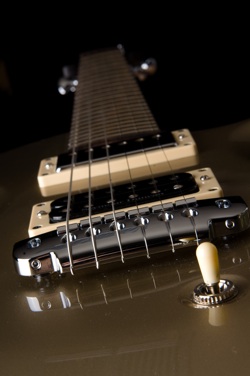
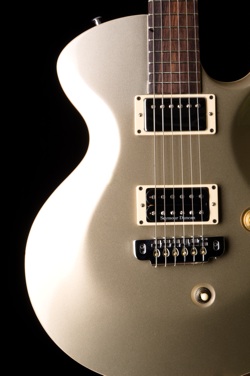
The Goldtop's Bridge
When I did my first Saint Guitars review of the Faded Blue Jeans model, I couldn’t believe how perfect the guitar was. The walnut body and neck, combined with the quilted maple top produced a bright and resonant tone that just begged to be explored to eek out all the possible tonal variations. With the Goldtop, the experience is still the same, but with that absolutely gorgeous finish, I’m experiencing a bliss that’s coming from both visual and aural sources.
Fit and Finish
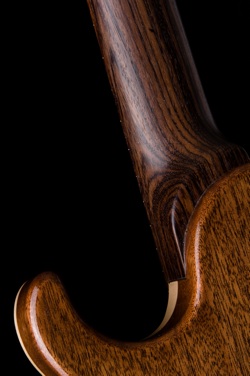
The Goldtop's Body and Neck
I’ve come to realize that there are some things in life that you can’t avoid describing with the heavy use of grandiose phrases, and the Goldtop definitely falls within this category with respect to how it looks. It’s perfect in every way. The creamy gold finish that almost looks white under light is a wonder to behold, but that’s just part of the equation. The gloss-finished mahogany body and open-pore rosewood neck add a certain sensuousness to the look of the guitar. I love that Adam had the foresight to keep the rosewood in as natural and organic state as possible. It feels absolutely wonderful when you grip the neck.
If I were to come up with a metaphor for how this guitar looks, it’s like admiring a beautiful woman that’s nicely dressed, but doesn’t need any makeup or other adornments to enhance her beauty. She’s self-aware and confident in how she looks, but doesn’t come across as aloof or unapproachable. In other words, this is a woman that has a purely natural and organic magnetism, and someone to whom I’d want to be close. That’s the response I have to this guitar.
Playability
I love the feel of natural grain, which is probably why I love my Strat so much with its maple neck. Again, for me there’s a certain sensousness in feeling the wood’s grain in my hand, and the Goldtop doesn’t disappoint in this department. When I first held the guitar, I was surprised and a little worried about the neck profile, which is wide by design, but add to that the C-shape, and I didn’t know if my relatively short fingers could reach all the frets, especially in the upper registers to hit the 6th string. But to my very pleasant surprise, I could get to those notes with ease.
As with all Saint’s that I’ve played, the Goldtop has a fast neck. The frets are just how I like them: Not too deep, but really lending themselves to a nice vibrato when you dig in a bit. And moving up and down the fretboard is a pure joy. The fret spacing is just right. As a guitar player himself, Adam really took great pains to get this part of the guitar right. For me, as I’ve said in the past, I’m not a really great improv guy, but I do play chords up and down the fretboard, and being able to move and nail the chords is very important. It’s as if precision was built into this guitar!
Adding to the playability is the arrangement of the neck and body. It’s very Les Paul-like, and that’s a good thing, which means that the higher frets are very easy to reach when the guitar hangs naturally from the straps. With my Strat, to get to the high frets, I have to physically shift the guitar to the left a couple of inches. Of course, part of that has to do with my gut 🙂 and it’s not really a problem, but I don’t have to shift the Goldtop at all.
How It Sounds
This is one of the best pickup combinations I’ve ever heard. The Pearly Gates in the neck has a nice, sweet, and smooth vintage tone. I liken it to a sip of a 25 year old Scotch. It’s warm and sweet and totally comforting. The Custom 5 is bright, but with a nice, taut low-end. When you turn up the gain on this pickup, you get the expected bright bridge tone, but because of the solid bottom-end, there is absolutely no “tinniness.” It’s just brighter sounding. This is a trait I’ve become accostomed to with all Saint Guitars. They’re the only guitars I’ve ever played that at least to me, have a usable bridge pickup. Combine the two in the middle switch position, and it’s pure heavenly tone. I could keep the guitar in this setting for practically everything I play, unless I wanted to get a super-smooth tone (neck), or need a bright tone to cut through the mix for a lead (bridge).
To me, the mark of a truly great guitar is balance in the dynamic response; more pointedly, that when you play high notes, the guitars volume doesn’t suddenly dive down. I don’t know how many guitars I’ve played that when I get above the 12th fret, the first three strings’ volumes literally sink, forcing you to really dig in with your pick to make them sound louder. That makes for a much more difficult playing approach, and is one thing that bugs me about my PRS SE II Soapbar. With that guitar, the first three strings are quite a bit lower in volume than string four through six. I’ve learned to compensate with my volume knob which thankfully is in a good position for on-the-fly tweaking. But with the Goldtop, and all the Saint’s I’ve played, this is not a problem. The dynamic response is balanced through all strings. It’s a testament to the resonance of the guitar. It picks up all the frequencies!
One thing I’ve learned about testing guitars is that the really important tonal properties are exposed when you play the guitar clean. I’ve played a lot of guitars that sound great when they distort, but just sound weak and hollow when you play them clean. Remember the beautiful woman I described above? This is her speaking voice: It’s rich and sensuous, and something you can listen to and never tire of it. Here’s a clip to prove the point:
I used an Aracom Amps Custom 45R that was re-tubed with 6L6’s from the stock KT-66 tubes, and Jeff kindly installed a Jensen Alnico speaker, replacing the Governor that I was testing with it. Both served to really open up the tone quite a bit with much more midrange – it started out very low-end focused.
What was amazing about this clip was that I wrote it earlier in the day, then recorded it 15 minutes before I had to leave to take my son to his lacrosse game, and just saved the audio file. When I finally sat down to listen to it, I couldn’t believe what I was hearing. Mind you, the clip is not EQ’d or mastered in any way. That’s the natural sound of the guitar out of the Custom 45R. I added just a touch of reverb on the amp, but other than that, it’s just the guitar, and the tone is – at least to me – amazing! It almost gives off a chorus effect. I thought it was due to the reverb at first, but when I came home, I played the song without any effects, and that chorusy tone was still there! I was blown away!
Overall Impressions
I didn’t think you could improve upon perfection, but the Goldtop is now my standard of perfection. As I wrote in a previous article, I’ve been in a bit of rut with writing music as of late, but with the Goldtop, I’m getting inspired again. It’s a marvelous guitar!
Ran across these demos on YouTube, and thought I’d share them here. This first one is from VOX at the NAMM show, and sound quality stinks, but the dude’s explanation of the differences between the two different voices (British or American):
This next clip comes from someone apparently in Japan, where the pedal was recently released. The sound quality is much better, and he inserted little conversation bubbles to show his settings. Picture quality isn’t that great but the quality of the sound makes up for it. Plus, it’s kind of amazing that this dude has such clever and articulate feet that he can make all the adjustments with his toes! HA! He’s not bad at guitar either! Check it out!
Especially after viewing the second clip (despite Mr. Clever Toes), this is definitely my next pedal – at least until after I try it out for myself. 🙂
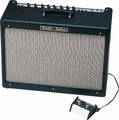
If you’ve had your ear to the ground about the oncoming Fender price hike well, it’s real, and it’s here. I was in a shop today, and a brand new Fender Hot Rod Deluxe – the exact same amp I own that I got for $599, for a whopping $839, with a list of $1200! For cryin’ out loud! This amp is NOT a boutique amp. While a tube amp, it has a solid state well, everything. All the electronics are on PCB boards, and the damn thing’s not even assembled in the USA!
If I was looking for my first tube amp, at these prices, I’d ignore Fender, and get something like an Orange Tiny Terror, or an Aracom RoxBox. The Tiny Terror costs $550 new, and RoxBox head is $895. I’ve played both, and they both sound way better (at least to my ears) right out of the box than the Hot Rod, which I had to spend even more money on mods and better tubes than the stock GrooveTubes that come with it.
Make no bones about it: Fender amps at this level ain’t boutique, not in the slightest, but they’re approaching boutique amp prices. Well, I guess it’s the sign of the economic times.

 Guitar Gear