I forgot how much fun this little 5 watter is to play! I just put in new tubes to make it have more headroom, as this is an incredibly pedal-friendly amp. The tubes I got were as follows: NOS JAN-Philips 12AT7 and a JJ 6V6. The idea behind this is that the 12AT7 has about half the gain of a regular 12AX7, so it won’t push the power tube as hard as a 12AX7. The JJ 6V6 has tons of gain, and is much harder to break up; thus, I hoped to attain more clean headroom with this combination.
While I like the breakup of the Champ 600, it’s a little weak, but the clean tone is spectacular with this amp. And hooking it up to a 1 X 12 extension cab really expands the depth of the tone it produces. Combine that with a couple of pedals, and the result is like candy to the ears.
Some people might frown upon this diminutive amp, but I used it throughout my first album, and for good reason: It’s so damn versatile! I can play pretty much any style with this amp, and miked properly, can make it sound much bigger than it actually is. And at $200 bucks (that’s what I paid for it), it was a total steal!
Here’s a simple clip I recorded using one of GarageBand’s “Magic Garage Band” backing tracks. It’s a slow blues in E. The first part of the song is played with the neck pickup of my Prestige Heritage Elite, into my Tone Freak Effects Abunai 2, into my Hardwire RV-7 Reverb, then into the Champ and out my custom Aracom 1 X 12 extension cab with a Jensen P12N (damn! that totally sounds like name dropping! Yikes!). In second half of the song, I switch to my bridge pickup and stack my Tube Screamer on top of the Abunai 2. Oh my freakin’ gawd! This was fun. In any case, here’s the clip:
Sorry for the mistakes. I actually didn’t care because I was having so much fun! And by the way, I played the lead parts with my brand-spankin’-new V-Picks Psycho pick, a 1 3/4″ wide, 5.85 mm thick monster of a pick. I’m in tone heaven right now! You just gotta check this pick out!
And I almost forgot! I just can’t believe who incredibly awesome these Wyres strings sound and play. They’re so pliable, so resonant, and they sustain so well that they send my inspiration through the roof! Like the Psycho pick, I just can’t enough of these absolutely wonderful strings!
I can just imagine the heat from the flames I’d get on the forums if I said this, but this is something I just can’t hold back any longer after reading so many threads on the Ultimate Attenuator. I’ve spent a lot of time studying how different attenuators work, and I’ve come to the conclusion that despite its popularity, this is not an attenuator that I’d even consider getting, even if it’s at a reasonable price – which it isn’t. I have a lot of different reasons for not liking this attenuator, but the biggest issue to me is the fact that with the UA, the amp is no longer reacting with the speaker and vice-versa. The UA has a cheap, solid-state amplifier built into its circuitry to re-amplify the amp’s signal after it has passed through the 32 ohm fixed resistor. At that point, the speaker is interacting with the solid-state amp. How that can pass for transparency is beyond me.
Then there’s the fixed resistor. Don’t even think about running a 2 or 4 ohm output into that attenuator. You’re risking serious damage to your amp if you do that. The impedance mismatch there is so high, it has the potential to fry your power tubes or worse. As an add-on, you can get the 16/32 ohm switch, or get one of Ted Webber’s impedance matchers. But then you’ve already spent $750 – that’s just nuts!
I use the Dr. Z Airbrake which uses a rheostat type of resistor to provide variable attenuation. People have complained that at high attenuation levels it sucks tone. It does indeed, but for normal usage, just above loud conversation volume, it is very transparent, and I would daresay that it’s much more transparent than the UA because the amp and speaker are still reacting to each other as there is no “middle-man” solid-state re-amplifier.
I’m probably going to piss people off with this little rant, but so be it. I freely admit that I’m no electronics expert, but I do have the intelligence to understand a thing or two about amps, and a re-amplified attenuated signal – at least to me – isn’t going to be transparent.
Ahhh… the venerable SRV in a classic guitarists pose. I used to think that was just something rock stars did for publicity shots, and that the poses were contrived. But then as I’ve delved more and more deeply into improvisation, I’ve realized it’s not contrived at all. That kind of pose or expression is all part of what can be called “gettin’ in the zone.” The Zen masters call the “the zone” the state of satori, where thought and action are one; where your consciousness is at a height where whatever enters your mind you do. From the perspective of playing guitar, the awareness of what your body is actually doing is lost. Your focus is entirely on expressing the music you’re playing.
For instance, have you ever been playing one day and just get into the groove of a song, close your eyes, and just let your fingers do the talking? You’re completely aware of the song, but that’s pretty much all you’re aware of; and when you play, it’s pure expression. I had recently had this experience. I was playing on top of a simple chord progression in D, and the song came to a part where I had a rather long lead break. A few years ago, I would’ve been terrified to do play such a long solo, but I’ve really started to get comfortable with my playing to handle something like this. Luckily for me, it was not a fast song. 🙂 But in any case, after the first few bars, I got into this groove where I didn’t worry about technique nor worry about how I was playing a phrase. I just played. It was pure expression.
After the gig, a few people came up to me and said that when I was playing, I had this look of pure rapture on my face. I replied, “Really? I thought I was just playing. Gawd, I hope I didn’t look like a poser weenie…” One of the folks was a guitarist and told me that it was genuine. He said, “Dude, you were in your own world.” I just chuckled because I was totally unaware of my posture or body language. I was completely focused on playing. I was really in the zone.
I think a lot of my latest inspiration is that I now have gear that gives me the tone that I’ve been after for awhile, and while I realize that 90% of your tone comes from your hands, having gear that facilitates your playing just adds to your inspiration. For me, I’m playing what I believe to be the absolutely perfect amp in my Aracom VRX22. The cleans are absolutely spectacular on any guitar I play with it, and that clean channel is the most pedal-friendly channel I’ve ever played. The drive channel on that just sings and sustains beautifully. I know, I know… I rave about this amp a lot, but I’ve searched high and low for an amp like this, and now that I’ve found it, it’s like I’ve died and gone to heaven!
I’d be interested in hearing your “in the zone” experiences. Feel free to share ’em!
I know, I know… I’ve been singing the praises of this amp and cab for the last couple of months since I got them. But folks, what Jeff Aragaki of Aracom Amps has put together in the VRX22 is simply magic. I just can’t say enough about how much I love this amp. It doesn’t matter what guitar I plug into it, the VRX22 delivers the goods.
A New Option for the VRX22
I have the standard production model, the first in the series. In its stock mode, I wouldn’t change a thing. But I know there are some vintage gear and tube amp buffs out there that would frown upon the fact that the VRX series in stock configuration has a solid state rectifier. For me, it makes not a bit of difference; I just love the tone.
But for those that require a tube rectifier, Jeff also offers an option of a GZ34 or 5AR4 tube rectifier in place of the solid state rectifier. An A/B test didn’t reveal a tonal difference, but for the purists out there (and by no means do I mean this derisively), this is certainly an option, and a reason why you should consider this amp in your amp evaluations. And here’s another consideration: All Aracom Amps are hand-wired, and cost FAR LESS than equivalent amps. For instance, the VRX line in stock configuration costs $895! That’s unheard of in the boutique market!
Have a Cab, Will Travel
But on top of all that, the 1 X 12 mini-cab that Jeff custom built for me is simply magical as well. Jeff went against the common wisdom of not using a cube shape and porting and such, and built a simple cube shape with a width that exactly matches the width of the amp (about 19″ wide). Amazingly, this cabinet is incredibly resonant. The reason for this is that instead of using 3/4″ board, Jeff opted with 1/2″ board. This resonates a lot more with the speaker, and provides a bass response that adds depth to the output. Granted, I also have an absolutely kick-ass Jensen P12N Alnico speaker, but that cabinet even sounds good with just about any speaker you put in it. Like I said, amazing.
To further demonstrate the versatility of the VRX22 and the Aracom 1 X 12 mini-cab, I recorded a short blues clip using three different guitars, all running straight into the VRX22 with no effects. There are to overlapping rhythm parts panned left and right, and a solo in the middle. For the left pan, I used my gorgeous Prestige Heritage Elite (“Sugar”) plugged into the VRX22. For the right pan, I used my Strat (“Pearl”) plugged into my Fender Champ 600 and ran the speaker out into the 1 X 12 (I didn’t think the Champ could sound this good wow!). For the lead, I used “Sharkie,” my PRS SE II Soapbar with P-90’s in the bridge position straight into the VRX22.
Sorry for the slight mistake in the solo; or as my buddy Phil calls it, a “clam.” But overall, I was just amazed how good Sharkie sounded on that clip. I added a touch of reverb to that track, but made no modifications to the guitar signal at all. It was the guitar plugged straight into the amp.
As I’ve said in the past, I’m not affiliated at all with Aracom. I’m just a faithful customer, and just can’t sing the praises enough for the job Jeff has done!
In addition to drive pedals, I love low wattage, single-ended amps, and there are lots of ’em out there. For instance, one of my favorite amps is my Fender Champ 600. I use it in my studio, but also gig with it in small venues – to be clear, I have to hook it up to an external cab to get some volume.
Just recently, I discovered the Concord from ValveTrain Amplification. This is a little 5 Watt amp based on a classic Fender 5 Watt design (I believe this is what Valve Train specializes in). It is a single-ended amp with a single 12AX7 and a 6V6 power tube; pretty similar to a Fender Champ 600. However, there is a difference… a huge difference between the Concord and the Champ. The Concord is completely hand-wired. Not only that, this little hand-wired amp only costs $499 street!
That’s an incredible price, and something I definitely have to consider…
I’ve heard of some people buying this amp sight unseen, and not being satisfied with its overdrive tone. But make no mistake about an amp like this: The design was never made for tons of high-gain distortion. For instance, my Champ breaks up nicely when I have the amp open all the way, but it never gets over-the-top with the breakup. It’s just not meant to do that, and I suspect that it’s the same thing with the Concord. Furthermore, you just can’t expect to get that high-gain distortion with an 8″ speaker. 🙂
I admit it: I’m an incurable GEAR SLUT! I jones for vintage and vintage style gear, as the music I play leans toward the blues and classic rock. And to satisfy that never-ending craving, I pore over the Internet and various magazines in search of all sorts of gear; hence, the existence of GuitarGear.org where I share with you, dear reader, the things that I come across.
Now in my search for gear, I occasionally buy things. They tend to be vintage-style modern gear because I just don’t have the money to buy real vintage gear; and that usually means I gravitate towards boutique gear; but not just any boutique gear. Remember, I don’t usually have all that much money to afford the real high-end stuff, so I spend a lot of my scouring my information resources to find boutique gear that I can afford. That’s what gravitated me towards Aracom Amps.
When I saw the price of a VRX series amp, my jaw dropped! Here was a hand-wired, vintage-style tube amp for $895!!! When I finally hooked up with Jeff Aragaki (founder of Aracom), and got a chance to play the VRX18, he shared that one of the ways he was able to keep the cost down was by using a solid-state sag simulating rectifier circuit. When I heard the words “solid-state,” the purist in me started reeling a bit. But then that amp sounded so freakin’ good that I didn’t give a flying you-know-what about the rectifier!
And that’s the point of this article. When you’re looking for and buying gear, don’t let yourself be swayed by an instrument’s or equipment’s pedigree or “all-tubeness” or lack thereof. LISTEN to the fuckin’ thing, and see if it turns you on! If it sounds good, and it works for YOU, then that’s all that matters, in my not so humble opinion on the subject. 🙂 If I had let the purist in me take over, I would’ve never ended up with my VRX22! And for the record, I’ve listened to many, many, many amps, with and without tube rectifiers, and the circuit that Jeff Aragaki employs in the VRX series simulates the sag of a rectifier tube so well, I can’t tell the difference. And if there is one, it’s probably so minute that it doesn’t matter anyway. I’ll put that amp up against any other boutique amp in the same wattage range, and it’ll sound just as good, if not better. And I paid less than half the price of a similarly configured amp!
Give the following clip a listen. I’m playing my Strat plugged straight into the clean channel of the VRX22. In some sections you could swear that the amp has a reverb, but that’s the solid-state rectifier simulating the sag of a tube rectifier. Also, this is the raw recording of the amp: No EQ, no filtering. The master volume was flat out, with the gain control around midway. My mic was about about 10″ away pointed directly at the center of the speaker cone.
I originally recorded that clip with my Prestige Heritage Elite. But that guitar has so much inherent sustain, it would’ve been cheating. 🙂 A Strat on the other hand doesn’t have that much sustain, so it brings out the sustaining quality of the amp much better. The result is just amazing.
And as to the tube vs. solid state rectifier issue, at least in the Aracom VRX series, it doesn’t make one whit of difference, especially when you’re playing live at gig levels. When I’m gigging, I almost never use reverb unless it’s a song where I can really isolate my guitar. Sag gives the effect of reverb, but at loud gig levels, you’ll never hear it.
Another great example of buying what sounds good to you is my friend Vinni Smith of V-Picks. That dude is one of the best guitarists I’ve ever known, and he gigs all the time! You know what he plays through? A freakin’ Roland Cube 30 cranked all the way up and miked into the PA. When he told me that, I almost flipped. Here was a true pro guitarist, playing through a $200 amp!
So don’t be taken in by pedigree. Buy what sounds good to you, and what you can make sound good. After all, 90% of your tone is in your hands.
For the last couple of years, I’ve had a serious case of GAS – not that I pulled the trigger and bought a bunch of stuff during that time – I did get a couple of pedals here and there to slake my appetite, but no major purchases until recently. Now I can say I’m gassed out – at least for now. If you’ve followed my blog for any amount of time, you’ll know what I’ve purchased, but I’ll recap the major purchases I’ve made in the last couple of months.
Aracom VRX22 Head with a custom Aracom 1 X 12 cabinet with a Jensen P12N
What an amp! I’ve shared with Jeff Aragaki, founder and designer of Aracom Amps, that the VRX22 is the perfect amp – at least to me. It’s a low power amp that packs a HUGE punch; both in tone and volume. It’s something I can use either in my home studio, or gigging. No matter what volume level I’m playing at, the VRX22 simply sounds awesome, never getting flabby in the low-end, and sporting what I consider to be the best Master Volume in the business.
The more I play this guitar, the more I fall in love with it. When I first got the guitar to evaluate it, I felt that all the adornments were a bit over the top. I’m a fairly uncomplicated guy, and I appreciate beauty in simplicity. But as time wore on, and I got to know this beauty queen better, the more she grew on me. So I decided to keep the guitar. Her new name is “Sugar” because amazingly enough, not only does she sound and play sweet, she actually smells like bubbling brown sugar! Could be because of the maple, but when I opened up the case for the first time, I was overtaken by the sweet smell of this guitar! So that’s how she got her name. She’s an incredibly expressive guitar, capable of producing gorgeous, ringing cleans to heavy grit. Brightly voiced, her tone just cuts through a mix like butter. I am really enjoying this guitar! Here’s a clip of both the VRX22 and the Heritage Elite:
In answer to my wife’s latest question, “Honey, how many guitars do you need?” I use the standard answer, “Just one more…” This was the exchange we had when I told her I was having Adam Hernandez, a close friend and founder of Saint Guitar Company, build me a guitar. It’s a Goldtop with a twist: Instead of the classic single cut body, I’m having the goldtop done on a double-cut. The body back is solid walnut with a maple top, and rock maple neck topped with an ebony fretboard. I wanted to go for a totally non-standard mix of woods that would produce a very bright tone. The bright tone, combined with the super sustain of Saint guitars in general, promises to be one sweet sounding tone machine. Of course, time will only tell, but I have high hopes for this guitar!
This isn’t even mentioning the smaller things I’ve purchased, but at least for now, I’m GASSED out – I’m also broke – again. 🙂
This is actually kind of exciting news: Roland has just released its most powerful Cube amp, the Cube 80x. Sporting 80 Watts of power through a 12″ speaker, this amp is poised to pack a serious punch. The Cube 60 has been quite successful since its inception a few years ago. Hell! Even I have a Cube 60 and I love it! The Cube 80x while being more powerful, also has some new features that are sure to turn heads (taken from the Roland web site):
* Powerful 80-watt output into a high performance 12″ speaker
* 10 COSM® amp models including new DLX Combo model
* Two channels: Clean and Lead plus new SOLO memory function
* New Spring Reverb modeling for vintage reverb sounds
* Easy to use Looper for unique live performance
* Convenient built in chromatic tuner
* Aux input for connecting MP-3 players or other audio sources
The Cube series amps have been known for their versatility. They sound great a pretty much any volume level, and they have enough features packed into them to make it easy to just pack the amp, a guitar and go. I have a couple of friends who use Cubes for club gigs!
There are a few of standout features that really pique my interest: 1. The ability to hook up an MP3 player to the amp to practice with; 2) The looper function, and finally; 3) The built-in chromatic tuner. This amp is made for gigging, and with the line out, you can go right into a board – which I’ve done many times with my Cube 60.
If you’re looking for a great, versatile amp, you can’t go wrong with a Cube. Just pick the one that suits the volume level you need (or the features you want), and you’re good to go!
Summary: Based on the original “RoxBox” (no longer available), the VRX18 sports an improved master volume inherited from the VRX22, and a reworked, smoother overdrive profile.
Pros: As dynamic and expressive as its 22 Watt sibling, the VRX22, but oozing that bright, chimey EL84 goodness. When driven, produces a nice, tight overdrive.
Head Cabinet
Standard Tolex: Black Levant. See options below for other colors.
– Dimensions: 19″w x 8″h x 8.25″d
– Weight: 23 lbs
Also available in 1 X12 and 1 X 10 combos (or Jeff can custom build one to your liking)
Tone Bone Score: 5.0. When I can swing it, I’ll be getting this amp to complete the VRX Series!
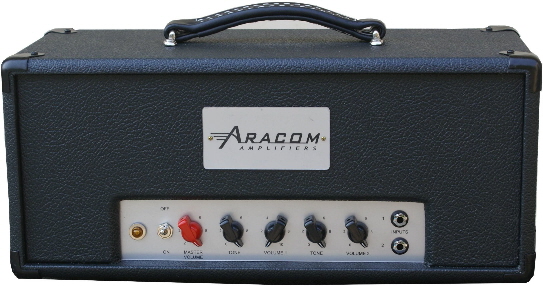
Jeff Aragaki, founder and builder of Aracom Amps, always chuckles when I tell him that he’s onto something with his VRX (short for Vintage Rox) series amps. With the VRX22, he seemed to have stumbled onto a sweet spot that produced an amp that has an incredible and beautfully balanced tone that bring out the best tonal aspects of the 6V6 tube. He’s done it yet again with the updated RoxBox 18, now renamed the VRX18, but incorporating many of the same features he built into the VRX22.
I just purchased the VRX22, having fallen in love with the tone that it produces, and I’ve fallen love yet again, but now with the VRX18. I’m like a hopeless romantic that loves two women for their individual virtues, but in this case, the women don’t mind – they can co-exist with each other. Okay, bad analogy… 🙂
I originally reviewed the RoxBox 18 back in December. At the time, I totally dug its tone, but took marks off because of the mildly harsh breakup at lower volumes. There’s nothing harsh about the tone of this amp now – at any volume! It’s a great amp to play, and as expected, it’s pedal friendly, and responds really well to overdrive pedals. Also, I played four guitars through it, and it sounded incredible with all of them!
I won’t go into a lot of detail, since I already covered pretty much all the descriptive information I needed to in the original review, so I’m going to cover some important things I’ve learned about the VRX 18 and the VRX series in general. But first, as opposed to doing this last, here’s a short clip featuring the VRX18 to show you how kick-ass it sounds:
For this clip, I used a Strat with just the middle pickup, plugged directly into the VRX18. I just dig that EL84 grind! I had the Channel 2 volume dimed, and the master volume at halfway in full-power mode. It was very loud, much to the chagrin of my wife. 🙂 But I needed to capture at least some of that EL84 compression.
What’s cool about the EL84 is that it compresses nicely when pushed, but still seems to retain a certain openness in its overdrive. This is unlike something like a KT-66 that compresses so much when pushed you lose volume.
The Best Master Volume in the Business
I don’t say this lightly when I say Jeff has the best master volume in the business. I’ve played many amps. But when Jeff created the VRX22, he did something with the master volume that is pure magic. It has a nice, even volume sweep that seems to act independently of the channel volume. This means you can crank the channel volume to get some serious grind, but control the output via the master, and it won’t suck your tone! I’ve found this to be a real problem with other amps. That master volume is incorporated into the VRX18.
The Best Half-Power Switch in the Business
A lot of manufacturers use a pentode/triode switch to achieve half-power settings in their amps. I’ve played several amps with this feature. But in half power mode with the pentode/triode configuration, I’ve noticed a distinct tonal difference between the two modes in amps configured this way. It’s not that the tone is bad. In fact, many I’ve played around with sound great in half-power mode. But it’s like two different amps.
Jeff Aragaki takes a different approach and instead adjusts the B+ voltage to maintain the usage of all pins in the power tubes. I’m not an electrician, and can’t even begin to explain this technically, so I’ll just say it this way: When you switch to half-power mode in any Aracom Amp, the amp doesn’t change its tonal characteristics. It sounds and plays the same!
The Difference Between Old and New
In addition to the great master volume Jeff incorporated into the VRX18, the first thing I noticed was that it was nowhere near as easy to get this amp to overdrive in channel 2 as it was with the original RoxBox 18. This is not a negative thing at all because as I mentioned in my original review, the overdrive was pretty harsh at lower volume levels. I spoke to Jeff about this, and he said that based upon my original tests and review, he decided to mellow out the extra gain stage in the VRX18 so you could get a nice overdrive tone at any volume level.
You won’t get over-the-top gain with the VRX18. But for that, I have a simple fix-all: Get a great booster pedal like a Creation Audio Labs Mk.4.23 (again, the best booster on the planet), and SLAM the front-end of the amp. 🙂
But all that said, if you’re in a venue where you can dime both master and channel volumes, you will be rewarded with gorgeous harmonics and overtones and luscious feedback!
Overall Impressions
Like I said, this is my next amp… It just rocks the house! And at $895 for the head, you could get both the VRX22 and VRX18 for under the price of a single boutique amp! This isn’t a sales pitch. The value proposition of the VRX series is something that should be seriously considered. You’re not getting a production line amp that’s built overseas. With the VRX series of amps, you’re getting a US-made, handwired amp for under a grand!!!
Admittedly, I was a little skeptical when I first ran across Aracom Amps. But I’m now a believer, and a faithful customer!
Ever been in one of those situations where you have to face up to something you’d said or done, but avoid it all costs because it gives you this feeling of impending doom? I was recently in a situation like this, and it wasn’t at all comfortable going through the emotional and psychic turmoil leading up to the conversation the ultimately resulted in – nothing. No slap on the wrist, no punishment. Just a good conversation where everyone involved learned from the experience.
Anyway, last night I was noodling on my guitar; my eyes were closed, letting my emotions drive my playing. Then I remembered that situation, and came up with the rhythm track for the song. It’s all instrumental – it’s not something I would ever want to put to words, but I did want to convey the emotions. Give it a listen let me know what you think:
For the rhythm parts, the Strat/Hot Rod is panned to the left of the mix, and the Heritage/VRX22 (clean channel) is panned to the right. The lead part sits dead center.
I’m particularly pleased with the Hot Rod’s tone. The clean tone with that awesome spring reverb is to die for (though I had the reverb down pretty low on it to give the Strat more presence). I’m also diggin’ the Prestige Heritage Elite; especially after I set it up. In particular, I adjusted the pickup heights to smooth out the treble pickup, and to get less boom from the rhythm pickup. It’s now very balanced; and played through the VRX22, it sounds just awesome. I played the lead part through the drive channel of the amp, and set the volume so that it was just on the edge of breakup, so if I dug in a bit, I’d get just a touch of overdrive. I wanted to create an effect of subdued aggression, and the VRX22 is so dynamic, I can achieve that easily.
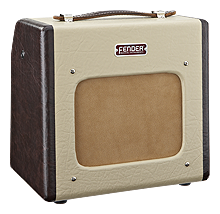 I forgot how much fun this little 5 watter is to play! I just put in new tubes to make it have more headroom, as this is an incredibly pedal-friendly amp. The tubes I got were as follows: NOS JAN-Philips 12AT7 and a JJ 6V6. The idea behind this is that the 12AT7 has about half the gain of a regular 12AX7, so it won’t push the power tube as hard as a 12AX7. The JJ 6V6 has tons of gain, and is much harder to break up; thus, I hoped to attain more clean headroom with this combination.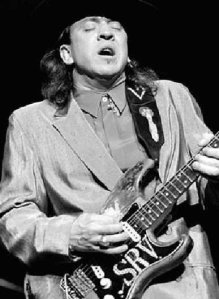

 In addition to drive pedals, I love low wattage, single-ended amps, and there are lots of ’em out there. For instance, one of my favorite amps is my Fender Champ 600. I use it in my studio, but also gig with it in small venues – to be clear, I have to hook it up to an external cab to get some volume.


 Guitar Gear