Feeds:
Posts
Comments

Archive for the ‘buying gear’ Category

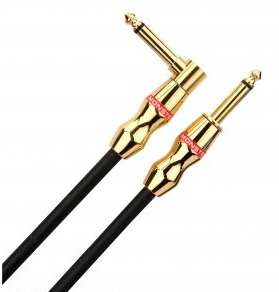
cablesAs much of a gear slut that I am, I’ve realized that I’ve completely overlooked one incredibly important piece of gear at GuitarGear.org that can have a huge effect on your tone: The guitar cable. Actually, I’ve shied away from this subject, much like I shied away from talking about speakers. Why? Because like speakers, there’s really no definitive way to classify cables as “good” or “bad,” no matter what materials are used. It’s a very subjective thing; that is, you have to use your ears to make the determination of what sounds good to you and what doesn’t.

Lots of manufacturers and gearheads will spout off terms regarding cable materials and electronics, and while those things are important, ultimately they’re only contributing factors and not one single thing will make one cable better over another. As I said, use your ears.

What’s in a cable?

A cable consists of four basic, discrete elements: A conductor, a dialectric, a jacket, and the plugs. The conductor is what transports your electrical signal end-to-end through the cable. Most conductors are made of copper, though some are coated with silver. There are pure silver conductor wires that some audiophiles swear by, but they are typically incredibly expensive. A colleague of mine wired his entire home stereo system with pure silver wire, costing him hundreds of dollars. But he swears by the purity of sound that this conductor produces. Regarding copper, the more pure the copper, the better the signal conductance, so in a sense, a cheap wire using cheap copper, will probably not sound as good as one that’s made from more pure copper.

The dialectric is a sheathing around the cable and is an essential component in that as the electrical signal flows down the cable, a large amount of the signal travels along the outside of the conductor. As you might think, some of that signal may “bleed” off, and indeed that is what happens. This is where the dialectric comes into play. It basically absorbs the electrons that break off the flow, then puts them back into the flow. Different materials are used as dialectrics, though teflon tends to be regarded as the best dialetric material.

The jacket is the visible layer of the cable that you see but typically, just underneath the jacket are insulators and shielding, to protect from transmitting signal out or letting external signals in.

Finally, we have the plugs. These are made up of a variety of materials from unplated brass to gold, nickel or silver plating. Each of these materials provide a different tone. Mind you, gold is not necessarily the best conductor, but it does provide excellent protection against corrosion, which will have a serious effect on your signal.

So what’s the big deal about capacitance?

Capacitance is probably the most common term bandied about by alleged pundits of cables. Essentially capacitance is a measurement of how much signal a conductor stores. At first blush, a lower capacitance number should indicate a much more efficient signal. But from what I’ve come to understand, capacitance, while important, is only part of the picture with respect to the overall tone of a cable. Throwing about this term without context is akin to throwing about a frequency response curve for a speaker. In that case, it gives you an idea of where the tone is delivered, but until you put that speaker in a cabinet, you’ll never know how it really performs. It’s a similar thing with capacitance. It’s only part of the whole picture. For me, though I mean no disrespect, I tend to ignore people who bandy about capacitance as something that should affect one’s decision to purchase a cable.

I asked a friend about this, and he said that yes, capacitance is an important consideration, but if a dialetric material is used that’s fairly absorbent and doesn’t return electrons back into the flow, what you’ve gained in capacitance, you’ve lost in the dialectric. I’ll be the first to admit I’m no electronics wizard, but that seems plausible enough to me.

So what do I look for?

Ultimately, for me it boils down to tone. I’ve recently taken a real liking to Monster Standard 100 cables. To my ears, they provide a great balanced tone. No, they don’t have gold plating or any silver, but it’s a good, versatile, all-around cable that I think sounds great. They also have great shielding which is really important in protecting against RF. But that’s me – to my ears they perform great. However, after trying out both the Acoustic and Rock models recently, I’m seriously considering of making an investment in those cables. I know there are others out there. I just have to find a place to try them out.
Read Full Post »

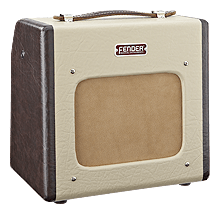
Fender Champion 600 Re-issueAs much as I have been ranting about Fender gear pricing as of late, and their latest “supposed” price drop (who knows for how long), my Champ 600 has been a tried and true companion in my studio ever since I got it. I’ve even used it at small venue gigs hooked to a 1 X12 cab, and it has performed wonderfully! This is a great amp!
Anyway, As I was doing a bit of research on the Fender price drop, I happened to go to GuitarCenter.com and couldn’t believe the pricing of the Champ 600 there! At $149, this is even cheaper than what I got it for two years ago!

Folks, this is phenomenal! While diminutive in size, this amp packs tone! You want classic Fender tone at a lower volume for home recording or just futzing around, this is the amp to get! And because it’s a low wattage amp, you can push it and not worry that your eardrums will start to bleed.

For my own purposes, this has been one of most pedal-friendly amps I’ve ever owned, so I retubed it with a NOS JAN-Philips 12AT7 and a JJ 6V6 to get maximum clean headroom out of the amp. Now, I have to open up the amp full to get even mild breakup. But that’s why I have my OD pedals. My thought behind this is that I want to get as pure character out of my OD’s as possible, so playing through a really clean amp will accomplish that.

So what’s the point of all this? As I mentioned above, this is a GREAT amp, and at $149, it’s a steal. Go get one at GC today!

Here’s a sample I recorded with the amp hooked up to my 1 X 12 extension cab:

Disclaimer: I’m not in any affiliate program with GC, so I get nothing out of announcing this. 🙂

Read Full Post »

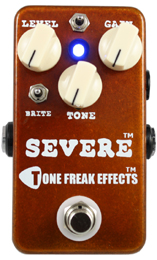
Tone Freak Effects Severe High Gain Distortion PedalReleased in May (how did I miss this?), the Severe is “Tone Freak Effects’ answer to high gain distortion.” Oh man… This looks like a incredibly mean pedal. Set up like the Abunai 2 with a 3-way clipping switch, with level, gain, and tone, the Severe also sports a 3-way bright switch so it can be used with different amps. Very cool.

As Derek Tabata mentions on his site, the Severe will never turn your tone into a compressed mushy mess. The distortion can be laid on thick but, remains open. I can attest to this with the Abunai 2. You can lay on thick overdrive with that pedal, but it’ll never turn super thick.

With the Severe, Derek has taken high-gain distortion to another level! I’m amazed at how it sounds in the sound clips! Check ’em out!

Severe Demo Clip

Les Paul

Les Paul

Tom Anderson

Personally, I’m not a high-gain type of player, however, as I’ve gotten more and more comfortable soloing, I’ve found that I’m pushing more and more into high-gain territory. The only problem is that to achieve that with an amp means it has to be LOUD. That’s why I love pedals like this! You get the effect you need at far lower sound levels.

And you can’t go wrong with Tone Freak Effects! You just can’t! For more information, visit the Tone Freak Effects web site!

Read Full Post »

What’s handmade, black and gold, and has the potential to catapult you into tonal heaven without breaking the bank and more importantly busting your eardrums? Simple: The soon-to-be-released Reason Amps Bambino! This article is the first news glimpse of this brand-new 7 Watt amp from the Reason guys that has all the tonal goodness you expect from a Reason amp but at volume level that won’t make your ears bleed, and almost as importantly, is easily within the financial reach of most cash-strapped gear sluts.

Reason Amps Bambino
When I first reviewed the Reason SM25 and the Reason SM40, I knew that what I was hearing was something special. These amps weren’t clone designs, and didn’t sound like anything that I had played before. Yes, they were based on classic 6V6 and EL84 power tubes, but the thing with those amps was that the power handling was magic, and either of these amps sounded way louder than you would expect with low to medium wattage amplifiers. Make no bones about it, what Obeid Kahn has figured out in the power transformer section of his amps is totally proprietary and SICK! Even as well as I’ve gotten to know Anthony and Obeid, that’s a subject they hold close to their chests.

So imagine my excitement when they shared with me several months ago that they were coming out with a brand-new low wattage amp. I wasn’t allowed to say anything about it at the time because Obeid was still working out the design, and hadn’t decided on the power tube he was going to use. All they would tell me was that it would be a sub-$700 amp that would have all the tonal goodness you’d expect from a Reason amplifier. Yeah, really definitive… ☺

But as luck would have it, I happened to give the Reason guys a call to see how they were doing, and much to my extreme pleasure, Anthony mentioned that they were almost ready to release the new amp, and that they were calling it the Bambino. After Anthony described the amp’s features, I started salivating. I LOVE LOW-WATTAGE AMPS! And this amp’s features totally kick the shit out of a lot of the low-wattage amps on the market, boutique and production alike. So let’s go over the features, shall we?

Reason Bambino Specs

Preamp Tubes: Three 12AX7’s

Power Tubes : Two 6AQ5’s in a push-pull configuration.

Output Power: 7 Watts, switchable to 1 Watt

Channels:
Normal – British cleans to Vox-like top-end. Includes a “thick” setting via pull-switch to get thick “Beano-like” grind.

Bright – Very American, SoCal type of bright and scooped tone, with smooth overdrive when pushed. Bass knob scoops the mids when you dime it, and the pull switch will add extra shimmer to the top end.

StackModeTM – As with all amps in the Reason Amps family, the Bambino also sports StackMode, which runs Channel 1 into Channel 2 plus an extra gain stage in a series. Want to get over-the-top grind? StackMode is it!

Sounds basic enough, but wait! There’s more!

Built-in Speaker Load Box Simulated Line Output with Level Control – The line output is not just another line output.  It starts with a fully inductive speaker impedance simulator, which then goes onto a complex frequency shaping network that simulates the sound of a classic 2×12 speaker cabinet.  The fully balanced TRS ¼” connection allows for connection to any recording devices or slave amplifiers. Can you say “re-amp” anyone? ☺ You can also use this output to perform true silent recording. Of course, nothing beats a speaker moving air, but when you need a straight guitar sound to record, now you have it.

Separate Headphone Output – Want to practice and not wake up the significant other? No problem, mahn!

If you’ve followed this blog for awhile, you know how much I love Reason Amps! They don’t pay me anything for telling their story – all you have to do is play a Reason Amp and you’ll be hooked! And at the price-point that the Bambino is coming in at, there is NO reason (excuse the pun) that you shouldn’t seriously consider this amp when it’s ready for shipping!

Not Your Daddy’s Oldsmobile

It would be so easy to dismiss this amp as yet another boutique amp. But you’d be wrong. One of the reasons I dig Reason amps so much is because they have a sound all their own. It’s also the reason I dig Aracom Amps so much. Manufacturers like these don’t settle for making copies of classic designs. They’re true innovators, taking the classic designs, improving on them, and adding their own special touches. The net result is that you get amps that have tones that are uniquely theirs.

And on top of that, Obeid Kahn is one of the leading amp designers around, the meticulous care and innovative spirit he has put into his designs is evident in the amps he has produced over the years, and with Reason Amps, that skill and innovation are at their paramount. These amps are special!

Stay tuned for more! I hope to get a test amp when they have one available! But for now, check out the Reason Amps site for any updates.

Read Full Post »

Nova Repeater

The Nova Repeater news is a tad old, as it started shipping a couple of weeks ago, but retailers are still only taking pre-orders on it. I’ve been waiting for the Nova Repeater to come out for awhile, ever since I heard about it from Winter NAMM news. As TC Electronic puts it, this pedal is “No frills, with a sound that kills.” It truly is no-frills. There’s no programming of the pedal. It has a few features and that’s it. But what it has that I’ve not seen with other pedals is a feature TC calls, “Audio Tapping.” Essentially, you hold the tap tempo button down, then strum your guitar, and the delay is set based upon the strum. I can’t wait to try out this delay pedal! Here’s a demo video:

Nova Drive

Next up is the Nova Drive, which is an analog overdrive and distortion pedal that is controlled with a digital interface. Not sure how that works, but it does sound very cool. This is the same drive/distortion circuit that is in the Nova System, so if you know about that tone, you know it’s very nice. There are a couple of things that stand out about this pedal for me. First, you can change the order of the drive and distortion, making drive first, distortion second; and vice-versa. Second, you can also run the effects in parallel, which is totally – it provides a completely different dimension in the tone this pedal produces. It also has a MIDI input that you can hook up to a G Major system to program it. Not bad. Anyway, here’s another demo video:

Read Full Post »

5 Tone Bones - Gear has stellar performance, value, and quality. This is definitely top of the class, best of breed, and it's a no-brainer to add this to your gear lineup!
stroborack
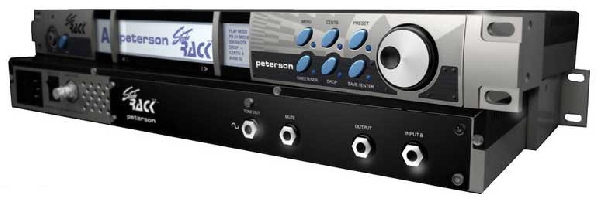
Peterson VS-R StroboRack

Summary: Super-accurate, super-sophisticated, yet super-easy-to-use. With point-one cent accuracy and built-in temperament and sweeteners, plus a huge display, accurate tuning is a breeze with this unit!

Pros: The big display makes tuning extremely easy, and the built-in sweeteners (I’ll get into that in a bit) ensure that once you’re tuned you sound great.

Cons: None, at least from the standpoint of features and capabilities. But as I’m not really a rackmount guy, lugging this around would mean having to get an enclosure. But in the studio, IT IS THE BOMB!!!

Features:

  • 0.1 Cent Accuracy
  • Large, Backlit Virtual Strobe™ Display
  • Exclusive Sweetened™ Tunings For Electric Guitar, Acoustic Guitar, Bass, Dobro®, Baritone, Steel Guitar, Electric Violin- total of 34
  • Buzz Feiten Tuning System® Presets
  • 8 User-Programmable Sweeteners
  • 25 Presets
  • Built-In Mic
  • Mute Button & Remote Jack
  • Tone Out Jack
  • All Metal Construction
  • Neutrik® Jacks
  • 12V BNC Output For Gooseneck Light (not included)
  • Built-In Power Supply (No Wall Wart.)

Price: $359 (street)

Tone Bone Score: 5.0. I’ve used a lot of tuners, and this by far is the most accurate I’ve ever used. Despite it being a rackmount, my use of it in the studio has proven

I used to never be into rackmount gear, let alone sophisticated tuning equipment. But the Peterson StroboRack has me reconsidering both those things, especially in my workshop/studio where tuning accuracy is incredibly important.

I received the StroboRack a few days ago, and since I set it up (which required all of two minutes to plug in the cords), I can see why so many people love these tuners. It’s a completely different way to tune an instrument. Instead of lining up a needle or LED, or even using the “strobe” effect on a TU-2, you tune by making the “checkerboard” pattern on the LCD stop moving. If it moves the left, you’re flat. If it moves to the right, you’re sharp.

Tuning with one of these things does take a little getting used to. First off, I had to really lighten my touch with the tuning keys, and also had to make sure I didn’t put any pressure on the neck. At .1 cent accuracy, even a slight pressure throws off the tuning. But once I got used to it, tuning was a breeze!

Do you take sugar with that?

The StroboRack includes what are called “sweeteners” for specific types of instruments. I’m not sure I understand this idea completely, but it has to do with setting the right intervals between notes – compensating for the type of instrument – so that the tuned instrument doesn’t just sound great tuned up, but when you actually chords, the chords are much more tonally accurate. Apparently a lot of math goes into calculating these sweeteners.

All I can say is that my guitars tuned up with the StroboRack, actually sound better than when tuned up with my little TU-2. It probably has a lot to do with the high degree of accuracy, but I have a feeling it has a lot to do with the “GTR” sweetener. For instance, I did an A/B comparison of tuning with the StroboRack vs. my TU-2. I took my time to get the most accurate tuning I could with both tuners. When I struck an E chord after tuning up with my TU-2, I had to make a couple of minor adjustments to my G and B strings – it wasn’t that the chord sounded bad, it just seemed to sound a bit “off.”

On the other hand, the E chord struck after tuning with the StroboRack with the GTR sweetener engaged sounded absolutely right on!

Fit and Finish

The StroboRack is encased in a nice, heavy-duty aluminum casing. It is really built like a tank, so I have no doubts that it could survive the rigors of the road. But I do advise getting an enclosure for it. It’s still a precision instrument, and should be handled with some care.

Overall Impressions

To say The Dawg digs this unit is an absolute understatement! Last night, I used it to set the intonation on a new guitar I got, and I have to tell you, the big display and scrolling checkerboard really made it easy. I know, a lot of folks would say, “But it’s just a tuner.” Well yeah… but the accuracy it affords you – especially you tone freaks out there – just can’t be beat. This is a unit that I will definitely be adding to my rig!

At $359 street, it’s not a cheap proposition by any means, but hell! We gear sluts spend tons of money each year on gadgets to make us sound better. One would think that sounding better also means being in tune. Of course, Peterson has several other tuners, like the StroboStomp that doesn’t have all the features of the rack unit, but it uses the same “Virtual Strobe Technology” as the StroboRack, so you know you’ll get the accuracy you need.

Mind you, I didn’t try out all the other features like outputting to two outputs, which is pretty cool, or using the XLR jack to go into a board. Those are great features, but frankly, they’re secondary to what’s important with this unit: Accurate tuning.

Read Full Post »

There are some things in life that you just can’t pass up. About a week ago, my friend Jeff Aragaki of Aracom Amps mentioned people finding great vintage gear in pawn shops. I kind of stored that tidbit away for future reference, mainly because there aren’t any pawn shops really close to where I live. But today, I happened to park in front of a pawn shop (I work about 20 miles from where I live), and after lunch, on a whim, decided to go in. This was a little pawn shop that mostly specialized in jewelry, but they had a number of amps and guitars as well.

I wasn’t overwhelmed by the selection of gear; mostly no-name brands that I had never heard of, and as far amps were concerned, cheapo solid-state practice amps. But tucked in behind some guitars was a Fernandes Strat-copy that caught my eye. It had a nice, white finish with a maple neck (I LOVE maple necks), and it was obviously well-used from where I could see it. The shop owner walked up, and I asked to inspect the guitar. I was really impressed by the workmanship. I had heard of Fernandes guitars being very high-quality for a great price, but upon seeing the workmanship up close for the first time, I was very impressed. And even though this guitar was well-used, I could tell it was taken care of because of only minor scratches and dings on the body.

The tag on the guitar said it was for sale for $115 (sorry… if you came from the gear page, I mistakenly listed it at $125), and I asked if she’d take $100 including tax, and she agreed. Unfortunately, they didn’t take plastic in any form, so I had to decline on the guitar. But that was a good thing because it gave me some time to do some research. From what I could glean, this Strat-copy is a late-80’s (’86 and later) model of this guitar. What’s ultra-cool about this one is that it’s pure white. Almost all the pictures I saw today of late-80’s Fernandes Strat-copies were either tobacco burst or a solid that was other than white. This made the guitar a bit more unique. This was confirmed by a former Fernandes endorser that I hooked up with on The Gear Page.

In any case, I got this guitar for a steal!!! I’m going to fix it up, swap out pickups, give it a good cleaning and setup. Don’t know if I’m going to keep it, but no matter. It was a great deal!

So if you have a chance, take a peak into a pawn shop sometime. Oh wait! Another place you could look is at estate sales. A few years ago, I met an older gentleman and acoustic guitarist who SCORED a 1940’s Martin for a couple of hundred bucks at an estate sale, and had it appraised at around forty-grand! Amazing! Talk about a steal!

Read Full Post »

In my quest for gear to review, I literally spend hours each week poring over the Internet and trade rags, looking for cool, new stuff, and I get especially excited when I come across familiar gear that’s expressed in completely new ways, such as the Quantum Drive from Acoustic Imaginearing that uses quantum tunneling to provide distortion. But a couple of weeks ago, I ran across a brand-new guitar company up in Washington called “Woody B Internal Combustion Guitars,” that is doing something so totally unique it has the potential of completely changing how we as guitarists approach tone. I don’t say this lightly. What Woody has invented is nothing short of amazing, and I am extremely excited to have run across this new guitar.

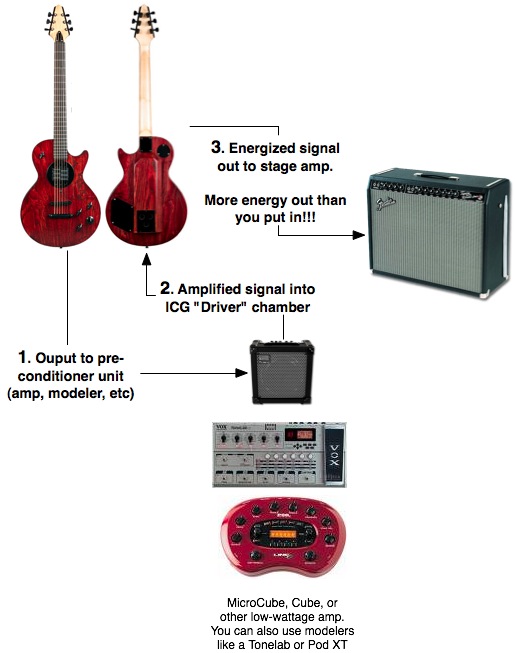
What makes these guitars so revolutionary is Woody’s invention: The Internal Combustion Drive System. This consists of a speaker transducer and special baffles and tone ports that direct added resonance to the strings and body. Essentially, the Drive System is a resonance chamber that builds up the guitar signal (with the help of a pre-conditioner that I’ll get into later) before it goes out to your main amp. According to Woody, whom I had the pleasure of speaking with for quite awhile yesterday, this is a guitar where you can feel your tone resonating throughout the guitar’s body.

So how does it work? Here’s a diagram. I’ll discuss it below:

internalcombustion

That signal is returned via a special plug that Woody provides that I assume returns the “conditioned” signal as a line-level output (though with a Cube, you should be able to use the Recording Out). The signal then passes into the Drive System, where it’s run through the speaker transducer and allowed to resonated withing the chamber. The signal is buffered, then sent out to your main stage amp.The way it works in principle is actually quite simple. You first send your output to a pre-conditioning unit. This could be a low-wattage solid state amp, or even a valve amp. This is also where you add effects, so you could run this into your pedal board, then into the low wattage amp. The net result is that the guitar outputs more energy than was put in, providing for what Woody calls a much fatter, fuller tone than you would get from other guitars.

In addition, adding to the natural resonance are copper bars that run through the body to the neck, creating a direct coupling between the neck and the guitar. Very cool. Woody B also uses very high-grade woods with four to choose from: Swamp Ash, Alder, Mahogany, and African Black Limba (I dig the Black Limba, myself).

For those of you “in the know,” you might ask, “Moog already did something like this.” Yes and no. Yes, from the perspective that the Moog guitar uses a pre-conditioner. But no from the perspective that Woody has taken a completely different approach to the electronics in the Drive System. First of all, where the Moog has around 3000 parts to produce its sound, and I believe requires external power, the ICG Drive System has only twelve parts. Furthermore, the Drive System is completely passive, not requiring any external power source. Finally, the Moog guitar costs in the neighborhood of $6000, whereas you can get into an Internal Combustion Guitar for as low as $1700. Woody is really trying to keep the price below or as close to $2000 so his guitars are attainable by a wider audience.

Here are some videos that Woody has put together:

Folks, this stuff is so awesome! I can’t wait to try one out! For more information, go to Woody B Internal Combustion Guitars.

Read Full Post »

Saint Guitar Company

The guys at Saint Guitar have been busy, and just this week did a “soft” release of their brand new web site, and the introduction of their new domain name (saintguitarco.com). “stguitars.com” still works, but they will be going with the new domain name going forward.

I’m so happy for these guys! Adam Hernandez has got to be one of the most talented young luthiers in the market today. Jon Peterson, who runs company operations is a great front-man. But as a company, and what really endears me to Saint Guitars is that this is something that started out as a dream between best friends, and they’re making it a reality. They’re doing it organically without investors or bank loans, spending all their available time and extra resources (read: money) building the company up, and producing what I think are the finest guitars on the planet. And guess what? Not too many people know about them!

I’m hoping that will change, and I, as a passionate supporter and customer will do my best to get the word out.

What’s so special about these guitars?

Like many other old-school style boutique guitars, these are completely handmade, built from a series of custom jigs and templates that Adam has designed and perfected over the last ten or so years. But that’s not differentiating at all. What is differentiating is the tone of these guitars. They’re on the bright side, but sustain for days. A lot of that sustain has to do with the neck joint that Adam has invented. These are the first guitars I’ve ever played where I can physically feel the sound waves resonate through the body. It’s subtle for sure, but it’s the first time I could really feel it.

As Vinni Smith of V-Picks put it, “[These guitars] have just about the best bridge pickup in the business.” Before I played a Saint Guitar, I was never big on the bridge pickup. But with Saint Guitars, I just love the bridge pickup. Adam really found a sweet spot with its positioning.

Other than that, there is a certain magic about the guitars from Saint Guitar Company. I’ve played some very high-end guitars that cost three to four times as much, and they’ve not really impressed me quite as much as what these guys are producing. Just think about this: The highest price you’ll pay for a Saint Guitar is around $4800. That’s full-gloss, nitro finish with top-of-the-line EVERYTHING. But they start at around $1800 for an open-pore, stain finish (which sounds just as good). That’s simply amazing to me. I’ve shared with Adam that his guitars are almost too affordable considering the quality compared to other custom guitars. I’d pit a Saint head-to-head with a high-end PRS any day. To me, it’ll play and sound just as well or even better and it’ll cost half as much. That’s a no-brainer for me.

In any case, I encourage you to check out their new site at: http://www.saintguitarco.com

Read Full Post »

5 Tone Bones - Gear has stellar performance, value, and quality. This is definitely top of the class, best of breed, and it's a no-brainer to add this to your gear lineup!

IK Multimedia Stealth Pedal

IK Multimedia Stealth Pedal

Summary: It’s official, IK Multimedia’s StealthPedal has just been released! The new StealthPedal is a lesson in packaging up familiar components to produce something totally unique. This is the first of its kind: A USB-powered guitar audio interface/software controller that you can use for recording or playing live as well as controlling any “Powered By Amplitube” software (or any MIDI-controllable software). With the StealthPedal, IK Multimedia completes the picture in providing an end-to-end computer-based guitar performance and recording solution.

Pros: Truly plug and play, it is automatically recognized by “Powered By Amplitube” software, and requires very little configuration.

Cons: None

Price: $199 Standard Bundle / $399 Deluxe Bundle

Specs:

• USB powered audio interface and pedal controller
• 2 balanced / unbalanced audio inputs (hi-Z or line level)
• 24 bit A/D and D/A conversion
• 44.1/48 kHz operation
• 2 balanced audio outputs
• Headphones output
• Volume control
• Built-in expression pedal and MIDI foot-switch
• Multiple LEDs can operate as Tuner or Level indicators with AmpliTube
• External double switch and expression pedal inputs
• Classic, rugged metal Wah-style construction
• High-quality, low-noise input stage (109dBA /104dB RMS S/N ratio)
• Control all “Powered by AmpliTube” software/plug-ins

• Control any MIDI controllable software/plug-ins

• Standard Bundle includes AmpliTube 2 Live standalone and plug-in, AmpliTube X-GEAR, Ampeg® SVX UNO standalone and plug-in, Sonoma WireWorks Riffworks™ T4, and AmpliGrooves Loops by Sonic Reality
• Deluxe Bundle: AmpliTube 2, Ampeg SVX, AmpliTube X-GEAR, Sonoma WireWorks RiffWorks t4, AmpliGrooves
• Compatible with all the most popular DAW software supporting ASIO and Core Audio drivers on PC and Mac
• Endless software expandability with AmpliTube modules

Tone Bone Score: 5.0 – I love enabling technologies that make anything that I do easier, but also add a ton of value. That can definitely be said of the new StealthPedal from IK Multimedia. A quick glance at picture of the unit, and you may think: Okay, just another pedal-style software controller. It is that, but it is also so very much more!

The StealthPedal is also an extremely easy-to-use, full-functioning analog-digital audio interface that you can use for recording or running modeling software live through your computer. And with 24-bit analog-digital, digital-analog conversion, and 44.1/48 kHz operation, you can count on the SteathPedal to produce high-fidelity sound in the studio an on the stage.

The StealthPedal looks just like a mere expression pedal from the top view. But look at the sides and the input and output jacks belie its humble appearance. On the left side of the pedal are ¼” jacks for right and left output, an 1/8” for headphones, another ¼” jack for a dual-switch external switching unit (extra), and the USB jack. On the right side of the pedal are ¼” jacks for inputs, a volume control knob, and a ¼” jack for plugging in another expression pedal. In other words, this “pedal” packs a punch and is so much more than what it appears!

Wah, wah, wah

It took me awhile to figure out that I had too early versions of X-Gear / Amplitube Fender to be automatically recognized the StealthPedal. My bad entirely. But once I had the right versions installed, adding software stomp effects and controlling them via the StealthPedal was a total breeze! The software automatically assigns the StealthPedal to control the first effect with some default behavior. For instance, with a wah effect plugin, the foot pedal is assigned to the wah effect and the switch is assigned to bypass. But you can change behavior simply by clicking the “setup” button at the top-right of the application window. It can’t get much simpler than that!

In the Studio

But before I even tried using it to control the included Amplitube software, I wanted to see how it performed as an audio interface. In this usage, I was totally blown away! Whereas other audio units such as those from DigiDesign require a software driver to operate (yes, even on the Mac), at least on the Mac, the StealthPedal follows Apple’s lead in design: Plug it in and it just works! So in a very real way the StealthPedal is aptly named as it just does what it does without you knowing how – or having to know how it works! Note that you do need a driver for Windows. But on my Mac, the process to be up and running took less than 5 minutes! That’s incredible!

Launching GarageBand, I just went into the preferences, and selected the StealthPedal as my input and output devices. I ran an unbalanced line from my mic pre-amp into the first input jack of the StealthPedal, added and setup a new track, hit record and started jamming on my guitar that was plugged into my amp. The StealthPedal worked as expected – actually a lot better than I expected because I was expecting only “okay” signal quality, considering the price point of this unit. Boy, was I wrong. The recorded signal was just as clean as my MBox 2, with no apparent shading of any kind. That put a smile on my face. And another thing that really blew me away was that lag was virtually non-existent. There was tiny bit, but nowhere in the realm of the lag that I normally get with my MBox 2. Amazing!

Then plugging my guitar directly into the StealthPedal, I fired up the Amplitube Fender plug-in, selected an amp, and started playing. This was truly the first time I could switch on track monitoring and not get thrown off from the lag!

What’s Not Obvious Is Usually Where the True Power Lays

Think about this carefully because it’s important: The real impact of the StealthPedal is not necessarily in its features, but in what it provides as a solution. As I mentioned above, the StealthPedal completes the picture for IK Multimedia to provide an end-to-end computer-based guitar performance and recording solution. I don’t say this lightly. Not only do they have totally kickass amp and effects modeling, with the StealthPedal, they now have a high-quality, high-fidelity guitar audio interface and software controller! Add to the fact that the StealthPedal requires ZERO setup to use (Mac only, sorry folks), and you’ve got a complete solution for all your computer-based guitar audio. And because the StealthPedal was built to work specifically for “Powered By Amplitube” products, you never have to worry about compatibility problems! I don’t know about you, but that’s just incredible to me. But wait there’s more!

Because it is a MIDI controller, the StealthPedal can also be used with other amp sim software via MIDI. So this just isn’t a solution for the AmpliTube user, it can be used by virtually all recording guitarists, and other musicians as well!

Overall Impressions

What can I say? I dig the StealthPedal! In the next couple of weeks, I’m going on a trip. Guess what’s coming with me? A guitar, the StealthPedal, a mic pre-amp, a mic, and a couple of cords. That’ll be enough to record any song, and besides the guitar, all that will fit into my computer bag!

Read Full Post »

« Newer Posts - Older Posts »