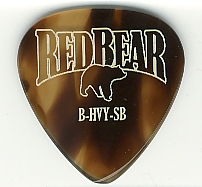
Summary: At 3mm, this is the thickest gauge that Red Bear offers (though you can get thicker ones by special order).
Pros: All the tactile goodness of a Tortis pick, but with real beef. At this gauge the speed bevel is very pronounced, and that is a good thing!
Cons: Cons? What cons? None.
Price: $30
Tone Bone Rating: 5.0 – This is my favorite Red Bear pick yet!
I love both Red Bear and V-Picks picks so much, that I give them away – and I gave my last Red Bear pick away last Tuesday to my friend and fellow musician Christy Martin of “Four Shillings Short,” a very long-lived Celtic band. It was great to see her reaction to how good my B Heavy felt to her! But that left me with no Red Bear!
As work has a tendency to make forget things, I was on my way to my weekly gig today when I realized that I didn’t have a pick! Luckily, my gig was a few minutes away from Gryphon Stringed Instruments in Palo Alto, so I resolved to go to the shop and pick up a new Red Bear. Once I entered the store, I went right to the pick case, and asked the sales guy to pull out the Red Bear tray. I was all set to get my normal B Heavy, when I noticed a Red Bear pick that I hadn’t seen before, a B-GJ! The sales guy said that the GJ stood for “Gypsy Jazz.” Well, of course I had to take it out of its pouch, and feel it. Mistake! The damn thing was beefy – nice and beefy, just how I like my picks.
I asked to try it out, and picked up a Martin dreadnought. From the very first strum, I knew this was the pick for me. But I also compared it to my beloved B Heavy, and there was just no comparison! I really loved the B Heavy, but since I’ve been playing with the V-Picks Snake on electric, I’ve developed a real penchant for super-thick picks, and at 3mm, this B-GJ felt just too good to pass up. So I returned to the case, pulled out my bank card, bought the pick, and went to my gig.
All I can say is that tonally, this had to be the best gig I’ve had in years! At this particular gig, I play solo with just me singing and accompanying myself with acoustic guitar and piano. I think I only touched the piano four times tonight! I was loving playing with this pick!
First off, as I’ve mentioned in previous articles about thick picks, you actually hold them lighter, which relaxes your hand muscles; thus you play faster. But from tone standpoint, I was in total heaven!
As expected, light strumming with the B-GJ produces wonderful, chimey and ringy tones. But the big difference I found between my old B-Heavy and B-GJ was when I dug into the bottom strings with the pick while simultaneously partially palm muting on the saddle of my guitar. What that usually produces is a subdued low-freq boomy kind of sound. With the GJ, it produced that tone, but it was much more pronounced. It was freakin’ awesome.
Moreover, I could ellicit all sorts of different tones by changing the angle of the pick. I could do that pretty well with the B-Heavy, but the tone was so much more full and rich with the B-GJ! I was really at my creative best tonight. A customer, who said he was also a guitarist, walked up to me at the end of his meal, and remarked how good my guitar sounded, and that it sounded nothing like an Ovation. I told him it was the pick, and let him hold it. “You could do all that with this pick? Damn! I gotta me one of these.”
Folks, this is just a dynamite pick, and it’s worth every penny of the $30 you pay for it retail (though it’s $5 cheaper if you buy direct from Red Bear Trading). For what this pick does for my acoustic tone, I just can’t think of using any other kind of pick for playing my Ovation!
Summary: Modeling 12 of the most famous Fender Amps, Amplitube Fender is pretty amazing. It’s scary how close to the real thing this software gets!
Pros: Super-easy to install, and super-convenient to use in your DAW software. The package comes with TONS of presets that require very little tweaking.
Cons: This is just a little nit because it sounds so good, and I don’t want to take that away from this excellent piece of software. But it doesn’t quite respond like a real amp.
Incredible tonal flexibility: mix and match amps, cabinets, mics and more
Sound-certified and approved by the tone gurus at Fender®
5 separate modules: Tuner, configurable Stomp pedal board, Amp head, Cabinet+Mic and Rack Effects
2 fully configurable rigs with up to 32 simultaneous effects
Digital Tuner
Standalone and VST/AU/RTAS plug-in
Includes SpeedTrainer™ and RiffWorks™ T4 Recording Software
Can be expanded with any “Powered by AmpliTube” models using AmpliTube X-GEAR
Can be controlled live with StompIO™, StealthPedal™, StealthPlug (included in AmpliTube Fender® Studio edition), or any traditional MIDI controller
400 presets included with more that can be downloaded online
Powered by AmpliTube® with exclusive DSM™ (Dynamic Saturation Modeling) and VRM™ (Volumetric Response Modeling)
Tone Bone Rating: 4.75 overall, but for a recording plug-in, it gets a 5.0
Being a snobbish purist about “real” gear, 🙂 I’m not easily impressed by emulation software. But when I heard clips of the Fender Edition of Amplitube, I knew I had to check this software out. A million thanks go to the folks at IK Multimedia to letting me evaluate this software because I am definitely impressed by Amplitube Fender! It’s not everyday that you have access to 12 awesome Fender amps, and to have them literally a mouse-click away is just insane! I don’t think amp software will ever replace a real amp, but this software comes so close to sounding like the real thing that especially for recording, I’d be hard-pressed to NOT use it for recording lots of guitar parts!
I used an earlier version of AmpliTube a few years ago, and was not at all impressed by how it sounded. But being in the software development world, with time, software gets better, and I have to say that this software is absolutely incredible!
Now and then, I go off for a weekend alone, and I lug a couple of guitars, a couple of mics, an amp or two, and my MacBook, along with my MBox 2 interface to just do some writing and recording. With Amplitube Fender, I don’t need to lug my amps! I can just load my laptop and MBox an a couple of cords and a mic, and I’m home free! Hey! Not having to lug any extra gear is HUGE! I’m sold on using this software! Not only do I have my four real amps, I now have 12 other amps to choose from when I record! It’s really exciting!
How It Sounds
Imagine that! No need to write a section on fit and finish! 🙂
In a word, it sounds AWESOME! Right after I installed the software, I plugged my Strat into the DI jack of my MBox 2, opened up GarageBand, started a new project, added a new track, and selected “Amplitube Fender” from a plug-in drop down. It was literally that easy! I randomly picked a ’57 Deluxe Dual Mic, then started to strum this little ditty in Am. Before I knew it, I was adding drum and bass tracks, to record the riff.
I’ve played through a ’57 Deluxe in the past, and I was amazed at how the software emulated that warm, bright and crisp sound that that amp is known for! I kept on thinking to myself, “This couldn’t be software – it sounds to friggin’ good!” After I recorded that rhythm track, I took out the Goldtop to play a lead. I ended up playing for over an hour this evening just tooling around with different amps. In the end, I wanted to get a sample out, so I chose a ’59 Bassman with a Fender Fuzz-Wah plug-in to get some fuzz, then recorded the following sound bite:
I don’t know about you, but I really can’t tell the difference between the real thing and software. Maybe because I’m starting to lose my hearing and my ability to discern audio fidelity is kind of going south. No matter, I think this software ROCKS!
Overall Impressions
Amplitube Fender does a fantastic job of amp emulation – there’s no arguing that at all. But there’s a certain “mojo” about a real amp that just can’t be captured with software, no matter how close to the real thing that software sounds. That said, however, even one as snobbish as myself, and other gear freaks I know would be hard-pressed not to seriously consider adding this to their arsenal of recording plug-ins!
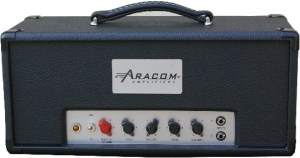
Summary: This brand-new 22 watter is the newest in the Aracom low-wattage amp series now called the Vintage Rox or VRX series, which includes the original RoxBox 18 (now called the VRX18). Loaded with a pair of 6V6 power tubes, this amp oozes vintage American clean and dirty tone ala Stevie Ray Vaughn.
Pros: More clean headroom in Channel 1 as compared to its EL84-based 18 Watt sibling. And despite its lower wattage rating, this amp is capable of getting LOUD! Plus the VRX series sports what I think are the best power switching and master volume in the business!
Cons: None.
Price: $895 Head / $995-$1095 for Combo (dep. on speaker)
Specs:
– (2) 6V6 Power Tubes
– (3) 12AX7 Preamp Tubes
– S.S. Rectifier with “sag” circuit
– Hi/Low B+ voltage switch (22/10 watts)
– On/Off Switch
– Indicator Lamp
– Custom Heavy Duty Aluminum Chassis
– Custom Wound Transformers
– 4, 8, 16 ohm Speaker Jacks
– Custom Handcrafted
Turret Board
– HandwiredTone Bone Rating: 5.0 – Jeff Aragaki has hit the ball out of the park with this amp! I loved the original RoxBox 18, and gave it a 4.75, but with this amp, Jeff “fixed” the harshness of the breakup at lower volumes. To me, it’s the perfect amp!
Let’s roll back the clock a couple of months. I get a call from Jeff Aragaki. The conversation went something like this…
“Hey Brendan! How’s it going?” asks Jeff.
“Not bad. Howzit with you?” I ask.
“It’s going good. Listen, I’m experimenting with a new tube compliment for the RoxBox and put a pair of 6V6’s in it to see how it sounds,” says Jeff.”
“Oh REALLY? Kinda tryin’ to get an American voicing, are ya…”
“Yeah, plus the output rating should be bit higher at around 22-25 Watts,” Jeff states.
“Okay,” I say, “Now you’ve got my attention. When can I try it out?” I ask.
<chuckle> “Well, I called to see if could bring it over to you for you try out and give me some feedback,” replies Jeff.
“Brand new amp? Experiment? Need you ask to see if I’d like to try it out? I’m free Saturday morning!” I exclaimed.
Fast-forward to the following Saturday, and Jeff lets me try the amp for a couple of days before he has to take it back, and I immediately start taking it through its paces. I even gig with it. I’d instantly fallen in love with it! I call Jeff and tell him that I think he’s onto something with this amp. He’s glad for the feedback, then a couple of days later, he picks it up to finish it out.
A few days later, he calls and tells me that he had to tweak the circuits a bit to handle the increased power. Uh-oh. So I asked, “Did it change the tone?”
“Hahaha… not at all. In fact it was actually running at way below 22 Watts. Since I reworked the circuitry, it has tons of power now, and it sounds even better. I even adjusted Channel 1 so you get even more clean headroom, and Channel 2 breaks up real nicely now. In any case, I’m going on a business trip to Indonesia and you can play with the amp for a couple of weeks while I’m gone.”
And play I did! That was one of the most exhausting two weeks of my life because I was up till late (like 2-3 am) playing that amp. I just couldn’t get enough of it, especially playing “Goldie” (a Saint Guitar Goldtop I recently reviewed) through the amp. And in all that time, I wanted to write a review of it, but I had agreed with Jeff to not talk about it (though I hinted a lot) until he got back from Indonesia and turned it into a production amp.
Once he returned from Indonesia a couple of weeks ago, he came over to pick the amp up. He asks me the usual questions about how I liked it, and I just said, “Jeff, this is a PERFECT amp! I can’t say anything bad about at all. Channel 1 is gorgeous and works great with pedals. Channel 2 just rocks the house! It’s the channel I used the most, and it’s also real pedal-friendly. And for once in my life, I’m at a total loss for words; that’s how much this amp affects me to the core.”
Jeff just laughed, and said, “Well, I’ve got a couple of other amps for you to try out…”
I cut him off, and told him that it’s fine if he wanted me to review them, but as far as what amp I’d choose to go with for my personal amp, the VRX22 was it. Search over. He laughed again, and said he’d get started on it….
Okay… fast forward to yesterday…
Jeff called me up to give me a status on my amp, and that he talked to someone this past week who is also getting one, choosing the VRX22 over a well-known boutique manufacturer. So it was definitely going into production, and he was almost done with the web page and announcement. Of course, I couldn’t keep my mouth shut and immediately wrote an announcement, despite his recommendation to wait until today). 🙂 I just promised I wouldn’t say too much, which I didn’t because I wanted to write a review.
What’s in a name…
To create alignment in the series, Jeff has renamed the “RoxBox” line to the “Vintage Rox” or VRX series. If you recall, the original RoxBox 18 sported a pair of EL84 power tubes and is now called the VRX18; and the only difference between the two amps is that the VRX22 employs 6V6’s and circuits that can deal with the increased power. In essence, with the VRX series, Jeff is providing both British (VRX 18) and an American (VRX 22) voicing options. The EL84-based VRX18 breaks up very similarly to a VOX AC15, with a lot of high-freq shimmer. The VRX22, on the other hand, breaks up like a classic Tweed. Frankly, once I have the bucks, playing both together will sound absolutely awesome!!! And priced at $895 each for the head models, that’s A LOT cheaper than a single hand-wired amp from most boutique manufacturers.
Hand-wired goodness at an affordable price
I can’t stress this enough: The thing that originally blew me away with Aracom Amps was the price of the RoxBox. I couldn’t believe Jeff could sell a hand-wired amp for less than a grand – even with a solid-state rectifier! As I’ve gotten to know Jeff, and I’ve come to understand one thing about him: He’s an incredibly shrewd businessman. As he shared with me this morning, “It’s a matter of philosophy. Some guys make boutique gear, give their stuff a nice paint job, then charge a bunch of money for their gear. Then there are other guys who just want to make a few bucks off their gear, but sell it at a lower price so more people will play it.”
The net result is that we consumers reap the rewards of that philosophy, and probably one of the reasons why Jeff’s amps are starting to gain a lot of traction in the industry. And artists have started to find out about Jeff’s amps. Gene Baker of B3 Guitars fame plays an early-model Evolver, and just recorded his new album using the Evolver in all the songs. Obviously, a guy like this who gigs all the time is a believer. I’m nowhere near Gene’s abilities, but I totally dig his amps – I think you can tell. 🙂
How It Sounds
I’m not going to rehash features here, since the features are the same as the original RoxBox 18 that I reviewed a few months ago. Again, the fundamental difference is the use of 6V6’s.
If you’re looking for a classic American tone, this amp is it. Yeah, you COULD go with a classic Tweed from Fender or other boutique manufacturers. But you’d pay way more for the sound. But I also need to qualify that. The tone is “American-like.” It has a voicing that whether Jeff stumbled onto it or not, is a voicing that is at once familiar, but all its own at the same time. To me, I don’t give a rat’s ass about the power rating of this amp. All I know is that it sounds like nothing I’ve played before. That’s the feeling I get with the Reason SM25, which is another 6V6 beauty, but has a sound all it own.
Channel 1 is bright and gorgeous. It’s chimey as you’d expect from a classic Tweed sound, but it’s amazingly very lush as well – which is where this amp is really distinct. The words that come to mind with this clean channel are “subltely sensuous.” It’s not like a hot chick dressed in a tight mini skirt. It’s more akin to a gorgeous woman dressed in a simple cotton summer dress who doesn’t need any makeup to enhance her looks, and she has nothing to prove. She just looks to be all-woman. The net result is that you’re just drawn into aura without really knowing why – nor caring. The clean channel of the VRX22 has a similar effect on me. It’s just a gorgeous tone with any guitar (though I especially loved play “Pearl,” my Strat through it. The raw tone just draws you in, and when you add effects, it just handles them beautifully.
Channel 2 is also bright and ballsy, but its breakup is incredibly smooth. This is the channel where I think Jeff has really hit the ball out of the park. One of the things that has bugged me about the power tube distortion in a lot of Tweed-types of amps is the harsh grind from the power tubes that you oftentimes have to tame with some filter cap and capacitor changes – it’s a bit too open. Not so with this amp. The “hidden” gain stage that acts as a tube overdrive pedal that’s always on helps smooth out the distortion by making it a bit tighter, but not so much that you lose that openness that you expect from a Tweed-type amp. I loved slamming the front-end of the amp with tons of input gain, and pushing both pre-amp and power tubes at the same time. Talk about compression and sustain!
Here’s a clip I used for my review of “Goldie.” The amp is in Channel 2 for the lead, and I added just a tad of Tube Screamer to get a more punchy midrange response. The TS overdrive was maybe at 10 am – not much at all. Plus I layered on some reverb with my Hardwire RV-7 Reverb. The bulk of the breakup came from the amp. The rhythm track was recorded with Pearl on Channel 1.
Man! I just listened to that track again, and can’t get over how great the amp sounds. Normally I record at bedroom levels, but I wanted the amp to move a bit more air this time, and I recorded it at gig levels (for me, that’s around 90-100db, so it’s fairly loud but not over the top), and I used a ribbon mic to pick up the ambient a bit better. The mic was placed at a 45 degree angle along the speaker cone about a foot and a half away from the amp.
Overall Impression
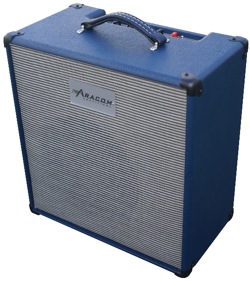
I just can’t rave about this amp more! To me, it’s the perfect balance of tone and power for practically all my needs! I’m getting the head with a 1X 12 cab, both wrapped in that awesome blue tolex that you see in the picture above!
Admittedly, the purist in me originally scoffed at the idea of a solid-state rectifier in the original RoxBox series. But as I told Jeff this morning, what people are typically after is the voltage sag you get with a tube rectifier. Jeff has built a custom “sag simulator” circuit that does the job so well that frankly, I can’t tell the difference. Besides, it’s what the amp sounds like that counts, not necessarily its components. Look at the classic Roland JC-120. That has to be one of my all-time favorite amps – even Satch played with one for years. It’s completely solid-state and it sounds freakin’ awesome!
But circling back to the VRX22. You can’t go wrong with this amp. Yes, it’s priced for value, but the tone that you get for that far surpasses anything that I’ve played at these lower wattages.
The Dawg always has his nose to the ground, trying to pick up the scent of new gear. And for the past few months with the economy in a deep recession, new gear has been tough to find; especially from the small-run manufacturers. Well, I just picked up the scent of a brand new amp from Aracom Amps, and despite the recommendations of its maker, Jeff Aragaki to wait until he updates his site, sorry Jeff, this alert just can’t wait!!! 🙂
The new amp is called the Vintage Rox Series, and is based upon his absolutely kick-ass RoxBox series, which is an EL84-based, 18 Watt head or combo. The Vintage Rox, or VRX, series on the other hand, uses the same chassis and layout as the RoxBox, but is 6V6-based, producing 22 Watts of output. Now you have a choice in low-wattage solutions from Aracom!
Time to come clean…
Okay, I’ll admit it: I didn’t just discover this amp. I was actually the primary tester for the amp (there are distinct advantages to being local to a manufacturer), and I have been literally waiting weeks and chomping at the bit to announce it. I’ve hinted at its existence in previous article, but couldn’t provide any details.
Why am I so excited? For lots of reasons. But I’ll name two. First, with this amp, I think Jeff has definitely hit the sweet spot for low-wattage amp solutions! With the RoxBox 18 and the VRX 22, players have a voicing choice that not many boutique builders offer. But even more special, both the RoxBox and VRX amps sell for significantly less; in many cases more than half as much as other boutique amps at the same or similar wattage.
Secondly, the tone this amp produces is freakin’ marvelous! So much so, that I’m taking delivery of the first production amp. When Jeff brought the first prototype to me several weeks ago as an “experiment” he was working on, my immediate feedback was that this was a special amp, and I couldn’t wait until he had a production model because that was the amp I wanted to get from him.
I’ll have a full review of the amp once I get some pictures from Jeff, but for now, start checking out the Aracom Amps site for the VRX 22 announcement. It should be up by tomorrow!
Folks, I haven’t been this excited about an amp since I reviewed the Reason SM25! It’s one special amp that really deserves your attention. Also, if you subscribe to Vintage Guitar mag, you should see a review of the Aracom Evolver there in the newest issue!
It’s one thing to test gear in a controlled environment, it’s an entirely different matter to use it for a gig. After receiving the Prestige Heritage Elite, I took it through its paces in my home studio, and it performed quite well; so well that I gave it very high marks, reflecting the excellent build quality as well as how it sounds, which was awesome in the studio. The operative word here is “studio.”
As I mentioned above, it’s an entirely different matter of testing gear in a gig situation. After all, during a gig, you don’t have the luxury to stop to make corrections on the fly. Furthermore, during a gig, an instrument’s tone interacts and reacts completely differently to the environment than in the studio.
Hope that little section above doesn’t make you nervous about how the Heritage Elite performed 🙂 because it worked great! I played the guitar at my weekly church gig with a full band. Now before you dismiss this venue, let me say that playing in a church is one of the most sonically challenging environments to play in because you don’t have the luxury to crank it up, and churches have pretty high ceilings so dealing with sound bouncing around a big space makes it even more challenging. In light of that, you have to rely a lot on the natural tone of the gear you’re playing. Especially with something like a guitar, it has to sound great at lower volumes, and have voicing that won’t get lost in the ambient.
In this, the Heritage Elite really excels. Surprisingly enough, it doesn’t have the deep ballsy voicing you’d expect from a Les Paul-type of guitar. In fact, the voicing is much brighter, but from the standpoint of playing live, that’s a good thing, and something for which I’ve always praised Saint Guitars. But like a Les Paul, it has that distinctive chirp – that kind of hard to describe, subtle sound. It’s very pleasing to the ears – I dig it!
The other great thing about playing at my church is that I can play a variety of musical styles throughout the course of the service. I played some hard driving rock as well as some soft, finger-style music. Whatever the style of music I played, the Heritage Elite performed great. I especially dug its clean tone while finger-picking.
I also forgot how fun it is to play with independent volume and tone controls. I usually peg the tone controls, then use varying amounts of gain between the neck and bridge pickups to dial in just the right tone for a song. I actually played most of the service in the middle position so I could take advantage of both volume controls, though I used the treble position for leads – the SH-4 JB in the bridge position rocks!
So, whether you use it in the studio or on the stage, the Prestige Guitars Heritage Elite will do the job handily!
By the way, I found out why these boutique-like guitars come in at such a low price point compared to their more expensive counterparts: The guitars are cut, built and finished in Korea, then shipped to Canada to have hardware added and set up. For people who care about build location, this might be an issue. But PRS does _everything_ in Korea for their SE guitars, and they sound and play great! And I guess that’s the point I’m trying to make. Who the hell cares where Prestige guitars cut and constructed? All I know is that the guitar I’ve reviewed has no finish flaws, and more importantly, it sounds and plays great! I’ve even lent it to my close friend, and he’s diggin’ it! He’s amazed at how well it plays and sounds! That’s the most important thing with any instrument.
Summary: Is it possible to build a better Les Paul. Prestige Guitars thinks so, and I think they’re on to something with the Heritage Elite. With its stunning looks and gorgeous voice, this is a great, all-around versatile guitar that will fit any style of music.
Pros: Very full and rich sound, and all the accoutrements make this guitar a real looker. Very nice treble pickup with higher gain settings.
Cons: This is just a little one. I’m not fond of the abalone outlining on the the neck as to me it takes away from the gorgeous vine inlay. But that’s just me. Also the intonation was off on the 6th string – again, it wasn’t a big deal – I just fixed it and went off to the races.
Tone Bone Rating: 4.75 – 6th string was slightly off in intonation, and I had to adjust it. Weird, because all the other strings were perfectly intoned. If it hadn’t been for that, the guitar would get a 5.0 rating.
Didn’t I just write a First Impressions? Well, I haven’t put this guitar down all day because I was having so much fun with it, so I decided to just go ahead and write the review. I’ll do a gig report once I’ve played it in a gig setting – which will be tomorrow. 🙂
Fit and Finish
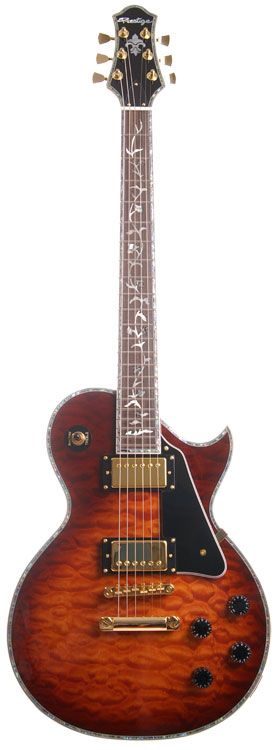
What can I say? This guitar is gorgeous, and except for my little nit, everything is perfect on this guitar. I love the stain burst finish that really accentuates the quilted maple top. There’s no glue marks or finish mistakes to be found on this beauty, and the abalone binding around the body and ebonized head stock is to die for! The neck joint is perfect as well, and is nicely set with no extra bulk, so reaching notes in the upper registers is an absolute breeze!
Prestige really thought out the design of this guitar really well. The gold hardware is a nice touch, and the Grover tuners are the bomb. Even though they’re not locking, the guitar stays in tune. I’ve only had to hit the tuner twice all day due to temperature changes in my garage/studio. The vine inlay on the neck is oh-so-stunning, and reminiscent of high-end guitars I’ve seen and played that cost a helluva lot more than this beauty queen. How Prestige was able to build a great-looking guitar with so much boutique bling at a fairly reasonable price is beyond me, but hey! Who’s complaining? Definitely not me.
Normally, I can’t stand pick guards, but somehow, the pick guard on the Heritage Elite is really unobtrusive. This guitar just “works.” I dig it.
Playability
I have to admit that after playing “Goldie,” a Saint Guitar Company Benchmark that has a wide profile neck, it was tough to get used to the comparatively narrower neck profile of this guitar. But once I got my hands dialed in, I gotta say that this guitar is very easy to play. The C-shape neck is a joy to play, and the rosewood fretboard is nice and smooth, yet with enough texture to give great tactile feedback.
The thin body makes positioning very easy – especially for a big guy like myself that has a middle-aged gut, so how it hangs from the strap is important. I didn’t have to make any positional adjustments with this guitar, which is something I have to do with a lot of guitars.
The shorter scale was something I also had to get used to, but that’s not even a nit. Again, once I got my hands dialed in to play this guitar, it was so very easy to play. The action was perfect out of the box – nice and low, which is how I like it. They strung it with D’Addario 10’s to boot, which is my preferred gauge and a brand I’ve used for years (though I’ve lately been using almost exclusively DR strings), so the strings were instantly familiar-feeling. As I mentioned, the only ding that the guitar got was the intonation on the 6th string. I understand that this could be due to shipping, but it was off enough where I had to get my micro allen wrench and adjust it. That always makes me nervous with these demo guitars because I don’t want scratch them out of respect for the manufacturer’s hard work. But all went smoothly, so no harm, no foul.
How It Sounds
In a word, “gorgeous.” It has that classic Les Paul fatness, but it’s also brightly voiced, like a Saint Guitar. It’s not as EQ balanced in its brightness like a Saint is, but for what it offers, this guitar really kicks ass tonally. The Heritage Elite packs tons of nice harmonics and overtones that add complexity to its tonal presentation. And another thing that I really dig about this guitar is that it has tons of sustain, which really comes out in the treble pickup, especially at high gain settings! I’ve played tons and tons of guitars, and most have ear shattering treble pickups. The Saint Guitars and this Heritage Elite have the most usable treble pickups I’ve played. I think this is due to the guitars’ inherent, natural sustain. In any case, check out some sound samples I made:
Clean – Both Pickups
Clean – Neck Pickup
Clean – Bridge Pickup
Dirty – Both Pickups
Dirty – Neck Pickup
Dirty – Bridge Pickup
Clean clips were played in the Clean channel of my Fender Hot Rod Deluxe, while the dirty clips were played in the Drive channel. For the dirty treble pickup clip, I slammed the front-end of the amp with a wide-open Creation Audio Labs Mk.4.23 clean boost, the best clean boost on the planet. That brought on tons of overtones and rich harmonics! Sweet.
Overall Impressions
I really like this guitar. It looks great, it sounds great and it plays great! By the way, this is their top of the line model, and at $1800 Canadian, it’s an incredible value proposition. Believe me when I tell you that you’re getting a boutique-quality guitar for a great price with the Prestige Heritage Elite!
I did a gear find about Prestige Guitars a couple of weeks ago, and was very intrigued about how this company could do such high-end work for a reasonable price. So I contacted them to do a review on their top-of-the-line Heritage Elite model. The guitar arrived late yesterday, but I had a gig last night so I couldn’t play it – oh well…
So with great anticipation, I jumped out of bed at 7 am this morning, and unwrapped the package. The guitar came with a nice, form-fitting old-school, black tolex-covered case. When I lifted the lid to see the guitar, I was blown away by how awesome it looked! The abalone binding on the body, neck and headstock was gorgeous, and the mother-of-pearl vine inlay on the fretboard is spectacular. But that said, if I had my druthers, I’d skip the abalone binding on the neck, but that’s just a nit – it’s all beautiful.
The finish on the body is incredible, with the burst stain bringing nicely bringing out the contours of the curly maple top. Around 8:30 am, my buddy Phil texted me and asked if I had received the guitar (I show him all the gear that I review), and demanded that we meet for coffee so he could see this gorgeous guitar. He fell in love with it immediately.
Out of the box, the setup was awesome, though during shipping, the intonation got thrown off a bit on the 6th string. That was very easy to remedy though, so it wasn’t really a problem. I also expect that out of instruments shipped to me, so it’s not a negative. The action on this guitar is low – very nicely low – with no string buzz unless you really hammer the strings, which is to be expected. To me, the action is perfect! The neck is nice and fast, and with a 24 3/4″ scale length, you can really move around on the neck. Another nice feature of the guitar is that it doesn’t have a big neck joint, so reaching notes in the upper registers is a breeze.
So, how does it sound? In a word, awesome. It’s very much like a Les Paul, with a Duncan ’59 in the neck and a SH-4JB in the bridge – two of my favorite pickups. The bridge pickup is nicely damp and rich sounding, and the treble pickup really screams. Played through my Hot Rod Deluxe, it’s got a great, mid-rangy sound. I especially like the bridge pickup. It’s nice and tight and doesn’t lose bottom end, which is a beef I’ve had about some Les Pauls I’ve played.
All-in-all, this is one sweet guitar, and at about US $1450, it’s a guitar that has a ton of boutique features at a relatively reasonable price point. I need to play with it for a few days to get to know it better, and I’ll do a full review.
But my preliminary rating is 4.75 Tone Bones. This is a great guitar!
It’s a huge step for that little shop in Fresno, CA called Saint Guitar Company. I’ve really gotten involved with Saint Guitars over the past several months, and I think Adam Hernandez on the verge of making the big time with his guitars. So to help him out, I asked Vinni Smith of V-Picks if he would do demo video of a Saint Guitar guitar to help get the word out, and he’s given it an absolutely glowing review! Check it out:
Summary: Thick at 4.1 mm, this is the beefiest pick I’ve ever played. But it’s uncanny just how fast and accurate you can be with this pick! Comes in both Rounded and Pointed corners, and Vinni also makes a hybrid that has both types of corners.
Pros: The bevel on this pick is perfect, and totally different than the other V-Picks I’ve played. Whether you go with the rounded or the pointed version, you’re gonna love playing this pick.
Cons: None.
Price: $10.00 ea
Specs:
4.1 millimeters thick
Hand-ground
Flame buffed
Sharp, almost triangular bevel
Tone Bone Rating: 5.0 – I REALLY love these picks for playing electric guitar!
In my previous review of the V-Picks Medium Rounded and Pointed, I shared how the tone that they produce just make my heart sing! But with “The Snake” Vinni just blew those out of the water! Within minutes of playing both the Rounded and Pointed versions, I knew I’d never go back to the medium rounded and pointed again. Damn, Vinni! You just keep on inventing great picks!
The big difference between “The Snake” and the standard picks other than the beefy 4.1 mm thickness is the bevel. It’s sharper than the standard picks, with a noticeable burm-like edge. When I initially took a close look at the edges of these picks, I have to admit that I was a little dubious. After all, Vinni had just told me the other day that The Snake was his “most outrageous pick ever.” That coming from a man who makes picks that are half and inch thick, for cryin’ out loud!
But as they say, the proof is in the pudding, and I picked up a Saint Guitars Goldtop Benchmark, took the rounded Snake in hand, and started playing a riff. My expectation was that this pick would produce a sound similar to my beloved Medium Rounded. To say that I was completely taken by surprise by the tone that ensued from my amp would be an understatement. I stopped, picked up my Medium Rounded, and played the same riff. But it didn’t have quite the punchiness and roundness that the Snake Rounded produced. I just shook my head, and literally said, “That f#$kin’ awesome!”
Then I picked up the Snake Pointed, and started playing the same riff. Again, my preconception was that the pointed would play similarly to the medium pointed: A sharp, crisp attack that was great for playing leads, but not very enjoyable for strumming. From the first strum, my jaw just dropped. Unlike the medium pointed, this pick just glided over the strings! There was a little more resistance than the rounded Snake, and I expected that, but I didn’t expect how well the pointed Snake would move over the strings. It’s truly uncanny! And unlike the sharp attack of the regular medium pointed, what this pick produces is an absolutely gorgeous ring. I could use this pick for both rhythm and leads – and that’s what I’m intending to do at my gig this weekend!
I believe the bevel on these picks make all the difference in the world, and what sets them apart from Vinni’s other picks! This bevel is special, and really the secret sauce behind the tone these picks produce. The thickness of these picks just add to the awesome vibe they evoke. I didn’t think a 4.1 mm pick would be very comfortable, but I love it even more than the regular mediums! By the way, these picks are about the same size as the regular mediums, so it was a good comparison. The funny thing is that I hold these thicker picks even lighter than the regular mediums. The Snake seems to grip you, as opposed the converse. I guess that’s why Vinni named the pick “The Snake.” It really feels like it’s holding me while I’m playing.
Okay Vinni, I have to agree. These really are your most outrageous picks! For more information, go to http://www.v-picks.com
You gotta love Canada. You just gotta. In addition to being the country that brought us my favorite sport, hockey (Go Sharks!), Canada is now raising the attention of guitarists. The first Canadian manufacturer that caught my attention was Godin guitars. I first played a Godin at a local shop, and was really impressed by them.
But I recently caught wind of another Canadian manufacturer – Prestige Guitars – that is making me raise my eyebrows – A LOT! Granted, it took me reading about them in Guitar World mag, but that brief review article of the Prestige Heritage Hollow compelled me to do research on Prestige and see what’s so special about them.
From what I can tell, these are production guitars with TONS of boutique accoutrements. Click on the picture to the left to see what I mean. This guitar, replete with abalone binding and intricate mother of pearl inlays on the fretboard sells for CAN $1800! That is roughly US $1450!
What a price point for these kinds of features! An equivalent boutique guitar will sell for three to four times as much, and here’s this Canadian company providing the same kinds of features for so much less! YOU GOTTA DIG IT! YOU JUST GOTTA!
I haven’t been able to find any sound bites the web, otherwise I’d list some, but I’m going to do some research, and I’m definitely going to see if I can somehow play one of these!




 Guitar Gear