Feeds:
Posts
Comments

Archive for the ‘guitar lifestyle’ Category

Brazilian Rosewood Tree

Brazilian Rosewood Tree

Important enough to use wood from an endangered species? Specifically, Brazilian Rosewood?

But let’s take this even a step further. How important is tone in general to you? Important enough to buy gear from manufacturers who use non-sustainable materials or do not practice environmentally-safe methods of construction and waste disposal?

I ran across an interesting thread on The Gear Page last night that really got me thinking. In that article, guitar builder Terry McInturff wrote that he lost a sale because he refuses to use Brazilian Rosewood – actually the article bothered me to the point that I decided to join in the call to action to not use Brazilian Rosewood (Click here to read the article – opens a new window).

But after a lot of troubled thought last night, I decided to make an environmental support statement of my own that not only includes Brazilian rosewood, but extends to other issues as well. Don’t get me wrong, I’m not a tree hugger, but I believe that as the highest-order intelligence inhabitants of this planet, we all have a responsibility to act as stewards of the Earth to protect and preserve its resources for the enjoyment and enrichment of the people of this world, now and in the future.

What troubled me last night is the fact that as a tone freak, my beloved instrument is often constructed of exotic woods, and often painted using dangerous and environmentally unsafe materials and disposal methods. There’s nothing I can do about guitars have already been built, but there is something I can do about the ones that haven’t, and lots I can do personally to not support deforestation of exotic woods and environmentally unsafe construction methods.

Why am I making this appeal here? Because I believe that we guitarists have a huge collective voice that will be heard if we take a stand together. Please don’t read this wrong: I’m not saying we should be militant and go out and commit some violent act to prove a point. That’s just plain stupidity and acting on rage. No one wins with that kind of behavior. Instead, I’m going to make what I’ll call my “Green” statement:

Brendan’s “Green” Guitar Statement

  1. I will only purchase guitars that are made with non-endangered species of wood.
  2. I will only purchase guitar gear from manufacturers who practice environmentally safe methods of construction and waste disposal.
  3. I will take the time to research companies’ practices before making a decision.
  4. I will encourage my fellow guitarists in making a “Green” stand.

This is a statement of passive resistance, and a refusal to be part of things that will have a deletrious effect on the Earth. I’m sure there will be those who will call me names, and who really don’t give a shit about any of this. I can’t control that, but neither will I judge them back. Everyone has a choice. I get that. I’m just taking public stand that I will do my best to contribute to the health and not the harm of our planet. If it makes me unpopular, so be it. But if I don’t have my principles, then what do I have?

I also realize that this eliminates a fairly wide range of gear builders, especially the big brands, who have fairly large facilities overseas where environmental controls are much more lax than in the States. It also means that I will probably have to pay a higher price for gear that abides by the stand I’m taking. Again, so be it. What’s the price to my children in the future if I don’t act responsibily about our Earth now?

Read Full Post »

…to give up on a dream, or perhaps, maybe an illusion. I wrote a new song yesterday for Mass based on Psalm 32, called “I Turn to You.” Give it a listen:

Anyway, when I uploaded it to iCompositions, and wrote the song summary, I included that the song and lyrics were free for the taking. I was just going to put it out there, and let whatever church musicians who come across it use it to their hearts’ content. As I said, “This was a gift to me, and I want to pay it forward.”

Let me qualify about “giving it up.” It’s more like giving up an offering to the universe. I’m not going to stop putting my music out there to get it heard. It’s just that I’m not going to be attached to a particular style or genre of music as a vehicle. I’m going to write what I write, and if happens to be religous, fine. If it’s not, also fine. I’ll basically take whatever inspiration I can get, and let that inspiration dictate the direction I go in.

The new song is the result of just giving it up to the universe. I looked at the verses of the Psalm in the Bible, and suddenly the music came to me. Likewise, I was re-listening to an instrumental I came up with to demonstrate how “Goldie” the Saint Guitars Goldtop Benchmark sounds, and got the idea for an entire song built around that phrase. I’m writing this entry as a break from tracking right now. 🙂

I guess the point to all this is that I released my emotional attachments to the direction I’m taking my music, and letting it just be what it is: Music; irrespective of religion or philosophy. I’m just going to write about things I’m compelled to write about, and share the story.

Read Full Post »

I don’t know about you, but as a songwriter, it bugs me when I go for long periods without writing songs; or more precisely to the point, when the inspiration to write doesn’t come to me. I’m not a calculating songwriter, and completely rely on that inner voice that inexplicably sends music to my head. For the past couple of months, I haven’t had the inspiration. Oh, I’ve written short clips of stuff, and I’ve had the beginnings of song ideas; in fact, I just counted last night, and in the last couple of months have recorded 25 song ideas. With some of these, I even recorded several instrument tracks. But none of these developed into full songs.

But over the weekend, I got a new guitar from Adam Hernandez of Saint Guitars (read the review here). This functional piece of artwork stirred something in my soul and I got the inspiration to write a song – it’s about time! The song is based upon Psalm 146; yeah, it’s religious, but hey, a song is a song in my book. Besides, I haven’t written a religious song in awhile, and it’s actually where I started, so nothing like going back to my roots. But more importantly, just getting that one song out has made my creative juices start flowing again, and that’s a good thing. Give it a listen:

Being naturally introspective, I took a look at how I got the inspiration. Sure, the trigger was probably that gorgeous guitar, but more importantly, it had the effect of changing my current perspective. And I think that’s the key to inspiration. When you’re feeling in a rut, do something else or try out some other gear. The idea is to derail the status quo.

Read Full Post »

Stuck in a Rut

…but there’s a light at the end of the tunnel… At least I hope so. 🙂

For the past few weeks, I’ve been in kind of a rut with writing music. I’ve got eight songs for my new record, which I recorded pretty regularly over the course of about three months. And it wasn’t just eight songs I wrote. I wrote and recorded about 20 other songs before deciding on the ones that made the final cut. The process was incredible! A song would come to me, I’d grab my guitar or sit at the piano, and in a relatively short amount of time, I’d have a song. Then I’d spark up my DAW, and record a raw piece to make sure I captured it. No sweat.

But as soon as Christmas season hit, it seems that the stress of getting stuff done at work before taking a vacaction, then Christmas itself just sucked the creative juices out of me. Okay, I’ve written some jam tracks and recorded some short snippets of songs, but to date, I really haven’t gotten the inspiration to write a full song. But in spite of that, I’m feeling really positive as there is a bright side to this lack of creative energy.

As you know, I’ve lately been driven to be more academic about what I’m playing; partly because I want to be able to effectively teach what I’m learning, but also because I just want to be a better player. So in lieu of writing music, I’ve been working on my improv skills, and I’ve been really happy with the progress I’ve been making! All this practice is just making me a better player, and that is inspiring in and of itself!

For instance, as many may know, one of my regular gigs is to play at church. Before any naysayers start ripping me about playing at church, understand this: Do a worship service of ANY kind poses particular challenges. For instance, you can’t just rock out all your songs or pick music that is always up-tempo. Worship services need to take people through an emotion journey with respect to the music. Typically, the beginning and the ending songs are pretty upbeat, while the middle songs are much more subdued or, if you do have a more upbeat song, you don’t go all out and rock. The idea is that the music is not the focus, the worship experience is, and the music you play needs to enhance that. Furthermore, because it’s in a church, you can’t play at real loud volumes the entire time. As I mentioned above, you can get away with it at the beginning and the end, but even in those spots, you can’t really play at club or concert levels.

Sounds a bit constraining, doesn’t it? I’ve been gigging for years, and each type of venue poses its own particular limitations. The trick is to work around those limitations so that you can be as expressive as you can be.

All that said, considering the constraints, last night’s service was awesome! To add to our normal volume constraints though, I was missing both a drummer and a bassist, and all we had were two other guitarists besides me, one of which just started playing with us that day. So it was particularly challenging because being the most experienced guitarist put holding down the rhythm to the songs on me. But that was the cool thing. All the work I’ve been doing on my technique has allowed me to so much more than just strumming chords, adding little runs or double adorning some chords with arpeggios or arpeggiated double-stops. This is stuff that I couldn’t do six months ago! And despite not really being able to do any leads, it didn’t matter, I felt totally inspired!

So yes, there is a bright side to this rut. At least I can still play… 🙂

Read Full Post »

New Year's ResolutionI normally don’t make New Year’s resolutions. Haven’t done it in years. I’ve always felt there was something innately dishonest about making resolutions like “I’m going to be a better person,” or “I’m going to do something nice for someone everyday.” Not that those aren’t noble pursuits, but in a lot of cases, they demand an enormous amount of self-discipline, self-sacrifice and changes in normal behavior that most of us can’t persevere. We’re good for a few days or maybe a couple of weeks, but something will happen and it all goes to pot.

In lieu of lofty resolutions, I’ve instead set concrete goals that in order to achieve, require changes in behavior and changes in thinking. I’ll share some of these goals here:

  • I will continue on my five-year plan of getting on the road and touring. I’m just starting my third year in the plan, and it’s going pretty well. I’ve release an album, and am working on my second one; a few of the songs of which I’ve entered into an international songwriters competition. I don’t expect to win, but the feedback that I get will be invaluable. Furthermore, going on the road will require that I get in shape, so I have been eating better and getting exercise in anticipation of going back on stage. I love to eat, so this has been a tough thing for me, but I’ve lost 25 lbs so far, so I’m well on my way.
  • I will study more music theory; especially scalar modes. I already started doing this a few months ago, but really want to master it in the coming year. First, because I want my improvisation to be better, and with an understanding of the intervalic nature of music, I’ll be able to move around the fretboard much easier. I don’t want to necessarily learn patterns that I chain together, I want to get to the point where I can jam in any key, and be confident that the next note I hit works well harmonically and musically with what I’m improvising. Also, mastering scales and modes will make me a better teacher. Don’t get me wrong, I have a very firm intellectual understanding of music theory, and can actually cold read charts, but in actual execution, I feel I’m lacking, so my aim is to meld the two.
  • I will have a custom amplifier built for me. I’m currently working with Jeff Aragaki of Aracom Amps to build me an amp around his RoxBox 18 Watt design. I’m “going off the reservation” with this one because I want a different speaker than what he offers, a bigger cabinet and a reverb tank, plus a built-in resistive attenuator for low volume applications. If you haven’t checked out the RoxBox, I suggest you do. It’s a great 18 Watt design that’s also a great value stock.
  • I will purchase a Reason amp. Not sure which will come first: Having Jeff finally construct my amp, or purchasing a Reason. I love the SM25 I have right now, but since I’m a StackMode freak, I’m also leaning towards the SM40 head. We’ll see.
  • I will have Adam Hernandez at Saint Gutiars build me a guitar. I’m so grateful to be able to test Adam’s guitars. We’ve already talked about what I might like in a guitar, but I really want one of my own.
  • As far as GuitarGear.org is concerned, I will rebuild the site to make it a lot easier to find things. I’ve already started doing this, but I really need to rethink the design of the site. I will probably go to a three-column layout so I can get more things “above the line” that is, the part of a page that you first see when a web page loads. Right now, the site is a bit narrow, so lots of things fall below the line that I’d like people to see; especially the companies I personally endorse.

Okay, that’s it for me. Anyone willing to share?

Read Full Post »

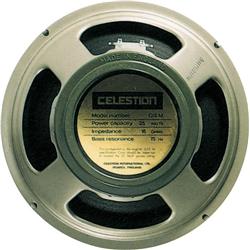
Celestion GreenbackMy good friend Phil of Phil ‘N The Blanks has been bugging me to write about speakers for the last couple of weeks. I’d talk about this speaker or that in some amp or cab, and he’d say, “There’s your next article, dude. You gotta write about speakers.” Admittedly, I’ve been a bit reticent about the subject because of all guitar parts, what makes a speaker sound good is purely a subjective thing; that is, someone’s assessment of a speaker’s tonal quality is entirely personal.

Oh yeah, you can argue the case of alnico vs. ceramic. You can argue vintage vs. modern voicing. You can argue about the materials used in a particular speaker. But in the end, none of that matters unless it sounds good to… well… you.

Phil has been trying to get me to write about certain speakers, but that’s something I just won’t do because again, it’s personal preference. For instance, Jeff Aragaki of Aracom Amps came over to my house today and we talked at length about his RoxBox 18 Watt Combo. I love the amp, but really wasn’t moved by the Eminence Red Coat Red Fang, which uses an alnico driver. On the other hand, I love the RoxBox head plugged into the Reason SM25 speaker cabinet that sports a Red Coat “The Governor,” which uses a ceramic driver. To me, it has a deeper sound. I kind of lean towards the “woman tone,” and “The Governor” is voiced a lot like a Celestion Greenback, which is known for its rich tones. Combined with my Strat I can get that tone. It just wasn’t happening for me with the Red Fang, though for really heavy rock stuff, the Red Fang really shines when it’s pumped up, as it compresses very nicely at high gain output. But that’s not the style I play, so it was hard for me to truly appreciate its virtues.

That said, Jeff mentioned another guitarist who just loves that setup. He’s more of a pure rock player, and loves the warmth and brightness that the Red Fang produces. See what I mean? To talk about this speaker or that is akin to starting a holy war. And you can’t tell anyone a particular speaker is bad or good because that’s just an opinion.

So here’s my advice if you want to switch to a different speaker: Go to a place where you can try speakers out and pick the one YOU like. Use reviews and sound bites as guides only. They’ll generally get you into the ballpark of the tone you want to achieve. And don’t be surprised if you get a speaker for cheap. Remember, as far as gear is concerned, something that costs more a lot of times just costs more – it may not sound any better to you. A good comparison to make is with the speakers I mentioned above. The Red Fang costs about $129, while The Governor costs $89. But I like the sound The Governor produces. If the prices were switched, I’d still go with The Governor.

So don’t be fooled by any marketing mumbo-jumbo. Go out and test for yourself! 🙂

There Phil, I wrote an article about speakers…

Read Full Post »

Red Bear Trading CompanyRunning a blog like mine is always rewarding; not just because of all the gear I get to play with but because of the incredible people I get to meet. Among them is Dave Skowron, maker of Red Bear picks and co-owner (with his wife) of Red Bear Trading company. If you read the previous article I posted today, you’d know I’m truly excited about these picks! They look and feel great, and if you didn’t know any better, you’d swear they’re natural tortoise shell. In fact, when Dave made his first prototypes for some friends in Nashville, they all said he was full of it when he told them they were made from a polymer made of animal protein that looks and feels just like tortoise shell. I’ve never had a tortoise shell pick, but I have felt antique stuff made of natural tortoise shell, and this stuff is close – damn close!

But whatever it’s made of, who cares? These picks are special. You wouldn’t think a guitar pick could make a difference in how you’d sound and play, but you’d be wrong. I know I was because I’m now a convert. But I’m also not any big name, so let me drop one: Dweezil Zappa swears by these picks! He shared a story with Dave about how he spent seven days a week for a year and a half woodshedding to learn his father’s songs in preparation for the “Zappa Plays Zappa” tour. He related to Dave that if he’d had been using Red Bear picks, he would’ve learned them in a few months. The point is that these picks not only make you sound better, they make you play better. I can personally attest to that! Whether you play acoustic or electric or both, you can’t go wrong with one of these picks. In fact, you can use the same pick for both types of guitars! I do.

In my excitement about Dave’s picks, I gave him a call to interview him. Funny thing, I really didn’t have to ask many questions, as Dave is a garralous and talkative guy, who’s got no problem speaking his mind. It was a real joy speaking with him. Here’s a transcript (a lot of it paraphrased) of my conversation with him:

So Dave, what’s your story? How did you get started with making picks?

I was a programmer by trade, specializing in Oracle DBA stuff, but I was also really into playing guitar. One thing led to another and I started building guitar. I made a couple, then started getting into building parts for guitar. I was hanging out on the Vintage Guitar forum before it closed, and met a bunch of other guys who were into building guitars. When that forum closed down, I started the 13th Fret web site. One of the guys that hung out there was a luthier who was looking for some tortoise shell-like material for making pick guards, and he came up with a compound that looked just like it, and he made some picks from it. The problem was that it worked great as a material pick guard, but horribly sucked as pick material. So he searched and found a company that made tortoise shell-like material that was great for picks, but horrible for pick guards, and asked if I could shape some.

It took a long time to refine my technique, but I was able to get some good results. So I sent some out to some friends I knew in Nashville for them to give them a try. They called back asking for more, and telling me I was full of shit that these picks weren’t made out of tortoise shell. I swore to ’em that they were made of a polymer made from animal protein. But the end result is Red Bear Trading Company.

How’d you come up with the name?

My dog’s name is Bear, and he has red hair, so “Red Bear.” [And here, I was thinking it was some Native American relationship!]

Without giving away your secret sauce, how are your picks constructed?

I get sheets of the material and use special laser cutters to cut the shapes, then use some precision sanding to get them to size and polish them up.

Sounds pretty involved.

Yeah. The stuff’s not easy to work with, which is why we charge the price we charge. In fact, some guy complained that the picks were way too expensive, so I sent him some of the material and told him to go ahead and try to fashion picks out of it, then tell me how much I should charge. <chuckle> He never did get any picks made…

[That really cracked me up!]

Did you have any idea that your picks would be such a hit, and that you’d get such a glowing endorsement from someone like Dweezil Zappa?

I never even thought we’d get that kind of response! It has been awesome! When we first started, as a bluegrass guy, I was really focused on the acoustic guitar flatpickers. I didn’t even think about the electric guitar community. But they found their way into that community. Mostly, it was the Nashville guys. These were players who were awesome guitarists in their own right, but they played for big names, so when you’d drop their name, people would say, “Who’s that?” I’d have to say that he played in so-and-so’s band. Then the light would go off, and they’d know who I was talking about. But when one of my picks found its way into Dweezil’s hands, and then he called me to get some more (which I didn’t believe at first when my wife said he was on the line), I knew we had made it. We’re so thankful to have his endorsement. He mentions our picks all the time. It is very cool.

——-

Very cool indeed. Our conversation actually went on for a long time. But I thought I’d just include the best parts. Like I said, it was a joy to speak with Dave. He’s the kind of guy that you could shoot the breeze with all day and talk about pretty much anything. He’s immediately personable and warm, and isn’t afraid of cussing when necessary – in other words, he’s real people.

This kind of stuff – the relationships I get to form with folks out there is what makes me keep on going with this blog! Cheers!

Read Full Post »

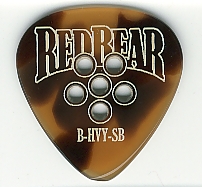
Red Bear Style B Heavy with Speed Bevel

Red Bear Style B Heavy with Speed Bevel

Does a pick really make a difference? For years, I’ve read about guitarists using custom picks made from tortoise shell or other special materials, seen all the ads from handmade pick manufacturers, and eschewed even the thought of getting one of them because I just couldn’t justify spending up to $40 for a freakin’ guitar pick! For instance, when I’d see an ad for one of these, I’d ask myself, Who in their right f’-in mind would get one of these? It’s just a gimmick – it’s all bull! It don’t make a damn bit of difference.

I couldn’t be more wrong. Playing with a great, handmade pick makes a difference; a HUGE difference in how you play and how you sound.

For the last 30 years, I’ve been using medium Dunlop Tortex picks – the orange ones. They’re cheap, and they get the job done. They’re strewn all over my studio, in my pockets, in my laundry – all over the place. And I don’t care if they break, scratch or if I lose them. They’re replaceable and of little consequence. Not any longer. Once I started playing with a Red Bear pick, I’m never going back to cheap picks unless it’s absolutely necessary (for instance, if I happen to break a good pick and need to get another).

So what’s the story? A good friend of mine was so very kind, and gave me a gift certificate for Christmas to a great guitar store in Palo Alto, CA called Gryphon Stringed Instruments. It’s a shop that specializes in acoustic guitars, but has all sorts of stuff, like parts. It just so happened that I needed to replace the pickup selector switch on my Epiphone Explorer, and as luck would have it, Gryphon had the switch in stock – what better way to spend at least part of my gift certificate?!! So I drove down to Gryphon, got the switch, then started looking at other stuff to spend on my gift certificate.

I got a few packs of strings for both electric and acoustic, and started looking at picks. It then occurred to me that they might have handmade picks. So I asked the fellow behind the counter if they had any, and he said they carried Red Bear picks. Then I asked the operative question, “I’ve read about handmade picks in the guitar rags, but like most people, don’t see what’s so special about them. So what’s so special?” He simply replied, “Once you play with a great pick, you won’t want to play with the cheap ones any longer. It’s hard to explain. They feel so much better, and you just play better with a great pick.”

Folks, that wasn’t a selling job. The look on the guy’s face said it all. But still, I was a bit incredulous, and he must’ve seen the look of disbelief on my face, so he said, “You’re welcome to try one out on any of our guitars. You’ll see the difference.” So I picked out a shape and bevel that I liked, grabbed mid-range Martin off the rack, sat down on a stool, and went through an instant transformation to complete and utter bliss! The pick felt so great in my fingers, and it glided smoothly over the strings. The sound that was produced was so milky smooth, I couldn’t believe my ears!

I thought it had a lot to do with the guitar – it was a nice one. But, being the good guitar gear tester and gear freakomaniac, I always have picks in my pocket, so I did an A/B test. With my standard Tortex, the guitar still sounded good, but not nearly as good with the Red Bear striking its strings. It was uncanny, to say the least! I was dumbfounded, and completely awestruck that a pick – a pick, for God’s sake – could make a guitar sound so good! I must’ve been grinning when I returned to the counter because the guy just said, “See what I mean?” I replied, “Oh yeah… I knew this was something special when strummed with the pick the first time. And doing those lead riffs was effortless.” The sales guy just grinned…

Needless to say, I had to have one, so I bought two, at $20 apiece. It was so well worth it! I had a gig last night and was able to use my new Red Bear, and was in heaven ALL NIGHT LONG! I was so enamored with how my acoustic sounded, that I played as many songs as I could with the pick, and played with the pick on songs I’d normally fingerpick.

So let me attempt to describe what it’s like to play with a great pick. First of all, it just feels great. It doesn’t slip. Next, handmade picks are thick. They don’t flex at all, but they glide over the strings so easily that it makes it easy to play – almost too easy. And because of their thickness, they force you to hold them lightly, and the expression you can get in your playing dynamics by holding the pick looser or tighter is nothing short of amazing. A great pick also makes the strings ring much better.

But the most important thing is that all those things together make it inspiring to play, bringing you into that other-worldly state of pure expression. It’s amazing that a pick can do that, but I’m now a believer. I won’t be going back to cheap picks – EVER.

Check out the Red Bear site for more information!

5 Tone Bones - Gear has stellar performance, value, and quality. This is definitely top of the class, best of breed, and it's a no-brainer to add this to your gear lineup!

Read Full Post »

playing inspiredIn last month’s issue of Guitar Player, Steve Cropper was spotlighted. Cropper was a great session guitarist for Stax records who wrote and played with the likes Otis Redding, and was arguably one of the great guitarists responsible for establishing the 60’s era soul sound. In the interview, he was asked what advice he’d give to aspiring rhythm guitarists. His reply was both amusing and incredibly insightful (I’m paraphrasing): “Pick the prettiest girl in the front row, look right at her, and play to her.”

On the surface, that may sound a little chauvinistic, but there’s an incredible amount of truth in that. As performers is to, well, perform. No matter how we perform, it’s always an outward facing activity. And from my standpoint, there’s nothing better at inspiring me to create on the than when I’m playing for someone, and shape my playing to describe what emotions are stirred by the thought of the person for whom I’m playing.

Mind you, it’s not a sexual thing. It’s about playing against the images that crop up when you look at someone. For instance, the restaurant that I play at every week is a nice, family-oriented restaurant. During my set, parents will bring their children to where I’m playing, to show their kids the “music man.” Seeing the smiles and faces full of wonderment is really inspiring to me, especially as I’m a father myself (of eight kids!), and I almost always change the way I’m playing when kids come to see me play. I’ll even do special kids songs just for them at times, and let them strum my guitar.

The point to all this is that when you’re playing inspired, you draw your audience in. As a performer, there’s nothing worse to me than being mechanical. The music comes out dry and worse yet, seemingly contrived. And people pick up on that. But play inspired, and you take your audience on your emotional journey.

So take Steve Cropper’s advice, and find someone in your audience who’ll inspire you. I guarantee you’ll like the results!

Read Full Post »

Reason Amps SM25 25 Watt Combo Amp

Reason Amps SM25 25 Watt Combo Amp

Reason SM25 25 Watt Combo Amp

Summary: Incredibly expressive and versatile amp that can deliver a wide range of tones from glassy, sparkly cleans, to lewd, rude, and crude distortion, all in a single cabinet!

Pros: Killer tones in all channels. Amp is voiced bright by design, which makes it great to use in the studio. StackModeTM is the best thing since sliced bread, and is THE secret sauce that makes Reason Amps stand out from the rest.

Cons: No effects loop, which would be handy for placing reverb and other modulation effects after the amplified signal. Just a nit.

Price: $2395

Specs:
• Output: 25 watts RMS @ 5% THD
• 1 X 12 Eminence Red Coat Driver
• (2) 6V6 output tubes, in Class AB Fixed Biased configuration
• (4) 12ax7 preamp tubes
• GZ34 Rectifier tube
• 3 way Stack switch – Normal, Stack, Bright
• Normal channel – Volume, Treble, Middle, Bass
• Bright channel – Volume, Tone
• StackMode™ – Bright & Normal channel controls are active, Stack Volume & Hi-Cut
• Oversized extra capacity power supply
• Power Switch
• Standby Switch
• Independent output jacks for 4,8, 16-Ohm operation
• Footswitch access to all three channels/modes

When I discovered the Reason Amplifier company a few weeks ago, I was so intrigued by what they had to offer that I immediately contacted them. I had the fortune of getting in touch with Anthony Bonadio, one of the founders of Reason to talk to him about his exciting new company and his new line of amps. That conversation led to him sending me an SM25 25 Watt combo to review; and since I’ve had it, I haven’t gotten much sleep from playing with it late into the night. Now you might say that I’m just excited about playing a new amp. Yes, that certainly has a lot to do with it. But what Reason has come up with in their amplifiers is so incredibly brilliant and unique that I’ve been spending all my free time trying to discover the subtle intricacies of this tone machine. There’s a lot to talk about, so let’s get started!

“Dahr-ling, you look mahvelous!”

The Reason founders, Anthony Bonadio and Obeid Kahn, are both vintage gear freak-o-maniacs, and the retro styling of the entire Reason amp line is a testament to that passion. The SM25 sports a black tolex cabinet with light brown trim around the grille cloth, and a thick leather handle with what appears to be brass accoutrements. Between the control surface and grill cloth is a prominent tolex-covered cross board sporting the Reason logo which, by the way, is very cool, very retro as well. The control board looks like burnished brass with black, bold lettering for labels. And to add to that retro vibe, chicken head knobs are used for all the controls. This amp, and all Reason amps for that matter, just ooze vintage mojo. Just looking at the amp, I can’t help but grin that grin you get when you see something so far-out COOL!

It’a hard to discern the actual size of the amp from just a picture. So make no mistake about its size: This is not a diminutive 25 Watt amp. In fact, it’s about as big as a Fender Twin, though not as deep. The shipping weight said 32 pounds, but from feel and comparison to my Fender Hot Rod, it weighs almost as much. But that’s not a bad thing. A beefy cabinet creates a lot of resonance if done correctly, and believe me, it’s done correctly with this amp.

How It Sounds

All Reason amps, including the SM25 are voiced bright. You don’t get beefy lows out of this, and that’s by design. Now before you dismiss that, on stage and in the studio, that bright voicing will ensure your guitar cuts through the mix. I recently played it at one of my regular gigs, and where my amp oftentimes gets lost in the mix, forcing me to pump up my volume, I had no problem cutting through, and mind you, I barely had to push my volume. The bright voicing let my guitar tone sit in the mids and highs. My sound guy even commented on how well he could hear my guitar without me pushing the volume like I usually do during a solo break; though admittedly, like any lead guitarist, I usually don’t mind being louder than everyone else. 🙂

In the studio, using the amp for recording is like being in heaven. The bright voicing combined with the rich tones the amp produces is simply candy for the ears. From a practical perspective, brightly voiced amps also record much better. For home recording I’ve had to stop using my big amp because it’s just too boomy, no matter how I set the EQ. I’ve had to use smaller, brighter amps because they cut through a mix much better. But since I’ve had the SM25, I’ve recorded two songs with it, and like I said, I’m in heaven. I now have a bright voice to cut through the mix, but rich tones as well. It’s the best of both worlds!

The SM25 is also incredibly touch-sensitive and responsive to the subtlest manipulations I made on my guitar. In fact, when I first started playing with it, I was a bit embarrassed by how I sounded. For my all my tests, I played along to some jam tracks I’ve produced for practicing different styles, and recorded what I played through the amp. When I played back what I had recorded, I was appalled at how crappy I sounded! All my mistakes came through! I couldn’t hide whatever bad habits or bad technique I had behind effects, like I normally would. In short, this amp has forced me to play better because it’s so unforgiving when you make a mistake. But hey! It’s never a bad thing to be shown your weaknesses. That’s how you grow and improve!

Multiple channels, lots of tone shaping possibilities…

The SM25 comes with two channels: Normal and Bright. But it also sports a third “channel” called StackModeTM that’s essentially the Normal and Bright channels run in a series with an extra gain stage, while retaining volume and tonal control over the Normal and Bright channels. To me, StackMode is Reason’s secret sauce, but I’ll get into that in a bit. I’ll first describe the independent channels.

The Normal channel sports a volume knob and a three-band EQ. The volume knob is also a push-pull knob, and pulling it out adds some extra high-freq boost to bring out the super high frequencies. The effect is that once you set up your EQ, pulling out the knob adds some extra high-freq shimmer and sparkle. It’s subtle, but absolutely delicious. Comparatively speaking, the Normal channel sounds like your classic, jangly American clean tone, but with the high-freq boost, you get a bit of the sharpness of the British clean – nice.

The Bright channel is well, bright. It too has a push-pull volume knob for extra high-freq boost, and it has a single tone knob to back off some of the brightness. The Bright channel is also the more “ballsy” of the two, and really kicks in some pretty high gain. It’s quite lovely, in my opinion, and it’s perfect for doing the traditional solo break that will cut right through a mix with ease.

Channels? We don’t need no stickin’ channels!

But for me, the real attraction of this amp, and actually any amp from Reason for that matter, is StackModeTM. In all my years of playing, I’ve never come across anything quite like it. On the surface, you might think this is just another channel on a multichannel amp. It is in a way, because of its independent gain stage. But that’s about as close a comparison that you can make to other multichannel amps. Unlike other multichannel amps where all the channels are independent, StackModeTM input doesn’t come directly from the guitar. The guitar’s signal is routed through the Normal and Bright channels first, then fed into the StackMode channel. And the volume and EQ settings on the Normal and Bright channels are still active!

Because volume and EQ are retained in the Normal and Bright channels in StackModeTM, the tone shaping possiblities are incredible. What you adjust in Normal or Bright affects the final output. You can crank up the volumes on the first two channels and achieve uber gain, with thick, rich distortion. Or you can dial it back a bit and take a more balanced approach. The point is that you can do a lot of tone shaping to your needs while in StackModeTM. And here’s the kicker: The amp still retains its touch and guitar volume sensitivity in StackModeTM.

What does this mean? Well, I soon discovered that StackModeTM was the only channel I’d probably ever use, unless I had to go super clean, whereas I’d just switch to the Normal channel. The amp in StackModeTM is so responsive to picking attack and volume knob levels that I found I just didn’t need to do any channel switching at all once I dialed in my settings for the Normal and Bright channels. It’s that good!

One other thing, the volume knob on the StackModeTM channel is a very good Master volume. When I’m playing late at night, I can turn the volume down on the StackModeTM channel, and still retain the characteristics of the settings I made in the first two channels. It’s just softer. How cool is that? So that’s why entitled this section, “Channels? We don’t need no stinkin’ channels.” Once you have your settings dialed into StackModeTM, you’ll never want to get out of it! So for me, the SM25 is effectively a single channel amp with adjustable stages.

My Tests

In any case, for my tests, I used four different guitars: A Strat, a PRS SE Soapbar II with P-90’s, an Epiphone Korina Explorer and a Saint Guitars Benchmark, both with humbuckers. I’ll talk about how each guitar sounds separately below.

Fender Strat

Obeid Kahn is known in the industry as a “Strat man,” and this amp really sounds great with a Strat. I’ve got the vintage re-issue Tex Mex pickups in mine, and slathering on reverb, you can get some awesome Dick Dale-like tones. But it doesn’t necessarily sound like a Fender amp. In fact, the clean tone is like a cross between a Fender and a Marshall. It’s creamy smooth, but bright and sparkly at the same time. The big cabinet adds to the resonance, and the ever so slight voltage sag that you get from the rectifier adds to the sustain and resonance. This is boon when you’re playing with a Strat because they do not sustain well at all. I could get country twang to hard-driving distortion with uber sustain with my Strat.

PRS SE Soapbar II

P-90’s are hot pickups by nature, and it doesn’t take much to push any amp into overdrive, and when it does this, it’s a preamp overdrive lover’s wet dream! With the SM25, the 12AX7’s just sing with sweet, smooth overdrive goodness. There’s nothing harsh about the sound this produces in the SM25, but one thing I did notice with the tone was that unlike other amps I’ve played with my SE Soapbar II, even though the amp is bright, the sound the amp produces with it is big and bold, without being boomy. It’s crystal clear, and doesn’t wash out the higher notes in a barre chord, which often happens with more boomy amps. All in all, I just dug that halfway between single coils and humbucker sound my P-90’s produced with the SM25.

Epiphone Korina Explorer

This is a real rock guitar, with a warm ballsy tone. Plugged into the SM25, I was amazed at how the amp responded to this guitar, and I was able to spew out some thick distortion and singing sustain with the volume knobs on the amp dimed to the hilt. I’m not a metal player, and technically, with the bright voicing of the Reason amps one wouldn’t think they’d be suitable for metal, but the lewd, rude, and crude drive I could produce with the Explorer plugged into the SM25 was scary! But in a good way. And when I scooped the EQ, yikes!

Saint Guitars Benchmark

Of all the guitars I used for testing the SM25, the amp seemed to love the Benchmark the most. This guitar was spec’d with Blues and Classic Rock in mind, and through the SM25, I’ve never heard it sing like this. I could go from deep, dreamy clean to rabid dog distortion, and the whole time, the SM25 maintained a tonal clarity and character; never muddying or washing out. It was other-worldly, to say the least.

Made for the Road and the Studio

Anthony Bonadio cautioned me during a previous conversation that he didn’t want to alienate people from buying the amps when he said, “Our amps are really intended for the gigging and session musician.” In other words, Reason amps aren’t really meant for the bedroom musician. These amps want to move air, and that’s no exception with the SM25. In fact, when cranked, it’s a hell of a lot louder than my 40 Watt Fender Hot Rod Deluxe, and that’s a loud amp! It just wants to project its voice. Premier Guitar even gave its bigger brother, the SM50, its “Loud as Hell” award. But in my opinion, the real test of an amp is how good it sounds throughout its entire range of volume. That’s a mark of versatility, and in spite of what Anthony claims is the focus of Reason’s line of amps, you actually can play these amps at bedroom levels and still produce kick-ass tone!

A lot of amps don’t sound good unless they’re cranked, but at lower volumes they just peter out and lose their character. But at least with my experience with the SM25, it sounds great at ANY volume. Considering that all Reason amps are built around the exact same circuitry, I can safely say that this probably applies to the entire line. So don’t be fooled by the “loud as hell” moniker. These amps are incredibly versatile amps that are comfortable be played in lots of different venues under a variety of conditions.

My Overall Take

I think you can guess that I just love the SM25. For a musician like me who plays small to medium venues, and whose studio is located in a carpeted garage, this amp is a dream come true. It’s expressive with all my guitars, and it’s so versatile that I can use it wherever I play.

As I shared with Anthony recently, StackModeTM is it for me. It’s the secret sauce that sets Reason amplifiers apart from the competition! For more information, go to the Reason Amps web site. And if your local dealer has some in stock, I encourage you to go there and play around with one. You will not be disappointed; in fact, you’ll be blown away!

Read Full Post »

« Newer Posts - Older Posts »