Feeds:
Posts
Comments

Archive for the ‘guitar’ Category

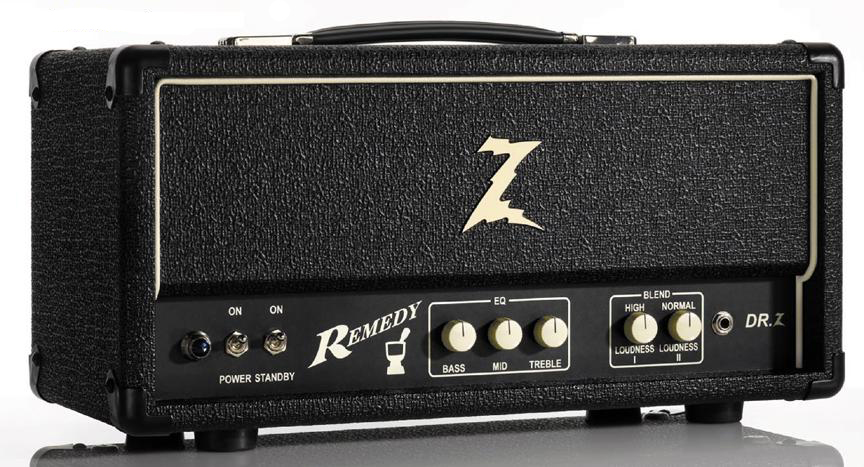
REMIn yesterday’s little adventure at Guitar Player Magazine, I got a chance to play the new Dr. Z Remedy amplifier. This amp is based upon a classic Marshall JTM circuit design, but with a twist: Instead of 4 inputs that allow you to jumper the two channels, the Remedy has a single input and the channels are already jumpered. You then have the ability to blend the amount of high and normal channel amounts via the two loudness knobs.

This amp is a lesson in simplicity. It has a three-band EQ, and the volume knobs for the High and Normal channels, plus Power On/Off and Standby toggles. That’s it. With this amp, you dial in your tone and sound levels, and play!

The amp is powered by a quad set of 6V6’s, and man they sound sweet! The power tubes are JJ’s which have kind of a “hybrid” 6V6 tone – I use these myself, and I love them. They’re brighter-sounding than the classic 6V6, and they’re extremely durable. I’ve never had one of these fail on any of my 6V6 amps, so it’s not a surprise Dr. Z uses the JJ’s for their reliability.

How It Sounds…

In a word, it sounds “big.” A lot bigger than I expected from just a 40 Watt amp. I played a Gibson ’59 Les Paul Special Re-issue through it and was really taken by the big sound that the Remedy produces. For classic rock and blues tones, this is an ideal amp. It responds incredibly well to picking dynamics and volume knob adjustments as well, which is why I mentioned you set your EQ and volume where you want it, then play. You can then adjust the cleanliness or dirtiness with your volume knob or attack. Very cool. You might dismiss the Remedy as another JTM clone as the circuitry is based upon that. But it has a sound all its own. The cleans are lush and defined, and the overdrive is nice and crunchy, and very little to no top-end raspiness. I think that’s an earmark of the 6V6’s. They just don’t get fizzy.

A Great Half-Power Mode

I played around with the half-power switch a couple of times, and it works as expected. But I wanted to find out more about how Dr. Z does his half power mode, so I gave him a call this morning, and found out some interesting things about how he does his half-power mode – very interesting things, indeed. There are a couple of ways I’m familiar with that amp manufacturers introduce half-power modes in their amps. A common way is to shut down half a tube, essentially going from pentode to triode. According to amp builders I’ve spoken with, this is the easiest, but it also changes the tone significantly between the two modes.

The second common way is to adjust the B+ voltage down, then provide some compensation so the correct heater voltages are maintained. This is what Jeff Aragaki does with his amps, and this technique is very transparent.

Dr Z. takes a completely different approach and leaves the front-end alone entirely, and works his magic from the power transformer, something he worked with the late Ken Fisher to produce. I won’t go into details – and Dr. Z didn’t go into a great deal of depth – but he effectively bypasses the power from two of the power tubes then does some other stuff to compensate for the impedance mismatch to half the power. The end result is a very tonally transparent switch from full power to half power, using a method no one else is using; at least according to Dr. Z.

I love stuff like this! I’m no electronics guy, but I love it when people think out of the box to handle common problems, and come up with approaches that no one else thought of, or didn’t try because they thought it was too hard! Kudos to Dr. Z for doing something like this!

I truly wish I had more time to spend with it so I could explore the amp’s capabilities more. Perhaps in the near future I’ll get that chance.

Read Full Post »

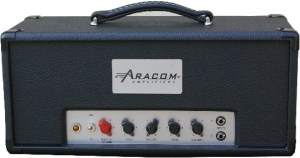
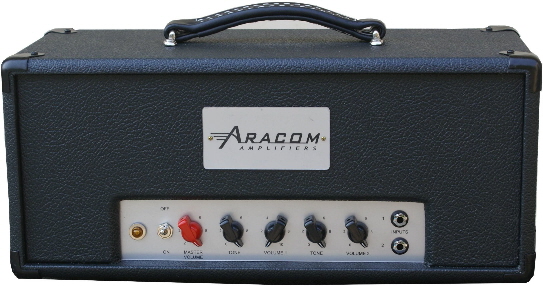
Just put in a re-labeled 1960’s-era Mullard ECC83 into my Aracom VRX22 this afternoon. I had a JJ 12AX7 in there, and make no bones about it; that’s a great pre-amp tube. But the difference in tone between the two is immense. Where my JJ had a great tone, one thing that I noticed was that the highs tended to be rather harsh when the tube was overdrive, and I found myself turning my Tone knob left of center – a lot – to bleed off some of the highs.

But after I installed the Mullard, I was absolutely blown away! The overdrive seemed so much more focused, with zero high-end harshness. It was some of the smoothest overdrive I’ve heard, and definitely the smoothest the VRX22 has sounded since I got it. That’s saying quite a bit because I love the tone of this amp immensely, even without the NOS Mullard. Which brings me to the crux of this entry…

As a tube amp aficionado, I’ve gone through lots of pre-amp tubes, and almost invariably, I’ve gravitated towards NOS tubes to get the tone I like. Some people I’ve spoken to say it’s all hype but, at least to me, it’s not. I suppose for some types of tubes, there’s not much of a difference. For instance, I almost invariably use JJ’s for power tubes because they just sound great to me. They’re well-made, and run pretty hot, and they break up nicely.

But with respect to pre-amp tubes, I’ve found a marked difference between NOS and new tubes. I love Mullard and JAN Phillips tubes for pre-amp tubes. They’re just so smooth sounding, smoother than all the new make tubes I’ve played. Plus, they were made during a time when most electronic devices were run with tubes, so the build expertise, equipment and materials for making tubes was abundant. According to my friend Jeff Aragaki of Aracom Amps, the alloys used in NOS tubes are not as readily available nowadays, and that could account for the difference in tone. Not sure if this is true, but it certainly makes sense. The only drawback is the price. That Mullard sells for $129 retail, and that is by no means inexpensive.

But I look at buying NOS tubes very much like buying a great pair of shoes. For instance, I spend almost $200 a pair for my everyday shoes. These are absolutely comfortable, and not only that they last a long time because they’re constructed so well. In fact, it takes me about 4-5 years to really wear them out. This in contrast to lower priced shoes that I’ve worn out within a few months. After a long period of time, I’ll spend more on the cheap shoes. A better case is my father. His shoes cost at least $500. But they last almost 20 years! He just gets them resoled every few years until the shoe repair guy says that it’s not worth it.

NOS tubes are similar. I’ve had the same NOS tubes in my Hot Rod Deluxe for almost five years, and they still sound great! I play that amp a lot. On the other hand, the new Tung-Sol tubes I put in another amp lasted all of two months before they started to lose their character, with one becoming microphonic. Granted, they’re fairly inexpensive tubes and they sound great, but if I have to shell out $25 every couple of months, that starts to add up. NOS tubes, especially the mil-spec tubes that I prefer were made for military usage, which means they had to be well-built and durable. That’s a huge advantage NOS tubes have over newer tubes.

Jeff also shared a story with me today about a friend of his who used to be stationed on an aircraft carrier. He was telling Jeff that when the ship replaced electronic components, they’d dump boxes of tubes – good ones, mind you – over the side of the ship. So the ocean has NOS tubes littering its bottom.

In any case, please do not just take me at my word! 🙂 This is simply my perception based upon my experience. In the end, as I am often apt to mention, you’re judge of what sounds pleasing to you. So only buy what makes sense to you!

Read Full Post »

Aracom Amps VRX18 18 Watt Head

Aracom Amps VRX18 18 Watt Head

I’m falling in love again with my Aracom VRX18. This was the amp that first got me introduced to Aracom and my good friend Jeff Aragaki. My amp is actually a tweaked version of the stock VRX18 as it sports an EZ81 tube rectifier, plus a tweaked circuit that adds a bit more sag and sustain. The result is just a gorgeous overdriven tone that really brings out the best of the EL84 power tubes.

One thing about EL84 amps is that if they’re done right, they have a distinctive overdrive tone that creates a subtle top-end fizz when they’re overdriven. I’ve played others that drive the power tubes too much, and they sound very harsh and incredibly compressed. Jeff did this amp right, and while the power tubes do indeed compress a bit, the overdrive tone retains its open character, while adding that nice top-end fizziness that EL84 amp lovers have come to appreciate.

The clip below is an excerpt from a slow blues song I wrote. It features my beloved Goldie plugged straight into the Aracom VRX18, and it also features the insane Aracom PRX150-Pro attenuator! Believe it or not, the amp was recorded at just above loud conversation levels! We’re talking less than 1/10 of a Watt, and the amp still retains its tone and dynamics! Anyway, here’s the clip:

Read Full Post »

4.75 Tone Bones - Almost perfect but not quitevoxac4tv VOX AC4TV Amplifier


Summary: For what it brings to the table, this is a great little amp. While it’s mainly touted as a practice amp, you can easily gig with this at small venues, or attach an external cab to it, and you could easily keep up with a drummer!

Pros: Classic VOX ACx cleans, and nice, warm overdrive via the Class A EL4 power section.

Cons: 1/4 Watt setting really narrows the bandwidth. The amp sounds pretty lifeless at this level, but that’s why I have a great attenuator. I would play this at 4 Watts all the time. No need to ever use the built-in attenuator.

Features:

  • Controls: Tone, Volume, OP Level (4W, 1W, ¼ W)
  • In/Out Jacks: Input, External Speaker Jack (¼’)
  • Output: 4 Watt RMS 16-Ohm
  • Speakers: AC4TV – 1 x 10″ 16-Ohm Celestion VX10 custom speaker;
  • Valve/Tube Complement: 1 x 12AX7 (pre) / 1 x EL84 (power)
  • AC4TV Dimensions: 13.78″ (W) x 8.46″ (D) x 14.76″ (H);
  • AC4TV Weight: 19.84 lbs.;
  • Power cable included

Price: ~$249 street

Tone Bone Score: 4.75 – I was very surprised by this little amp. The 10″ Celestion speaker really packs a nice punch, and the controls are dead simple. I would easily add this to my growing stable of amps!

I’ve been on this low wattage amp craze for awhile, and it’s wonderful to see all these great low wattage amps entering the market! Orange has the Tiny Terror, and VOX also has the Night Train. Those amps just mentioned are all pretty much modern styling, but I should qualify my craze. I love the old vintage styled low wattage amps.

It all started out with the Fender Champ 600, which I reviewed awhile ago here. I was looking for a low wattage tube amp that I could get some serious overdrive tone from without making my ears bleed. I immediately fell in love with that amp, and since I’ve had it have only made some minor changes, like putting in NOS tubes. But other than that, this amp has served me quite well, both in the studio and even in small venue gigs (using a 1 X 12 of course).

So it was a very nice surprise to encounter the VOX AC4TV in a store yesterday. This is a sweet looking little amp, with the classic TV type of box harkening back to yesteryear. The blonde vinyl is a very nice touch!

How it sounds…

The AC4TV is little tone monster. This single-ended amp packs quite a punch, despite its diminutive size and 10″ speaker. Surprisingly great tones are to be had with this amp, from your classic VOX EL84 cleans to some very nice crunch and grind when you push it. As a single-ended amp, it’s simple as expected, just a volume and tone knob, plus a selector switch for choosing 4, 1 and 1/4 watt output.

At 4 Watts, the amp puts out a great clean tone. With a Strat it starts mildly breaking up at about noon on the volume knob, and at about 10 o’clock with a humbucker – for that, I used a gorgeous sunburst finish Gibby ES-335 – damn I wish I hadn’t sold mine! Cleans with the ES-335 were incredibly lush as expected from that semi-hollowbody, yet they were also very chimey due to the natural character of the EL84 power tubes. It was a very good combination!

Going into grind, you get that classic EL84 crunch, but it’s obvious VOX must’ve installed a filter cap to prevent the power tubes from over-saturating and creating a compressed, squishy mush. The overdrive remains nice and open, with great dynamics and touch sensitivity.

At 1 Watt, the amp still retains a very nice tone, though the tone bandwidth is slightly narrowed. It’s not bad at all, and at this power setting you can crank the amp up (but keep in mind that sonically, 1 Watt is still pretty loud), but the volume will be fairly reasonable.

The 1/4 Watt setting was not really pleasing at all, though in a pinch, if you really have to be quiet, it’ll do as a reference point for practicing. At this setting, the tone gets muddy and the dynamics are abysmal. Were I to get one of these, I’d get the head and cabinet version so I could use a proper attenuator with this, and keep the amp in its 4 Watt mode to get all the gorgeous tones that the full power setting has to offer.

I any case folks, this is classic VOX tone. The EL84 are bright and chimey as expected, and when pushed, the amp doesn’t produce over-the-top overdrive. It’s nicely controlled and surprisingly smooth.

Overall Impressions

The rating says it all. I love the tones that this amp produces, and I love that classic blonde look. At a street price of $249, it’s a very nicely priced amp to boot! You can use this for practice or, with an external cab, there’s no reason it will not fit right in at a small venue gig. The custom power transformer has a lot to do with the power handling here, and it helps the amp produce a big voice for such a small package. Definitely a thumbs up for the VOX AC4TV!

Here’s a great demo video of the AC4TV from VOX:

Read Full Post »

Aracom Amps VRX18 18 Watt Head

This morning, the guy who’s painting my house came into my garage/studio to ask me a question, and being a guitar player himself said, “Dude… you have a great setup.” So the conversation turned to my favorite topic, and of course, that involves talking about guitar gear. 🙂 During the course of our discussion he talked about how he loves Vox amps, and so I demonstrated my Aracom VRX18, which is actually based upon a classic Marshall 18 Plexi, but it had EL84’s. I wanted to give him a reference tone. He just smiled and said, “That’s yummy.”

He had to get back to work, but after not playing that amp for awhile (probably a couple of months), I forgot how much I love its tone. My VRX18 is quite special in that it’s a custom VRX18 that has a tube rectifier, which is an option when you get one of the VRX series amps. Jeff has it tweaked quite nicely, and the amp has tons of sustain, and gorgeous sag without getting mushy and compressed when driven. That’s probably a reason why I haven’t really used EL84 amps that much. My experience has been that they compress a lot when they’re driven hard.

But not this one… Jeff also adjusted the extra gain channel so it wouldn’t compress the power tubes too much. You get lots of dirt, but you maintain the clarity of your notes. This is a great little amp! In any case, I recorded a clip where I have the Master at 3 o’clock, and the Volume at 2 o’clock. That produces some serious grind, but as you’ll hear in the clip, there’s very little compression.

The drive tone the VRX18 produces is absolutely magnificent! When I recorded the clip, I couldn’t believe all the overtones and subtle harmonics that the amp was producing! Jeff really got the tone nailed with this amp!

In addition to the amp, I played through Goldie, running her straight into the amp, then through the insanely transparent PRX150-Pro attenuator set at variable attenuation mode at about 3 o’clock, then into a custom Aracom 1 X 12. Output volume was just yelling level. 🙂

Here’s a list of the Aracom VRX18’s features as a review:

– Channel 1: Volume and Tone Controls
– Channel 2: Volume and Tone Controls
– Master Volume Control (PPIMV)
– On/Off Switch
– Indicator Lamp
– Hi/Low B+ voltage switch (18/9 watts)
– (2) EL84 Power Tubes
– (2) 12AX7 & (1) 12AT7 Preamp Tubes
– Cathode Biased Power Tubes
– S.S. Rectifier with “sag” circuit
* EZ81 Tube Rectifier – Optional
– Custom Heavy Duty Aluminum Chassis
– Custom “Black” Plexi Front and Back Panels
– ARACOM Power Transformer: hand-wound and interleaved
– ARACOM Output Transformer: hand-wound, interleaved on a paper bobbin
– 4, 8, 16 ohm Speaker Jacks
– Detachable Power Cord (IEC320-C13 Socket)
– External Fuse Holder
– Custom Turret Board (G-10/FR4 Flame Resistant)
– Handwired and Handcrafted in the USA.

This little tone beast is such a value as well! At $895 for the head, it’s an absolute steal, and a real hidden gem in the boutique market, as is the VRX22, which is based on 6V6’s.

For more information, go to the Aracom VRX18 page!

Read Full Post »

Last Friday before I left for work, I went to my garage/studio to fetch my trusty acoustic guitar for my weekly solo acoustic gig, and I couldn’t find it! After a bit of searching, I finally found my guitar – buried under a pile of stuff my wife had taken out of her van! OMG! I unpiled the stuff rather unceremoniously, picked up my gig bag, opened it up, and pulled out my acoustic. Upon initial inspection, nothing seemed amiss. But when I strummed a chord, I could hear a slight buzz issuing from inside the guitar. I shook it to see if something was loose, but nothing rattled inside the body, which led me to believe that the weight of the stuff on the top of my guitar was sufficient enough to loosen up the glue to one of the bracing spans. That’s fixable. I could live with the buzzing if it didn’t show up when I plugged in the guitar. So much for my rationale. The buzzing was even worse when I plugged it in, as the vibrations from the top were transmitted to the under-the-saddle pickup.

Surprisingly enough, I didn’t freak or get pissed off at my wife, partially because the fault was mine for placing it in an area where that could happen. But I had a gig that night, and I had to figure out something – and fast! To make a long story short, I ended up buying what has turned out to be a surprisingly versatile value-priced guitar from Fender, the Stratacoustic Deluxe. I recently wrote a review of this guitar, so I won’t go into details. But after I bought it, the thought occurred to me…

Is it really a case of GAS, when you have an obvious need?

Part of me says that I just acquired more gear, so it’s technically GAS. But the other part of me says that I was replacing a critical component, so it’s not GAS.

In any case, I’m very satisfied, but thought I try to get some feedback. Your thoughts?

Read Full Post »

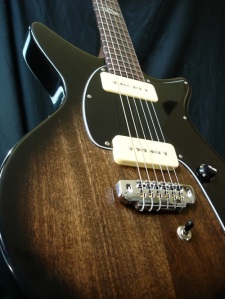
Vintage10-2-09 003A few days ago, I announced the new Vintage Series model from Saint Guitar Company. At the time, Adam sent me pictures, but few details, so there wasn’t much to report on. However, I’ve since spoken with Adam, and was able to get some juicy details on this guitar and his vision for the Vintage Series.
  • This first guitar sports a solid mahogany body and neck.
  • The pickups are Seymour Duncan Vintage p-90 Soapbars.
  • Rosewood fretboard with Saint Logo on the 12th fret.
  • Volume and Tone knobs, and a Three-way pickup selector switch.
  • Dark burst finish (natural stain to black)
  • Custom, flush pick guard.

Here’s the best thing about this guitar: It will range in price between $1300 and $2300, significantly less than Adam’s Benchmark and Messenger models which start at $3300 and go up from there. That in no way means lower quality. Said Adam of the price, “I still make the guitars by hand with custom templates and jigs, but the difference is the flat top. Because I don’t have to shape a carved top, the guitar is a lot less labor-intensive to build. Also the dark burst finish is a lot less time-consuming as well. So because I’m saving on time and labor, I want to pass that savings on to my customers.”

Since I already have a Saint Guitar, I know this will be special. I should be getting a test drive of this baby in the next few weeks. I’ll keep you posted!

Read Full Post »

blackie Fridays are solo gig days for me where I play at a restaurant doing a variety of tunes on both piano and guitar from the Beatles to Puccini (opera, that is). My shtick has been the ability to perform a variety of styles and genres of music, and for the classic rock, folk and country stuff I do, the guitar has been an integral part of my act.

As you might now, if you’ve been to my rig page, you’ll see that my acoustic has been an Ovation Celebrity Elite. I’ve been playing that guitar pretty much continuously for the past 16 years. That guitar’s been on the road with me and in the studio, and has always had a special place in my heart… until yesterday…

I won’t go into the particular details about exactly what happened to “Sunset,” but suffice it to say that she got a crack somewhere under her top that didn’t have a bad effect with her unplugged, but became very magnified once I plugged her in. Not good. I found her in this state yesterday morning (Friday), and while I didn’t freak, I knew I had to solve the problem! So I called the wife to explain the situation, and since I had to own up to putting the guitar in a place where she could get a crack – however inadvertently – I shared that I’d pay half for a new guitar out of my gig money.

I wasn’t too hopeful about finding a new guitar yesterday, considering the acoustic guitar store that I was originally going to go to mainly dealt with high-end acoustics; right, big money. But a chance call to B Street Music in San Mateo, CA where I work as I was leaving changed all that. I called them up to see if they carried Ovations, thinking that I’d just replace Sunset with another Ovation, and they said they carried them! Yippee!

Anyway, I got to the shop and started pulling guitars that looked pretty cool off the racks, and lining them up on guitar stands so I could do evals. Among them were a couple of Ovations Celebrities, a Godin (very nice looking), and the Fender Stratacoustic that I ended up buying. Mind you, I wasn’t at all interested in how the guitars sounded unplugged, though I love the Ovation acoustic sound. Since I use practically all my guitars in gigging situations, I really needed a guitar that sounded great plugged in.

As expected, the Ovations performed incredibly well. There’s something that Ovation has down with their electronics. After I tested the Ovations, I plugged in the Stratacoustic – it didn’t work. Luckily, it was just the battery that was out. Once I had it all set up, I took a few minutes to familiarize myself with the guitar. It really didn’t take that long because what I felt I was holding was an acoustic Strat! The Stratacoustic features a shallow acoustic body with a Strat neck, so from a feel standpoint, it felt completely familiar. I closed my eyes and felt as if I was playing my trusty “Pearl!”

The dude at the shop was helpful, and explained that the guitar was equipped with a Tele single coil, and a Fishman acoustic which you could blend with the Blend slider on the control panel; speaking of which, the control panel features independent controls for Bass, Mid, and Treble, a Volume slider, and a Blend slider. It also has a pretty decent built-in tuner. Nice features for sure!

Mind you, I was still a bit dubious of the acoustic sound of the guitar. It was flat and tinny, and was something I’d never play unplugged. Here are the sales guy’s own words, “Don’t be fooled by the acoustic, unplugged sound. It sounds like shit. Just wait till you plug it in. Fender’s done something really special with this guitar.” Yeah, right, I thought. It’s production line Fender after all! But I’ve learned to keep an open mind with respect to new gear.

Anyway, after I got familiarized with the controls, it was time to plug her in. So I plugged her in and WAS IMMEDIATELY FLOORED BY THE TONE! I had the Blend set dead in the middle, with both pickups contributing to the overall sound. Kind of hard to describe what I was hearing but it truly was a mix between an acoustic and electric; rich in mids, and not too much bass, but with a chimey, top-end finish. The Fishman provided a nice, organic acoustic tone, while the ring and chime I was hearing had to be coming from the Tele pickup. I proved that out by isolating each pickup.

I played through it for a couple of more minutes, and then turned to the guy and said, “Sold.” He just smiled… Not because he got a sale, but because he shared that as a Strat player himself, this was a total unsung hero in the shop. I commented that the guitar had a bunch of fingerprints all over it, and there was a tiny, tiny scratch on the top near the bridge, so would he give me a deal for it? And he did! I got the guitar for $499 plus a gig bag and a nice 3.5″ wide leather strap! The guitar normally retails for $629! Was I jazzed or what?

So now I am the proud and exceedingly happy owner of a very weird, but full of Strat mojo guitar, the Stratacoustic!

Gig Report

Of course, as I started today’s story, I had a gig last night. The real test for any device is playing it in a live situation. So how did it do? In a word, FANTASTIC!!! As I mentioned, each pickup contributes to the blend, and even though the guitar sports a Tele pickup, with the Tele pick isolated, the guitar still retains its acoustic qualities. So the gig for me last night was utter heaven! Plugged into my DigiTech Vocalists Live 4 then right into the PA, I was amazed at the incredible tones this guitar produces.

How It Sounds

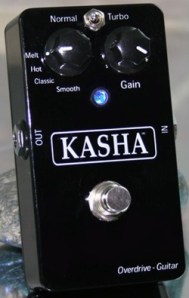
I was going to end this article with my gig report, but I got inspired to record the guitar and provide a clip. This is a short song that I quickly put together that features the Stratacoustic. The left channel is a fingerpicked rhythm. Then in the right channel, I layer the same riff but strumming – it almost sounds like a piano! Nice. I used a light reverb effect on both rhythm parts using my Hardwire reverb. Then I do a solo dead center with the guitar in the Tele position, and playing it through my KASHA Overdrive in the Classic channel to get a real nice, slightly dirty Strat tone. Almost forgot to mention: I played all the parts through a regular amp, my Aracom VRX22! It is absolutely amazing how natural and organic this guitar sounds through a regular amp! I’m in heaven! Anyway here’s the clip:

Excuse the 60Hz hum from the single coil in the solo… 🙂 I wasn’t turned the right way to eliminate it while I played… 🙂 The guitar was recorded through a miked amp! The rhythm sounds are unlike anything I’ve ever heard plugged in! At least to me, it sounds as if I miked the guitar, then added reverb in production. But in reality the guitar was plugged into my board! I just can’t get over the plugged in tone of this guitar! And the Tele pickup is just to die for!

If you’re looking for a stage acoustic that sounds absolutely KILLER plugged in, look no further. You get all the benefits of the feel of a Strat, but in an acoustic, but you can also use this thing as a straight electric as well by just using the Tele pickup! Simply amazing!

Read Full Post »

KASHA KA-ODP-A
I finally got some time to record a couple of clips of the absolutely wonderful KASHA Overdrive tonight, and I am just so blown away by how it sounds! This little box is like having 4 differently voiced amps in a little box! I’m not going to spend too much time praising it because I’ve already done that a couple of time here, so let’s get into the clips, shall we?

The first clip is slow, slow blues clip in Am. The chord progression is actually adapted from one of Chuck D’Aloia’s “Blues With Brains” video lessons. If you’re looking to get more into the blues, I highly recommend this set of lessons. It’s the best $40 bucks you’ll ever spend! In any case, I used the chord progression to test out the KASHA Overdrive, and to practice some of the concepts I learned tonight.

Anyway, there are two parts to the clip. The rhythm part was recorded with the KASHA Overdrive in Smooth with the gain set at 12 o’clock. This acts just like a clean boost, and at 12 o’clock it’s at unity gain. The first part features the Classic “channel,” and the second part features the Hot channel. Give it a listen:

The second clip has no backing track, and features the Melt channel with a simple chord riff. Excuse the sloppy playing, but instead, focus on the articulation of the notes. I had the Gain pushed up to about 3pm, which is almost all the way up. But even at a really high gain setting, you can still hear the individual notes. THIS IS AMAZING! And man, the touch sensitivity in this channel is to die for!

By the way, both clips were played through the clean channel of my Aracom VRX22, and recorded at conversation levels using the incredible Aracom PRX150-Pro attenuator. To me, this is the absolute king of attenuators. Oh! Almost forgot that I used my beloved Goldie to record the clips.

Read Full Post »

OMG!!!

It is totally weird not having a case of GAS right now. Since 2007, when I first started this blog, I’ve been GAS-ing. Not a week would go by without me getting some kind of gear. But since I purchased my KASHA Overdrive a couple of weeks ago, and finally started using it, I haven’t had any serious case of GAS.

Mind you, that doesn’t mean that there’s not gear that I don’t want to get. For instance, I’m still going to get a TC Electronic Nova Repeater, and I’m working on the design of a new amp that I would like to have built for me. But I don’t have that uncontrollable urge to reach into my pocket and pull out my bank card to get some gear. I’m much more calm, and for the first time in a long time, I’m not in a rush to get that other gear.

But I think that’s the disturbing thing. I’ve had this GASeous urge for so long that I’m in kind of unfamiliar territory. F&$k!!! It’s like having nicotine withdrawal symptoms! I’m not used to this. But I can tell you, my bank account is thanking me right now…

Read Full Post »

« Newer Posts - Older Posts »