Feeds:
Posts
Comments

Archive for the ‘guitar’ Category

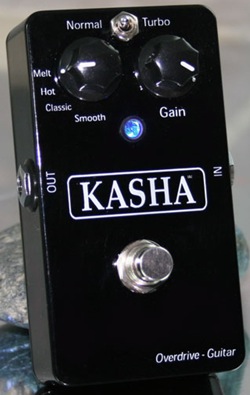
KASHA KA-ODP-A

OMG!!! Just gigged with my brand-new KASHA Overdrive last night, and I was in tonal heaven! Even though I’d done a pretty good test on it in my original review, there’s nothing like using gear in a live situation. So here are my observations:

  • Incredible Dynamics – The one thing that is readily apparent is how this pedal responds to pick attack and volume knob changes. It is so amp-like, it’s uncanny! I set the pedal up in unity gain with just normal strums on my guitar. But if I dug in a bit more, the pedal responded just like an amp with a bit more punch and volume. Frankly, the volume swell surprised the hell out of me. It’s not huge, mind you, but the response is so amp-like, it really does take you by surprise. I totally dug that while gigging last night!
  • Plays Well With Other Overdrive Pedals – I love stacking overdrives, and the KASHA OD performs beautifully in this role. I set it up as a based OD pedal, then stack it with my Tone Freak Effects Abunai 2. Those two together are an awesome combination!
  • Lots of Tonal Variety – While my favorite channel on this is the Classic channel that adds a chimey mote to your tone, I also played in the Hot channel as well, and the grit and grind was super-sweet. But add to that the dynamic response of the pedal, and what you’ve got is a pedal that has a lot of inherent tonal variety. Last night, I ran it mostly through the clean channel of my amp. But later, I screwed around with it a bit more in my studio, with my amp set at the very edge of breakup. This is where the pedal just warms my heart! With its touch sensitivity, when my amp is set up at the edge of breakup, I can take my tone from gritty and grimy to sweet and chimey with just a touch of dirt simply by modifying my attack or adjusting my volume knob.
  • Open Distortion Characteristics – No matter what channel you use with the KASHA Overdrive, the overdrive never gets compressed. It just gets dirtier. The cool thing about that is that any kind of compression will then come from your power tubes. I’ve rarely liked that compression in pedals, save for my Abunai 2, which compresses in a very pleasing way, but for most overdrive pedals, I don’t want that at all, and thankfully, the KASHA Overdrive remains very open, no matter how hot you go on the channels.
  • Simple Design – Probably one of the best features of this pedal that I appreciate is its straight-forward design. Notice that it doesn’t have an EQ control. It doesn’t need it. It takes your signal, adds a voice to it, and that’s it! Set your EQ on your guitar and/or amp to where you want it, then set the gain knob on the pedal, and just play. What could be more simple?

All in all, I’m pretty much done with my search for an overdrive pedal. I knew it from the first time I played this; and combined with my other OD’s, I can pretty much say – at least for quite awhile – I’m set in the overdrive department!

I’m an overdrive pedal freak, and I can safely say that this is the best overdrive pedal that I have ever played! It’s hard to believe that this little black monster does what it does. I’m totally blown away by it, and I’ve only gigged with it once! I can’t wait to really start using it in all its modes!

For more information, go to the KASHA web site!
Read Full Post »

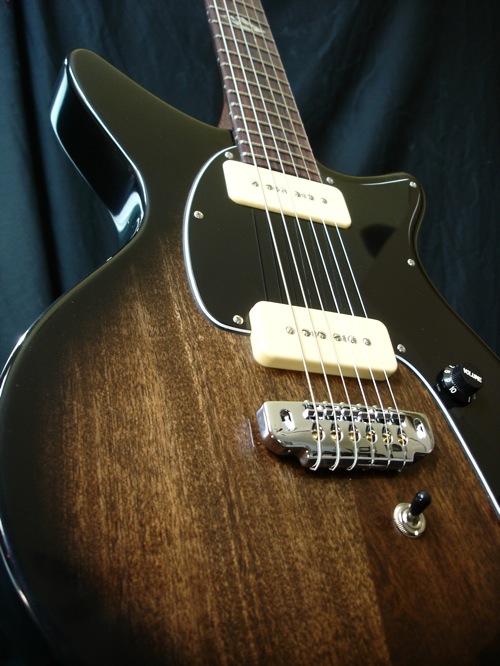
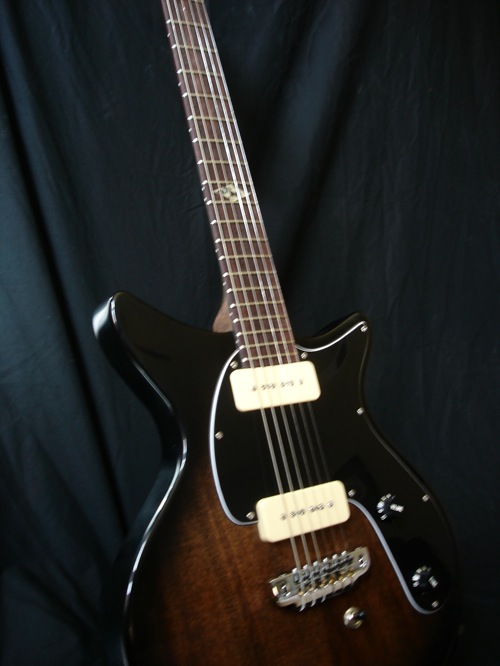
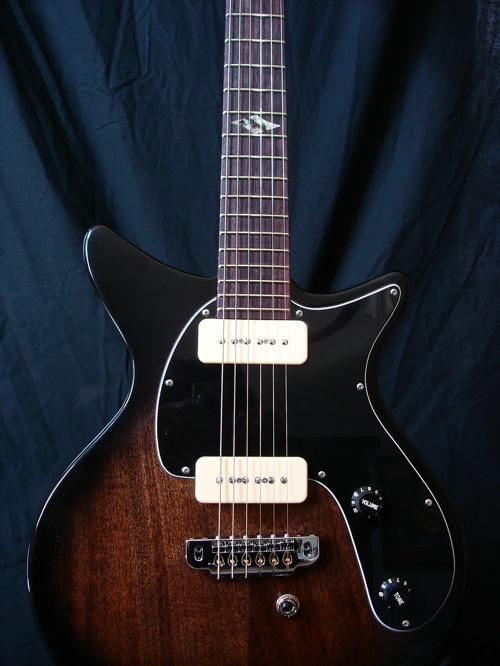
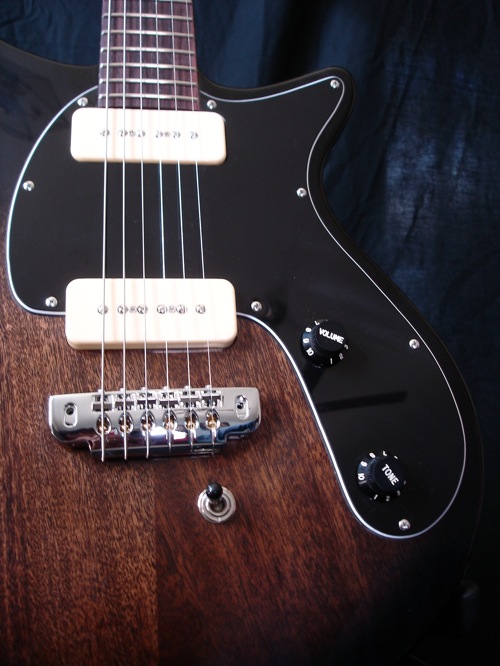
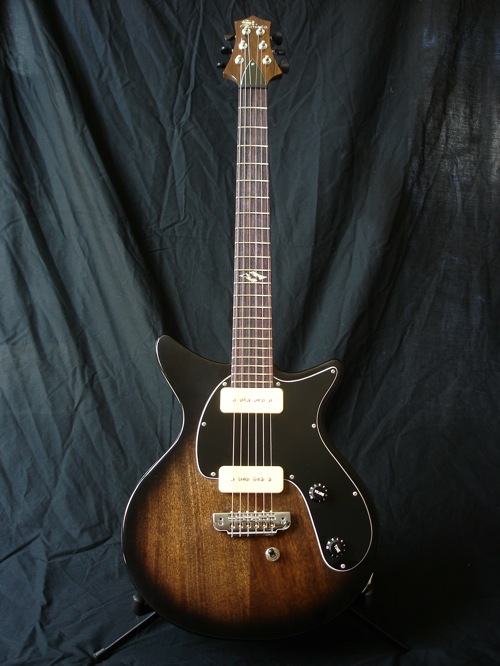
This announcement is so new that Saint Guitar Company hasn’t even put it up on their web site! I first caught wind of this new series a few months ago when Adam mentioned to me in a conversation that he was starting to work on a new style of guitar. This new series was to be a mild departure from the modern rock-inspired designs he has been building for the past several years, and roll time back just a bit to create what he was coining his new “Vintage” series, which would be chambered, have retro styling, and employ P-90 pickups. I don’t have any final build details as of yet, but his first in the series sure looks fantastic. Here are some pictures for your enjoyment!

I can’t wait to do an evaluation on one of these. It’s really exciting! I love the body style on this, with the less pronounced horns, and rounder lower bout, and I dig that flat top! Very cool!

Read Full Post »

Wanna slam the front-end of your amp with up to 50dB of gain, then be able to add some distortion? Then look no further than the Way Huge Angry Troll. I don’t have much information on it yet, but it’s a simple two knob affair. The left-hand knob controls the variable boost, while the right-hand knob provides 6 positions of “Anger” from no anger (clean boost) to a full fist. Here’s ProGuitarShop.com’s video demo.

Read Full Post »

5 Tone Bones - Gear has stellar performance, value, and quality. This is definitely top of the class, best of breed, and it's a no-brainer to add this to your gear lineup!stagetrix_riser StageTrix Pedal Risers

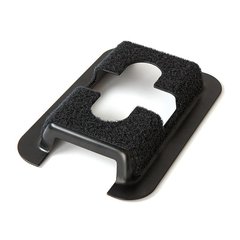
Summary: Definitely one of those “why didn’t I think of that” kinds of products. Elevates pedals 1 inch and makes reaching your back row easy. Routing allows you to keep your wires out of the way!

Pros: Very well made, with convenient fuzz to attach your Velcro’d pedals.

Cons: None.

Features:

  • Raises the second row of pedals to the perfect height.
  • Front, back and side openings enable effective cable routing.
  • Premium 18-gauge steel.
  • Attaches to board via heavy duty hook-and-loop fastener on base, which holds firm up to 200°F.
  • Designed to withstand temperatures of up to 200F without melting, so leaving your pedal board in your vehicle on a summer day won’t result in a gooey mess with all the Velcro peeling off.
  • Works with most pedalboards. To be sure, check that you have an extra 1″ of clearance when case is closed. The vast majority do.

Price: $16.99

Tone Bone Score: 5.0 – I dig these things. No, they don’t improve my tone nor technique, but they sure make it easier to tap dance on my pedal board!

This will most likely be a short review because this product doesn’t do much at all – that’s not a bad thing, either… It simply elevates your pedals. But as an accessory, since I’ve installed a set of four on my board, it has proven invaluable to me! In one fell swoop, the StageTrix Pedal Risers made the back row of my board instantly accessible AND cleaned up my cable runs! Where I used to have to run my cables along the sides if my pedals, I now run them underneath the risers because of their built-in routing. My board hasn’t looked this good – EVER!

Admittedly, I was a bit dubious about their ruggedness when I first discovered them. But once I got them, that opinion changed quickly. These risers are heavy and it’s obvious a lot of attention was paid to the details in their construction. They won’t bend, and that’s a testament to their construction. I even stood on one (I’m not a small man), and the pedal riser didn’t budge!

On top of that, the Pedal Risers are set up for immediate and easy use. The entire base is covered with velcro out of the box, and the top is covered with a thin fuzz for attaching your pedals. No assembly required! I hate to attach velcro tape to stuff. It’s a pain in the ass!

Once I got my board set up, I hooked it up to my amp and started tap-dancing. I immediately started smiling because for the first time, I didn’t have to put my foot in an awkward position to engage one of my pedals in my back row for fear of messing up the settings of a pedal on my front line – or heaven forbid, engaging a pedal that I didn’t want to engage. Nothing like doing a clean solo, clicking on my vibe and simultaneously engaging an overdrive. No doubt, it’s a little unsettling. But that won’t happen any longer. The StageTrix Pedal Risers completely eliminate that possibility!

Currently, they’re sold out, so you can’t get them directly from StageTrix Products at the moment. But they should soon make it to retail stores. Check their site often, as they often update it with news!

Read Full Post »

4 Tone Bones - Excellent gear, that exceeds expectations of its performance, value, and quality. Strongly consider purchasing this.

Pointless Picks

Pointless Picks

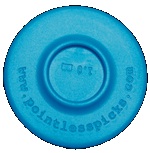
Summary: Really out-of-the-box approach to picks. They’re perfectly round with a raised bevel in the center so you don’t drop ’em.

Pros: Really easy to hold, and strumming with these picks creates a nice ringing tone – not nearly as fat as I thought, but that’s okay! Works great as rhythm guitar pickup or for playing acoustic guitar where a lot of strumming is involved. Great to use as a strummer!

Cons: I found picking out individual notes only okay, and if you’re one of those folks that holds their picks at a 45 degree angle to the string, it’ll take awhile to get used to this pick. It works best straight on, and it’s not that bad. But it’s also kind of big. If it was a smaller diameter, I’d probably love it!

Features:

  • Made from Acetal, which is similar to nylon, but very durable.
  • Raised bevel makes holding onto the pick easy
  • Comes in three thicknesses: .58mm, .72mm, 1mm

Price: < $1.00 ea. through various retailers

Tone Bone Score: 4.0 – These aren’t bad picks, though they do require that you spend a bit of time with them. I actually thought that I’d like the 1mm pick the best, but actually, the thinnest one actually worked best for me.

If you’re a regular visitor to GuitarGear.org, you’ll notice that I rarely review name-brand gear. My thought is that mainstream gear gets lots of coverage, so I tend to gravitate to either the novel or less well-known gear manufacturers. Pointless Picks definitely fall into this latter category!

When I received the envelope from Pointless Picks today, I opened it up in anticipation, and was surprised by them. The pictures you see online really don’t prepare you for the real thing. They’re totally weird looking in a good sort of way. But I’ve learned to keep an open mind, so I took one of each pick (I got several), and went out to my studio to try them out.

I systematically tested each thickness of pick. As a thick pick lover, I thought that my favorite would be the 1mm pick, but the exact opposite was true. The one I liked the most was actually the .58mm pick. I believe this is because of how large a diameter the pick is. When you strum, the pick hits the string with a lot of surface area. With the thicker pick, there naturally isn’t much give, and with my heavy strum technique, the thicker pick didn’t really work well for me. But with the thin pick, it was a different story. I could dig in and the give of the pick made for much easier strumming.

If you’re the type of player who turns their picks around to play with the fat end of the pick, you’ll probably like this pick. Me? I’ll be honest. I like these picks, but I’m not sure I’d like them enough to switch to them exclusively. I even gigged with them this past weekend. As an acoustic pick, I dug them – or at least the thin pick. I was able to get some nice, fat, but also ringing tones from my acoustic. Not sure that I’d use them for electric though. The feel is a bit too heavy for my tastes. You see, I like playing with the pointy end. 🙂

All in all though, these are pretty cool picks.

Read Full Post »

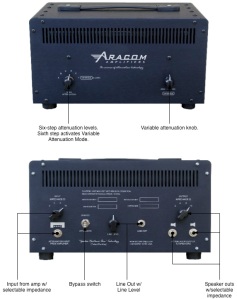
Aracom Amps PRX150-Pro AttenuatorAs many know, I’m a big fan of attenuators. In the past I’ve owned a couple and have tried out several. And with the addition of the Aracom PRX150-Pro to my rig, I’ve finally got a device that is helping me realize all the tonal goodness my amps have to offer. But this entry isn’t about the Aracom attenuator. There are a few attenuators that have entered the market in the recent past including the Faustine Phantom and others that are having the same effect on axe slingers and how they approach their tone.

So what’s the big deal? Most folks know how an attenuator operates. It sits between your amp and your speaker(s), and squelches the output signal from your amp which results in a lower output volume, so you can drive your amp to high gain levels and not shatter your eardrums. That’s the basic premise behind attenuators in general. But up until recently, attenuation came at a price, and that is the loss of tone and dynamics, or completely changed tone at higher attenuation levels; to put it simply, loss of tonal quality. I’m willing to bet that this very thing has kept lots of people from using an attenuator.

But with the new breed of attenuators hitting the market, loss of tonal quality is much less of an issue, if it’s an issue at all. Now you can bring your output volume WAY down, and be assured that the tonal quality you’ve worked so hard to achieve is still there.

So how will this change the way we approach our tone? I would venture to guess that many guitarists have really never known what their amp sounds like fully cranked up – at least for extended periods of time. Sure, if you’re a pro and regularly play huge venues, you know what it sounds like. But for us mere mortals who rarely play in more than a dance club, we’ve never been able to fully experience the cranked up tone of our amps, and that’s where a great attenuator comes into play.

When I hooked up my PRX150-Pro, the first thing I did was to set it on load mode and turn the variable to full attenuation, then dimed the master and volume on my amp to see what it would sound like. I wasn’t prepared for the onslaught of new tones that were suddenly available to me: rich harmonics, tons of sustain, and incredible touch sensitivity. It was as if a whole new world was opened up to me.

With my old attenuator, I rarely went to real high levels of attenuation because it made my tone sound weak and lifeless.  Plus, I didn’t want to burn out my tubes – which I learned the hard way when I cranked my amp while hooked up to the attenuator. But with the Aracom attenuator, I knew I could crank it as high as I wanted to and still be safe. What this means is that I now have access to a wider landscape of tones and dynamics that I can also safely reach. And that’s another feature of the new breed of attenuators: They appear to be much safer to use than the older designs out there.

Here’s an interesting question I got from a buddy of mine: Will I get rid of my overdrive pedals as a result now being able to get the fully cranked tone of my amp? Not on your life! 🙂 I love how they add color to my tone. But I will tell you this: Now that I can crank up my amp to high gain levels without the concomitant high volume levels, I’m actually not using my overdrive pedals as much. Oh, I still use them because they add certain characteristics that aren’t possible with my natural overdrive tone; just not as much as I used to because when I want just straight amp overdrive, I just crank my amp. But when I want to use them, I run them through the clean channel of my amp that has lots of clean headroom, so I can take advantage of the tone that they offer.

So is it a significant change to how we approach our tone? Possibly. I know of some folks who’ve completely stopped using overdrive pedals altogether as a result of using an attenuator, and use a clean boost or even just their volume knob on their guitar to get the lead volume they want. Me? I like to have a few different “brushes” that I can use to create different textures, but in either case, getting that cranked up tone naturally without shattering eardrums is pretty huge.

I think the folks who will gain the most from these great new attenuators are the home studio musicians. Imagine being able to record a screaming guitar solo, and not have the wife or neighbors yelling at you to turn down your volume! I regularly do my recording into the wee hours of the morning, so having an attenuator has been a godsend. But up until I got my PRX150-Pro, I had to wait to record solos until it was day when I could turn up my amp to a gain level that didn’t get me yelled at, as my other attenuators just didn’t give me the tone I needed at high attenuation levels. Even if I used an overdrive pedal, it doesn’t sound good unless it’s working with your amp and pushing your pre-amp tubes, and that takes juice! With a great, transparent, or non-tone-sucking attenuator, you can push your amp hard, and keep your volume under control!

I know of a lot musicians who poo-poo the use of an attenuator. But an attenuator can do wonders for gigging. Want to make the sound guys happy? Here’s another way to look at it: With an attenuator, you can focus on your tone, and not projecting out to the audience. Get enough volume to hear yourself on stage, then let the sound guys do their thing. PA technology has come a long way since the early days of rock and roll, where amps had to be played loud to get the sound out to the audience. Also, if you think about it, speakers are highly directional. If you want to disperse your sound, use the PA.

There’s been an interesting thread that I’ve been lurking on The Gear Page entitled, “Sound guys think I’m too loud.” Someone suggested early on that the original poster could use an attenuator or a smaller amp to reduce their volume. The suggestion of using an attenuator went largely ignored, but as I followed this thread and read all the various insights, using an attenuator is the perfect solution for this.

I’ve heard a lot of the complaints about attenuators in the past, and I’ve also had my issues with them. But with the new breed of attenuators, tone suck is no longer an issue. And that tonal quality will be sure to change how guitarists approach their performances.

Read Full Post »

Pointless Picks

I got a Twitter notification today of someone now following GuitarGear, so I checked Twitter to see who it was, and was intrigued by their website URL: http://www.pointlesspicks.com. Curious, I clicked on their link and was taken to their site. Sure enough, it was a product site dedicated to picks that were – as the name implies – pointless.

These are perfectly round picks, made of a polymer called Acetal. Acetal is a thermoplastic and apparently one of the stiffest and most durable plastics in the thermoplastic family. It has a variety of uses, and often competes with nylon for the same applications, according to the Plastics Web, such as the production of plectrums.

These picks are very interesting to me at first blush. As they’re round, there’s not a “wrong” way to hold them. And if you’re the type of player that almost always rounds off their points or plays with the fat end of a standard pick, then this pick may be appealing to you. It’s certainly a novel idea, and apparently they’ve got a lot of retailers selling them. They won a “Best in Show” at Summer NAMM last year, so obviously these picks made an impact on the judging panel.

Unfortunately, there aren’t many reviews of them, and the few that I found were pretty much copies from a single review, which was fairly short. I only found one video on YouTube that mentions Pointless Picks, and it wasn’t a review, though the guitar playing was pretty good, but you can’t see the dude using the pick!

Personally, I’m not sure how I feel about these. I love big fat picks, and these come in 1mm at their thickest. But if they’re really stiff, I may just like them. But it makes me wonder how to do fast alternate picking with them. I’m not a particularly fast player, but I hold my pick at about a 45 degree angle when I’m picking individual notes. It would seem to me that at that angle, the pick would just slide over the string. Maybe there’s some inherent friction…. Guess I’ll have to try them out to see what they’re like. But hey! Best in Show at NAMM is nothing to shake a stick at, so I’m game!

Anyway, for more information, check out the the Pointless Picks web site for more information.

Read Full Post »

stagetrix_riserOne of the things that completely pisses me off when I’m gigging is when I reach my foot out to activate a pedal in the back row of my board, and I end up also activating a pedal in the front row. Aiiiyeeee!!! This happened to me recently at a church gig. I was playing a nice, sweet, clean solo, and want to texture my sound a bit by adding some reverb.

To give some background, my reverb pedal (Hardwire RV-7) is the last pedal in my chain and it sits right above my Holy Fire overdrive. Instead of a toggle switch, the RV-7 has a switch plate, and the travel before it actually activates is enough so that I have to really point my toe so I don’t brush my Holy Fire’s knobs or accidentally activate it. Well, in this instance, I did both: I somehow completely dimed the overdrive knob AND activated the pedal. The next note I struck not only startled me, but also startled the prayerful assembly – enough so that some people actually squeaked! Yikes! No doubt, it was a bit embarrassing…

Then today, I got a Twitter alert that a new user called StageTrix was following me, so I went to Twitter to do an exchange follow, and on StageTrix’s site, I saw a Twitter reply from Premiere Guitar. Intrigued, I checked out their site, and was greeted with a solution to my problem: An 18-gauge steel pedal riser that you can use to prop up the second row of your board to make your back row of pedals more easily accessible! What a great freakin’ idea! It’s one of those ideas where you slap your forehead and say, “Now why didn’t I think of that?” 🙂

I had the opportunity to chat with one of the StageTrix guys a few minutes ago to discuss StageTrix’s invention. They’ve apparently been developing it for about a year and a half, and doing prototypes with various musicians. And their reason for building it? Exactly for what I was lamenting just above!

Here are some details from their site:

  • Raises the second row of pedals to the perfect height.
  • Front, back and side openings enable effective cable routing.
  • Premium 18-gauge steel.
  • Attaches to board via heavy duty hook-and-loop fastener on base, which holds firm up to 200°F.
  • Designed to withstand temperatures of up to 200F without melting, so leaving your pedal board in your vehicle on a summer day won’t result in a gooey mess with all the Velcro peeling off.
  • Works with most pedalboards. To be sure, check that you have an extra 1″ of clearance when case is closed. The vast majority do.

If you go to their site, they’re doing a promotion by putting several of these units up for bid on EBay, with a starting bid at a $1.00. These pedals list for $23.99 on their site, so it’s possible that if you get the winning bid, you could get one for significantly less…

Right now, they’re only available through StageTrix, but they should soon be available in stores. I will be getting a review unit within the next week or so, and will do a review.

Check out the StageTrix site now!

Read Full Post »

large-relay-2

large-relay-1

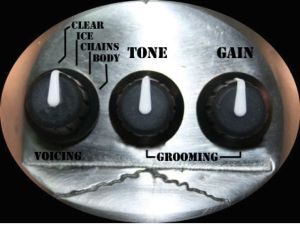
How ’bout a completely different take on an overdrive pedal? Well KASHA is at it yet again, teaming up with Tone Box, Inc., with the brand-new Skull Crusher Drive! Utilizing KASHA’s RockMod technology, the Skull Crusher sports four voicings and a tone and gain knob. Plus with a 10db boost, you have 8 different analog overdrive possibilities in a single pedal!

Sounds hauntingly similar to the KASHA overdrive pedal I just tested last week. It is a bit different, as it has a Tone knob, which is different from the KASHA overdrive. But I can personally attest to the quality of the tone of the KASHA overdrive, so you can bet the Skull Crusher will have that same sweet tone itself!

BTW, my KASHA OD is in production and on its way. I got lucky, and will be getting one of the signed models with a handwritten serial number… Oh goody! Might be able to sell one of these for a grand in 30 years! HA!

In any case, I’ve never seen a pedal like the Skull Crusher before! This is a totally new approach to pedals, adding a visual as well as tonal touch to an effect. The pedal will be distributed by Tone Box, Inc. and will retail for $399.

As for the physical appearance of the box, each pedal is hand-sculpted stainless steel, and comes in four finishes: gun metal, stainless steel, aged and ancient. According to KASHA, there will also be 24K gold and Sterling Silver models as well. Damn! Imagine having a stomp box that’s worth more than your guitar! HAHAHAHAHA!!! I LOVE IT!

Read Full Post »

Aracom Amps PRX150-Pro AttenuatorAracom Amps has just posted a page on their site which features Gene Baker – luthier of the famed Baker Guitars and now of Fine Tuned Instruments producing “B3” guitars – demonstrating the transparency of the Aracom PRX150-Pro Attenuator at various attenuation levels.

Gene has also provided commentary on the recording and how no EQ adjustments were made to the amp – even down to bedroom levels! This is a re-affirmation of what I’ve been saying all along about this awesome device! The PRX150-Pro simply retains the tone you work hard for – no matter how much attenuate your signal; and more importantly eliminating the need to compensate with EQ.

Check out Aracom’s Gene Baker audio page here!

Having someone like Gene Baker demonstrate the capabilities of the PRX150-Pro is huge! Gene is an incredible guitarist!

Read Full Post »

« Newer Posts - Older Posts »