Feeds:
Posts
Comments

Archive for the ‘guitar’ Category

Jacques Overtube Vintage Pro Overdrive Effects Pedal

Jacques Overtube Vintage Pro Overdrive

The Dawg likes to sniff around for new and interesting gear all the time. Unfortunately, I don’t always have time to write or test stuff out. But I do love it when I come across some potentially awesome gear, and I take the time to share it here. The Jacques Overtube Vintage Pro Overdrive most definitely fits the bill in that department. By the way, think “Jacques Cousteau” when pronouncing the name… 🙂

The Overtube is supposedly a faithful reproduction of the original TS-808 Tube Screamer circuit. Now you might be thinking, as did I, that that is nothing special. But what is special about this pedal is that little toggle labeled “CASC” between the Tone and Drive knobs. “CASC” stands for “cascade” and it’s meant to simulate running two TS-808 pedals simultaneously ala SRV!

Check out this video on Guitar Player TV. I’ll be damned if that pedal doesn’t do a Tube Screamer exceptionally well! And with the cascade on, this pedal sounds sweet as can be with lots of thick mid-range wail!

As many of my readers know, I’m a big fan of the mid-rangy kind of drive distortion, so I’m gonna be hard-pressed not to give this pedal a whirl.

It’s a steal at $139!!! Check it out!

Read Full Post »

Sorry, but sometimes I just have to vent. I know lots of dudes who call themselves guitar players who are just wankers in disguise. They’re wankers because they have some kickass and expensive gear, which they don’t hesitate to let you know how much they spent, but they couldn’t play it if their life depended on it! Sorry, but it kind of grates on my nerves because when I run across a wanker, I find myself thinking, “Damn! If I had that guitar, I could make that bad-boy SING!” Maybe I’m crossing the line here of being the supportive web site host, into a petulant and honory SOB, but even though I realize that I’m not the greatest guitar player in the world, at least I can play my friggin’ axes and make some decent sounding music!

To me, a great guitar or amp will just help inspire me to explore tonal landscapes I haven’t been to before; and help me express my music to an even greater degree. And a great piece of gear is like having an expensive screwdriver from Mac or Snap-on Tools. Functionally, it’s no different from the cheap one you can buy for a buck ninety-nine at the corner drugstore’s hardware department. But that good screwdriver makes work so much easier because so much care and consideration were put into making that tool work so much better for the job, with high-grade materials, and ergonomic design. But wankers really don’t know the difference. They just think that expensive must be better. But so many great players have proven you don’t need the expensive gear to create a good tone (think Eddie Van Halen, Willie Nelson, etc). With a wanker, it doesn’t matter what they play: They still sound bad!

I know, I’m being really harsh and probably incredibly arrogant, but I get sick and tired of wankers who insist on playing the “my dick is bigger than yours” game with their bankrolls. Show me you can play that thing, and maybe I’ll show you some respect. In the meantime, keep your mouth shut, and learn how to use your gear!

Read Full Post »

I got so inspired by the Greg Howe video I posted here the other day, that I recorded a Jam Track to Sunny that I could jam to… I had A LOT of fun with this one… Check it out!

http://www.icompositions.com/music/song.php?sid=96867

Read Full Post »

Ibanez Jemini Distortion Pedal

Ibanez Jemini Distortion Pedal

Does the guitar playing world need yet another distortion pedal? That’s almost like asking if your town needs another Starbucks. Hmmm… maybe that’s a bad analogy because while we could probably do without yet another coffee commodity, I for one don’t ever mind seeing another distortion pedal hit the market.

And just when I thought I’d heard all the variations of distortion around, and that not much else could be done, along comes Ibanez with yet another mind-blowing distortion box, designed by none other than one of my guitar heroes, Steve Vai. I gotta admit it: I’m really impressed with this latest offering from Ibanez – at least as much as I was impressed with the Vox Satchurator. Don’t get me wrong; it’s not because of Steve Vai, or because I’m a Vai wannabe. It’s because there’s something about a great distortion sound that evokes a visceral response inside of me. It’s hard to explain. So I’m more than pleasantly surprised about the Jemini because it produces a GREAT distortion sound; at least from what I could tell from this video starring Steve Vai and Steve Vai – you’ll get the joke once you watch it:

Leave it to Steve Vai to not only demonstrate his mastery over the guitar, but the eternal showman manages to make the video a joy to watch. I was laughing my ass off at his antics! He’s so likeable!

Okay… now for a reality check… I really would like to get this pedal, but at $199, it’s a bit out of my price range right now. But being two distortion pedals in one for that price, it’s a hundred bucks a pedal. That’s actually not bad at all. But I have to admit, I have my sights set on a Satchurator right now. I kind of go for the more mid-rangy type of distortion. But I’m not going to let that keep me from taking one out for a spin.

On a final note, what’s been really great as of late is that big-name gear manufacturers are finally producing what could be considered boutique-type pedals. Having played with the Satchurator, that thing is built like a tank, and it just kicks ass. The Jemini appears to follow suit of well-made, gig-worthy quality. That’s very pleasing to me, because I’m a big proponent of getting great sound without breaking the bank.

Read Full Post »

I don’t plug other web sites often, mainly because there are so many out there, it’s difficult to keep up. But a new site, called TonePedia is so interesting in its concept, I just had to share it! The basis of the site is for members to share the tone of their rigs through sound bites they share with the community. Want to know what an LP sounds like through a Crate amp? It’s there on the site.

What a cool idea! Check it out! I’m going to post a few samples myself! Er… Once I find some time… 🙂

Read Full Post »

The mags and rags of the guitar playing world seem to have forgotten about the absolutely amazing virtuosity of Greg Howe who, in my maybe not so humble opinion ranks among the best guitarists in the world, hands down. He’s as fast as Yngwie or Paul Gilbert, but in my opinion covers a lot broader musical territory. But the guy’s not only a speed demon, his solos are incredibly expressive, employing a lot of phrases that you’d expect to hear in jazz.

I’ve been amazed by Greg Howe’s mastery over the guitar for years, and I actually feel bad that I hadn’t acknowledged him here. Maybe it’s because he’s considered to be more of a fusion artist more than a rock and roll dude… Who knows? Actually, who cares? Greg Howe KICKS ASS!

Here’s a video that displays just some of that musicality and other-worldly technique. Please view it to the end. When he starts out, you’ll think it’s nothing special… Wait until he hits his stride! Aiyeeeeeee!

Click here to see more on YouTube!

Read Full Post »

I was reading several interesting threads about technique and improv the other day. I have to admit that I was quietly embarassed by the fact that I don’t have a large library of techniques that I can tap into while I read the posts and articles. There are so many things to learn with respect to technique out there that it’s daunting!

But after reading those articles, I realized that a lot of the technique I have developed – especially over the past couple of years – has come from stumbling upon how to play a certain phrase through experimentation. I’ll be the first to admit that I’m not a disciplined improv dude that can instantly tap into a library of patterns and apply them. I’ve never taken guitar to that intellectual level. My approach to soloing tends to be fairly experimental; primarily because I don’t have a lot of techniques on which to fall back. But that doesn’t mean the process of experimentation isn’t cool in an of itself.

In fact, that process, at least for me, has been absolutely rewarding, and after I’m done with an “experimentation” session and play back the different takes, I often say to myself, “Did I actually play that?” It’s mildly amusing, but it’s also a bit scary because I’ll eventually have to play that or at least something similar to that when I play the song live. But that gets me to practice the technique until I have it down.

For instance, early on when I started my experimentation, I stumbled upon the minor pentatonic scale just by playing what fit. At the time, I didn’t know that it was the minor pentatonic scale. I just know that what I played fit with the song. I’ve since learned the other patterns of the minor pentatonic, and it’s something I tap into regularly. In another instance a few years ago, I was playing a solo, and one of the other musicians in my band asked, “Hey man, did you just do that in Mixolydian mode?” I replied, “Mixo-what? I don’t know, I just thought that it would be cool to start the lead a fifth above the root and play within that relative area.” Mind you, I still don’t know all the modes by heart – I think I stick to Dorian and Mixolydian a lot, or often start playing a minor pentatonic in the relative minor of the root chord (if it’s a major chord).

The point is that I don’t go out to specifically learn and practice a technique or mode or scale. Admittedly, that has probably slowed my technical advancement to a large degree, and I’ll have to admit that for the more organized and discplined among us, that approach is probably unacceptable, but it works for me, and I’ve learned a lot of things that I was later able to identify as formal techniques.

I know that there thousands of guitar players who are a whole lot better than me, but here’s a glimpse into my experimentation process:

  • GarageBand or some other package where you can easily set up loops and record rhythm parts is kind of essential. Having this is akin to having a basic chemistry set to mix chemicals.
  • Once you come up with a loop, play it continuously and jam to it to see what falls out of your experimentation. Never mind trying to be intellectual – just let it flow.

I’ve literally spent hours at a time practicing using this method, and a lot of these progressions have turned into songs.

To get you started, here’s a Jam Track that you can use. It’s a simple, 3 minute track in the key of A. I laid it down because I wanted to practice chord soloing… er… actually to see if I could do it. 🙂 In any case, have a go!

Read Full Post »

Just got my latest issue of Guitar Player, and as usual, went to the gear section first to see if there were any new and interesting pieces of gear. Normally, the stuff there is pretty tame, but I got really intrigued by a short product review on the Harmonic Capo. Unlike a normal capo that you place on a particular fret to play open chords at a particular fret position, the harmonic capo is placed at a harmonic fret: 12th, 7th, or 5th, and it will play the harmonic there. But the really cool thing about this is that unlike a normal capo, where you can only play the frets above the capo’d position, with the harmonic capo, you can play at frets above AND below the fretted position of the capo. It’s a very interesting concept that can yield some very interesting tonal possibilities. Check out this video by the inventor:

Read Full Post »

Fishman SoloAmp

Fishman SoloAmp

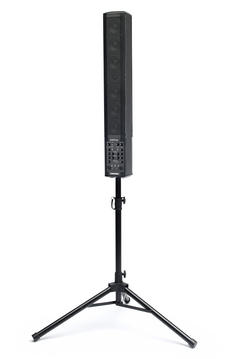
Okay, I admit it, I’m a sucker for gadgets. Aw hell! I wouldn’t be writing this blog if I wasn’t! So there I was earlier this evening, surfing the web in search of new gear, and lo and behold, I run across the Fishman SoloAmp, a 220W bi-amp for acoustic guitar and vocals. It’s an amp and a PA in one package, and I have to tell you, for solo gigs, it seems too good to be true.

Here are some specs from the Fishman web site:

  • Compact Line Array = Ultra wide horizontal dispersion & deeper sound penetration
  • Two Mic/Instrument Channels
  • – High-quality preamps
    – 3-band EQ
    – Phantom Power
    – Independent Reverb level
    – Effect Loop
    – Feedback-fighting Phase and Notch filters

  • Drivers
  • – Six 4′ mid-woofers, patented dual gap, high excursion design, neodymium magnets (200W)
    – One 1′ neodymium soft dome tweeter with level control (20W)

  • Auxiliary Stereo Input with Level control
  • Four Digital Reverb effects with master level
  • Balanced XLR D.I. outputs for both channels and main mix
  • Unique Monitor I/O for improved on-stage ensemble monitoring
  • Mute with remote footswitch input
  • Tuner Output
  • Ships with Stand and padded Carry Bag (w/ wheels)
  • Dimensions: 41.5′ H x 5.6′ W x 6.6′ D
  • *Weight: 25 lbs without Stand, 35lbs with Bag and Stand

I’ve only listened to sound bites and audio from the Fishman site, but from what I could tell, this lightweight PA kicks ass for small venues!

I do a lot of solo gigs and I’m always looking for ways to reduce the size of my rig. The first step for me was getting the DigiTech Vocalist Live 4 that acts as both a harmonizer and mixer. Combined with something like the SoloAmp… okay… I have to stop slobbering now. 🙂

If anyone has tried one of these, please let me know!

Read Full Post »

Vox Satchurator

Vox Satchurator

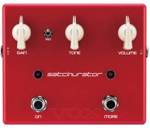
Summary: From grind to snarl, the Satchurator can deliver it. Built like a tank, with chicken head knobs, and a fire engine red paint job. Definitely gig-worthy! “More” switch is awesome!

Pros: Incredibly versatile, this box has the ability to deliver a wide variety of tones.

Cons: Just a nit: True character of this pedal doesn’t come out until you’re at gig levels in volume.

Price: $129 Street

Features (fr. VOX site):

  • Analog distortion pedal designed under the complete supervision of Joe Satriani
  • Controls for Gain, Tone and Volume
  • ‘More’ gain boost switch enables two footswitchable distortion sounds in one pedal. This gain boost is dramatic when gain knob is set low, and is a subtle solo boost when gain knob is set to maximum.
  • ‘Pad’ switch pads down input to allow for high gain pedals (such as modern wahs) placed before Satchurator. Up is pad ‘ON’. Down is pad ‘OFF’ for full Satchurator effect.
  • High gain, low noise design provides vintage to modern distortion sounds
  • Dynamic circuit is highly responsive to rolling off the guitar’s volume and preserves the guitar’s high end when the volume is rolled off.
  • Cream chicken-head knobs for precise positioning and high visibility on dark stages

I am not shredder; never was, never will be. It’s just not my style. But that doesn’t mean I don’t love the sound of distortion and playing with a distorted sound. In fact, to me, there’s nothing like the sweet, sustained, and compressed tone of saturated power tubes, or the dirty color that comes from a great overdrive or distortion box. Thus, I’ve had several stomps over the years from DS-1’s to MXR’s to my current line up of a Tube Screamer, Bad Monkey and an OCD. Each pedal has its own unique character, and I employ all of them either individually or by chaining a couple together. It now looks like I’m going to add to my lineup.

When I first heard about the VOX Satchurator, I got excited. I figured anything that was designed and built to Joe Satriani’s specifications had to at least be something to take a good look at, if not outright buy. Plus, with VOX being known for high-quality, I knew that whatever was produced from this partnership would not be crap. So I knew that it would be a good bet that I’d get this pedal. In fact, I’m writing this review right after my test. But luckily, I’m not THAT impulsive that I left the store with one in hand – though I have been known to buy first think later. Luckily I have my trusty GAS Calculator to keep those impulses in check. 🙂 I scored a 5, which is on the high side of still considering the gear and just one point below of getting it, but I didn’t score a 6 or above, so I held back on my purchase for now (honestly, it’s a matter of available funds 🙂 ). Now back to our regularly scheduled program….

Okay… if you read no further, please read this:

THE SATURATOR WILL NOT MAKE YOU SOUND LIKE JOE SATRIANI!!!

No one sounds like Satch, but Professor Satchifunkilus himself. You may use the exact same equipment (I used a JSX for my test, but I used a PRS SE Custom Semi-hollowbody for one of the guitars and a Strat and Epiphone Les Paul for the others). You may even have incredible technique that matches or surpasses the maestro, but you will not sound exactly like him. I’m only saying this because I don’t want you to get your hopes up. What you do get though, is the same TYPE of distortion tone that Satch gets. What you do with that is entirely up to how you play; and that is a good thing. Okay, ’nuff said.

Here’s my take on the Satchurator: Forget about how cool it looks – it looks AWESOME, by the way – the Satchurator is an incredibly versatile distortion box that can serve up mild grind to unadulterated, in-your-face, lewd, crude, with a mouth full of food snarl (got that saying from Guitar Player mag 🙂 ). It also has incredible attack and volume knob sensitivity at any volume level.

The Satchurator is also not for the faint of heart. Once you switch on the box, you get breakup, even with the gain swept to zero. In other words, once it’s on, you’re committed to having even modest amounts of distortion in your signal. To coin a phrase from a close friend, “This ain’t for pussies.” But the cool thing is that the distortion is highly controllable based upon your guitar’s volume knob and how you attack the strings. From a volume knob perspective, I just DIG how the Satchurator responds to volume knob settings. Want less distortion, just sweep your volume down. Want more bite, do the opposite.

When I test pedals, I usually start out with everything set in the 12 o’clock setting. Through my test, which was about 45 minutes, I only moved the gain knob twice: All the way down to get a gorgeous bluesy breakup, then all the way up to see how bad the pedal clipped, which surprisingly enough, it didn’t do. For the rest of the test, I just kept the gain set at the centerline, then used a combination of attack and volume knob sweeps to dial in the right amount of distortion that I wanted. From a gigging standpoint, the less you have to bend over or crouch to set pedals, the better.

It has been noted that Satch actually plugs the Satchurator into a clean amp, then sweeps the gain knob. Personally, I like the sound that power tubes produce, so I set the JSX into the first gain stage, but left it pretty clean, allowing the Satchurator to drive the tubes into breakup. I do have to say that I loved that combination of tube breakup along with the Satchurator distortion.

More really is more

There’s an interesting switch on the right side of the pedal called “More.” This switch provides even more gain when you switch it on. It’s great for cutting through a mix. The interesting thing is that the boost effect is less dramatic with higher gain settings on the pedal. With the gain knob pegged, pressing More definitely adds more, but it’s just a bit more, like going from 10 to 11 on your amp. Where I had it set at 12 o’clock, the More switch was nicely dramtic, and it’s something that I’ll definitely be using when I gig.

Will play nice with the other kids...

I didn’t get to try this feature out, but the Satchurator also includes a toggle switch called “Pad.” Apparently, this allows the pedal to play well with high output pedals like wah pedals and not change your tone. It essentially “pads” their signals so the Satchurator’s tone doesn’t fluctuate wildly. I’ve never seen a pedal that had this feature. Very, very useful. Once I put the Satchurator in my chain, I’ll definitely be using the “Pad” to help tame my vibe pedal that could potentially cause wild tonal fluctuations, which it does with my OCD, which doesn’t like to be played with the vibe.

So how did it REALLY perform

I wish I had more time to try out a couple of other amps, but alas, I just didn’t. But I did try it out with three guitars, so that’s good. Here’s my synopsis:

  1. The first guitar I played it with was PRS SE Custom. This is a semi-hollowbody guitar. I’m glad I switched to another guitar because I wouldn’t buy the pedal if I just did my review with just that guitar. It’s not that the guitar was bad, and it wasn’t that the tone that was produced was bad. It’s just that the combination of this particular guitar with the Satchurator was uninspiring. I wasn’t blown away.
  2. After the PRS, I switched to a Strat, and my inspiration meter went through the roof! The sound was FAN-FREAKIN’-TASTIC!!! I had the same result with Epi LP I plugged in. In other words, at least from my perspective, the Satchurator sound best with solid body guitars. To be fair, I probably could’ve coaxed a great sound using the PRS, but with limited time, I didn’t have the patience. And in a gigging situation, the last thing you want to do is tweak.

Wrapping it up

As I mentioned above, this pedal will not make you sound like Satch, but it will give you the same kind of distortion Satch employs. I love that kind of distortion. It’s not super-compressed, but it’s also not so open that it comes across as hollow. As with Baby Bear’s porridge in “Goldilocks and the Three Bears,” it’s just right!

Read Full Post »

« Newer Posts - Older Posts »