Feeds:
Posts
Comments

Archive for the ‘Guitars’ Category

replicaWhen I bought “Ox” from my good buddy Jeff Aragaki, it had already changed hands a few times. I bought it with the intent to make it an investment guitar, and though I actually did have it sold awhile back, the deal fell through, much to the chagrin of the buyer who then tried to buy it again with a trade and cash. I turned it down for a couple of reasons: 1) I was admittedly sour on dealing with that person a second time after they reneged on the original deal – not that they weren’t nice, but I felt they were a bit wishy-washy, and didn’t want to go through the hassle of dealing with their indecisiveness; 2) After I got Ox back, I set it up with different guitar strings. I had been using pure nickel, and decided to use steel strings for more bite. So I strung the guitar with Ernie Ball RPS-10 strings, and it was if a veil was lifted off the tone of the guitar!

Point 1) above is actually a trivial contributor to my decision to keep the guitar. It was changing the strings to Ernie Ball RPS-10’s (10-46) that brought out the true nature of the guitar’s tone. I’ve since switched to Ernie Ball Cobalts, which sound just a tad bit smoother than the RPS-10’s, but they have all the attack and bite on tap that I need. And once I heard the tones issuing from my amps from just that little change, there was no way I was going to part with this fabulous guitar.

Circling back around to my original purchase of the guitar, a little research revealed that the guitar had changed hands at least a few times before it landed on my doorstep. But perhaps in the case of this guitar, they didn’t have the right combination of gear and accessories to truly experience the tones this guitar can deliver. Who knows? But I have it, and I love it! 🙂

In any case, even though I found out who the luthier was who made the guitar, I had never made contact with him. As I said in my original review of the guitar, I also didn’t want to “out” him publicly to spare him from Gibson’s litigious wrath. But finally, after four years of owning this guitar, the luthier contacted me after reading my review, which was forwarded to him via a prospective customer. We had a great email exchange where he shared some details about the neck and body of the guitar.

I always wondered how he achieved the tone he achieved with Ox. For the longest time, I felt all that juicy tone came from the types of wood that were used. Ox’s body and neck are made from old-growth mahogany, the top is hard-rock maple, and the fretboard is Brazilian rosewood. I thought that just the wood combination accounted for how good the guitar sounds, but after he explained how the wood was cut, and how the pieces interact with each other, I realized it was way more than just the combination of woods, and believe me, considering what this guy’s day job is, he knows what he’s talking about!

I can’t share all the details of what we spoke about because again, I just don’t want to out him. But suffice it to say that the more I find out about Ox, the more I’m convinced that it was the smart thing to do to keep it.

For the past couple of months, I’ve been gigging with it fairly regularly. In fact, I’ve been gigging with Ox almost to the exclusion of all my other electrics. I haven’t played “Amber” my R8 for quite awhile. And my Slash L Katie May is now my main composing tool. I’ve gigged with her a bit, but she’s such a nice guitar that I like to keep her close to home.

In any case, here are a couple of clips of the 59 Replica.

This first one is a song that I’m currently working on. There’s no lead in it, but Ox has a very distinctive neck pickup sound that I can’t quite get with any of my other guitars. It’s very evident when I start finger-picking.

This next is my song “Strutter” but played with the 59 in the lead. I love the rock sounds this guitar makes!

Read Full Post »

I originally wrote this about four years ago, and always meant to finish it. It remained in sketch form until I happened to listen to it for the first time in a couple of years. So I resolved to re-record it and give it the justice it deserved.

“Down Highway 29” is about driving down Highway 29 in the heart of California. I was in a bit of a pensive mood, just enjoying the drive down a lonely stretch of road, when the melody line of the song popped in my head, and luckily stayed with me until we got to our destination and I could record it (I always have a IK Multimedia StealthPlug with me so I track ideas). Anyway here it is:

Acoustic Guitar: Yamaha APX900
Lead Guitar: Slash L Guitars “Katie May”
Amp: Aracom VRX18 into a closed-back 1 X 12 with a Jensen P12N Alnico speaker.

As with most of my recordings, the lead part is not EQ’d. I let the guitar and amp do all the EQ work, then just add effects. In this case, I used a matrix reverb to get that large room sound and a sample delay to add a bit more ambiance. There’s nothing else done to the guitar tone. Even without the modulation effects, the tone is very rich, which is why I do my best to not do too much with it in production.

Read Full Post »

This morning I got a notification on my WordPress dashboard that today is When I first started this blog, I started it with the express intention of using the blog as an online diary documenting my purchases of new gear; specifically, I wanted to use GuitarGear.org as a way to record my transition to valve amps and all the cool stuff that I was going to buy.

And buy I did… 🙂

Back in 2009, GuitarGear.org suddenly boomed. I was writing pretty religiously, adding at least 5 articles a week, and I was active on several gear forums. Then manufacturers started come to me to review their gear, and GearGear.org kind of took on a life of its own. And though to date, the blog has had about 1.25 Million unique visitors – which is peanuts compared to big, commercial sites that get more than that in hour – I’m honored that that many people over the course of its existence have found GuitarGear.org valuable enough to visit.

I never meant GuitarGear.org to be a “go-to” resource for gear, but that’s kind of what it has become; at least in some capacity. But because I’m just a single guy working on it, I’ve had to be rather selective about the gear that I’d review, and so I’ve kept my focus on either things that I would use myself, or the “little guys.” That probably accounts for why I’ve got a fairly focused set of visitors. I just don’t cover much of the mainstream. That would be a full time job!

In any case, I’d like to thank everyone who visits this blog for making GuitarGear.org what it is today!

Read Full Post »

EHX Soul Food OverdriveI hate to admit it, but I’ve become a little jaded about pedals over the years, especially overdrive pedals. And admittedly, at the rate that EHX pumps out pedals, I tend to not put as much effort in checking out their offerings when I get announcements in email. With respect to the Soul Food, which was released late last year, I did another ho-hum, another EHX pedal…

But that meh turned in an, eh? this afternoon when I happened to be checking out the Holy Grail Max demo on YouTube. I saw the Soul Food demo in the related videos list, and decided to check it out after I watched the Holy Grail Max demo. I sat through all 16 minutes and change completely mesmerized; not by just the sound of the pedal, but by the player playing in it. My curiosity about the pedal brought me to the video, but the playing kept me there. Before I go on, check out the demo. The dude playing is the SHIT!

Apparently, the Soul Food is a part-for-part clone of the Klon, and it’s supposed to sound and feel like a Klon but at a fraction – I mean a small fraction – of the price. With Klon’s selling on eBay for $1500 minimum, at $62, the Soul Food is quite an attractive offering.

Klon Hype

The Klon is sort of a “Dumble” of overdrives. People have hyped about it for years. I’ve personally never played one, and perhaps back when they first came out and sold for $300-$400, I would’ve considered buying one. But at the price they are now, I could get a good amp and be happy. Is it THAT good? Only those who play one can tell. But as with a Dumble, or any gear for that matter, what might sound good to one person, may not sound good to another. For me, at the price I’d have to pay for a Klon, I’ve got enough great gear to keep me for even considering it.

However, $62 isn’t at all a stretch, and after seeing the following head-to-head comparison, makes the Soul Food something I’m putting on my “to-buy” list. Check it out:

This is a great head-to-head comparison. Personally, I think that in most cases, they sound insanely close, though the Klon does seem much richer in low-gain settings. However, that said, the best test would be in a gigging venue where the sound gets a chance to bounce off air molecules. Could be that that is where the Klon shines. It’s the same with a Dumble. Close-miked, it’s hard to tell what’s so special. But when you hear it in an open environment, there is certainly some magic in the tone.

I’ve done a bit of research over the past couple of days; specifically, I was looking for comparisons between the Timmy and the Klon or Soul Food, since the Klon is also touted as a transparent overdrive. In my mind, the only thing that would keep me from getting the Soul Food was if it was truly transparent. I don’t need that; I already have a Timmy. But from what I understand, there is a definite mid-hump color that the Klon/Soul Food introduces, and that is something in which I’m interested. To me, even though the mid-hump suggests something akin to the venerable and most-copied TubeScreamer, it’s a different sound; seemingly a little rounder and fatter than a TS mid-hump.

I’ll be ordering a Soul Food pretty soon. Hehe… You never can have too many overdrive pedals. 🙂

Read Full Post »

I love traveling. It gives me time to get away from the pressures at work and do some writing for myself, which means I write about gear; or in this case, people and their gear…

A couple of weeks ago, my wife called me up at work and asked me if I’d like to go to see Styx play at the San Jose Civic Auditorium. Having not been to a concert in a long time, and not ever having seen Styx live, plus having a the rare chance to go on a date with my wife, I of course agreed.

Styx performed most of their classics, with the exception of some Dennis DeYoung tunes. But personally, I didn’t miss them much because I was more into their rock-flavored, guitar-driven material and much less so their pop material, even though it was their pop stuff that drove much of their success. As such, I of course was endeared to the guitar playing of James Young and Tommy Shaw.

Before I go on, one thing that was cool in the show was that both JY and Tommy Shaw didn’t activate their effects themselves. They’d be playing along, then suddenly Tommy would cut into a lead, and voila! He’d have some boost/overdrive and delay. I was thinking to myself, Damn! That would be cool to have someone do that for me so I could just play and entertain! Of course, that requires a very high degree of coordination with your sound tech. I remember reading about this in an interview with Tommy Shaw years ago, but until I experienced it for myself, I didn’t realize how cool that would be. Anyway, I digress…

One thing I like to do when I see my favorite guitarists is keep track of the guitars they play. James Young was easy. He only plays Strats, and only the colors change and fretboards. And though I love his tone, there’s not much variety. 🙂 On the other hand, Tommy Shaw plays a few different guitars.

First up was a 1998 R9 Les Paul. Looked like a Tea Burst which endears me to him even more, since I have an R8 Tea Burst. As an aside, according to an article I read, Tommy doesn’t play vintage guitars because he says he’s rough on his axes, so he tends to play newer guitars. From what I could tell, his guitars were nice and shiny, so that may hold true.

The next Les Paul he played was definitely a Standard but in Silver Burst. Don’t know the exact make on that one, but it sure did sound nice.

Next was a Taylor solid body. It looked like a Les Paul from a distance, but on closer inspection, had only two knobs and a trem. Really nice-looking and nice sounding axe.

Tommy also sported a black ES-335 that he played in several songs. That actually surprised me because he got a real heavy sound with it. I was very impressed with this guitar because it hadn’t occurred to me that an ES-335 would sound good in a straight-ahead rock setting. But he played it on one of my favorite Styx tunes, “Crystal Ball.” The sustain that he was getting on that guitar was fabulous! Granted, having some delay applied certainly helped, but it was clear that he was getting a lot of sustain from the guitar itself.

He played a couple of Taylor acoustics as well, a 6-string and 12-string. To be honest, I thought his acoustic tone was horrid. But that’s been my experience whenever I see Taylors used on-stage, plugged in. At least for me, their electronics seem to produce way too much midrange, and they sound flat and lifeless to me. The 12-string sounded better and richer due to having twice as many strings, but the 6-string was a bit annoying to me. That could also be the sound system. Who knows? But I suspect it’s the guitar’s electronics. I’ve seen several acoustic players such as Michael Hedges, James Taylor, and even Joe Bonamassa that have great acoustic tone plugged in, so hearing Tommy Shaw with less than stellar acoustic tone was a bit disappointing.

But back to his electrics…

Tommy used his Les Pauls predominantly in the concert – though he also rocked the 335 quite a bit as well. No, he’s not the fastest player in the world, but he could make his guitars absolutely sing. It was classic Les Paul tone!

Here’s cell phone vid taken from the concert (it’s the finale) in Scottsdale back in January, so it’s fairly recent. Here, Tommy rocks the 335:

Read Full Post »

Sometimes, Success Means Taking Risks

At last night’s gig, I walked away with lots of tips; probably one of the largest amounts I’ve made in tips that wasn’t in the holiday season. It actually shouldn’t have been that good since restaurant traffic, even for a Saturday night, wasn’t all that heavy. By about 7:30, while the restaurant was full, there was no wait, and that was unusual for a Saturday night. Normally, on “light” nights like this I take more regular breaks, but for some reason last night, I got in a groove and ended up playing a 2 hour and 45 minute first set. Most of the tunes I was playing were primarily vocal-centric, but last night, I added some instrumental parts to several of the songs with my looper and just improvised over the chord progressions. I’m not all that technically savvy, and probably only know a few modes at best, but I decided to take the risk, and just go for it.

I must’ve been doing something right because the response was immense, as I saw my tip jar filling up. That just spurred me on to keep experimenting and pushing outside my comfort zone with my playing. At one point, I even pulled a bit of a “George Benson” and scatted along with some phrases. That was something I’d never done in the thirteen years I’ve been playing at the restaurant. I was so inspired that I even did a song that I knew well, but had never performed (“Summertime” from Porgy and Bess), with a chord progression that really departed from the original, then put on the looper and scatted/improv’d over that.

Who knows? Maybe I got a bit of inspiration from the two elderly African American women who seemed so appreciative of what I was playing. For them, I pulled out an old, old Nat King Cole tune called “Nature Boy” that they recognized – it warmed my heart to see them smile then close their eyes in reminiscence, perhaps pulling them back to a time when they had more to look forward to and less to look back upon. When I see reactions like that, it eggs me on, and even with that song, which I played on the piano, I did some scales and runs that I had never done.

But the important thing to me when I looked back on the gig after I finished was that I made the choice to take the risk of looking like a total fool. In the process, I discovered that I had some latent skills tucked into my subconscious that only needed the permission to come out. The proof of the success of the evening was in my tip jar, which was packed and literally filled to the brim.

Of course, it’s important to be aware of the reaction – I really don’t know if I’d be able to pull this off with another crowd – but I could only know if something worked if I tried it out, or more precisely, took the risk. In this case, the risk came with some nice rewards.

Read Full Post »

Since Michael passed away in 1997, the only video examples that I’ve been able to find have been single songs. But this afternoon as I was reminiscing about his music and the time in my life when I spent at least three nights a week at the Varsity Theatre in Palo Alto, CA to watch Michael play, I came across this video, which is the last full-length concert video recorded two weeks prior to his death. I encourage you to watch this video in its entirety as like me, you’ll be mesmerized by his technique. And though the sound quality isn’t the best, you’ll be amazed by the tones he can produce from his acoustic guitar. Even after all these years, I can’t help but be in awe of the man.

Read Full Post »

The BeatBuddy Is Truly Amazing!

BeatBuddy

Quick note: You can still get a BeatBuddy for $199 if you join the crowdsource campaign by February 4. After that the unit will retail at $399. For more information, go to mybeatbuddy.com.

I introduced the BeatBuddy drum machine pedal several weeks ago and have provided regular updates on this incredible device that I believe will completely shake up the market once its released and people have started using it. Originally, I didn’t pay too much attention to its extraneous features other than the MIDI sync – I want to use it with a sync-able looper – but when considering all the features that come with the pedal itself, it’s more of a drum machine “system” than just something you plop on your board. You can certainly do that, and admittedly, once I get mine, I’ll forgo all the peripheral stuff and just gig with it.

But once the dust settles from my excitement about this new toy, I’ll turn to the system management stuff. For instance, the BeatBuddy comes with PC and Mac software that provide you with the capability to manage practically everything in the device. You can create folders, song lists, and even add and edit entire songs! Check this demonstration out:

For my solo gigs, I can see setting up a folder with 5 or 6 songs set up specifically for the tunes I play in my gigs. With the optional foot switch controller, it’ll be easy to choose the song I need, then just go to town. But if I have special requirements (like for my own songs that I perform), I can use the software to create a custom song, then store that in the list as well. I can even add my own 16- or 24-bit WAV content myself! So the BeatBuddy isn’t just some single-dimensional drum machine playback device; it’s a full-on system that will change the way you approach your performances.

I was just thinking that I could use the BeatBuddy with my church band when we don’t have a drummer. Now THAT would be totally awesome. It would be a bit tricky to train all the musicians to follow the BeatBuddy, but I think with practice, we’ll be able to really rock it up!

Here’s another instructional video the BeatBuddy guys put together to demonstrate how you use the unit and navigate through its menus, plus using a dual foot switch for added control. This thing is absolutely easy to use!!!

To follow and get regular YouTube updates, go to the MyBeatBuddy YouTube page.

As I alluded to above, I think the BeatBuddy is going to turn the market on its ear. How it didn’t win a NAMM “Best In Show” award is beyond me. But looking at the list, it’s mainly mainstream manufacturers and some obscure ones. That’s too bad, because if this unit gets into big box retail stores, it’ll sell like hotcakes; of that I have no doubt. Everyone I’ve been talking to about this unit wants one. Oh well… maybe they’ll get the award next year.

In any case, if this is your first time hearing about this amazing device/system, check out their site at http://mybeatbuddy.com!

And just to be clear, I’m not at all affiliated with the BeatBuddy guys, but the BeatBuddy holds so much promise for me that I can’t help sharing my excitement!

Read Full Post »

4.75 Tone Bones - Almost perfect but not quite

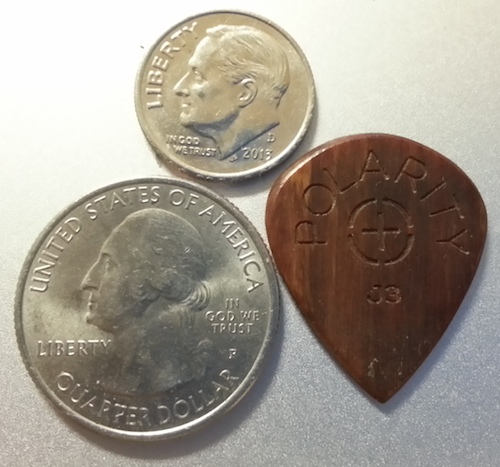
polarity_j3

Polarity J3

Summary: Made out of one of the hardest woods in nature, the Polarity J3 pick produces a warm, but also “spanky” tone that is perfect for leads.

Pros: I’m a big fan of natural materials for plectrums, and the J3 doesn’t disappoint with its feel in the hand. Natural materials also tend to not squeak when striking a vibrating string. As far as sound is concerned, I dig the sound that this pick produces – A LOT!

Cons: My only concern with this pick is its lifetime. I took the picture I supplied to the left after playing with the pick for about an hour on various guitars, strumming and playing solos. If you click on it, you can see where some of the Carnuba wax has already started wearing away, so I’m not sure just how long the pick will last. However, I’ll have a better idea after I gig with it this coming weekend and will post a follow-up article. NOTE: This is a fairly small nit because I only put a few hours of playing on it, and note that the only wear was the wax coating. The wood itself didn’t have any wear on it.

Price: $29.00 ea

Specs:

  • 1.3 millimeters thick
  • 7/8″ wide X 1″ long
  • Handmade
  • Magnetic

Tone Bone Rating: 4.75 – If I didn’t have the initial concern that this pick might have a short lifetime, I’d give the pick a 5 Tone Bones as it plays and feels and most importantly, sounds great.

As with most gear I write about, how good it feels, plays, and sounds is a matter of personal preference. That also affects what I’d be willing to pay for gear as well. So based upon my initial experience with the Polarity J3 pick, though the pick is on the pricey side, I’d make an investment in it just the same. It plays and feels and sounds fantastic. Is it something I’d use for general use? Probably not, simply because despite the wood being extremely hard, it’s still wood, and will most probably wear at a quicker rate than harder materials. I certainly wouldn’t use it for rhythm playing with a Strat that has vintage-style pickups with the poles that protrude. I nicked several Red Bear picks on my Strats, so I never play a Strat with a Red Bear pick.

But for leads? This is a great pick for that. Here’s a little ditty I put together last night to demonstrate how it sounds (I used my Slash L Katie May through a Fender Twin AmpliTube model):

I already have the perfect application for it. As of late, at my solo gigs, I’ve been making a lot of use of my looper to create live tracks that I can improv over. The “backing tracks” are usually recorded finger-style or using a variation on a clawhammer technique, and most of the time, I just hold my pick in my hand. This is a perfect pick to use for that application, and it’ll get a lot of use; especially this Friday and Saturday. So I’m looking forward to playing with it!

I love a number of things about this pick.

  • Being a rigid pick, it has a relatively fast attack, as compared to standard flexible picks. Even for strumming the quick response helps to stay in time.
  • The pointy tip produces a nice, bright tone, but the wood helps balance that out with some warmth in the mid-range.
  • Amazingly enough, I was expecting to have a bit of friction because of the wood. But it’s so hard that it slides over the strings quite easily, but the awesome thing is that it’s just soft enough so you don’t get that ugly squeak when you’re hitting a vibrating string, as you often get with hard plastic picks.
  • I was a little dubious about its size when I first got it, but after playing with it for just a few minutes, it’s extremely comfortable to hold plus, there’s a lot to be said about holding natural and natural-feeling material.

Will it last?

That’s really the big question, isn’t it? Despite being made of a hardwood, it’s still wood, and wood is somewhat delicate. Only time will tell if it holds up. As I mentioned above, I was a little concerned about the wax coating wearing so quickly after just a little bit of time playing the pick, but the wood was absolutely intact, so my feeling is that as long as I keep the scope of how I use it fairly narrow, this pick should hold up for a long time.

Overall Impression

I’m diggin’ this pick, and will use it this coming weekend at three gigs, so I will get a really good idea about its durability. But as it stands now, I’ve put in a few hours of playing with the pick on acoustic and electric guitars, and even used it with my bass. This is not a pick that I’d use for strumming; not that I’m concerned that it’ll break, but because of its size and shape, it just seems to be made for doing solos.

Read Full Post »

Australian Bulloak Pick

When I first heard about these, I was admittedly rather incredulous about the prospect of a wooden pick. But after going to the Polarity Sound page, and checking out their offerings, I’m extremely intrigued. I’ve played with all sorts of picks made with different materials from milk-protein polymer to acrylic to high-velocity plastic to ceramic, etc. Can’t say that I’ve played anything made from wood, so this pick really makes me wonder.

They currently make a single style of pick that is similar in size to a Dunlop Jazz 3 – they call it the J3. And at first blush, you might think, “Ho-hum, just another pick,” but there are two things that distinguish this pick from others:

  1. The picks are made of extremely hard wood; either Lignum Vitae or Australian Bulloak
  2. The picks are magnetic. Yup, magnetic. They even come with a magnet that you can put on the inside of your guitar body, so you can place the pick when you’re not using it.

From what I could tell from the video, the picks produce a nice, chime-y, bright tone. I thought it would be a bit warmer, but given the hardness of the wood, it’s not too surprising. In any case, I’ll hopefully get one of these in for review, and I’ll let you know what I think of it, plus a bit more technical stuff in detail.

A question in my mind is: Just how durable are these picks? I’ll have to flesh that out once I play one, but chances are with the hardness of these woods, they’ll probably hold up for a long time and so long as you care for them properly. I imagine they’d be similar in durability to Red Bear picks (made from milk protein polymer).

Read Full Post »

« Newer Posts - Older Posts »