Feeds:
Posts
Comments

Archive for the ‘new gear’ Category

5 Tone Bones - Gear has stellar performance, value, and quality. This is definitely top of the class, best of breed, and it's a no-brainer to add this to your gear lineup!
stroborack
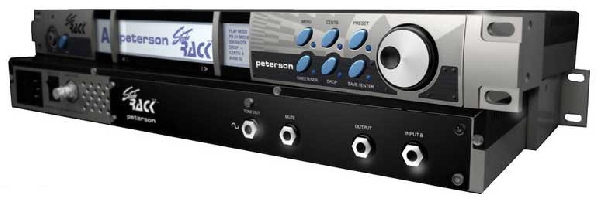
Peterson VS-R StroboRack

Summary: Super-accurate, super-sophisticated, yet super-easy-to-use. With point-one cent accuracy and built-in temperament and sweeteners, plus a huge display, accurate tuning is a breeze with this unit!

Pros: The big display makes tuning extremely easy, and the built-in sweeteners (I’ll get into that in a bit) ensure that once you’re tuned you sound great.

Cons: None, at least from the standpoint of features and capabilities. But as I’m not really a rackmount guy, lugging this around would mean having to get an enclosure. But in the studio, IT IS THE BOMB!!!

Features:

  • 0.1 Cent Accuracy
  • Large, Backlit Virtual Strobe™ Display
  • Exclusive Sweetened™ Tunings For Electric Guitar, Acoustic Guitar, Bass, Dobro®, Baritone, Steel Guitar, Electric Violin- total of 34
  • Buzz Feiten Tuning System® Presets
  • 8 User-Programmable Sweeteners
  • 25 Presets
  • Built-In Mic
  • Mute Button & Remote Jack
  • Tone Out Jack
  • All Metal Construction
  • Neutrik® Jacks
  • 12V BNC Output For Gooseneck Light (not included)
  • Built-In Power Supply (No Wall Wart.)

Price: $359 (street)

Tone Bone Score: 5.0. I’ve used a lot of tuners, and this by far is the most accurate I’ve ever used. Despite it being a rackmount, my use of it in the studio has proven

I used to never be into rackmount gear, let alone sophisticated tuning equipment. But the Peterson StroboRack has me reconsidering both those things, especially in my workshop/studio where tuning accuracy is incredibly important.

I received the StroboRack a few days ago, and since I set it up (which required all of two minutes to plug in the cords), I can see why so many people love these tuners. It’s a completely different way to tune an instrument. Instead of lining up a needle or LED, or even using the “strobe” effect on a TU-2, you tune by making the “checkerboard” pattern on the LCD stop moving. If it moves the left, you’re flat. If it moves to the right, you’re sharp.

Tuning with one of these things does take a little getting used to. First off, I had to really lighten my touch with the tuning keys, and also had to make sure I didn’t put any pressure on the neck. At .1 cent accuracy, even a slight pressure throws off the tuning. But once I got used to it, tuning was a breeze!

Do you take sugar with that?

The StroboRack includes what are called “sweeteners” for specific types of instruments. I’m not sure I understand this idea completely, but it has to do with setting the right intervals between notes – compensating for the type of instrument – so that the tuned instrument doesn’t just sound great tuned up, but when you actually chords, the chords are much more tonally accurate. Apparently a lot of math goes into calculating these sweeteners.

All I can say is that my guitars tuned up with the StroboRack, actually sound better than when tuned up with my little TU-2. It probably has a lot to do with the high degree of accuracy, but I have a feeling it has a lot to do with the “GTR” sweetener. For instance, I did an A/B comparison of tuning with the StroboRack vs. my TU-2. I took my time to get the most accurate tuning I could with both tuners. When I struck an E chord after tuning up with my TU-2, I had to make a couple of minor adjustments to my G and B strings – it wasn’t that the chord sounded bad, it just seemed to sound a bit “off.”

On the other hand, the E chord struck after tuning with the StroboRack with the GTR sweetener engaged sounded absolutely right on!

Fit and Finish

The StroboRack is encased in a nice, heavy-duty aluminum casing. It is really built like a tank, so I have no doubts that it could survive the rigors of the road. But I do advise getting an enclosure for it. It’s still a precision instrument, and should be handled with some care.

Overall Impressions

To say The Dawg digs this unit is an absolute understatement! Last night, I used it to set the intonation on a new guitar I got, and I have to tell you, the big display and scrolling checkerboard really made it easy. I know, a lot of folks would say, “But it’s just a tuner.” Well yeah… but the accuracy it affords you – especially you tone freaks out there – just can’t be beat. This is a unit that I will definitely be adding to my rig!

At $359 street, it’s not a cheap proposition by any means, but hell! We gear sluts spend tons of money each year on gadgets to make us sound better. One would think that sounding better also means being in tune. Of course, Peterson has several other tuners, like the StroboStomp that doesn’t have all the features of the rack unit, but it uses the same “Virtual Strobe Technology” as the StroboRack, so you know you’ll get the accuracy you need.

Mind you, I didn’t try out all the other features like outputting to two outputs, which is pretty cool, or using the XLR jack to go into a board. Those are great features, but frankly, they’re secondary to what’s important with this unit: Accurate tuning.

Read Full Post »

There are some things in life that you just can’t pass up. About a week ago, my friend Jeff Aragaki of Aracom Amps mentioned people finding great vintage gear in pawn shops. I kind of stored that tidbit away for future reference, mainly because there aren’t any pawn shops really close to where I live. But today, I happened to park in front of a pawn shop (I work about 20 miles from where I live), and after lunch, on a whim, decided to go in. This was a little pawn shop that mostly specialized in jewelry, but they had a number of amps and guitars as well.

I wasn’t overwhelmed by the selection of gear; mostly no-name brands that I had never heard of, and as far amps were concerned, cheapo solid-state practice amps. But tucked in behind some guitars was a Fernandes Strat-copy that caught my eye. It had a nice, white finish with a maple neck (I LOVE maple necks), and it was obviously well-used from where I could see it. The shop owner walked up, and I asked to inspect the guitar. I was really impressed by the workmanship. I had heard of Fernandes guitars being very high-quality for a great price, but upon seeing the workmanship up close for the first time, I was very impressed. And even though this guitar was well-used, I could tell it was taken care of because of only minor scratches and dings on the body.

The tag on the guitar said it was for sale for $115 (sorry… if you came from the gear page, I mistakenly listed it at $125), and I asked if she’d take $100 including tax, and she agreed. Unfortunately, they didn’t take plastic in any form, so I had to decline on the guitar. But that was a good thing because it gave me some time to do some research. From what I could glean, this Strat-copy is a late-80’s (’86 and later) model of this guitar. What’s ultra-cool about this one is that it’s pure white. Almost all the pictures I saw today of late-80’s Fernandes Strat-copies were either tobacco burst or a solid that was other than white. This made the guitar a bit more unique. This was confirmed by a former Fernandes endorser that I hooked up with on The Gear Page.

In any case, I got this guitar for a steal!!! I’m going to fix it up, swap out pickups, give it a good cleaning and setup. Don’t know if I’m going to keep it, but no matter. It was a great deal!

So if you have a chance, take a peak into a pawn shop sometime. Oh wait! Another place you could look is at estate sales. A few years ago, I met an older gentleman and acoustic guitarist who SCORED a 1940’s Martin for a couple of hundred bucks at an estate sale, and had it appraised at around forty-grand! Amazing! Talk about a steal!

Read Full Post »

In my quest for gear to review, I literally spend hours each week poring over the Internet and trade rags, looking for cool, new stuff, and I get especially excited when I come across familiar gear that’s expressed in completely new ways, such as the Quantum Drive from Acoustic Imaginearing that uses quantum tunneling to provide distortion. But a couple of weeks ago, I ran across a brand-new guitar company up in Washington called “Woody B Internal Combustion Guitars,” that is doing something so totally unique it has the potential of completely changing how we as guitarists approach tone. I don’t say this lightly. What Woody has invented is nothing short of amazing, and I am extremely excited to have run across this new guitar.

What makes these guitars so revolutionary is Woody’s invention: The Internal Combustion Drive System. This consists of a speaker transducer and special baffles and tone ports that direct added resonance to the strings and body. Essentially, the Drive System is a resonance chamber that builds up the guitar signal (with the help of a pre-conditioner that I’ll get into later) before it goes out to your main amp. According to Woody, whom I had the pleasure of speaking with for quite awhile yesterday, this is a guitar where you can feel your tone resonating throughout the guitar’s body.

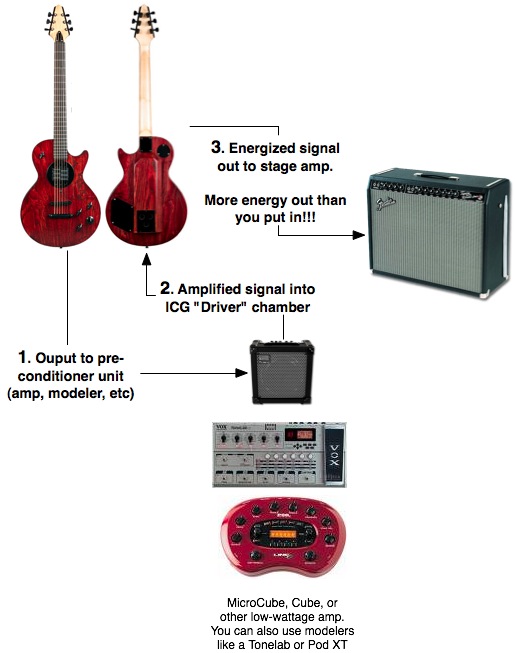
So how does it work? Here’s a diagram. I’ll discuss it below:

internalcombustion

That signal is returned via a special plug that Woody provides that I assume returns the “conditioned” signal as a line-level output (though with a Cube, you should be able to use the Recording Out). The signal then passes into the Drive System, where it’s run through the speaker transducer and allowed to resonated withing the chamber. The signal is buffered, then sent out to your main stage amp.The way it works in principle is actually quite simple. You first send your output to a pre-conditioning unit. This could be a low-wattage solid state amp, or even a valve amp. This is also where you add effects, so you could run this into your pedal board, then into the low wattage amp. The net result is that the guitar outputs more energy than was put in, providing for what Woody calls a much fatter, fuller tone than you would get from other guitars.

In addition, adding to the natural resonance are copper bars that run through the body to the neck, creating a direct coupling between the neck and the guitar. Very cool. Woody B also uses very high-grade woods with four to choose from: Swamp Ash, Alder, Mahogany, and African Black Limba (I dig the Black Limba, myself).

For those of you “in the know,” you might ask, “Moog already did something like this.” Yes and no. Yes, from the perspective that the Moog guitar uses a pre-conditioner. But no from the perspective that Woody has taken a completely different approach to the electronics in the Drive System. First of all, where the Moog has around 3000 parts to produce its sound, and I believe requires external power, the ICG Drive System has only twelve parts. Furthermore, the Drive System is completely passive, not requiring any external power source. Finally, the Moog guitar costs in the neighborhood of $6000, whereas you can get into an Internal Combustion Guitar for as low as $1700. Woody is really trying to keep the price below or as close to $2000 so his guitars are attainable by a wider audience.

Here are some videos that Woody has put together:

Folks, this stuff is so awesome! I can’t wait to try one out! For more information, go to Woody B Internal Combustion Guitars.

Read Full Post »

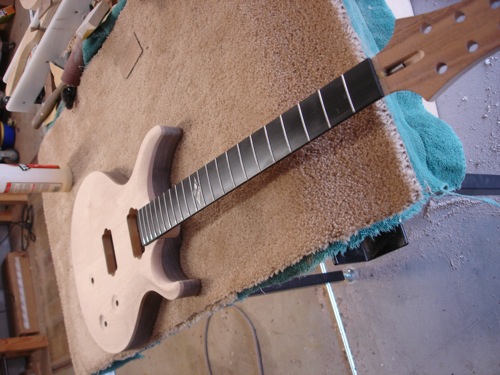
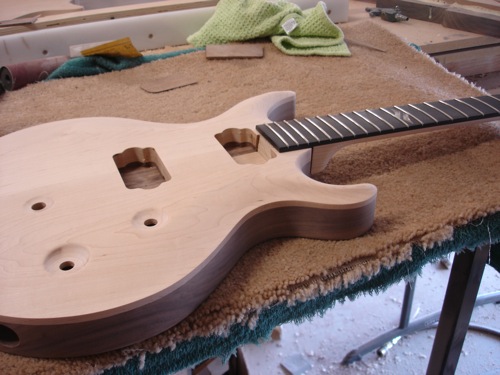
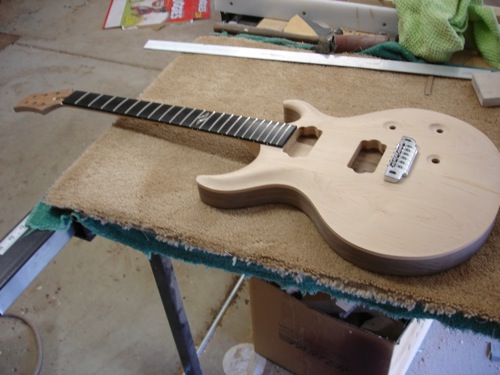
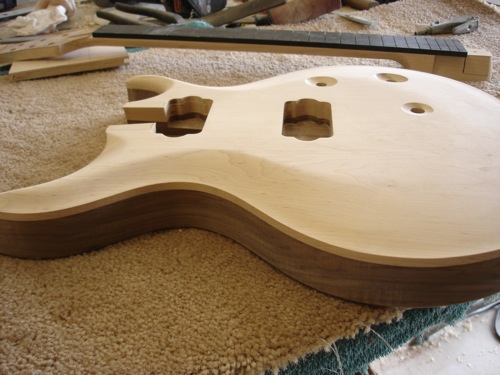
Talk about being blown away! I talked to Adam Hernandez of Saint Guitars the other day just to shoot the breeze and let him know I posted an announcement about his new web site. He in turn thanked me, then absolutely blew me away saying that Goldie was ready for finishing and would be done before the weekend! OMG!!! He sent me some progress pictures from just before finishing. BTW, the finish is vintage Les Paul gold…. Again, OMG!!!

In any case, here are pictures of my guitar right before it went into finishing. I just can’t wait to play her!

I know I probably sound like a broken record and maybe a walking billboard for Saint Gutiars, but these are special guitars. Anyone who has played one of these will attest to that. And to have one of my own is just incredible. Adam and Jon just rock the house with their guitars!

They are also coming up with a new “Vintage” model. I don’t know all the details, but it looks like a semi-hollowbody with a trapeze-style bridge. Very retro!

I just have to say this…

I know there are a lot of people out there who have lots of gear, and who trade their axes after a certain amount of time. That’s totally cool. I’ve spoken to some folks who are concerned about the resale value of these guitars. Because this is such a small company, there aren’t a lot of Saints out there, so there’s no price precedence. But in reply to that all I have to say is that from my perspective, Goldie isn’t a guitar that I’d ever consider trading away or selling. Why would I when she was made to my exact specifications?

For sure, Goldie won’t be the last guitar I ever buy. I’m way too much of a gear freak, slut, maniac, what-have-you, to settle with my collection; it’s a living breathing thing. But Goldie will always be special because she’s the very first custom guitar I’ve ever had, but also she’s the very first Saint Guitar I’ve owned.

Read Full Post »

I was sniffing around the Internet for some juicy tidbits of information, and ran across a great demo by Johnny Demarco demonstrating the various capabilities of this awesome amp! I have a Cube 60, and this amp totally kicks its ass with built-in tap tempo delay, a looper, and 10 amp models. I’ve always contended that the Cubes are just fantastic amps, and the Cube 80x is simply a great amp. And at $349 street, you just can’t beat it for the price. Here’s the video:

That video was a great demo of the amp’s capabilities, but I really dig this one done by Alex Hutchings at Musikmesse 2009. He’s a great player!

Read Full Post »

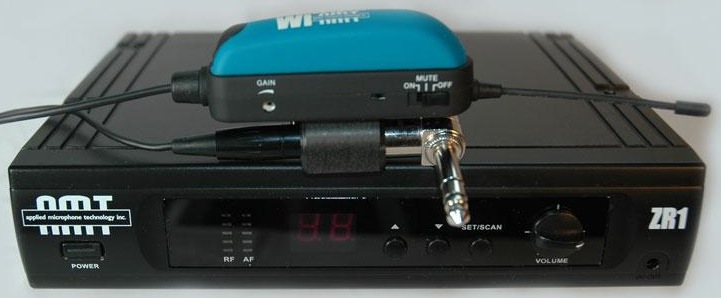
Applied Microphone Technology Wi5GI’ve been in the market for a wireless system for awhile, and there are lots of options out there. But one thing that has kept me from going completely wireless is that most wireless systems out there require the use of a beltpack. The AKG WMS40 is an exception to the rule, and from what I can tell, it’s a great solution for a great price (I have yet to try this unit out).

But the Wi5G shows a lot more promise in that not only can it be used with an electric guitar, you can attach it to an AMT micro-equipped unit on your acoustic guitar. So in terms of versatility, this unit sound pretty cool. Here’s the press release:

The AMT Wi5G — Guitar Wireless System is a removable 16 selectable channel wireless setup. The Wi5G is intended to work with all types of electric guitars. The system allows players to perform wireless without being tied down to a belt pack or wires of any type. The Wi5G features a plug in play style transmitter that is very light in weight. The sound clarity and wireless reception are very high. AMT’s philosophy is to develop the highest sonic quality in there products, and the guitar system stays right in line.

The most impressive feature of the Wi5G Guitar Wireless System is its ability to convert / adapt to all AMT microphones as well. The Wi5G transmitter, by unplugging the included ¼ in adapter, can then plug directly into any AMT microphone with D.C.T. (AMT’s disconnect cable technology). This feature allows the player to use the Wi5G system with there electric guitar, unplug the transmitter from there electric guitar and plug it into an AMT S15G acoustic guitar microphone setup already in place on an acoustic rig. The Wi5G is the only system on the market with the ability to switch from an electric pickup to a high quality acoustic instrument microphone. Along with the ability to switch between 16 channels, this makes the Wi5G and a S15G a valuable set of tools for all guitar players.

The Wi5G wireless system has changed the way a guitarist can perform. By allowing total freedom from wires, a belt pack, and / or a preamp the performers are able to move freely around the performance area. This concept frees up the artist from standing in front of a guitar amp tied down with a cable. The Wi5G assures that every nuance of the performance is heard as the artist intended it to be heard without changing the sonic quality of there instrument rig. AMT has developed there name on this high quality hand made philosophy.

The Wi5G transmitter features an on / off and a mute switch along with a gain adjustment. An LED is featured to show on / off as well as a low battery indicator. One AAA battery is needed to power the transmitter. Designed to be used with either pedals or an acoustic guitar, the ZR series receiver comes with both a ¼ inch and XLR output. The receiver, with an optional rack mount kit, can be mounted in a rack, set freely next to your pedals, amp, or any where close by.

The Wi5G works with all types of electric guitars with the included ¼” jack, as well as AMT microphone models: LS, WS, TA2, Z1, P800, M40, S15G, VS, S25B, and the S18C. Microphones sold separately.

Sound interesting? I think so…

Read Full Post »

5 Tone Bones - Gear has stellar performance, value, and quality. This is definitely top of the class, best of breed, and it's a no-brainer to add this to your gear lineup!

IK Multimedia Stealth Pedal

IK Multimedia Stealth Pedal

Summary: It’s official, IK Multimedia’s StealthPedal has just been released! The new StealthPedal is a lesson in packaging up familiar components to produce something totally unique. This is the first of its kind: A USB-powered guitar audio interface/software controller that you can use for recording or playing live as well as controlling any “Powered By Amplitube” software (or any MIDI-controllable software). With the StealthPedal, IK Multimedia completes the picture in providing an end-to-end computer-based guitar performance and recording solution.

Pros: Truly plug and play, it is automatically recognized by “Powered By Amplitube” software, and requires very little configuration.

Cons: None

Price: $199 Standard Bundle / $399 Deluxe Bundle

Specs:

• USB powered audio interface and pedal controller
• 2 balanced / unbalanced audio inputs (hi-Z or line level)
• 24 bit A/D and D/A conversion
• 44.1/48 kHz operation
• 2 balanced audio outputs
• Headphones output
• Volume control
• Built-in expression pedal and MIDI foot-switch
• Multiple LEDs can operate as Tuner or Level indicators with AmpliTube
• External double switch and expression pedal inputs
• Classic, rugged metal Wah-style construction
• High-quality, low-noise input stage (109dBA /104dB RMS S/N ratio)
• Control all “Powered by AmpliTube” software/plug-ins

• Control any MIDI controllable software/plug-ins

• Standard Bundle includes AmpliTube 2 Live standalone and plug-in, AmpliTube X-GEAR, Ampeg® SVX UNO standalone and plug-in, Sonoma WireWorks Riffworks™ T4, and AmpliGrooves Loops by Sonic Reality
• Deluxe Bundle: AmpliTube 2, Ampeg SVX, AmpliTube X-GEAR, Sonoma WireWorks RiffWorks t4, AmpliGrooves
• Compatible with all the most popular DAW software supporting ASIO and Core Audio drivers on PC and Mac
• Endless software expandability with AmpliTube modules

Tone Bone Score: 5.0 – I love enabling technologies that make anything that I do easier, but also add a ton of value. That can definitely be said of the new StealthPedal from IK Multimedia. A quick glance at picture of the unit, and you may think: Okay, just another pedal-style software controller. It is that, but it is also so very much more!

The StealthPedal is also an extremely easy-to-use, full-functioning analog-digital audio interface that you can use for recording or running modeling software live through your computer. And with 24-bit analog-digital, digital-analog conversion, and 44.1/48 kHz operation, you can count on the SteathPedal to produce high-fidelity sound in the studio an on the stage.

The StealthPedal looks just like a mere expression pedal from the top view. But look at the sides and the input and output jacks belie its humble appearance. On the left side of the pedal are ¼” jacks for right and left output, an 1/8” for headphones, another ¼” jack for a dual-switch external switching unit (extra), and the USB jack. On the right side of the pedal are ¼” jacks for inputs, a volume control knob, and a ¼” jack for plugging in another expression pedal. In other words, this “pedal” packs a punch and is so much more than what it appears!

Wah, wah, wah

It took me awhile to figure out that I had too early versions of X-Gear / Amplitube Fender to be automatically recognized the StealthPedal. My bad entirely. But once I had the right versions installed, adding software stomp effects and controlling them via the StealthPedal was a total breeze! The software automatically assigns the StealthPedal to control the first effect with some default behavior. For instance, with a wah effect plugin, the foot pedal is assigned to the wah effect and the switch is assigned to bypass. But you can change behavior simply by clicking the “setup” button at the top-right of the application window. It can’t get much simpler than that!

In the Studio

But before I even tried using it to control the included Amplitube software, I wanted to see how it performed as an audio interface. In this usage, I was totally blown away! Whereas other audio units such as those from DigiDesign require a software driver to operate (yes, even on the Mac), at least on the Mac, the StealthPedal follows Apple’s lead in design: Plug it in and it just works! So in a very real way the StealthPedal is aptly named as it just does what it does without you knowing how – or having to know how it works! Note that you do need a driver for Windows. But on my Mac, the process to be up and running took less than 5 minutes! That’s incredible!

Launching GarageBand, I just went into the preferences, and selected the StealthPedal as my input and output devices. I ran an unbalanced line from my mic pre-amp into the first input jack of the StealthPedal, added and setup a new track, hit record and started jamming on my guitar that was plugged into my amp. The StealthPedal worked as expected – actually a lot better than I expected because I was expecting only “okay” signal quality, considering the price point of this unit. Boy, was I wrong. The recorded signal was just as clean as my MBox 2, with no apparent shading of any kind. That put a smile on my face. And another thing that really blew me away was that lag was virtually non-existent. There was tiny bit, but nowhere in the realm of the lag that I normally get with my MBox 2. Amazing!

Then plugging my guitar directly into the StealthPedal, I fired up the Amplitube Fender plug-in, selected an amp, and started playing. This was truly the first time I could switch on track monitoring and not get thrown off from the lag!

What’s Not Obvious Is Usually Where the True Power Lays

Think about this carefully because it’s important: The real impact of the StealthPedal is not necessarily in its features, but in what it provides as a solution. As I mentioned above, the StealthPedal completes the picture for IK Multimedia to provide an end-to-end computer-based guitar performance and recording solution. I don’t say this lightly. Not only do they have totally kickass amp and effects modeling, with the StealthPedal, they now have a high-quality, high-fidelity guitar audio interface and software controller! Add to the fact that the StealthPedal requires ZERO setup to use (Mac only, sorry folks), and you’ve got a complete solution for all your computer-based guitar audio. And because the StealthPedal was built to work specifically for “Powered By Amplitube” products, you never have to worry about compatibility problems! I don’t know about you, but that’s just incredible to me. But wait there’s more!

Because it is a MIDI controller, the StealthPedal can also be used with other amp sim software via MIDI. So this just isn’t a solution for the AmpliTube user, it can be used by virtually all recording guitarists, and other musicians as well!

Overall Impressions

What can I say? I dig the StealthPedal! In the next couple of weeks, I’m going on a trip. Guess what’s coming with me? A guitar, the StealthPedal, a mic pre-amp, a mic, and a couple of cords. That’ll be enough to record any song, and besides the guitar, all that will fit into my computer bag!

Read Full Post »

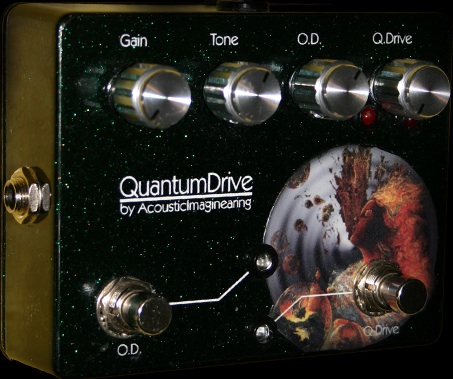
Acoustic Imaginearing Quantum DriveBrand-new from what appears to be a brand-new kind of overdrive/distortion, Acoustic Imaginearing has just released its new QuantumDrive, overdrive/distortion pedal. Folks, this appears to be totally new technology; the first and only that employs quantum mechanics tunneling to produce its distortion sound!

I’m no physicist, so I’ll let you do your own research on what quantum tunneling is. But this is a totally new twist on distortion! Here’s the press release:

The QuantumDrive, A.I.’s flagship product, is a versatile and unique overdrive and distortion unit that uses a patent pending process to dynamically shape the sound of the guitar by means of a quantum tunneling device. Quantum tunneling is a curious physics principle which allows matter to “pass through” other matter which would normally be impenetrable. A.I. has developed a means of using this effect to modify a guitar signal in unique and previously unheard of ways. The quantum distortion appears to add a vowel sound to the signal as well as emphasizing the consonant, fricative guitar distinctiveness. Affecting the edge of the waveform and not just the peaks, the result is a very expressive tone when played “in the zone.” Of course the pedal is also capable of wild and quirky, outside the norm distortions — each distinctive to the instrument processed by the Quantum Drive.

The effect is well suited for both guitar and bass, as bass frequencies are retained without becoming muddy. It has been used by Tony Levin on the latest King Crimson tour.

In addition to the distortion channel, the pedal has a solid overdrive channel, also uniquely designed, that can be used independently or chained together with the quantum channel.

I gotta tell you, I love this kind of stuff! And the fact that this is an overdrive/distortion pedal (you know OD is my favorite kind of pedal) is even better! I’m very excited when inventors add a new twist to something familiar. It just goes to show that there’s no shortage of creativity and innovation in the world!

How It Sounds

There are very limited sound clips available on the site, but the interface to listen to them is a bit screwy. I was able to do a debug trace to figure out the sound clip file names. The following clips were done with a Les Paul with the rhythm pickup into the QuantumDrive and output through a Peavey Classic 30. The clips actually aren’t that good, as the massive amounts of reverb kind of mask what could really be a great sounding pedal. But from what I could here, this is a real open sounding distortion, with just a little fizz. What I like is how the signal tails off.

Light Quantum Drive

Medium Quantum Drive

High Quantum Drive

Note that this pedal also has an overdrive that you can mix with the quantum drive as well.

Where to Buy

You can get this pedal on EBay for $165 as a “Buy It Now” or bid on it for $160 starting bid/$225 Buy It Now (in another auction).

This pedal is so new, they only have two dealers. This is a great find!

Read Full Post »

Wyres Strings

5 Tone Bones - Gear has stellar performance, value, and quality. This is definitely top of the class, best of breed, and it's a no-brainer to add this to your gear lineup!Up until recently, I had never heard of Wyres Strings until I was in a nostaligic mood, and looked up the great French acoustic guitarist, Pierre Bensusan, went to his site, and saw this page, where he was endorsing Wyres Strings. Intrigued, I looked up the Wyres string company on the web, and looked at the various pros who are using them to get an idea of what kind of musicians have used these strings. What I discovered is that the range of musical styles where these strings are used is very wide, ranging from acoustic to hard rock. That was a good sign. I’ve found other “specialized” string companies who only have appeal in a specific genre of music. Not so with Wyres.

Emboldened with this knowledge (and my incessant curiosity), I contacted Nick Walton, owner of Wyres strings to get his story and to see if I could review some strings. I already believed them to be great strings if the great Pierre Bensusan was endorsing them (and according to Nick, this wasn’t due to some “pay me and I’ll endorse your strings” type of deal. Here’s Pierre’s testimony:

Dealing with strings has generally been for me a source of compromise and often frustration. For more than 30 years, I have been waiting for the right medium, embracing top quality but also longevity, fluidity, touch and beauty of-sound. I came across Wyres Strings and found the answers to all my concerns. These strings are just phenomenal, they are handmade, sound extremely well, feel great under the fingers, allow for an extensive use of their sustain to “work” the touch, the tone and the history of the note, they do not break and, icing on the cake, thanks to a very subtle coating which doesn’t not take any harmonics away, they last for ever ! I feel completely relieved and will always remain really impressed with this performance.

Wyres Strings surpass any other brand on the market today! I am proud and honored to collaborate to a Signature set with Nick Walton and his company. A dream came true.

Note that Pierre wasn’t prompted or coached to say what he said. Coming from a master composer and guitarist such as Bensusan, that is quite and endorsement! Okay, let’s get into details, but first, let me say this:

These are hands-down the best guitar strings I have ever played!!! The sound, feel, and playability are amazing! Like Bensusan, I will never use another string manufacturer. I love these! I know, people swear by pure nickel, and admittedly, they are fine strings, but they are also expensive. As a gigging musician with a family to feed, pure nickels are a luxury I can’t afford, but I can afford to spend a few bucks more on high performance strings. And the fact that they’re coated and will last longer than a normal string makes them even more economical. But that’s not my main motivation. These strings sustain for days, and they have tons of tone – but I’m getting ahead of myself.

Handmade and Coated, And They Feel FANTASTIC!!!

All Wyres strings are handmade and hand-wound by skilled craftsmen. They come in both coated and uncoated versions, but the coated are by far their best sellers. Coating is done with a special process that actually lubricates the string as you play, which apparently results in a longer lasting string from both a mechanical and tonal perspective.

Personally, I’ve never been a fan of coated strings. I’ve always found them to be very brittle feeling and over-bright. I tried Elixirs a few times, and couldn’t stand the sound, plus, I felt as if they were cutting into my fingertips because they feel sticky. Wyres feel that way at first, but after a just a short while, the coating starts working into the pores of the strings, and your fingers just glide.

I gigged with these strings last night for the first time, actually playing a bit of roulette by stringing up with these never-before-played strings right before I left for my gig. As expected, when I first put them on, they were as bright-sounding as any new string. But the thing I immediately noticed was that they were very full-sounding as well. I knew that these were very special strings. I was very excited to play with them.

I strung the strings tighter than standard tuning so they’d be stretched by the time I started my gig. By the way, the strings I played are the 12 – 54 version, hence the model TP1254 – they’re equivalent to “lights”). And once I got to my gig and tuned up, and struck my first chord, a huge smile just formed on my face. They sounded absolutely incredible (which I’ll get into), but almost more importantly, they had a great feel, despite the fact that I could still feel the coating. After a few numbers – I set up my opening set list so that I’d play songs that ensured I’d play up and down the fretboard, either with a capo or barre chords – the strings started to settle, and feel really good. I found that I didn’t have to dig in hardly at all to get notes to resound, and doing little runs with subtle microtonal bends was a breeze! The strings felt almost like electric guitar strings. They were pliable and incredibly resonant – the feel of these strings really got me into a groove!

How They Sound

I guess the proof is in the pudding. I’ve played great feeling strings that just sounded dead. But these strings produce gorgeous tones, and as I mentioned they’re incredibly resonant. The sustain from these strings is like nothing I’ve experienced, short of really expensive sets I’ve tried in the past that cost an arm and a leg. In my solo gig, I play a variety of styles from jazz standards to claw-and-hammer fingerstyle songs. No matter what style I played, these Wyres were the best sounding guitar strings I’ve ever played. It’s no small wonder why Pierre Bensusan endorses these strings (though he plays with a set of 13’s, which I’ll review once I wear this current set of 12’s out).

Overall Impression

Obviously, the 5 Tone Bones I assigned to these strings speaks to how much I love them! For me, I won’t be using any other strings from now on. Like Bensusan, I’ve found my string of choice. Now get this: These strings go for $14.95 to $17.95; about the same as what you can get a set of Elixirs for. But these strings kick the shit out of Elixirs, hands down – at least for me. And considering that these strings are nowhere near the brittleness of Elixirs, and they’re handmade, I’ll go with these, thank you. No more machined strings for me!

Read Full Post »

Tone Freak Effects Abunai 2I’ve been playing my Prestige Heritage Elite so much lately that I forgot how fun it was to get funky with my Strat. So this morning, I plugged my Strat into my board, switched on the Abunai 2, and found a sweet spot that would give me just a bit of grind when I played single notes with nice grit when I dug in or played chords. Then I started playing this little funky riff that I just laid down.

I just can’t get over how good this pedal sounds with any guitar! With my Strat, I’ve always tended to play it much more clean than my other guitars. The ’57 Tex Mex pickups – at least to my ears – have never sounded very good with overdrive. I’ve always felt the drive was harsh. But the Abunai 2 really smoothens out the drive, and now I’m diggin’ playing with some real grit on my Strat.

By the way, if you missed the first clip I recorded using my Heritage Elite, here it is below:

My Aracom VRX22 just loves this pedal as well. Some might argue that with such a great amp that has a fantastic overdriven sound that I should be using the natural overdrive of the amp. In answer to that, sometimes I want a completely different overdrive character than what my amp has to offer, and an overdrive pedal through the clean channel of an amp has a totally different character than the drive channel.

Also, in a home studio environment where I have to keep the volume down, an overdrive pedal allows me to get some snarling-dog overdrive without having to crank my amp. And with a pedal like the Abunai 2 that simulates voltage sag and tube compression so well, I can get that cranked amp tone at bedroom levels!

Anyway, I hope you enjoy the clips!

For more information on the Abunai 2, and for other Tone Freak Effects pedals, please visit the Tone Freak Effects web site!

Read Full Post »

« Newer Posts - Older Posts »