Feeds:
Posts
Comments

Just read this in today’s Gibson email feed in my inbox. Great story behind the history of this particular guitar. In any case,Β  the custom shop has made three versions of this guitar, which you can view here. There will be 50 hand-aged and signed guitars, then 100 hand-aged guitars, and 150 VOS models. Oy-vay! That’s a pretty guitar. Prices seem to be around $13k for the aged/signed, $10.3k for the aged, and $7.3k for the VOS. Hmm… a bit better priced than the Jimmy Page #1 re-issue that I saw in a shop for $27k. Oh well, wtf… I don’t think I’d ever spend that kind of money on a guitar even if I had it. I’m not a collector. But it’s sometimes okay to just drool… πŸ™‚

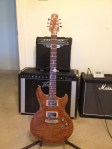
My ’59 replica is finished with a “Perry-burst,” plus has a similar grain pattern to the plain top. Despite the fact that I’d never buy a real Joe Perry, I can attest to the fact that it is a great-looking guitar. The “Perry-burst” is not quite as blonde as a standard tobacco finish. It has a bit of an orange hue to it. Quite lovely.

…to drop your shiny guitar and you buy strap locks.

As soon as I decided to keep Katie May, my first thought was to get strap locks. I learned my lesson about that years ago when I dropped “Pearl,” my 60th Anniversary Strat, and put a big scratch on the front of her from her falling on a guitar stand. Sucked big time. Now, I either buy a guitar with strap locks on it already, or I go out and get a set.

My personal preference is Schaller strap locks. I’ve tried Dunlop strap locks, and did not like them one bit. Maybe it was how they were installed (not by me), but they kept on coming loose. They were quickly replaced with Schallers.

Whether you’re an active musician or a bedroom player, do yourself a favor and get some strap locks. Peace of mind is a good thing…

Ernie Ball Slinky CobaltMaking the switch to steel…

Picked up a couple of packs of Ernie Ball Slinky Cobalt strings yesterday to see if they actually are louder and have more frequency response with the iron/cobalt alloy. Actually, I was looking for a set of RPS-10’s, and I saw these on the shelf. Dug that neon yellow. πŸ™‚ No, I didn’t buy them because of the pretty packaging, though they did stand out somewhat, and I had never played cobalt strings. So I’m going to give ’em a whirl and how they sound.

Speaking of strings, I think I’m done with nickel for awhile. I’ve been using pure nickel strings either from DR or Wyres for the few years. For the blues-centric stuff I was writing at the time, the warmth of the nickel was perfect. But lately, I’ve been exploring a more “edgy” tone – edgy for me at least – and have felt my guitars just didn’t have much “oomph.” So instead of spending tons of money on new pickups, I decided to try switching out strings first.

As a fan of Slash, and especially the tone he gets with a Les Paul/Marshall set up, I looked up what strings he uses, and was pleasantly surprised that he uses Ernie Ball Power strings (the purple pack). Far be it from me to try to duplicate his sound. That wasn’t my goal. What I was after was more punch and especially more brightness, not Slash’s tone. I picked up a set of RPS-10’s and strung up one my ’59 Les Paul replica with them. That guitar was already bright with the Wolfetone Dr. Vintage pickups that are in her, but with the RPS-10’s I felt she had quite a bit more high-frequency bite. Just what the doctor ordered!

With the EB Cobalts, I’m going to first install them on my R8. I’ve still got nickels on her. Hopefully it’ll help resolve some of the warmth issues I have with the neck pickup.

An eye-rolling moment…

I just finished yet another round of 4 gigs in 4 days, which will probably be a regular thing for me the next month as the restaurant fired the Thursday night guy, and the Saturday night guy got really sick then started a show (he’s in theatre). Man, I do love to gig! It’s pretty good money to boot with tips and a decent hourly stipend. The restaurant I work at has been traditionally known as an “Opera Cafe,” so we’ve had singing waiters that did opera and show tunes. I kind of changed the game a bit because while I do some opera and show tunes, I normally stick to classic rock and folk, and have introduced acoustic versions of contemporary and pop songs. The cool thing is that it has opened it up for whoever sings to explore stuff other than opera and show tunes. So here’s the eye-rolling moment…

Over the years (I’m in my 13th year playing there now), we have had a number of voice teachers working at the restaurant. First eye-roller: Almost invariably, the first thing they mention to me when they come to me for accompaniment is that they’re vocal coaches or teachers. It’s as if I’m supposed to automagically assume that they can sing and, that they’re something special. I’ve been performing for over 40 years, and I can tell you this: There are few truly special voices I’ve heard. Don’t get me wrong, there are lots of people I’ve met who are very talented. But like with professional sports, the truly elite performers are few and far between. But here’s the problem I have with voice teachers: They’re never open to constructive feedback! For instance, there was one vocal coach who would always sing songs that were too high for her range, and she’d always be flat with the high notes. I once suggested that we change the key for a song by saying, “That song’s in a pretty high key and I can see you straining a bit. Why don’t we bring it down a step or two, so you can be in the sweet spot of your range.” She gave me this “excuse me” look, and replied, “Look, I’m a vocal teacher, and I can sing this song. We’re going to keep it the original key!” I just laughed and said, “You know, I didn’t say anything to attack you or make any comments on your tone. You’re straining with that song, and I just want you to feel comfortable.” She just sneered and walked off. Arrogance. Ugh!

On the other hand, I worked with a guy who was an active performer in musical theater at the time, but who is now working on Broadway. He was such a joy. He had this really high tenor voice, that was a bit nasally; a bit like Michael Crawford. The thing about him was that not only did he take feedback and listen respectfully to suggestions, he always asked how he could do better; and even better than that, would often ask for my feedback on what songs would be good for him to sing. He was someone who didn’t want to sing songs just because he liked them, or what he thought the audience would like. He wanted to sing songs that would bring out the best qualities of his voice so he could give a maximum performance. To me, he is a true performer. He approaches his craft with humility and an open heart, and guess what? It shows in his performance. Truth be told, he actually didn’t have that strong of a voice. He wasn’t off key, but he hadn’t developed power at the time we worked together. But he was self-aware and mindful of what tools he did have, and he WORKED them! Not a small wonder why he’s working as a professional.

More adventures with the VHT Special 6

Excuse the pun, but vht_special_6_frontthere is indeed something very special about the VHT Special 6. I got mine a couple of years ago within the first week of its release. It was a total impulse buy. I was in Oregon, just outside of Portland, on my to drive out to the Oregon coast when I saw this music shop across the parking lot from where I was filling up my gas tank. I of course had to check it out. While I was browsing through the store, the owner, who was showing me around, led me over to the amps as he wanted to show me and amazing little amp that had just arrived from VHT. At first glance, I have to admit that I wasn’t impressed, but I slung on a guitar and plugged in. Okay, I was immediately impressed by the tone, especially coming from a 10″ speaker. Then the guy shared that the amp was hand-wired in China, and when I looked at the price of $199.00, I said, “Okay, I’ve seen and heard enough. Pack it up.”
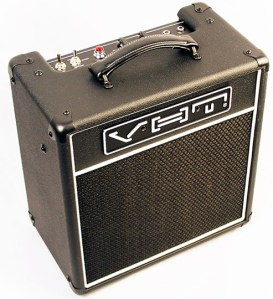
While I really didn’t have a problem with its stock tubes and speakers, I did swap those out. I swapped the speaker out for Jensen Jet Electric Lightning because I was evaluating the speaker for Jensen, and decided to keep it. I swapped the tubes out simply because I had some extra circa-1950’s NOS tubes sitting around, and well, I wanted to put them to use. πŸ™‚

Used the Special 6 yesterday with Katie May (yes, I decided to keep her), andΒ  I have to say that that amp just sings! It has a lot of clean headroom, so it’s perfect for use with a distortion pedal. This is one of those rare amps that you can use anywhere. It could keep up with a band with the right cabinet. In fact, at yesterday’s gig, we played as a power trio, and it kept up just fine. I just made sure to keep the amp close to me, and just relied on my sound guy to get my tone out to the audience. It’s a lovely-sounding amp!


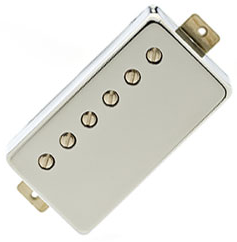
imperialI just put down “Katie May,” the wonderful guitar I just reviewed from Perry Riggs’ Slash L Guitars. From the first time I plugged her in up to now, one of the most striking things about the guitar that I shared with Perry was the incredible tone and dynamics from the Lollar Imperials he installed. Having played Les Pauls for years, one thing I’ve become accustomed to is the “bloom” from the pickups when sustaining a note.

It’s hard to characterize exactly what “bloom” is and unfortunately it’s difficult so record. But when a pickup “blooms” I hear and feel it as a subtle change in character of the note being played. The overtones and harmonics seem to take over, creating a sweet-sounding tail-end to the note. With a Les Paul, the overall experience of the note is a distinctive “honk.” It was a very pleasant surprise to hear the Lollars do that.

Apparently, the Imperials are PAF-style pickups, and from what I’ve been able to gather from other sources, many people have found them to be great replacements to the BurstBuckers in their Les Pauls. After my experience with them, I’d tend to agree with that. But we’re talking about Katie May, and in Katie May – excuse the cliche – they’re a match made in heaven!

One thing that is notably different in the Imperials compared to BurstBuckers is the smooth top-end. There’s just enough high-end sparkle to provide a great balance to the tight low-end these pickups produce, but it’s not ice-pick sharp. I wouldn’t call them warm which, especially with a Les Paul, often translates to a muddy tone in the neck. The Imperials, on the other hand, whether in neck or bridge are extremely balanced. Of course, the neck pickup is warmer than the bridge pickup; that’s to be expected. But it’s not muddy as this clip illustrates:

For more clips, check out the review of Katie May.

This is a simple riff but what I wanted to demonstrate with it is that while there is a definite emphasis on the low-end, it isn’t so much that it muddies the tone. When I hit the lower strings, you can hear the notes clearly.

Another incredible thing about the Imperials is their incredibly wide dynamic range and sensitivity. For instance, I can set an amp at the edge of breakup, set the volume on the guitar at about halfway, and easily roll overdrive up and down, setting it to exactly the amount that I need. Could be the pots that Perry has used. Volume changes are very even throughout the entire sweep of the pot. Irrespective of that though, the pickups respond beautifully.

Having been around gear a long time, there seems to be a lot focus on tone woods when talking about guitars. Make no mistake about it, tone woods are important, but pickups are a huge factor in tone and I find that they’re often overlooked. I liken them to tires on a car. You have to have the right tires for the car. If you don’t, not only will they look funny, they’ll affect the performance. You wouldn’t put passenger tires on a Ferrari, would you? Or you wouldn’t waste money on Z-rated tires for your Nissan Versa (maybe a “ricer” would – worst I saw was a whale tail on a Corolla – but that’s an entirely different topic). So it is with pickups. You can have an absolutely gorgeous guitar that sounds like crap due to the pickups. I got lucky with my R8 which has BurstBuckers. I love ’em in that guitar, but I’ve played some LPs that sound horrid with the same pickups! The point to this is if you have a match between guitar and pickups, your world will be right. With Katie Mae, because of how she plays, I could sit with her all day long and never get tired of how she feels. Add to that the awesome sound of the Lollar Imperials, and all is right in the world!


Here’s a quick quip from the NAMM news page on the Gibson site:

Gibson has designated 2013 as the Year of Les Paul, paying tribute to the avid inventor, expert player, creative sound engineer, and long-time partner of Gibson Guitars. The entire Les Paul collection will be showcased at NAMM – that’s awesome, still bringing in guitars from the bus though… Set-up day is crazy!

As I said yesterday, there really hasn’t been much to compel me to go to NAMM. But I’d actually go – just for a day – to see the entire Les Paul collection, and I could salivate over all the LPs I can’t have because I’m too broke to buy one. πŸ™‚ That’s okay, I’m happy with the two I have and I’ll never sell them.

As for Gibby dedicating this year as the Year of the Les Paul well… when isn’t it the Year of the Les Paul for Gibson? Personally, even before I was into Les Pauls, when I saw the Gibson logo, or heard the Gibson name, the image that came into my mind was that of a Les Paul. Not an SG, not an Explorer, not a Flying V. But a Les Paul. I suppose it’s because of the bands I listened to as youngster: Peter Frampton, Cream, Heart, REO Speedwagon. They all played Les Pauls.

Look, I don’t want to knock Gibson. It’s a venerable brand. But to me at least, EVERY year is the Year of the Les Paul. πŸ™‚

Ho-hum… Not going yet again… And probably won’t make Summer NAMM this year – again…

I’m not pouting, though… Unfortunately, I’m just not much of a convention-goer. Yeah, there’s really cool stuff, and yeah, several manufacturers have offered me passes and asked if I’d come by their booths or rooms to do interviews and try out gear. Then there’s all the SWAG, the concerts, etc., etc…. Gear slut like me pass that up? Unfortunately, my sense of duty outweighs my sense of fun, and I’m right in the middle of a huge project at work, building the UI for the first release of a completely brand-new product.

But then again, while I love gear, I’ve never been all that compelled to go to the biggest gear convention in the world (or is Musikmesse bigger – dunno). I used to go to tech conventions all the time; the funnest being the Borland Developer Conferences. Phillipe Kahn, Borland’s founder, was an avid musician, and would always have a jazz band playing, and you could jam with them at night in the bar. That was pretty fun.

But I have to admit that conventions have always been information overload for me. I come back exhausted and drained. Yeah, I’ve had a lot of fun at conventions, but frankly, at my age, my idea of a good time is much more mundane: Sipping on a glass of fine wine, retreating to my “man cave” to mess around with gear, going to a nice dinner with the wifey, playing with the kids. Damn! I’m getting old!

I’ll probably eat my words, and eventually I’ll make it to a NAMM in the future. But at least for now, I’m content reading the manufacturer announcements…

5 Tone Bones - Gear has stellar performance, value, and quality. This is definitely top of the class, best of breed, and it's a no-brainer to add this to your gear lineup!

Slash L Guitars
Summary: Yet another custom beauty from Perry Riggs, owner, and luthier of Slash L Guitars. This amazing through-neck guitar is not only aesthetically gorgeous, it’s capable of some incredible tones!

Pros: Lightweight (Perry lists at 8 lbs, but it feels even lighter). There’s a lot to be said about the through neck design. Tone comes from the neck and this laminated mahogany and maple neck creates both a jangly and lush tone, with sustain that’s on par with a Les Paul. I’m in heaven!

Cons: None. Absolutely none.Price: Call

Features:

  • Body: Quilted Soft Maple over Ribbon Sapele Mahogany
  • Neck: Grain-matched Flamed Hard Maple and Mahogany / Wide, Shallow “C” profile
  • Fretboard: Bound Honduran Rosewood / 24 frets – very nice
  • Nut: 1 11/16″ Bleached Bone Nut
  • Gotoh 510 hardware (my favorite – a wraparound bridge, and super-accurate tuners)
  • Lollar Imperial Pickups
  • Master Volume, Master Tone
  • 3-way pickup selector

Tone Bone Rating: Wow! Starting off the year with two 5.0 reviews! What can I say? I got pretty lucky! πŸ™‚ Perry Riggs is a guy who loves building guitars, and the workmanship and tone of his excellent instruments never cease to amaze me!

What comes out of Texas? Great barbecue beef (especially brisket), a fantastic music scene in Austin, and Slash L Guitars out of Richmond. Perry Riggs discovered my blog a couple of years ago and asked if I’d like to review one of his guitars. He was a luthier whom I had never heard of, and after having a nice phone conversation, I agreed to review “Lana.” If I was impressed by Lana, I am even more impressed with Katie May. It’s clear that in the couple of years since I reviewed Lana, Perry has honed his craft even more. Katie May is an incredibly expressive and sophisticated-sounding guitar, and I’ll just say it now: If I had the money on hand, I’d keep this guitar, and make it my numero uno! That’s how good this guitar is!

Fit and Finish

When you purchase a custom guitar, you’re not purchasing something that you’ll resell. After all, a custom guitar is a pretty personal thing. Perry usually builds on commission, but then he occasionally builds some for inventory, like Lana and Katie May. I have to say that Katie May feels as if she was made just for me. πŸ™‚ The neck is absolutely perfect, and dynamics and feel are EXACTLY how I like them.

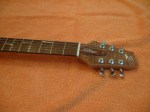
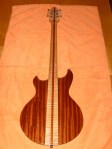
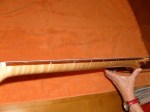
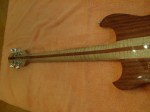
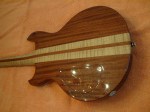
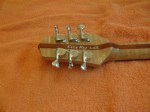
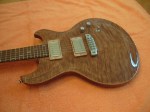
The finish and workmanship that went into this guitar make it look like a piece of furniture! Everything about this guitar just screams organic. There’s a certain understated quality to this guitar that’s hard to describe, but it just looks “natural,” as if everything that should be on the guitar is on the guitar. There’s nothing extra, and there’s nothing missing. Check out some pictures:

The pictures don’t do the guitar justice. I wish I had more time to do a photo shoot of the guitar, but unfortunately, the demands of work precluded me from doing so. The quilted maple top is absolutely insane. I love how Perry used a simple stain then glossed it over with lacquer. I know, I’m really a burst kind of guy, but I’d use this on stage any day!

How It Sounds

The Lollar Imperials are absolutely incredible. They’re the perfect set for this guitar. Even though they’re just standard wound, they have a gain range that super-wide, and when dimed, they produce an absolutely velvety-smooth overdrive tone. When I gigged with the guitar over the weekend, when it came to leads,Β  I just closed my eyes and soaked up the wonderful tone of this guitar! Here are some clips (all recorded with an Aracom VRX18 in the drive channel cranked. The Lollars clean up fantastically!):

  • Middle-clean / Dead or Alive (Bon Jovi)

With this clip, I wanted to capture that simultaneous lushness and jangle that the guitar can produce. It’s best when in the middle position. When I gigged this weekend, I used the neck pickup with delay and spring reverb for a haunting, fingerstyle tone.

  • Neck-dirty

With that clip, I wanted to demonstrate the punch of the neck pickup, from which the guitar gets is super-lush, deep tones.

  • Bridge-dirty

This clip was all about “fun.” I used that song to demonstrate the “spank” of the neck pickup. It can create some searing lead tones, but with the volume backed off, will provide lots of snap.

  • Bridge clean and dirty

Remember I mentioned the spank of the bridge pickup? That’s most evident when playing a funky, clean riff. Combine that with an incredibly smooth and refined lead tone, and you’ve got a guitar that can create all sorts of tones!

By the way, my total rig for these demo clips was the guitar plugged directly into the Aracom VRX18 into an Aracom PRX150-Pro then out to my custom Aracom 1 X 12 cabinet with a Jensen Jet Falcon 12″ speaker. Amazingly enough, all clips were recorded at normal conversation levels. The PRX150 never ceases to amaze me! In any case, I miked the cabinet with a Sennheiser e609 instrument mic fed into a Presonus TUBEPre and into my audio interface. Everything was recorded using Logic on my Mac with no EQ or effects added, so what you hear is the raw guitar sound. I didn’t want to muddy the waters by running it through any effects.

Playability

Normally, it takes me awhile to get used to a guitar; especially a custom guitar. But Katie May was playable right out of the box. For me, the neck is absolutely perfect. It’s super-fast and the medium-jumbo frets just do not get in the way. They’re deep enough to provide some room for vibrato, but they’re low enough where they allow you to move around very easily. In fact, when I record the lead for the last clip, I actually had to take several takes because I kept on going too fast! That’s saying a lot for me because I’m not really a fast player.

Overall Impression

The rating says it all. Great looks? Check. Great sound? Check. Great playability? Check. This is a guitar that I would add to my collection any day, and I’m going to be jealous of the person who ends up with her. Kudos to Perry Riggs for creating such a masterpiece of a guitar! And by the way, Perry, if you’re reading this, I now hate you for torturing me with this guitar. I’m a horse, and Katie May is the carrot that’s dangled in front of me. πŸ™‚

The rating says it all. Great looks? Check. Great sound? Check. Great playability? Check. This is a guitar that I would add to my collection any day, and I’m going to be jealous of the person who ends up with her. Kudos to Perry Riggs for creating such a masterpiece of a guitar! And by the way Perry, if you’re reading this, I now hate you for torturing me with this guitar. I’m a horse, and Katie May is the carrot that’s dangled in front of me. πŸ™‚

The rating says it all. Great looks? Check. Great sound? Check. Great playability? Check. This is a guitar that I would add to my collection any day, and I’m going to be jealous of the person who ends up with her. Kudos to Perry Riggs for creating such a masterpiece of a guitar! And by the way Perry, if you’re reading this, I now hate you for torturing me with this guitar. I’m a horse, and Katie May is the carrot that’s dangled in front of me. πŸ™‚

5 Tone Bones - Gear has stellar performance, value, and quality. This is definitely top of the class, best of breed, and it's a no-brainer to add this to your gear lineup!

Β DSC_0344

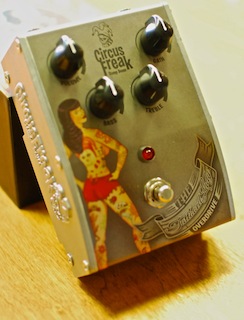
Circus Freak Tattooed Lady Overdrive
Summary: Whether you’re looking for a reactive overdrive or an amp-in-a-box, this pedal delivers! Combine that with great tone, and at least for me, there’s nothing to dislike about this pedal.

Pros: Superb dynamic response, with lots of volume and gain on tap.

Cons: None.

Price: $149.00 Street

Features:

  • Volume and Gain controls (volume has lots of output gain)
  • Independent Active Bass and Treble EQ controls
  • Amp-like dynamic response
  • Incredibly touch sensitive
  • Voice Toggle (up = flat response, down = slight treble boost for thicker-sounding guitars)
  • True Bypass
  • Can take up to 18v input power

Tone Bone Rating: 5.0 ~ I don’t give these out lightly; especially to brand-new gear manufacturers, but after playing with this pedal for past few weeks, I just can’t find anything NOT to like. I’ve thrown it in front of four different amps used it with three different guitars, and love its tone with every combination!

I’ll admit it. I find chicks with tattoos incredibly sexy. Not too fond of “tramp stamps” but tats on the rest of the body are a turn-on for me. So I suppose I had a predisposition for liking the Tattooed Lady Overdrive by Circus Freak Music. πŸ™‚ But truth be told, I certainly did have an underlying excitement prior to receiving the pedal for review after having an introductory conversation with its creators back in mid-December. I felt that for the first time in a long time, a new player to the guitar gear market “got it,” bringing not only great technology but solid business acumen to the table. The guys at Reason Amps certainly got it when they came to market, and my very good friend, Jeff Aragaki with Aracom Amps gets it for sure. Lots of boutique guys are nice guys who make gear as a hobby and go into business after building up a local following, but lots of time, they get kind of lost in the background noise of all the outfits that come to market each year.

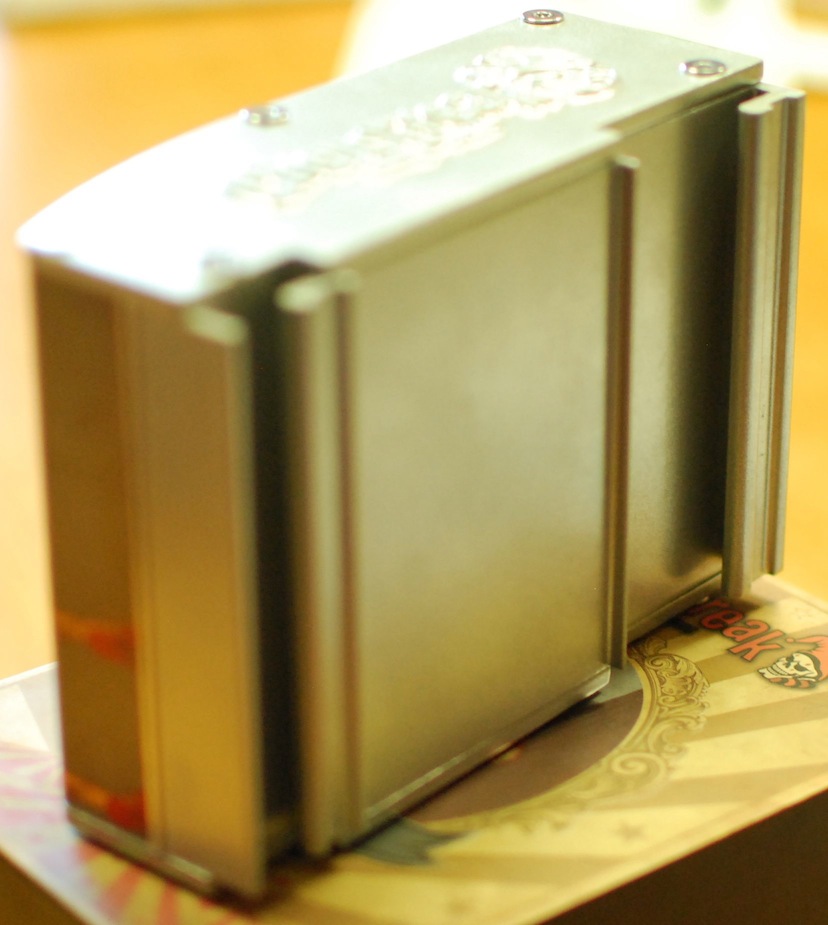
tl_bottomSo what sets Circus Freak apart from other pedal manufacturers? Frankly, they have a vision which ties their current lineup of products with their future ones. For instance, it’s one thing to say you’re eschewing the typical Hammond box for a custom box. Lots of folks do this. But it’s obvious that the customizations aren’t just to be different. They’re functional. For instance, the bottom of the custom box (shown at right) has been purpose-built for mounting on some sort of rail system – there’s definitely a pedal board on tap, even though they haven’t released one yet!

Who’s to say if a business will be successful or not. People have to like and buy your products. But having been a poster-child for startup companies in my career as a software engineer, I can tell you that having a unifying vision and executing on that vision – while not necessarily guarantees to success – certainly provide a foundation for success, and that’s what excites me about Circus Freak Music.

But I digress… let’s talk about the pedal, shall we?

Fit and Finish

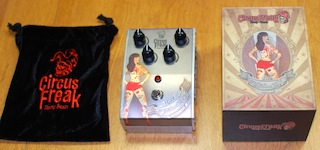
DSC_0338Part of the vision that Shannon and AJ of Circus Freak shared with me was that they wanted their products to be likened to sideshow performers of old. One thing about sideshow performers is that they’re memorable, so it was important to the guys to create a visual package that people wouldn’t easily forget. Not only is the enclosure unique, as I mentioned above, but each pedal comes in a velvet bag, and boxed with aΒ  box that has some incredible graphics! These guys put a lot of thought into their image, and their execution reflects the depth of thought. Of course, time will only tell how that will work for them, but they certainly have made a great start!

How It Sounds

As they say, “the proof is in the pudding,” and as far as performance is concerned, the Tattooed Lady provides the proof of operation and tone that back up their packaging. For the first couple of weeks that I had the pedal, I had it hooked up to my little VHT Special 6 combo. That amp has lots of clean headroom, so I really got a feel for how the pedal stood on its own. As an “amp-in-a-box,” I was totally blown away! I set the pedal to unity volume, which is just past 9am on the volume knob, and set the gain to about 3pm. At that setting, I could control the breakup of the pedal purely through attack and guitar volume changes.

The distortion that the pedal produces is nice and open. There’s a very slight compression, but it never gets squishy, even when I have my guitar volume all dimed. That’s very amp-like in nature! Because of time constraints (I’ve got lots of gear that I’m reviewing right now), I only have a single clip, but it’s a clip that really captures the dynamic range of the pedal. I first start out playing a simpleΒ  arpeggio chord progression with the pedal disengaged, and my Les Paul volumes both at under halfway. I then switch on the pedal. One thing you’ll notice is a sudden increase in definition with just a touch of volume increase. At this point, the guitar’s set the same way, and I’m still picking pretty lightly. Then I get into strummed chords and crack my bridge volume to play a Townshend-like chord progression. What totally amazes me is that even with fully-strummed chords, the note separation is maintained! Finally, I back down the volume back to where it was, and the tone completely cleans up.

Here’s the clip:

What turns me on about the open distortion this pedal produces is that it’s UGLY – in a good way. It’s got that edgy, snarling-dog quality to it, and with the church music I write and play, that provides a contrast to the much softer message in my songs. πŸ™‚ I love the juxtaposition!

Mind you, this pedal is also very loud, and though I did test it to slam my pre-amp to break it up, and it does a fantastic job with that, I’ve relegated that duty to my trusty Timmy which I use as my transparent overdrive/booster. To me at least, where the Tattooed Lady totally shines is as an amp in a box. YMMV, of course… And don’t mistake my use of it as a pure distortion pedal. That’s a completely different animal and is square-wave. There’s a big difference between that and a soft-clipping device like an overdrive.

Overall Impression

I’m not returning this pedal. Sure, I’ll pay for it, but I’m not returning it – ever. How’s that for an overall impression? I’ve been looking for an amp-in-a-box overdrive for a long time, and this is the first pedal in that long line of pedals that completely fits my tastes. Sure, there are others out there like the Caitlinbread Dirty Little Secret or the GeekMacDaddy British Ball Breaker, but those are specifically full-strack Marshall-esque type pedals. I’ve been looking for an overdrive that was brand-agnostic. Honestly, I don’t know if it was ever meant to be used like this considering all the volume on tap, but that’s how I’m going to be using it – so there! πŸ™‚

ROCK ON!

I’m not really an American Idol fan, but my daughter was watching it and I had a bit of time to kill before leaving for my gig yesterday. So I sat down to watch the show. I didn’t know that they had a whole new set of judges on board – like I said, I’m not a fan and don’t keep up with any “Idol” news – so it was a pleasant surprise to see that Keith Urban was one of the judges. I dig that guy!

Not surprising to me was that it was Keith Urban who said something that struck me. The judges were discussing a person who had just left the room after their audition, and all the judges were commenting on his easy-going style and his natural feel. Then out of nowhere, Keith Urban said, “He’s like what they say about real musicians. They’d do it anyway.”

That struck me to the core and made me smile because I said something similar to that to my wife years ago when we first got married. She was trying to push me – lovingly, mind you – towards make music a full-time profession. I told her that the reality is that we have a family to raise and that takes precedence. “Besides,” I said, “I’d do music anyway, whether I was professional or not. It’s a large part of what defines me as a person.” I also absolutely love software engineering, and frankly, I wasn’t about to give that up; especially since I was experiencing so much professional success in that area and have had a lot of success to this day.

But I never gave up music. Like I said those years back, it’s part of what makes me who I am as a person. I just do music as a matter of course in my life and really don’t think about it too much. I write the occasional praise and worship song, I record when I can, and I gig a lot (I did about my average of 150 gigs last year). I get paid for almost all my gigs, but there are some I do gratis. I just love to play.

Speaking of getting paid, I remember lurking through a thread on a popular musicians forum a couple of years back where people were debating about whether they’d do a free gig. There were some folks who said they’d play for free, but most said they’d only do a gig if they got paid, and some were quite emphatic that they’d NEVER do a free gig under any circumstances. Though I didn’t reply, the thought struck me that those folks probably don’t gig all that much. I could be wrong, but to me, that’s a bit of a shit attitude.

I did a few free or very low-paying gigs last year. But my take on those was that I needed to take the long view with those gigs, because invariably, people would take my card when I’m done. I’ve been hired several times for gigs based upon people seeing me previously, so I I don’t get paid then, I’ll make up for it later. πŸ™‚ But moreover, I just want to play. It goes back to what Keith Urban said about the real musicians. For me, I don’t claim ultimate virtuosity on my beloved instrument, but as the saying goes, I’m going to play anyway…

ROCK ON!

Yeah, seemingly a bit off-topic from this blog, but I thought I’d share it just the same because no matter what you do in life, there are always opportunities to both learn and teach leadership. I’m currently about halfway through this excellent leadership book by Col. Lee Ellis, USAF (ret.). It’s a fascinating story of his days in the “Hanoi Hilton” POW camp during the Vietnam War, and the subsequent leadership lessons he learned while incarcerated.

I purchased this book two days ago, and have had a very hard time putting it down. Not only is Lee Ellis’ story of being a POW fascinating, but his leadership lessons are just about the most pointed and frankly the best I’ve read (as a longtime technical manager, I’ve attended several leadership seminars and have read many leadership books). Take, for instance, his lesson on resiliency. Here’s an excerpt from the book:

Authentic leaders know that life is difficult. They expect to get knocked down, and they have the proper attitude and outlook to persevere. You have a choice about how you will respond to difficulties. Confront the brutal realities of your situation, but never give up hope. Develop your plan, connect with your support team, and bounce back.

That statement hit me like a ton of bricks! While it was more of affirmation lesson for me, that pointed statement distilled down a concept that I have always felt to be a tenet of great leaders: They bounce backΒ  by never quitting, and calling upon the support they can garner to get the job done.

I look at my own experience as a music ministry leader at my church. When I first started, there were lots of naysayers; in fact, there were some that quite plainly and rudely said that my newly-founded group wouldn’t last more than six months. But here we are, 12 years later, and growing stronger each year. When I first heard that feedback, it admittedly depressed me. But I had a vision for the group that extended far beyond the limited perspective of the doubters and detractors, and I stuck to my principles, picked myself up, and fought through my own fear of failing. We now have a dedicated core group of adults and teens who come week in and week out; making their participation in the ministry a priority in their lives. We’ve even had a few of our younger members return to the group after moving away to go to college!

You see, that wasn’t just me doing the leading, but making sure that everyone – adults and teens alike – practiced leadership among our group and with the community at large. That was my vision. I knew that though I have a fairly “out-there and in-your-face” personality, that it couldn’t be just me that would make our group successful. It would have to be a collective effort founded on the dedication and inspiration of our members. It worked.

So when I read that passage in the book, it made me smile because it reminded me that true leaders – great or small – have the resiliency to bounce back in spite of adversity and overcome it.

ROCK ON!!!