Feeds:
Posts
Comments

Over the years, I’ve tested and played and owned several overdrive pedals, from TubeScreamer types to transparent, to amp “simulator” types of overdrives. Not knowing the exact number of overdrive pedals on the market, I’d venture to guess that are probably at least a couple of hundred overdrives from different builders from which to choose that are available to guitarists today. And new overdrives continue to hit the market each year; granted, the rate at which they’re popping up seems to have slowed over the last couple of years, but people are still building them.

But given the literal glut of overdrives available to us guitarists, I continually ask myself if the new overdrives arriving on the market are relevant; or are they just a “copy cat” effort meant to capitalize on the success of previous products?

To answer that question, I’ve had to look at the landscape, as it were, of the overdrives out there (mind you, we’re talking overdrive as in “soft clipping,” not distortion or fuzz). In general, to me, overdrives fall into two camps: TubeScreamer-type overdrives, and non-TubeScreamer-type overdrives. This has more to do with history than anything else. Back in the early- to mid-70’s, Maxon came out with the OD-808, which was then picked up by Ibanez and eventually called the TubeScreamer (it was simply called Overdrive and Overdrive II before that), though early versions had the TubeScreamer brand, but the “Overdrive Pro” designation. All that aside, that original pedal, which used the JRC4558D OpAmp chip, created the foundation for several follow-on variants; but the “style” was marked by the mid-range hump that the JRC4558D chip produced. On the market today, you have several TubeScreamer variants from all sorts of builders including Danelectro and DigiTech for mainstream builders, to boutique builders such as Doodad Guitars and Tone Freak Effects.

In non-TubeScreamer land, it’s almost impossible to name builders purely because there are so many that offer so many different approaches. Some, such as Creation Audio Labs and Paul Cochrane or even TC Electronic go for transparency; other builders such as GeekMacDaddy build overdrives to simulate amp stacks; still others build pedals based upon entirely different vintage circuit topologies from the TubeScreamer such as the ColorSound Overdriver. Still others try to push the limit by combining an overdrive circuit with something else (Pigtronix comes to mind here).

Now given that, I think I’ve answered my own question. I believe that despite the shear numbers of overdrive pedals on the market, new overdrives are always relevant purely based upon their variability. Moreover, not all overdrives work well with some rigs. The reason I have so many overdrives in my possession is that depending upon the amp I’m using, some pedals just work better than others, though I do have to say my Timmy pedal works with everything I have; even my Fender Hot Rod Deluxe, which is actually a pretty finicky amp.

The only problem with having so many overdrives available kind of boils down to the classic fable: You have to kiss a lot of frogs before you find the prince (or princess). That doesn’t reduce the relevance of new overdrives, but it does make it harder to find the right one for your rig.

ROCK ON!

Ever since I’ve been playing guitar, I’ve been using a capo. My capo of choice is the Kyser Quick Change Capo (shown to the left), but I’ve used Shubb capos as well. I prefer the Kyser because it’s great for mid-song key changes, something I learned from watching James Taylor play “Your Smilin’ Face” on a TV special years ago. Up to that point, I was using Shubb capos which are great for getting just the right tension, but forget about mid-song key changes.
Anyway, yeah, yeah, yeah… some “purists” call them “cheaters.” But I regularly play 4-hour acoustic gigs, and frankly, I just couldn’t do without a capo. Being able to Capo III play D to play a song written in F is a helluva lot easier than using all barre chords, plus it frees up my fingers to more complicated runs. To each, his or her own…

Vamping on my 80’s band reminiscing, I wanted to post a video of one of my favorite bands of that time, Night Ranger.

This was right in the middle of the glam rock days, and what I loved about Night Ranger was their ability to write and perform a wide range of music from pop to hard rock, but always with an emphasis on screaming, melodic electric guitar. Brad Gillis was a wizard of the Floyd Rose trem, while Jeff Watson absolutely rocked a Les Paul (that 8-finger tapping was insane).

So the question arose – why aren’t there bands like this any more? Maybe it’s just the old guy in me who just love this kind of music, but bands like this just affirmed my love of the guitar, plus at the time, were a ray of hope in the dreary sea of copy-cat glam bands. And even though Night Ranger was a contemporary with the likes of Poison and Motley Crue, they never took on the glam affectations, and produced well-written songs that ROCKED THE HOUSE! I also dug that you never heard of them partying (though I’m sure they did their share of it), or their debauchery, or nonsense like that. To me at least, they were a group of hard-working musicians whose only aim was to rock it every night.

I was reminiscing about my favorite rock bands, Night Ranger, this evening, and ran across this video from guitar great Jeff Watson (who is also a NorCal boy) and founding member Night Ranger on the proper micing of acoustic and electric guitars. While I dug Brad Gillis, I always dug Jeff Watson because of what he could do with a Les Paul. Besides, I was always in awe of his 8-finger tapping! Check it out:

For years, I’ve used two mics for acoustic very similarly to how they do it in the video (though I don’t have a Telefunkin). But I’ve actually preferred using a ribbon mic pointed at the 12th fret on acoustic. It seems to capture a much more rounded tone on my guitars.

As far as electric goes, I use a Sennheiser e609 Silver, along with a ribbom mic. But what struck me about what they were doing on the video was also using a large diaphragm mic. Then on top of that, all the mics were close in. I’m going to have to try that some time.

Anyway, there’s a lot to learn from this vid. Glad I found it!

Gruesome Album Covers

I was perusing the Web for Halloween-themed, guitar-related material, when I came across this article at GuitarWorld.com entitled, “The 13 Most Gruesome Album Covers.” And tucked between #1 and the #2 most gruesome album covers was the album cover for the Poison album, “Look What the Cat Dragged In.”

Talk about getting a great laugh! During the ’80’s, I really wasn’t a big fan of Glam Rock. To me, they all sounded the same. Even though so many guitarists could do some incredible things on the guitar, lots of them were doing the same damn thing, so it was pretty monotonous, and Poison was the epitome of what I absolutely hated about Glam Rock: All fluff and no substance. During that time, standout hard rock bands for me were Night Ranger, Damn Yankees, GnR, the Scorpions and that ilk. They weren’t without their issues, but at least they eschewed all the fluff for some great music.

Anyway, Happy Halloween!

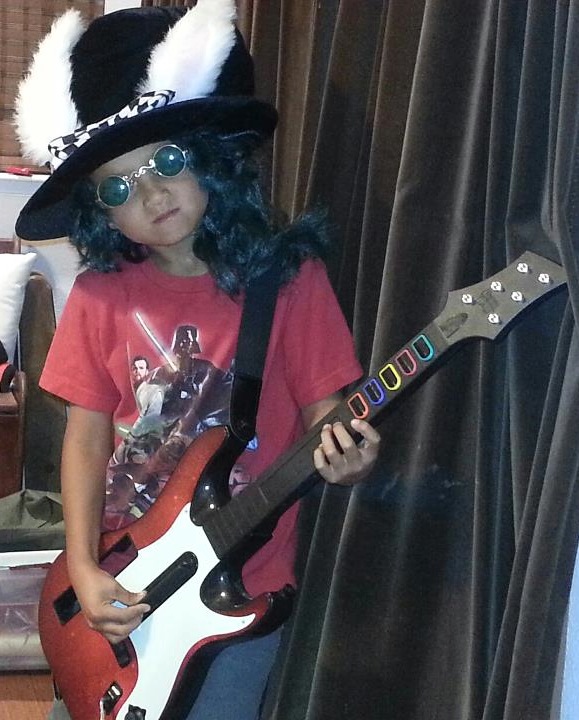
…When your little boy comes into your room to model his Halloween costume. Here’s our dialogue:

“Hey Daddy, look at my Halloween costume!” exclaims my seven year old.

“Cool, son! Who are you supposed to be?” I ask.

“Funky Slash!” he replies. I just had to take a picture and share it.

I never saw this costume coming. Whereas his friends are going as super-heroes, he decided to dress up like one of his Daddy’s favorite guitarists. He even has the pose down! I’m beaming with pride.

Why? Because some of us will pay ungodly sums of money to have some gear. For instance, this morning a friend of mine sent me a link to an eBay item:  A 1967 Marshall Supa Fuzz pedal. The seller is asking $4,999.00. That’s under $5,000! Wow! And shipping is included! What a deal!

Granted, this was Pete Townshend’s favorite pedal back in the 60’s and 70’s; I get that. And I totally get the vintage mojo with a pedal like this. But $5K? Not sure about that. And besides, if memory serves, this was a clone of the Tone Bender.

But there’s no rhyme or reason to getting gear, so I would never begrudge anyone for spending their money on something they want. For me though, paying several thousand for a pedal isn’t for me.

So I got an email announcement of Gibson’s new Billy Joe Armstrong Les Paul Junior Double Cut. I’m not a big Green Day fan, but I’ve followed them over the years, and earned an appreciation for their body of work and success. Over the years, there has been lots of debate over Green Day. Did they sell out to Warner? Are they really that good? In guitar circles, people have debated on BJA’s playing ability.

Given the previous debates I’ve heard over the years, I clicked the link to look at the guitar. But while I scanned over the specs, what I was really more interested in were the comments. Sure enough, the debates about Green Day haven’t stopped. Also, the whole “cost of a Gibson” debate churns on… After reading through several pages of comments, I decided to chime in here, and share my perspective on a few of the issues.

  1. On Green Day selling out…
    I had this very debate with my oldest son while listening to “Wake Me Up When September Ends” on the radio several years ago. I asked him if he still liked Green Day, and he replied, “Only their old stuff. They sold out, and I don’t really like their new stuff.” In rebuttal, I replied that I had read that they had been given full artistic control in their contract, and I shared that with my son. If they had full artistic control, then they were writing what they wanted. My argument – as a composer myself – was that just because a band writes in another style doesn’t necessarily mean they’ve sold out. I know that songs just sit out there waiting to be written. They could be blues, they could be rock, they could be classical, they could be pop. But as an artist, you write what you write and what comes out. In BJA’s defense, I think he wrote was what was in his heart at the time. If it happened to be mainstream, that’s fine. We don’t know what motivates a composer to write; I’ve been writing for years, and I really don’t know where the songs come from. They just come. So with Green Day coming up with mainstream music, at least to me, who cares?
  2. On Billy Joe Armstrong’s playing ability…
    There is a lot to be said about playing in the pocket. Tell someone like Steve Cropper who has been around for years he’s no good because he plays rhythm guitar – or even Malcom Young for that matter. So what if BJA doesn’t play screaming leads?!! I know lots of players out there who can play all sorts of leads and cool licks, but they couldn’t carry a song if their life depended on it. Besides, with his punk roots, BJA’s message and energy are far more important than being able to do two-handed arpeggios, and sweep picking.
  3. On the cost of a Gibson…
    I’m kind of with the camp that says, “You don’t like it, buy something else.” Everyone has a choice in what to buy. Are Gibson guitars pricey? In general, yeah. And while they had suffered in quality back in the late 80’s and early 90’s (which is probably where a lot of this angst comes from), I haven’t played a newer Gibson that I could complain about its quality. You have to pay for a good guitar, and a Gibson is a good guitar. Some of the complainers I’ve met have no problem shelling out several thousand dollars for a custom, boutique guitar. Hey! That’s their choice. For me personally, I love Les Pauls. I honestly couldn’t afford most of the brand-new Custom Shop guitars, but to me, and especially because I have an R8, for the most part, I think they’re worth the money. There are some like that Jimmy Page #1 copy that I think are over-priced, but I don’t really have too much of a problem with the pricing of a Les Paul.

We guitarists are certainly a passionate lot.  But one thing that I’ll reiterate again and again is: Whatever floats your boat, that’s fine with me.

Just when I think I’m strong, and have overcome my GAS, Gibson comes out with a new Les Paul that I just have to have. But that’s not what I’m hatin’ about… What I can’t stand is that they release teaser pictures then provide no information on it at all on the web site! They did this with the Green Widow, and they’ve done it yet again with their new “Gold Burst.” Dammit! Here’s the picture they posted on Facebook…

I’ve always loved goldtops, but I love bursts more, and to have both… OMG!!! I’m salivating! The gold hardware is awesome, and I dig the golden brown stain on the body back and sides, and that figured maple looks awesome!

Gibson, please release information on this – especially when you’re going to make available in stores!

Game changers 2012

A few years ago, I wrote about gear that has changed my life. I wrote that at a time when I was in the midst of a buying binge, as I was discovering new gear. But in the ensuing years, as I’ve found the “sweet spot” of my personal tone, while the gear that I mentioned certainly changed my life, there are other things from the more recent past that have helped solidify who I am as a musician. So I thought I’d share those here. These aren’t necessarily in order…

  1. Gibson 1958 Les Paul Standard Historic Reissue (R8).
    Getting this guitar helped me nail down my electric tone. Up to that point, I had been using all sorts of different guitars from Strats and Telecasters to even a hand-made, custom guitar. It wasn’t until I started playing that Les Paul that I truly felt that felt completely comfortable with my tone. With my other axes (which I still have), I felt compelled to keep searching. There’s a certain “magic” about the R8 that I’ve never been able to capture with other guitars.
  2. 1959 Les Paul Replica.
    Like the mask in the Jim Carrey movie, “The Mask,” this is a guitar that I’ve tried to get rid of, but it keeps coming back, so I’m keeping it. Or it’s like the ring of power in the Lord of the Rings; this guitar has adopted me, and will not leave. 🙂 This is a special, special guitar. It has a brighter tone than my R8, but with the old-growth mahogany and the Brazilian rosewood fretboard, the sustain on this guitar is even more than my R8. Up until two weeks ago, I was trying to sell it, but after gigging with it last week, I realized that selling it would have been a mistake. As a game-changer, it drives home the point that there is some gear that you should never get rid of.
  3. Mad Professor Deep Blue Delay (hand-wired).
    This pedal changed everything for me with respect to delay. I had been using digital delays for years, and was never fully satisfied with them. I was always after that subtle, ambient tone, and digital delays just wouldn’t cut it for me. I really didn’t like the analog delays I had tried because they just felt to gloomy and dark. Then I played this delay. It was warm, and the ambient feel was more dreamy than dark, and it was totally inspiring. Yeah, I paid $325 for the pedal, and had the PCB version come out, I probably would’ve gotten that, but there’s no way I’m trading this now that I have it. It’s a permanent fixture on my board!
  4. Paul Cochrane “Timmy” Overdrive. For years, I dismissed the hype surrounding the Timmy and Tim overdrives from Paul Cochrane. Hanging out on The Gear Page made me jaded. But then I got to see and hear the pedal up close and personal at a “Luce” concert at the Little Fox Theatre in Redwood City, CA. Dylan Brock, Luce’s guitarist at the time, played one, and I just couldn’t believe the tone he was getting, so I put one on order, and six months later, I had it, and it hasn’t left my board since. Sound-wise, I’ve been able to achieve something similar with other overdrive pedals. But with the Timmy, there’s a certain feel to the pedal that I’ve never been able to duplicate. From a pure sound standpoint that might not make a bit of difference, but from a performance standpoint, “feel” equals expression.
  5. The Aracom PRX150-Pro Attenuator.
    Still a game-changer for me. I use this unit everywhere; in the studio and live. Being able to control my output volume and still crank my amp has been a boon to performing. In the studio, it has saved my ears. I can keep my headphone volume at a reasonable level, and still get my power tubes working. And no, a master volume just doesn’t cut it because to me, there’s nothing like the sound of a fully cranked amp where both the preamp and power tubes are saturated. Joe Satriani, Steve Miller, and Mark Knopfler are among big-name artists who are using one of these. The PRX150 is simply the best attenuator out there.
  6. TC Helicon VoiceLive Play gtx.
    It doesn’t have as many voices of harmony as my venerable Vocalist Live 4, and you can’t control the intervals of the harmonies either. But the sound quality of the vocal processing, combined with the fantastic built-in guitar effects simply blow away anything I’ve used in the past. Whether I’m plugging into a house PA or plugging into my Fishman SA220 SoloAmp PA, I can feel confident that my sound will always be great. So what if I don’t have as many voices of harmony? All that is nothing if it sounds lifeless and dry; and in comparison, especially with the guitar processing, the VoiceLive puts my old Vocalist Live 4 to shame.
  7. Fishman SA220 SoloAmp.
    This self-contained guitar amp/PA has made solo gigging SO much easier for me since I got it a couple of years ago. I chose it over the Bose L1 Compact – even though they were similarly priced – purely for convenience: It has as built-in two-channel mixer with 3-band EQ, independent passive loops, it has a rollered gig bag for easy transport, AND it literally takes less than a minute to set up! As a solo artist, convenience is HUGE and the SA220 just keeps on delivering on that!
  8. EWS Little Brute Drive.
    Until I played this little monster, I never appreciated distortion boxes. Part of that was due to relying on my amps to provide the distortion that I needed. But this pedal produces such sweet distortion, and it has become a critical tool for when I’m playing songs that go from totally clean to super-driven. And for playing leads, the sustain this pedal produces is incredible!
  9. Wegen Picks “Fatone” Pick.
    Finally, a pick that I could comfortably play with ANY guitar. I’ve been using this pick for less than a month, and I will never switch to another pick. I have a collection of expensive picks (probably a few hundred dollars worth), and I used to use different picks for different guitars and styles. With this pick, all that has changed.