Feeds:
Posts
Comments

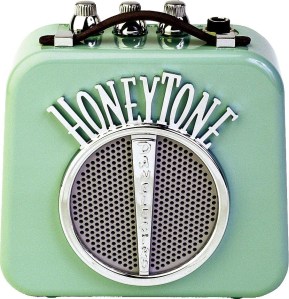
Honeytone_aqua_lg. Over the years, people have – for better or for worse – tried to talk about where tone comes from. Many players say it comes from your fingers. They are then quickly dispatched by obnoxious gear freaks who say tone comes from your gear. So who’s right?

The answer is… both and neither. How’s that for not taking sides? 🙂

Actually, my opinion is that either of these views together are only a small part of what I call Tone – with a capital “T.” From my perspective, there are two types of “tone:” The first, “tone” with a little “t,” is the natural sound produced by your guitar(s), effect box(es) (if any), and amp(s). In other words, “tone” is the sound of what’s in your rig.

The second, what I call “Tone” with a capital “T” is the sound of your gear, combined with your – for lack of a better word – heart; that is, the emotion and passion that travels from the center of your being to your fingers, onto your strings and fretboard, down through your rig, and out your amp. Tone is the music you express through your gear that is uniquely you.

In that light, I tend to gravitate to the “tone is in your fingers” camp, in that what you “feel” while you’re playing is transmitted to your fingers which in turn manipulate your guitar. And I think that’s where the important distinction must be made from those who say your tone is simply your gear. Of course, the quality of your gear and the purity of the signal are certainly important factors to consider. But music played with no passion and feeling just sounds flat and uninteresting, even through great gear.

On the other hand, even what could be considered cheap or crappy gear played by someone who can truly express themselves will sound great – and they will sound like themselves, no matter what gear they play. I was watching a video recently of a guy down in LA who is session musician that uses a Squire Strat and a Sears Silvertone amp, and he’s on a lot of big-name groups’ albums.

To add to that, around the middle of last year, I was listening to an interview with Ronnie Montrose, and he recounted a story from his early days where he was sitting at a table with Carlos Santana, taking a break from a recording session. Apparently Carlos had a new guitar and amp that he was showing everyone. Ronnie picked up the guitar started playing, and everyone was amazed that even with Carlos’ gear, he sounded like himself!

So to sum up, yes, tone comes from your gear; yes, tone comes from your fingers. But Tone – your sound – comes from your heart.

dylan_brock Just went to see a fantastic SF Bay Area band called LUCE (pr. “loose”) last night at the Little Fox Theatre in Redwood City. This is a medium sized club with a decent sized stage. Their music is in the Alt-Pop realms, even close to Folk Punk, but who cares? They make great music!

In any case, I had a chance to rap with Dylan Brock, LUCE’s guitarist. That dude can PLAY! He was playing through a Hiwatt Custom 20 through a matching Hiwatt 2 X 12 cab (didn’t get what speakers he had). Granted, the venue wasn’t an arena, but he was plenty loud with just 20 Watts! The sound guy used what looked like a Senheiser e609 amp mic on his cab to run through the PA, and his tone was simply killer!

It just goes to show that you don’t need a lot of wattage to get your sound out. He just needed stage volume, and the sound guy did the rest! I always speak about the virtues of playing with low wattage amps. The thinking is that when you can work your power tubes into your tone equation, very good things happen. Dylan totally proved that point last night!

If you want to hear more about them, check out LUCE on iTunes!

guitars3

Right now, it is an absolutely AWESOME time to be a guitarist! There is so much great gear out there nowadays, that it’s hard to choose what to get. But the great thing is that there is SO MUCH to choose from! For example, look at all the great overdrive pedals that are out there right now. It is freaking amazing, I tell ya!

Some might think that there’s too much gear out there right now. That may be, but it also means that if you spend the time evaluating gear, you’ll most probably find exactly what you’re looking for – at least for now. 🙂

I say “at least for now” because if you’re a gear freak like me, it’s not too long that you want to add something to your rig to enhance your tonal palette. It’s a bad disease, this gear addiction, but it is oh-so-incredible.

But back to the topic at hand, with this much gear, you might think that the likelihood of making a bad choice is also fairly large. But the interesting thing that I’ve found is that most of the gear out there is really high quality, and not only that, at great prices.

Take, for instance, handmade, hand-wired boutique amps. Traditionally, boutique amps have sold for thousands of dollars. But there are some boutique manufacturers out there that are creating great-sounding, high-quality, hand-wired amps for a reasonable price. Most of these are “entry-level” amps meant to establish the manufacturer’s sound and quality, and to provide inroads to their flagship products. A good example of this is the recently released Reason Bambino, an 8/2 Watt tone machine. Priced at $699 and packed with tons of features, this is one of those must-have amps for the studio, and for small venues; not to mention that the tone this amp produces is simply to die for!

Then there are manufacturers like Valve Train Amps and Aracom Amps who simply make reasonably priced, hand-wired amps. Period. Their philosophy is that great tone doesn’t have to cost a lot. And while they’d probably admit that their margins are lower compared to their more expensive brethren, they’ll be the first to say that they want to get their gear into as many players’ hands as possible. With Aracom’s VRX series, that has been the case. Jeff has found a real magical tone with the VRX series (they come in 18 and 22 Watts EL84/6V6 respectively). The heads are $895, and they sound absolutely KILLER! He has been selling these things as fast as he can create them!

But I believe the greatest stuff is coming from the pedal makers. There are absolutely killer pedals out there! And it seems each week brings yet another promising pedal to the industry. There are so many, I can’t keep up with them! Off the top of my head, here are some stellar pedals that have recently come out that are worth a look: TC Electronic Nova Repeater, The Original Geek GeekDriver, Kasha Amps Overdrive, Effectrode Tube Driver, Catalinbread Dirty Little Secret, Tone Freak Effects Abunai 2. Yeah, yeah, I’ve mentioned OD pedals. Well, you know how much I love ’em. 🙂 My personal favorite right now is the GeekDriver, and it will always be on my board. It’s not really an overdrive, and it’s not completely a booster. It’s something in between, and it’s freakin’ awesome, especially when it’s used to drive my Abunai 2, or Creation Audio Labs Holy Fire. As Geek explained to me, the GeekDriver was meant to be stacked. Very cool! And at $205, it is not out of this world.

Even things such as strings and picks are out there for us to enjoy! As far accessories are concerned, they actually start getting a bit more pricey at the “boutique” level, but they are so worth it! I swear by Wyres Strings and V-Picks and Red Bear Picks. Especially with the picks, I’ve paid up to $30 for a single pick, but they last a long time with care, and not only that, they feel so good in your hand that you don’t even notice that they’re there. And that’s what a great pick will do for you.

I could go on talking about great gear that out there, but I’ll just say this one more time: It’s a great time to be a guitarist!

Gear Find: Ark Amps

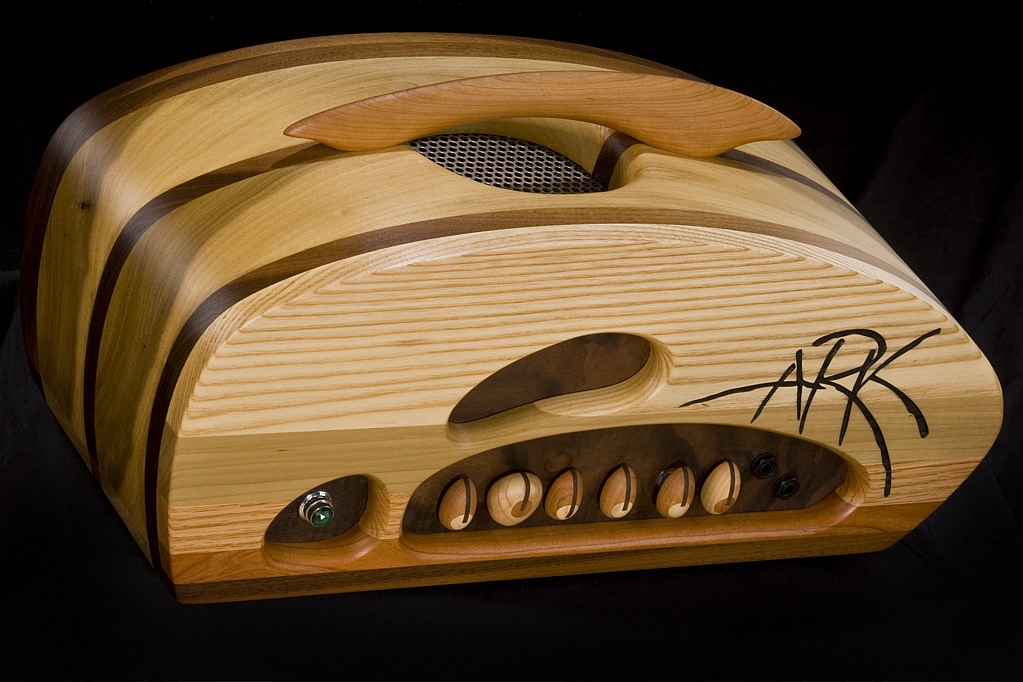
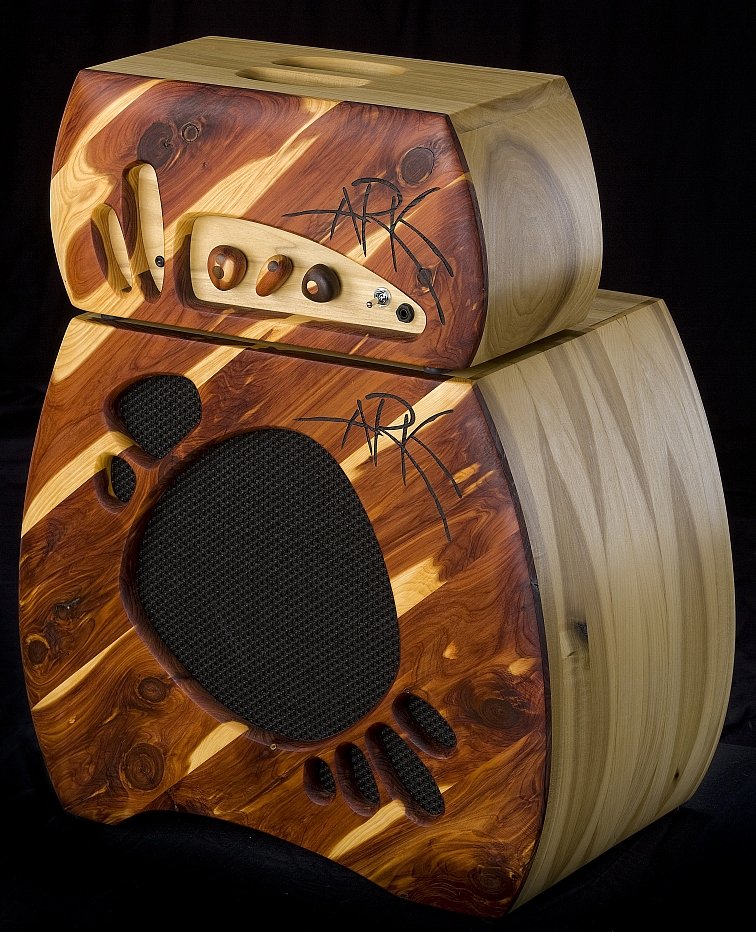
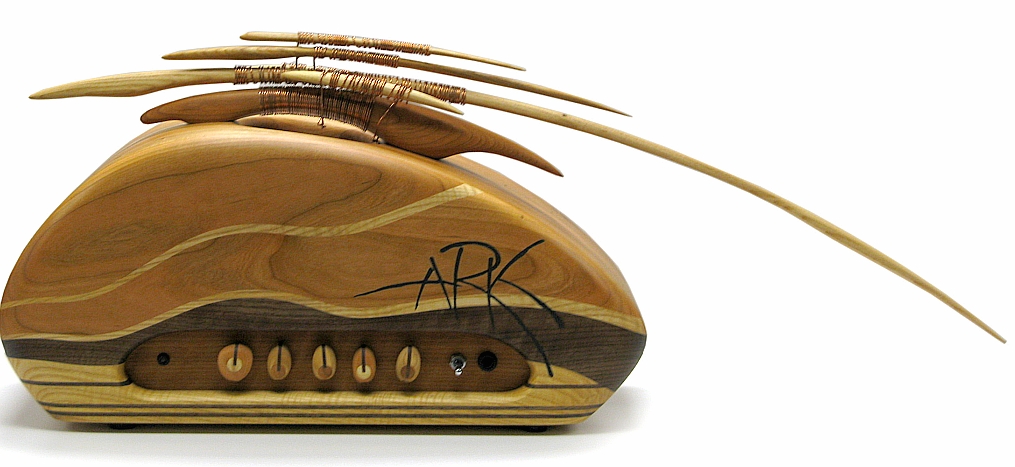
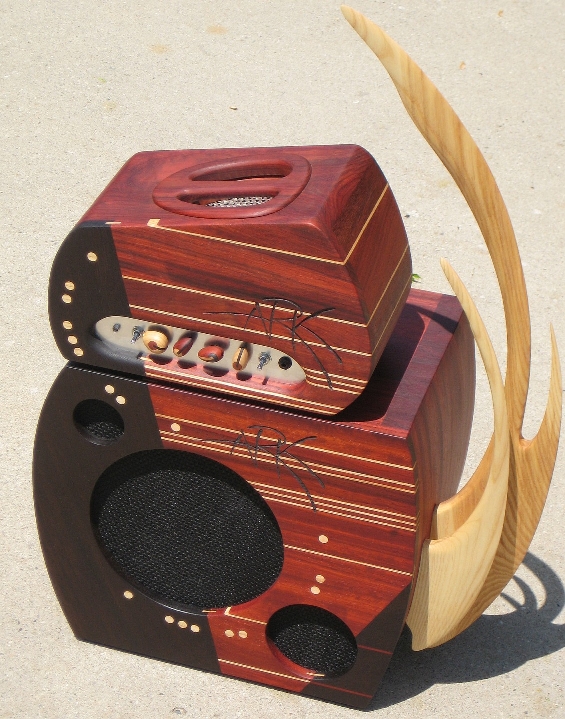
arkDid I ever say, “I love my job?” Well… GuitarGear.org isn’t exactly a job, but even it were, I’d still love it because I get to sniff around the Internet for different kinds of gear. Recently, through The Gear Page forums, I ran across this great amp company called Ark Amps. I had heard the name in passing but didn’t know much about them. Still don’t, but they make some gorgeous amps! The designs are really out of this world with incredible woodwork! And from what I can gather from the audio clips, these are nice-sounding amps as well.

To give you an idea of just how awesome these designs are check out these pictures! Talk about combining art with function! I’ve never seen amp cabinet designs like this – ever! Check ’em out for yourself at Ark Amps!

I’ve often extolled the virtues of a cranked amp here at GuitarGear.org and elsewhere. My belief is that when you’ve got both your pre-amp and power tubes working, you get the real character out of your amp. There’s something that happens to your tone once you get juice into your power tubes that adds a certain dynamicism and complexity that you just can’t get with just your pre-amp tubes. Unfortunately, most mere mortals, like myself, don’t normally play venues that that will allow us to crank our amps to the point where the power tubes of our amp come into play.

Take, for instance, my good buddy Phil. He’s the lead singer of a bar band called Phil ‘N The Blanks. Up until recently he was playing through a Marshall DSL100 JCM2000 100 Watt head into a Marshall 1936 2 X 12 cab. Talk about too much amp for his gigs! I ran sound for him at a gig a couple of months ago, and could only turn his volume and gain controls to about 3 each before he stepped on the band entirely; not to mention peeling faces off! Since he’d owned the DSL100, he’d never played above 5 because it was way too loud.

Recently, I lent him my Aracom PRX150-Pro attenuator so he could squelched down the volume but crank up his amp. He couldn’t believe his ears! He was finally able to get the gain up in his amp where his power tubes would break up. It was like a completely different amp once he heard the cranked up tone. I had been telling him for months that there’s really nothing quite like a cranked up amp, and for the first time since he owned the amp he was able to hear for himself what I had been talking about. Before that, he was on tonal training wheels! 🙂

Ultimately, he decided against going with an attenuator, but he did a very smart thing: He purchased a low-wattage amp, the Marshall Haze MHZ15 15 Watt amp. It hasn’t arrived yet, but I’m excited for him because he’ll be able to crank that amp at a reasonable volume level, as the lower wattage amp will break up a lot earlier, and he’ll be able to reap the benefits of the response of his cranked amp!

1 Watt is LOUD!

But here’s the funny thing: 15 Watts can still be freakin’ loud when cranked! The following chart shows SPL at 1 meter vs. Wattage (I got this from the Aracom site where Jeff discusses understanding attenuation).

POWER VS. LOUDNESS CHART

Watts

SPL (db)

Loudness

0.0078

79

Passenger car at 10 (60-80dB)

0.0156

82

0.0312

85

Vacuum cleaner

0.0625

88

Major Road Noise (80-90dB)

0.125

91

Noisy factory

0.25

94

0.5

97

1

100

Jack hammer at 1m

2

103

4

106

8

109

Accelerating motorcycle at 5m

16

112

32

115

Hearing Damage (short term exposure)

64

118

Rock concert

128

121

256

124

512

127

Jet at 100 meters (110-140 dB)

1024

130

Threshold of pain

What’s amazing from the table is how loud 1 Watt is at 1 meter! It’s as loud as a jack hammer! And 0.0312 Watt is as loud a vacuum cleaner! Jeff got this information from a well-known study done in 1933 by Harvey Fletcher and W A Munson about human hearing response. For those people who say, “P-shah” to low wattage amps, just reference this chart.

Granted, there is a certain mojo about a 100 Watt amp cranked up – even a 50 Watt amp. But most people other than those playing large venues can crank their amps to experience that mojo. But in spite of that, there’s been a movement in the industry these past few years towards lower wattage amps. I think a big part of the reason for this is the improvement in PA gear over the years. Want to get your sound out there? Mic your amp. After all, all you need is stage volume so you can hear yourself. Let the sound guys project your sound out.

My buddy Vinni Smith of V-Picks does exactly that. As amazing as he is with a guitar, he gigs with a Roland Cube 30! He just gets his stage volume, then has his amp miked to get his guitar out to the audience. This dude gigs alot, and he’s living proof that you don’t need a lot of power to get perform. As long as you can get your tone, you’re golden!

Circling back to the title of this article, there really isn’t anything like the sound and feeling of a cranked amp. Especially with tube amps, when the power tubes have juice, they add all sorts of things to your tone such as compression, a different kind of breakup and even more touch sensitivity. You can get that in a couple of ways:

  1. Get an attenuator. There are several on the market, including the increasingly popular Faustine Phantom, but my bet is on the Aracom PRX150-Pro, as it takes a completely different approach to attenuation than all others. I’ve never played an attenuator as transparent is this.
  2. Get a lower wattage amp. I’m not even going to list what amps to buy as there are tons of fantastic amps – both boutique and mainstream – on the market. Just make sure you give them a listen.

Reason Amps Bambino

I was messing around with this chord progression the other day, and decided to put a song together with it. I composed the progression and laid it down with a temporary drum track and a simple bass line. Then it sat while I figured out what I’d like to do with the actual song. I knew I’d probably compose the solo, but try as I might, I just wasn’t feeling the mojo. But this morning, I hooked up my Strat to my Reason Bambino, and the gorgeous sounds that issued from the amp inspired me to write the solo. This is the first cut of the track, and I’ve got some timing issues and some mistakes, but I wanted to demonstrate just how incredible this little amp is!

And I think it brings to the foray one of my philosophies about gear. I truly believe that whatever gear I buy should inspire me in some way, shape or form. There’s a huge difference in the “feel” or vibe between something played that’s mechanical, and something that’s the result of pure inspiration. So from that standpoint, the Bambino’s tone is so inspirational to me. The more I play it, the more I fall in love with it.

About the recording

The chord progression (rhythm part) was recorded using my Strat and my trusty Fender Hot Rod Deluxe. To this day, I just love the cleans on the amp. For the solo, I again used my Strat but with the Bambino on the Normal Channel at about half volume and the tone control at about 1pm. I also had the fat boost engaged. While any guitar sounds awesome with the Bambino, it really brings the best out of a Strat.

All the amps were recorded at bedroom level (they’d be too loud and my wife would complain…) using the Aracom PRX150-Pro attenuator. That little unit never ceases to amaze me with its transparency! All my dynamics and tone bandwidth are always maintained. It’s simply amazing. And note that I didn’t have to do anything to the EQ on my amp or in post production to compensate for a loss of tone at bedroom levels. The PRX150-Pro retains all your EQ at all volume levels so no compensatory changes are required!

Anyway, here’s the recording:

Excuse the mistakes… 🙂

For more information about the Bambino, go to the Reason Amps site!

Carl Martin Crunch Drive at Tonepedia.com
The guys at Tonepedia.com are at it again! In their last members-only giveaway, they gave away an Ibanez Tube Screamer. This time, it’s a 2003 Carl Martin Crunch Drive. The last giveaway was based upon the best uploaded clip. I didn’t win, but I was in the top 10, and got a great set of strings out of it. This time, all you have to be is a registered Tonepedia.com user. Names will be drawn from a hat, and the winner will get this awesome Carl Martin Crunch Drive.

I’ve played this pedal in the past, and I really dug it, though admittedly, I didn’t have enough time to really dial in the the tone that really pleasing to me. Maybe this time if I win, I can spend more time with it! 🙂

Anyway, click on the picture to get details on the giveaway.

About Tonepedia.com

Tonepedia.com was started by Danny Strelitz and Sagi Eiland to provide a place where axe-slingers can upload clips of their gear. I’ve found this site to be particularly useful in finding out how various types of gear sound in combination. All the clips are created by users, and believe me, some clips are really well-done, showing off the skills of members. Anyway, check it out!

Ladies and Gentlemen! Welcome to the bout of the century! A truly momentous occasion in the vein of David versus Goliath! In the red corner we have a Goliath, the reigning King of Attenuators, the Ultimate Attenuator; self-proclaimed King of Transparency – Guaranteed! In the blue corner is the Aracom Power Rox PRX150-Pro, a virtual David, armed with only a transparency sling ! And here’s the opening bell!

The Ultimate Attenuator strikes first, tongue lolling, with bombastic claims of pure transparency. The agile Power Rox ducks, and moves away, its sling of true transparency whirring rapidly. Wait! It launches! It strikes the Ultimate Attenuator square in the head. It’s going down! Oh the humanity! Oh the humanity! The match was over before it was even begun!

I had the great opportunity this evening of testing the Aracom Power Rox and the Ultimate Attenuator in a head-to-head shootout to determine which was the most transparent attenuator. As you can tell from the somewhat facetious and fictitious pseudo-boxing match, you know who won: The Aracom Power Rox PRX150-Pro. Folks, it wasn’t even a contest. Even at the lowest attenuation levels, the Power Rox swept the floor with the Ultimate Attenuator!

My Test Procedures

Equipment: My test was conducted using a Replica JTM45 equipped with original Mustard Caps and a pair of  KT-66’s, into a 4 X 12 cabinet equipped with (2) Original 55Hz Greenbacks and (2) Custom Weber (75Hz) Greenbacks, with a ‘Gibson 57 Les Paul Historic Goldtop as my test guitar.

Clean Test

First, I started with the amp totally clean. I strummed a simple chord progression to get my base tone. Setting the Ultimate Attenuator at about half “volume,” I activated it. I immediately noticed a distinct loss in both highs and lows, as even at minimal attenuation, the bandwidth of my tone was severely narrowed. The full bottom-end and sparkly top-end of my clean tone were significantly reduced. The tone wasn’t that bad, mind you, but it certainly lacked the richness of my base tone – it sounded flat.

One thing that really bugged me was activating the UA, which required a strumming the guitar, then switching on the UA, as if the UA needed a signal to pass through it to even start working. What a pain! It’s amazing that users would even tolerate this.

I repeated the same test with the Power Rox, setting it at half attenuation on the 6-way switch. The result was a reduced volume, but no loss of bottom- or top-end at all.

Clean Test – Bedroom Mode

Same test as above with both attenuators. With the Ultimate Attenuator, can you say “tone sucker?” The tone was not at all pleasing! Even more narrow bandwidth, and non-existent dynamics. There was nothing even remotely good to like at this level with the UA. How the UA website can claim to be “the most transparent and safest tube amplifier attenuator on the market in the world. Guaranteed” is beyond me. Even my old Dr. Z Airbrake sounded better than the UA. So again, at this level, the Power Rox just kicked ass. Lower volume, but full retention of bandwidth and dynamics.

Dirty Tests

In my dirty tests, I ran the amp in its drive channel cranked up fully. 40 Watts through a 4 X 12 is LOUD!!! Especially when you’re standing right in front of the cab! Actually there’s nothing like feeling the SPL’s with an amp full-out! I ran the same tests as I did with the clean channel with both attenuators, and as expected got the same results: The Ultimate Attenuator really sucked my tone, while the PRX150-Pro retained tone and dynamics at all levels. The Plexi switch just made the tone even worse, acting like a treble booster, which made an already horrid tone even worse by just upping the highs. The tone was akin to an old transistor radio played at the volume of a loud TV. Not pleasing at all, and actually, it was a bit annoying, like cats screeching! YUCK!

The Power Rox, on the other hand, again just reduced the volume. The tone remained rich and full, and all the overtones and harmonics came through. It’s amazing what those subtleties do for your tone. You really miss them when they’re not there, as they provide depth.

It’s evident that the Power Rox’s Speaker Reactance Thru technology is far superior at any application. For me, the Ultimate Attenuator company can make all the claims it wants about transparency, but that’s all they are: claims. And while it doesn’t sound all that bad at low attenuation levels, the marked difference in tone between the UA and Power Rox at any attenuation level relegates the UA – at least to me – to the junk heap. You couldn’t get me to put this in my rig if you paid me.

I realize that the UA was the best game in town for quite awhile, and I am sure that at the time it came out, it outperformed the THD HotPlate, which I have also tested, and didn’t like. I also realize that I’m being fairly harsh – much more harsh than I’ve ever been with a product – but all the claims of the UA being truly transparent are mere exaggerations, and not backed up by any discussion of its technology. In fact, all the hyperbole surrounding the UA is quite irritating!

If you knew what went into a UA, you’d have serious concerns, not the least of which is the 32 ohm fixed resistor, which essentially flattens out your impedance, and creates a mismatch so high that you could fry your amp! Adding insult to injury, the solid-state amplifier is what is really running your speaker. Transparent? Hell no! Not electronically, and definitely not audibly.

And mind you, I’m not the only person who feels this way. One new PRX150-Pro user, who is also a former UA user was so impressed with the Power Rox and disgusted by the UA’s tone compared to the Power Rox, that he bought two Power Rox’s! That says quite a bit.

For more information about the Aracom Power Rox PRX150-Pro, visit the Aracom Amps PRX150-Pro product page!
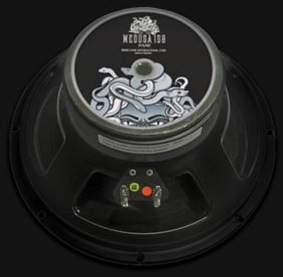
4.5 Tone Bones - Very solid performer, and has almost everything but just missing a couple of thingsFane Medusa 150 Fane Medusa 150 12″ Speaker Summary: If you’re looking for a speaker with a big bottom end, while retaining the clarity of your mids and highs, this is the speaker for you.

Pros: Huge bottom end on this little beasty. Played clean, it’s very acoustic-sounding and quite pleasing. With a sensitivity rating of 103, this speaker puts out some volume!

Cons: With the prevalence of the lows, this speaker really belongs in a 2 X 12 cab, balanced out by a more mid-rangy speaker.

Features:

Nominal Chassis Diameter 12″
Impedance 4 /8 /16 Ω
Power Rating (AES) 150 w
Sensitivity 1w – 1m 103 dB
Chassis Type Pressed Steel
Voice Coil Diameter 2” / 50.8mm
Coil Material Copper
Magnet Type Ferrite
Magnet Weight 50 oz
Usable Frequency Range 80 Hz – 6.2 kHz
Resonance FS Hz 84
RE Ohms 6.3 Ω

Price: $209 direct from Tonic Amps

Tone Bone Score: 4.5. I really dig the sound of this speaker, but as I mentioned above, it really belongs in a 2 X 12. Granted, I say that within the context of the type of music I play, which leans towards classic rock and blues.

Fane has been around awhile, providing the classic British tone of the Hiwatt and Orange amps of the 60’s and 70’s, and their speakers have helped define the sound of rock and roll, having at one time provided up to 75% of all loudspeakers in England. They’ve been around since 1958, so they know their speaker technology.

The Medusa 150 is one of their most popular models. With its ferrite magnet, it pumps out HUGE bottom end, but amazingly retains the overall clarity of sound throughout the entire EQ range.

How it sounds

Played clean, the Medusa 150 has a very acoustic-like response. This has a lot to do with the big bottom end that helps to give the clean tone a much bigger sound. Here’s an example:

I played this clip in the neck pickup of Goldie, my Saint Guitars Goldtop Messenger, which is a Duncan Custom Custom, which is usually put in the bridge position because it’s a pretty hot pickup. Despite that, I still got a real acoustic response that was VERY pleasing.

Turning up the gain on my amp, and getting lots of power tube distortion really brings out the true character of the Medusa 150. In this next clip, I’m able to cop a pretty close Neil Young:

That’s a fairly simple progression, but I chose it because it’s a good test of how clear the speaker would be in a high-gain situation playing low on the fretboard, which almost always has the potential of muddying your tone when you use speakers that aren’t well-defined. A lot of speakers wouldn’t be up to the task, and would definitely “flab” out. Not the Medusa 150.

Overall Impressions

For my style of playing, which leans toward the classic rock and blues, this is a speaker that I’d pop into a 2 X 12 with a brighter, more mid-rangy speaker, like my Jensen P12N, or if I was to use a Fane, I’d mix it with an Axiom Studio 12L or an Axiom AXA-12 Alnico. But for much heavier metal, this speaker would be ideal, especially for detuned songs.

I actually gigged with the speaker tonight. The only beef I had was that the bottom-end made the general tone a bit too close to the bass, so I was getting a little lost in the mix and had to crank up my amp a bit more, much to the chagrin of my other guitarist. 🙂 But overall, the speaker performed quite well.

For more information on how to obtain Fane speakers here in the US, go to the Tonic Amps web site.


Kasha KA-ODP-A

Awhile ago, I was perusing a forum where one of the members mentioned in a reply that it’s a good time to be a guitarist. There’s so much varied gear out there that guitarists have all sorts of options to choose from. One area of guitar gear that certainly seems to get regular entries is the overdrive pedal.

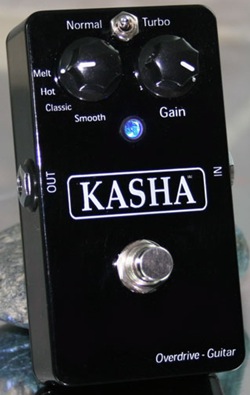
The OD pedal is something of which I never tire. There are so many great ones out there – I just can’t get enough of ’em. One such pedal that has just recently caught my eye is the KA-ODP-A 4-Channel Overdrive Pedal from Kasha amps. This pedal promises to be something special. Check out its features:

– 4 channels with separate voicing and gain structure
– Analog design
– 10 dB clear boost
– True bypass switching
– Very low power consumption (3mA and runs on a single 9V battery)
– No tone change, only enhances sound
– Compact standard aluminum chassis (4 3/8″x2 1/4″ x 1 1/4″)
– AC power jack (uses standard Boss DC power supplies)
– High gloss mirror black powder coat
– Hand made in the USA
– Low noise
– Crystal Blue LED (high intensity)
– Weight: 1.5lb

Built By an Amp Builder

There’s something about gear that’s built by an amp builder, especially when it comes to pedals or other peripheral devices. Amp builders have an innate understanding of the electronics behind tone, and how peripheral devices interact with their amps. A great example of this is Jeff Aragaki from Aracom Amps and his brand-new attenuatore, the Power Rox PRX150-Pro. Jeff totally gets it with how an amp interacts with a speaker, and the Power Rox is a testament to that. The same may be said of the Kasha overdrive in front of an amp. I had a chance to speak with John (Kasha’s owner and builder) this afternoon about the pedal, and it was clear from our conversation that this guy really understands the interplay between effects and an amp – especially with respect to overdrive.

Kasha has been around awhile, having been building the famous ROCKMOD line of amps since the 80’s, so they know something about amps, and their tone is well-known. Guitarists such as George Lynch and Davey Johnstone (Elton John), and tons of session guitarists have been playing ROCKMODS for years. So when John decided to build an overdrive pedal, he didn’t want to model it off of traditional circuits, so he created his own. The result is the 4-Channel Kasha Overdrive.

What’s very intriguing about this pedal is that it doesn’t have an EQ. John designed the pedal in such a way that it preserves the tone going in and outputs it with some OD “flavor” as John puts it. The thinking is that you don’t need an EQ if you’re not doing anything to the EQ of the signal. Smart.

The Kasha overdrive is a lesson in simplicity, having only two knobs: An overdrive selection knob to choose from one of the four different overdrives, and a gain knob. Very simple. But it also sports a “Turbo” switch at the top which will add a 10db clean boost to slam your pre-amp tubes with even more gain. But despite all that, this thing operates on 3 milliamps and only requires a standard 9V power source! That is incredible! My beloved Holy Fire requires a special 48V power supply! So what John has created is definitely special.

I’m going to be trying this pedal out in the next coming weeks, and I’m excited! I’ll keep you posted!

For more information, go to the Kasha product page (scroll down to the end to see the overdrive)