I don’t post as often as I’d like on thegearpage.net, but I certainly lurk there at least three or four times a day. For the last couple of days, TGP has been down due to a hardware failure of some sort. While it was down, I realized just how much I liked visiting that site. I’m not really friends with anyone there yet, but it’s a place I definitely enjoy visiting. It’s a great community!
I’m pleased to announce that TGP is back once again, and running like nothing happened! That’s awesome! Now I can while away the hourse once more… 🙂
More often than not, the way I end most of my days is to strap on an axe, plug into one of my amps, and just noodle or jam to a jam track I put together. But tomorrow, I’m doing an outdoor gig that requires the use of my amps (had to drop them off tonight), and even though I have a little Fender Champ 600 for practice and recording, I was more in the mood for a bigger sound.
It was then I remembered my copy of IK Multimedia’s Fender Edition! I could plug directly into my DAW, spark up AmpliTube X-Gear, Amplitube’s excellent standalone and plug-in modeling software, and jam away! And with 12 different amps and boatload of presets to play with, I could get any sound I wanted! So I lost myself for over an hour of playing and trying out a bunch of different models and presets. It was truly marvelous and a great way to cap the end of a great day!
When I finally came up for air, I realized the power and allure of using these amp plug-ins from AmpliTube. They’re certainly not the real thing, but they’re so close to real, it almost doesn’t matter. Imagine going to a gig, and all you lug with you is a laptop, a DAW, and a couple of cords. You plug straight into the board and output through the PA. Then all you do is monitor your tone through your stage monitor.
IK Multimedia has tools to make it even easier to do exactly this. AmpliTube Fender – or any modeling software they make for that matter – is fully controllable via MIDI. So IK Multimedia has a product called StompIO, a USB stage controller that gives you full control over “Powered by AmpliTube” plug-ins, such as AmpliTube Fender Edition. Want to switch to a different amp? Add some chorus? Add a little dirt? It’s all available via the StompIO! The coolness factor of this is way huge, and at least for someone like me, it has some interesting ramifications.
For one thing, I play mostly small venues, so the more simple I can keep it, the better. Also, except for real purists, most people just can’t tell the difference that you’re playing through a model or a real amp. For instance, last year, I went up to Lake Tahoe and was sitting in a bar at a Casino, and there was this excellent male/female duo playing classic rock covers. The lead singer was a real excellent guitarist, so during one of their breaks, I went over to talk to him and see what gear he was playing. Amazingly enough, I discovered that his amp wasn’t an amp at all; it was a VOX ToneLab that he ouputted straight into his mixing board! I consider myself to be pretty good at making the distinction between a model and the real thing, but as the dude explained it, with all the ambient crowd and general bustle of the casino, it would be tough to tell he was using a modeler. It didn’t matter to me just the same, because the guy was such a damn good guitarist who could make his guitar absolutely sing. So for someone like that, he could make pretty much make anything sound great!
He shared that for larger gigs, and for playing solos in the recording studio, he still used a real amp – there’s just no substitution. But for tracking rhythm parts, and for playing in the casino, there was a lot to be said about the gear he didn’t have to bring with him. And that’s the point of something like AmpliTube Fender Edition. The less gear I have to lug around, the better! Of course, there’s no substitution for a real amp. Even though software can come close – incredibly close – to sounding like a real amp, there’s nothing like playing through the real thing.
But that said, when I want to go on a song writing trip, I can now pack everything I need to record my ideas in one bag, and all I’ll have to do is bring a couple of guitars! When I return home to lay down the tracks for good, I’ll just keep the rhythm tracks I recorded with the software models, and layer solos using a real amp.
I always love being able to get great tone at a bargain. It’s not that I’m cheap. I’ll pay top-dollar for great gear, but when potentially great gear comes at an incredibly affordable price, the Dawg’s ears perk up, and his nose starts sniffing around to see where he can play some gear.
Such was the case when I first came across this little pedal company located in Portland, Oregon called Catalinbread. I had run across the name on a couple of gear forums, but didn’t get a chance to check out their site until today when I read their press release in Harmony Central Effects News. After I read the press release, I had to check out Catalinbread’s site, and much to my pleasure, Catalinbread offers several, very cool pedals.
One thing that makes them stand apart is their diminutive size. As noted in ProGuitarShop’s Catalinbread company page, “One of the defining features of Catalinbread effects pedals is the size.Catalinbread pedals are half the size of your standard MXR.That’s right, take a Phase 90 and cut it in half vertically and you’ve got the basic size of Catalinbread’s pint-sized pedals.” But, as they say, size isn’t everything. Apparently Catalinbread’s pedals pack a lot of sonic punch.
The other thing that makes Catalinbread pedals stand apart is their price. Their most expensive pedal that I found was US$179.95. Several of their pedals are under US$120.00! Mind you, these are handmade pedals! That’s so awesome! Catalinbread is definitely taking the stand of selling gear at lower prices to get it into players’ hands. Creation Audio Labs does this with their awesome pedals, and Aracom Amps does it with their VRX line. This ain’t trivial stuff, either. This is great, handmade gear at a great price!
Can you keep a secret?
The Dirty Little Secret could be construed as another “amp in a box” pedal. But from what I’ve heard from sound clips, it’s far from that. Catalinbread claims to have built into the box amp-like touch sensitivity that accurately respond to your playing dynamics and volume input; so much so that you feel like you’re playing in front of an amp, and not through a pedal. But there are several videos on the DLS product page that bears this out. Check out that page here.
Of course, only a live test will reveal if that is true, but I’m intrigued enough to go try one out if I can. The only problem with that is there are none to be found. This pedal’s so scarce that you can’t even order one on the Catalinbread’s web site! I have a feeling they’re being sucked up as fast as the company can produce them. Even retailers who were hawking the pedals awhile ago have either removed their sale pages or replaced their “buy now” link with ‘Email us about ordering.”
Well… my brother lives up in Portland. Maybe I’ll have him look these guys up!
Wow! I can’t believe that in all this time, I haven’t reviewed a speaker! I’ve focused so much on amps and guitars, and pedals, and other kinds of gear, yet I haven’t even touched upon this particular subject. I suppose it’s because a speaker isn’t something you actually see – it’s a part. Now I’ve made mention of how much I like particular speakers in a combo or a cab, but never a speaker itself. I’m going to remedy that now.
The cool thing about testing gear for someone, namely Jeff Aragaki of Aracom Amps is that in order to effectively give feedback on the gear you’re testing, you have to play it in different configurations. I’ve played a lot of Jeff’s amps through various combos and cabinets to get a feel of how his amps sound.
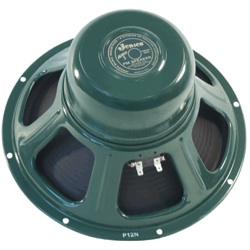
When I was testing the Aracom VRX22 prior to its release, Jeff installed a Jensen P12N in a cabinet for me to try out. In short, it was love at first strum! The P12N has to be one of the most musical speakers I’ve ever played through. It has a real punchy midrange that is balanced by a real smooth low-end response. The highs are present, but not overdone. The tone is – for lack of a better word – versatile.
To me, that versatility is its strength. The cleans are pure and chimey, whether you’re playing single coils or humbuckers, and the overdrive tone, again, at least to my ears, is to die for.
The P12N is actually a re-issue of the famed P12N from back in the ’60’s. Some claim that it’s shadow of the original with respect to tone, but tone is such a subjective thing. For instance, there are those that rave about the Celestong Blue. I’ve played through that speaker, and frankly wasn’t all that impressed by it. It could’ve been the amp/cabinet/speaker combination just didn’t work very well. In spite of that, it was nice, but just not all that special to me.
On the other hand, the P12N in the custom cabinet I got from Aracom sounds so incredibly smooth and lustrous. Granted, it helps that before Jeff installed it in my cabinet, it had already seen many hours of use: About two weeks straight from me alone, and several test runs from a variety of guitarists playing everything from blues to modern alternative rock. In short, the speaker cone was already somewhat broken in. As an aside, I hate breaking in new speakers. To me they’re all harsh-sounding out of the box. But I can tell that with my P12N, if it sounds sweet now, in a few months to a year, it’s going to sound even better!
How It Sounds
In a closed back cabinet, the bass response really shines, but never overpowers. And with an overdriven amp through a closed back cabinet, the distortion is tight and ballsy, yet not so thick that you lose clarity. In my custom Aracom 1 X 12 cabinet, when it’s closed, sometimes I think I’m playing through a much bigger amp. The tone is just so tight and well-defined. And for rockin’ songs, the P12N in a closed cab well, rocks!
With an open back cabinet, the P12N brings on the chime, especially with single coils. It’s 11:15 right now, and I actually started writing this article around 10pm. But I kind of got carried away jamming on my Strat with the back opened on my cabinet. The tone was so voluminous; much more open, and it was like each note just kind of hung in the air. The overall tone also brightens up significantly, with a definite emphasis on the midrange, which I love.
So which do I prefer? Closed back or open back? Actually, neither. Each brings its own unique qualities to the table, which now obviates the need for me to get a second cabinet from Jeff so I can play both simultaneously, which would sound totally awesome. 🙂
But, be aware that this speaker is not cheap. At retail, the lowest I’ve seen it is $220. But I do have to say that it is worth every single penny! Mind you, that is with the bell cover. I’m not sure about the tonal differences between having a bell cover versus not having one. All I know is that the P12N with the bell cover sounds absolutely dynamite!
Here’s a clip that I recorded to demonstrate the VRX22, but the P12N was used in all guitar parts. The rhythm parts were played through an open-back 1 X 12 cabinet, while the lead was played with the back of the cabinet closed:
For how awesome this speaker sounds, it gets a 5 Tone Bones! For more information, visit the Jensen site.
Ahh… yet another distortion box! Hehe. You know I just dig ’em. This one is from the same guys that bring us the J. Backlund Designs guitars; specifically, Bruce Bennet, of Bennett Music Labs, the actual maker of the J. Backlund Designs guitars.
That turned out to be a bit of dead-end because I couldn’t find where to buy them. I finally found a place that sells the pedals, call OohLaLa Manufacturing. Apparently, they’re a distributor and production house for a bunch of boutique pedals. They either take designs from pedal designers, then manufacture them or, as I found out from Bruce Bennett today, they just distribute the finished pedals. Defintely check out their site! Too bad they don’t have sound samples.
The Brown Sound
The original “Brown Sound” was popularized by the likes of Jimi Hendrix and Clapton with the “Woman Tone.” In its simplest sense, the Brown Sound was produced by using a bit of fuzz combined with TONS of power tube distortion. The end result was a way huge sound! Fast-forward a bit, and the Brown Sound then became associated with Eddie Van Halen. But to produce his tone requires a bit more work.
What about the Brown Sound pedal? Well, it’s not an EVH tone simulator. Apparently, it’s more of a Hendrix tone simulator as the guys at Analogman describe here. Interesting to note that this pedal is not meant to add gain. The volume knob is more of a volume cut, and the drive adjusts the amount of “Brown” you get. That’s actually kind of cool because I’m assume you don’t have to mess around with the volume much to find unity gain. Just leave the volume knob wide open, and let the pedal do its thing.
I’m gonna have to contact the guys over at OohLaLa to get more information about this pedal. I love that tone, and to get it in a box would be awesome!
I forgot to mention: The pedal is all hand-wired, and it’s only $159! Pretty cool! Anyway, check out the video of how it’s made.
I know I’m dating myself, but I used to love watching “The Jetsons” when I was a kid. It gave me my first impressions of what the future might hold, like flying cars and floating burger drive-ins where you docked your car. Ah, those nostalgic memories of the 60’s…
Well, if there were to be a guitar on the Jetsons, I imagine that it would have to come from J. Backlund Designs. Talk about retro-modern mojo! The JDB-100 shown to the left just oozes that! What a gorgeous guitar, and from what I heard of the sound from the video below, it has a pretty aggressive tone that seems to fit with that retro-modern styling.
At first, I thought I’d hear something like Dick Dale doing some surf stuff, but the dude doing the review played pretty heavy stuff. I’d actually like to hear what it sounds like clean.
Anyhow, here are some specs:
Mahogany Neck and Body
Set-Neck Construction
Custom Inlays
Custom Double Action Two Way Truss Rod
Scale Length: 24.75
Hipshot Locking Keys
Hipshot Baby Grand Bridge
7 Degree Tilt Back Headstock Angle
Custom Color Matched Lace Sensor Alumi-tone Pickups
N-Tune Built In Chromatic Tuner
All USA Components
Custom Triple Chrome Plated Pick Guard
Custom Snakeskin Case
A real cool feature of this guitar is the built-in tuner. When engaged, the signal to the amp is cut off, so you can tune quietly. Hmm… Imagine that! You could remove the tuner from your board, and replace it with another boutique pedal! <sinister chuckle>
For more information, check out the J. Backlund Designs site! They’ve got 4 models, and the funny thing is that the JBD-100 is probably their most conservative-looking guitar! But they’re all cool!
Vinni Smith is such a great guitarist. He just released a new video entitled, “Why should you play V-Picks?” Yeah, it’s to hawk his picks, but everything he says is true. Having played V-Picks for a few months on my electrics, I just gotta say that these picks are the absolute bomb! I use only V-Picks on electric guitar. And that electric guitar he’s playing? That’s right, it’s a Saint Guitar Benchmark. 🙂
Yeah, yeah, I know… My last few posts have pretty much centered around this amp, but hey! I just can’t contain my excitement about how good it sounds! This afternoon, I brought it to my weekly church gig to try it out in a live situation. I already loved it in my little home studio, but you just don’t get to really know what am amp can do until you play it live.
Today was one of the first days that I didn’t use my pedal board all that much. In fact, I only used my chorus on one soft song, and then only used my booster at the very end of last song to throw the gain over the top to finish off the service. Other than that, I just played the amp straight. Most of the songs I played were through Channel 1, and with my Strat, the VRX22 delivered gorgeous, bell-like tones that seemed to hang in the air, with so much presence that you could almost touch them – it doesn’t even have presence knob to up the mids and highs! Switching over to Channel 2 for a couple of numbers, I was rewarded with layers of open and complex overdrive that were so very smooth; none of that phasing in and out that you often get with lesser amps at high gain. It stayed nice and even. And the sustain and touch sensitivity at high gain was just to die for – all on a Strat, no less!
When I slammed the front-end with my booster pedal, I was in compression heaven! But luckily the 6V6’s don’t compress so much that they make the amp lose volume. The compression is noticeable, but the gain tone stays fairly open. It tightens up, but not too tight.
I’ve tested several Aracom amps, and they’re all very sweet sounding. But the higher wattage amps need tons of volume before they really start sounding good. The VRX22 is so versatile. With a 1 X 12 cabinet, it can be used with ease in small to medium-sized venues, like clubs and small halls. For larger venues, a bigger cab will get you the volume you need. On top of that, both the amp and cabinet are pretty light in weight, making lugging to and from a gig real easy!
Just got my brand-spankin’-new Aracom VRX 22 amp, and I’m just lovin’ it! The blue tolex is absolutely gorgeous, and the amp sounds freakin’ fantastic through my 1 X 12 cabinet with a Jensen P12N speaker!
Yesterday, I wrote about how I was anticipating the delivery of my amp, and I have to tell you that there’s nothing like having the real thing sitting in front of you! I was so inspired after Jeff Aragaki dropped of the amp that I re-recorded the sound bite I originally created, to demonstrate just how good the amp sounds!
In the new clip, I recorded my Strat and Saint Guitars Benchmark through Channel 1 and panned the Strat to the left and the Benchmark to the right to isolate their individual clean sounds. Then I recorded the Benchmark wailing out of Channel 2, with the Volume at about 8, and the Master right in the middle. I closed up the back of the cabinet completely to get more bass response as well. Anyway, here’s the clip:
I’ve never had a #1 of anything in my life – or at least nothing of consequence – but this weekend, I’m taking delivery of the very first production amp in the Aracom VRX 22 line! That’s it to the left! OMG!!! I’m excited! This is a real special time for me. I’ve played all sorts of fantastic gear, but I’ve never played something so impactful on my music where I got the first unit! It’ll probably never happen again, but who cares? It’s happened once, and that’s all that matters.
I decided to go with the separate head and cab for more versatility (plus I could use the cab with other amps – like my Fender Champ, and as an extra speaker for my Hot Rod). This amp is just perfect, driven by a couple of 6V6 power tubes. Read the review I gave it previously! In a nutshell, when I had the pre-production unit, I just couldn’t stop playing it! I’d totally lose track of time! That’s the mark of a special piece of gear!
The cool thing about the cab is that it has removable slats so I can go from fully closed to get extra bass response to wide open. Jeff made this suggestion when we were talking about what I was looking for in an extension cabinet. A musician himself, he’s constantly thinking of how he’d use his amps in a live situation, and he made this suggestion to add tonal versatility to the cabinet because we were talking about closed back versus open back designs. So why not the best of both worlds?
Also, the speaker is a Jensen P12N Alnico. I tried this speaker out in a different amp that I was testing for Jeff, and just fell in love with it! It is a very dynamic speaker capable of handling a wide range of tones.
So how did I end up with the very first amp in the line? Easy. I tested the original prototype, and the final pre-production unit. When Jeff picked it up, he was going to bring over other amps for me to try out, but I told him that the VRX 22 was the one I wanted, and verbally placed my order.
This is a real special amp, and it is so versatile. It is capable of going from super chimey cleans to all-out snarling overdrive. Here are some sound samples from the Aracom site (sorry, no cleans in this set – I’ll record some and post them later):
Slight Grind (this one says it’s the combo, but it’s the head into a prototype cabinet – I know because I recorded the clip 🙂 )
The following clips were recorded with the head plugged into a 4 X 12 cabinet.
Slight grind with a slide:
Grinding Blues:
More grinding Blues:
Fully cranked in Channel 2! Volume and Master on 10!
While the clips all sound great, this amp live is absolutely gorgeous-sounding!
Oh, and by the way, the amp head only costs $895. But don’t be fooled by the price: The VRX (as well as all Aracom Amps) is completely handwired and uses a solid-state rectifier and voltage sag simulator, which accounts for the lower price. But who cares? It sounds freakin’ awesome. I gigged with both the prototype and the pre-production units, and I can attest to how great it sounds. And great sound at a price like this is simply amazing!





 Guitar Gear