Feeds:
Posts
Comments

Posts Tagged ‘musicians’

Imagine a TC Electronic pedal for under $200! That’s right! It’s the Nova Repeater Delay. It has the same great quality you expect from TC Electronic, but at a great price. As TC Electronic puts it, the Nova Repeater is a “no-frills-with-a-sound-that-kills” type of pedal. In other words, it doesn’t have a lot of bells and whistles. You dial in your settings and play. The most useful feature I dig is the tap tempo you can do strumming your guitar! You hold down the tap tempo button, strum your guitar, and the pedal picks up the tempo you strum! Very cool! When you hold down the tap tempo to set your tempo via your guitar, the pedal shuts off the signal to your amp, so you can set your tempo practically noiselessly. The TC Electronic dudes are awesome! Here’s a video:

I’ve been wanting to get a simple delay pedal for awhile now, and this one looks very promising. However, TC Electronic announced this pedal on March 27, 2009, and it hasn’t hit the stores yet! Damn! I was going to lay down the $149 for this sight-unseen! Oh well, guess I’ll have to wait, or get the Catalinbread Dirty Little Secret first… 🙂

Read Full Post »

Guitar AffairActually, GuitarAffair.com has been around for a few months now, but I discovered it when it was still pretty new back in January of this year. GuitarAffair.com is a great take on “try before you buy” with high-end guitars. Owned and operated by Jim Basara (yes, that’s the same Jim Basara who does reviews for Guitar Jam Daily), the site is set up to let people rent high-end guitars for a period of time – but they can keep them if they like them (of course, they have to pay for them). Here’s an excerpt from Jim in an e-mail he sent to me:

There are two parts to my business.  One model is to rent  guitars to business travelers who are guitar enthusiasts and never get to play  because they travel a lot (I used to be one of these guys).  The other  is, of course, to sell guitars.  By targeting business travelers, my goal  is to get boutique instruments into the hands of people with the means to buy  them.  I ship all over the country, so it’s a fairly large pool.  For  the sales piece, if someone rents a guitar and then purchases one, I rebate the rental fee.  This turns the business into kind of a demo program for  those manufacturers I am a dealer for.  And on that note, as a custom  builder, you may be interested in what I’m doing for Gigliotti Guitars…   …for people who are interested in purchasing a Gigliotti,  but want to play one [before buying one outright], I send them a Gigliotti and three  additional necks with the more popular neck profiles.  Each of those  necks is fretted with three different sized fretwire.  This way, the  buyer gets to play the Gigliotti but also feel more comfortable about picking  the neck carve and fret wire…  …I’ve also had interest  from some tier-2 pros who don’t like the hassle of taking their guitars on  commercial planes all the time.

While Jim targets business travelers, the business is pretty much open to anyone who wants to try a guitar out before buying it – or just wants to be able to play some great guitars! Check out the site! It is very cool!

On a personal note, GuitarAffair is one of those ideas I wish I had come up with… I dig it when people latch on to a great idea and expand on it to make living out of their passion. That’s exactly what Jim hopes to do with GuitarAffair.com.

A note about Jim…

Jim BasaraJim has a long history with vintage guitars, having established himself as a vintage gear guru and technician, having learned the ins and outs of guitar tech at Fretworks. He has also been writing reviews for Guitar Jam Daily since day one, which is how I first encountered him. An avid player himself, he has played for several years, and loves to play so much taken guitars with him on trips the world over! The dude knows his stuff!

Read Full Post »

VOX Tonelab ST

VOX Tonelab ST

I got my first introduction to VOX Tonelab boards when I saw a dude playing one direct into his PA at a casino a couple of years back. I was amazed at how awesome it sounded, and completely changed my opinion of using models in a live situation. Since then, I’ve played with some of the Tonelab series boards and Valvetronix amps, and have generally been pleased with them. But with the Tonelab SE, I think I’m going to take a really good look at this new offering from Vox.

  • First off, it’s nice and compact. It’s their smallest footprint yet!
  • 50 Presets and 50 User programs.
  • 33 amps and a 11 cabinets – more than you’ll ever need to customize your sound.
  • I’ve always dug the fact that it has an on-board expression pedal to adjust a bunch of different parameters – but most of all, to use as a wah (the wah is actually pretty sweet on these units).
  • Finally, at $199 (street), there’s tons of value in this little unit!

For more information, check out the VOX Tonelabe page.

Read Full Post »

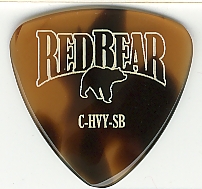
Red Bear Style "C"

Red Bear Style "C"

Imagine a pick shaped like the one to the left, but at 4 mm thick! That’s the Super Thick Gypsy Jazz Pick!

A couple of weeks ago, I was having a conversation with Dave Skowron, maker of Red Bear Trading picks, and said, “You know Dave, I just dig this Gypsy Jazz thick pick that I just bought. But as you know, for electrics, I play with a V-Picks Snake because I love the 4.1 mm thickness.” As background, I had just purchased a standard GJ thickness to replace the Heavy that I gave to a friend so she could try it out. I continued, “Do you have anything that is even close to that thickness? I would love to have that kind of thickness for playing acoustic.”

Dave replied, “Yeah, I have a sheet of the Tortis material that is pretty close to that thickness at about 4 mm. I did something even thicker for a guy once.”

“No, no any thicker, Dave, and I think it would be too much. But if you have a 4 mm thick pick, I’m all over it!”

“Okay, I’ll make up a prototype and send it to you to evaluate.”

All I can say after playing with “the prototype” for a couple of days is I hope that pick goes out of prototype because it is an incredible pick! You know how I love the feel and sound of Tortis, especially on acoustic guitar. In fact, I love the sound of Tortis with acoustic guitar that I won’t play any other type of pick on my acoustic. On electric, I dig my V-Picks Snake for its speed, tone, and thickness. Put all that together in one pick, and what you’ve got is a “Super Pick!”

The thicker you go with picks, the deeper and richer the sound. It’s not that you lose the highs; you don’t. It’s just that the thicker picks also bring out the lows, so what you get in a nice, even tonal presentation. That’s why I dig thick picks! On top of that, there is something magical with the way a Tortis pick interacts with an acoustic guitar’s strings. With me at least, playing a Tortis pick on acoustic evokes a certain visceral feeling that makes me want to close my eyes and just soak up all the tonal goodness. Not only that, Tortis, being made of a natural material, just feels natural. It’s the perfect complement for playing acoustic guitar!

So what about this super-thick Gyspy Jazz gauge? OMG!!! I am in guitar-playing heaven with this pick! It has the thickness of my beloved V-Picks snake, but all the feel and tone that I’ve come to love with my Tortis picks! To just call it “awesome” would be a complete understatement.

I first played the “Super Thick” last Friday at a gig that was primarily acoustic guitar. It started with playing some dinner entertainment music before a re-enactment of Christ’s passion. I was playing my Ovation Celebrity directly into a Genz-Benz 100 Watt upright. When I struck the first chord of the opening song. I actually had to pause and let the chord just ring and hang in the air. It was quiet enough in the room where I was playing that I could hear my guitar, as the amp was there for simple sound reinforcement. I thought my original GJ as awesome at 2.3 mm. What this pick did to the natural tone of my guitar was otherwordly!

I spent most of the day yesterday playing guitar, much to the chagrin of my wife! It feels so incredible!

In any case, if you’re interested in getting one of these, contact Dave Skowron at Red Bear Trading. I’m sure he’ll make one for you. Mind you, this thickness of pick won’t be cheap, but it’ll be well worth the investment!

5 Tone Bones - Gear has stellar performance, value, and quality. This is definitely top of the class, best of breed, and it's a no-brainer to add this to your gear lineup! If I could go higher, I would with this rating. But this pick gets my highest rating!

Read Full Post »

5 Tone Bones - Gear has stellar performance, value, and quality. This is definitely top of the class, best of breed, and it's a no-brainer to add this to your gear lineup!

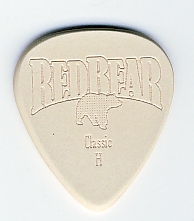
Red Bear Trading Tuff-Tone Classic H

Red Bear Trading Tuff-Tone Classic H

Red Bear Trading Tuff-Tone Picks

Summary:Made from an entirely new pick material, Tuff-Tone picks provide the same, high-quality sound you expect from Red Bear picks, but are much more durable than standard Tortis picks.

Pros: Get ’em wet, put ’em in your pocket with all your keys and change, put ’em in the washer and dryer. They won’t break or warp.

Cons: None.

Price: $10 direct from Red Bear Trading

Tone Bone Rating: 5.0 – The totally unique sound and feel of a Tuff-Tone pick makes it a winner in my book.

I love it when I get gear in the mail, and I especially love it when it’s a padded envelope from Red Bear Trading. I came home early from work yesterday afternoon to get ready to go to a gig in the early evening, and much to my extreme surprise and pleasure, a padded envelope from Red Bear Trading what waiting for me on the kitchen table. I immediately opened the envelope, poured out the contents into my hand and out dropped three pick packages: Two Tuff-Tone picks (a Tri-Tip and B-Style – both heavy gauge), and a super-super thick C Style Tortis measuring 4mm. I’ll be covering the Tortis in another review, so I’ll just mention it here.

I’ve been anticipating receiving these Tuff-Tone picks ever since I spoke to Dave Skowron – maker of Red Bear Picks – about them a few weeks ago, after I saw the announcement on his site. Rather than have me paraphrase the announcement, here’s an excerpt:

After a few years of research and development we have finally come up with a material which is an alternative to our standard pick material. The requirements we sought for this new line of picks were simple – deliver the same great tone and have the same comfortable feel as or regular picks while possessing unbeatable strength and warp-resistance. We feel that we have found that material. After months of beta-testing by some of the industry’s top players, we are ready to roll out the new line. The tone and feel have been confirmed in our tests. These picks are as good sounding as our standard line. They last and last, and are basically worry-free. In blind tests they were indiscernible from our standard line.

I have to disagree with Dave on the last line of the paragraph. To me at least, they aren’t indiscernible from the standard line. They’re similar in tonal response, in that they produce sound very quickly, but they are resoundingly not the same. I’ll get into more detail about this in just a bit. Where they are indiscernible is in their build quality. One of the things that has always impressed me about Red Bear picks is Dave’s attention to detail with respect to the build quality of his picks. To date, I have never received a single pick from Red Bear with any flaws. The bevels have always been perfect. Dave takes quality seriously, and all the picks I’ve had and evaluated have been flawless…

What about the sound?

In a word, awesome! But as I mentioned above, Tuff-Tones aren’t tonally indiscernible from the standard Tortis picks. Frankly, to me at least, they have a sound all their own. The material is much harder than Tortis, and to me sound just a bit brigher tonally. Or maybe I shouldn’t say brighter. The tone they produce is much more “chimey.” They produce the same rich tone you’d expect from standard Tortis, but I believe they bring out the high frequency tones much more than Tortis picks. If I were to make a comparison, tonally they sit right in the middle between a standard Tortis Heavy and a V-Picks heavy; the V-Picks heavy being the bright side.

But even then, these picks are tonally distinct, and no recording is going to capture the sound properly. I actually tried this morning, and it just didn’t work, probably due to my microphones, which double as stage mics, so the EQ tends to stay in the midrange. I could hear the differences in my amp, but just couldn’t capture the sound – sorry. You’ll have to buy a couple to see what I’m talking about. 🙂 Which you should – these picks rock!

How they feel…

Make no bones about it; not only are they tonally distinct they have a totally unique feel. Unlike Tortis or V-Picks picks, these aren’t glossy at all. They have a flat finish, and a rougher, almost tackier feel. But they feel so good! When I first held one of the Tuff-Tones I got, I was a little doubtful about them because of how they felt. I was wondering if they’d be slower. I’ve been so used to playing gloss-finish picks, that these were like sandpaper by comparison (mind you, that’s just flowery language – they actually have a smooth finish). But all my concerns were laid to rest when I started to play. Like Tortis and V-Picks picks, they just glide across the strings. I really love how they feel!

Even at the heavy gauge, which is 1.7mm, these have got to be the most rigid picks I’ve ever played. I love that about these picks. They really don’t give, so they give you immediate tactile feedback while you’re playing.

Overall Impressions

Talk about being torn! I love these picks. I kind of lean towards brighter tone, and these totally give it to me. But I also love the super-rich tones of my Tortis picks, and the chimey tones that my V-Picks Snake gives me. I’m chuckling right now because I would have never thought I’d look at a pick as a tone-shaping device. Most people just use a single pick – I was the same until I discovered the virtues of using high-end picks. But the thing with high-end picks is that they each bring something different to the table with respect to tone and feel, helping you dial in just the right kind of tone for the song you’re playing. I now look at picks much like a painter looks at brushes. I now have yet another brush to add to my collection of tone “brushes.”

Read Full Post »

I don’t post as often as I’d like on thegearpage.net, but I certainly lurk there at least three or four times a day. For the last couple of days, TGP has been down due to a hardware failure of some sort. While it was down, I realized just how much I liked visiting that site. I’m not really friends with anyone there yet, but it’s a place I definitely enjoy visiting. It’s a great community!

I’m pleased to announce that TGP is back once again, and running like nothing happened! That’s awesome! Now I can while away the hourse once more… 🙂

Read Full Post »

Amplitube Fender EditionMore often than not, the way I end most of my days is to strap on an axe, plug into one of my amps, and just noodle or jam to a jam track I put together. But tomorrow, I’m doing an outdoor gig that requires the use of my amps (had to drop them off tonight), and even though I have a little Fender Champ 600 for practice and recording, I was more in the mood for a bigger sound.

It was then I remembered my copy of IK Multimedia’s Fender Edition! I could plug directly into my DAW, spark up AmpliTube X-Gear, Amplitube’s excellent standalone and plug-in modeling software, and jam away! And with 12 different amps and boatload of presets to play with, I could get any sound I wanted! So I lost myself for over an hour of playing and trying out a bunch of different models and presets. It was truly marvelous and a great way to cap the end of a great day!

When I finally came up for air, I realized the power and allure of using these amp plug-ins from AmpliTube. They’re certainly not the real thing, but they’re so close to real, it almost doesn’t matter. Imagine going to a gig, and all you lug with you is a laptop, a DAW, and a couple of cords. You plug straight into the board and output through the PA. Then all you do is monitor your tone through your stage monitor.

IK Multimedia has tools to make it even easier to do exactly this. AmpliTube Fender – or any modeling software they make for that matter – is fully controllable via MIDI. So IK Multimedia has a product called StompIO, a USB stage controller that gives you full control over “Powered by AmpliTube” plug-ins, such as AmpliTube Fender Edition. Want to switch to a different amp? Add some chorus? Add a little dirt? It’s all available via the StompIO! The coolness factor of this is way huge, and at least for someone like me, it has some interesting ramifications.

For one thing, I play mostly small venues, so the more simple I can keep it, the better. Also, except for real purists, most people just can’t tell the difference that you’re playing through a model or a real amp. For instance, last year, I went up to Lake Tahoe and was sitting in a bar at a Casino, and there was this excellent male/female duo playing classic rock covers. The lead singer was a real excellent guitarist, so during one of their breaks, I went over to talk to him and see what gear he was playing. Amazingly enough, I discovered that his amp wasn’t an amp at all; it was a VOX ToneLab that he ouputted straight into his mixing board! I consider myself to be pretty good at making the distinction between a model and the real thing, but as the dude explained it, with all the ambient crowd and general bustle of the casino, it would be tough to tell he was using a modeler. It didn’t matter to me just the same, because the guy was such a damn good guitarist who could make his guitar absolutely sing. So for someone like that, he could make pretty much make anything sound great!

He shared that for larger gigs, and for playing solos in the recording studio, he still used a real amp – there’s just no substitution. But for tracking rhythm parts, and for playing in the casino, there was a lot to be said about the gear he didn’t have to bring with him. And that’s the point of something like AmpliTube Fender Edition. The less gear I have to lug around, the better! Of course, there’s no substitution for a real amp. Even though software can come close – incredibly close – to sounding like a real amp, there’s nothing like playing through the real thing.

But that said, when I want to go on a song writing trip, I can now pack everything I need to record my ideas in one bag, and all I’ll have to do is bring a couple of guitars! When I return home to lay down the tracks for good, I’ll just keep the rhythm tracks I recorded with the software models, and layer solos using a real amp.

Cool? You betcha!

Read Full Post »

Catalinbread Dirty Little SecretI always love being able to get great tone at a bargain. It’s not that I’m cheap. I’ll pay top-dollar for great gear, but when potentially great gear comes at an incredibly affordable price, the Dawg’s ears perk up, and his nose starts sniffing around to see where he can play some gear.

Such was the case when I first came across this little pedal company located in Portland, Oregon called Catalinbread. I had run across the name on a couple of gear forums, but didn’t get a chance to check out their site until today when I read their press release in Harmony Central Effects News. After I read the press release, I had to check out Catalinbread’s site, and much to my pleasure, Catalinbread offers several, very cool pedals.

One thing that makes them stand apart is their diminutive size. As noted in ProGuitarShop’s Catalinbread company page, “One of the defining features of Catalinbread effects pedals is the size. Catalinbread pedals are half the size of your standard MXR. That’s right, take a Phase 90 and cut it in half vertically and you’ve got the basic size of Catalinbread’s pint-sized pedals.” But, as they say, size isn’t everything. Apparently Catalinbread’s pedals pack a lot of sonic punch.

The other thing that makes Catalinbread pedals stand apart is their price. Their most expensive pedal that I found was US$179.95. Several of their pedals are under US$120.00! Mind you, these are handmade pedals! That’s so awesome! Catalinbread is definitely taking the stand of selling gear at lower prices to get it into players’ hands. Creation Audio Labs does this with their awesome pedals, and Aracom Amps does it with their VRX line. This ain’t trivial stuff, either. This is great, handmade gear at a great price!

Can you keep a secret?

The Dirty Little Secret could be construed as another “amp in a box” pedal. But from what I’ve heard from sound clips, it’s far from that. Catalinbread claims to have built into the box amp-like touch sensitivity that accurately respond to your playing dynamics and volume input; so much so that you feel like you’re playing in front of an amp, and not through a pedal. But there are several videos on the DLS product page that bears this out. Check out that page here.

Of course, only a live test will reveal if that is true, but I’m intrigued enough to go try one out if I can. The only problem with that is there are none to be found. This pedal’s so scarce that you can’t even order one on the Catalinbread’s web site! I have a feeling they’re being sucked up as fast as the company can produce them. Even retailers who were hawking the pedals awhile ago have either removed their sale pages or replaced their “buy now” link with ‘Email us about ordering.”

Well… my brother lives up in Portland. Maybe I’ll have him look these guys up!

Read Full Post »

A couple of weeks ago, the Dawg was sniffing around for some new and interesting gear, and came across a little company in Raleigh, NC called Acoustic Image, that specializes in acoustic and bass amps. While I love my Roland Cube 60 for its acoustic channel, I was really impressed by the sound of the Acoustic Image Corus. Now, I could only go off the sound of the YouTube video below, but this puppy has some serious, natural tone. Amazingly enough, it’s a diminutive amp with a 10″ downward firing woofer, a 5″ midrange driver, and 1″ tweeter. It produces 450W at 8 ohms and 800W at 4 ohms. That’s a boatload of power! But we’re talking solid state here, so it’s tough to compare to tube amps. But power isn’t everything – it’s the sound that counts, and from what I can tell, this amp sounds fantastic! I need to get to a store that carries these to try it out with my acoustic/electric. Check out the video!

Read Full Post »

yodaAh, Padawan. Come to receive the wisdom of the ages, you have I see. Into the realms of guitar playing greatness delve deep do you wish; to play among the stars of guitar such as Vai, Satriani, Johnson and others of that ilk. Good for you! Welcome you with open arms, do I. Now dispensed with the pleasantries have we Padawan, it is time to let you down…

  1. There is no magic wand I can wave to make you great
  2. Wish all you want, and you’ll never become a guitar god.
  3. Meditate on the virtues of truly great guitarists – It will do you no good.

Now that sufficiently crushed your dreams of guitar greatness have I, tell you I will the secret to achieving your place among the titans:

There are no shortcuts!!!

Bwah-hahahahahahahahahahahaha!!!

Okay, enough of the Yoda talk… 🙂

To be completely serious, if you want to be a great guitarist, there is no other way to get to greatness without dedication and focus. Simply put, you have to practice – a lot! You can learn all the theory in the world, you can take all the A/V classes out there. All of these things are absolutely helpful. But until you apply the things that you learn and master the techniques, you’ll never get there.

Playing guitar, or any instrument for that matter, isn’t something that you can be good at simply by intellectualizing being good. It takes practice – every day – to develop the skills to play well. I look on my own experience with playing guitar. Yeah, I’ve been playing for over 35 years, but I’ve only reached a certain level of proficiency in the last five years when I decided that I wanted to change the direction of my music, which was almost entirely acoustic, to include more electric guitar.

The experience in the last five years has been both rewarding and painful. When I was starting out, it was so frustrating because I could hear in my head what I wanted out of my guitars, but I didn’t have the technique. So I put my head down, so to speak, and started playing and practicing everyday, seven days a week. I’d even bring a couple of guitars and an amp on vacation! I try to play at least a half-hour each day. It’s not necessarily just straight practice of scales, and different techniques, I also spend a lot of time exploring how to express music that comes into my head.

I’m still learning. I feel I have so much further to travel, but I have also come a long way compared to where I was five years ago. Back then, all I knew were chords and playing chords in alternate tunings. I could fingerpick pretty well, and do a lot of stuff with an acoustic guitar – that’s all great, and I don’t want to discount what I could do on acoustic, but my abilities on the electric guitar, especially with doing improv, were sorely lacking. But from constant practice, I can do at least a basic lead in pretty much any key. That’s the reward; having the satisfaction of knowing I’ve made a lot of progress.

I originally got the inspiration for this article from a blog entry I read at GuitarVibe. It really got me thinking about what I’ve accomplished over the past few years, and moreover, how I got to where I am. Like with anything in life, learning is often fraught with moments of despair and discouragement, but it also has its times of complete satisfaction and reward.

So go practice, young Padawan, and may the Force be with you!

Read Full Post »

« Newer Posts - Older Posts »