Just came across this today, and it is the most comprehensive OD shootout I’ve seen/heard – EVER! This isn’t a simple A/B. This is 36 OD pedals. Very good!
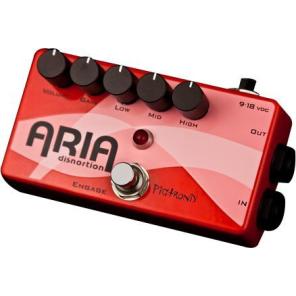
I usually keep up on new stuff, but the Aria has been around for about a year now. Can’t believe I missed it! In any case, I just spoke with Dave Koltai of Pigtronix, and he said the Aria was the result of releasing a product with no marketing. I take it that Dave is one of those back-room geek dudes who come up with lots of amazing shit, then just put it out there. 🙂 Actually, after speaking with him, he’s a really cool guy, and it’s great to meet someone who has a passion for what they do, and that was clear that he has a passion for creating great pedals.
I’ve known about Pigtronix for quite awhile, but it wasn’t until I got the press release on the Keymaster and shared it, that I started looking in on Pigtronix’s product line. They’ve got an impressive array of pedals. The one that I’m really keeping an eye on is the Philosopher King pedal, which is a compressor/sustainer, grit, and envelope filter. Have to save my pennies up for that one, but it’s definitely something I’d like to add to my board. But more to the immediate, I also came across the Aria Disnortion pedal, and that’s what this post is about…
I love dirt pedals! I’ve got a bunch of ’em, and for some reason, I just can’t get enough of ’em (I know… I say that a lot, but it’s true). Each one that I have has a different character, and they rotate on my board with seeming regularity as I get the in the mood for different tones now and then. As of late, I’ve really been into more transparent overdrives and boost, as I love the natural sound of my amps when overdriven, and the Aria definitely seems to fit the bill.
Now with respect to transparency, let’s face it, nothing is transparent. Everything you put on your board will change your tone. But what I tend to look for – especially in dirt pedals – is that they don’t take anything away, ESPECIALLY dynamics and and note separation. Some pedals I’ve tried in the past sound pretty decent and have lots of dynamics, but at high gain levels, lose clarity and note separation. While I’m not a speed demon on the fretboard by any stretch of the imagination, I do have more of a legato style of playing where I play several notes in one complete phrase which I’ll end with a bend or sustain, depending upon what I’m playing. So note separation is VERY important to me. There’s nothing worse than playing a well thought out phrase, only to lose it in a mush. From what I’ve heard from the demonstrations by Peter Thorn and Andy at Pro Guitar Shops, even at high gain settings, the pedal retains note separation. That’s a huge plus!
Another plus of this pedal that I can see is the 3-band active EQ that provide 12dB of cut or boost to really shape your tone. The gain knob will give you clean boost to fuzz, which makes this an incredibly versatile dirt pedal. This ain’t no one-trick-pony; that’s fo sho!
Then add to all that this pedal retails for a street price of $149, OMG! I have to get this pedal! 🙂
Since I’ve gotten it, I’ve been absolutely digging the VHT Special 6. It’s such a versatile little amp, with bright cleans and capable of creating some gorgeous, sustaining overdrive. And while I do certainly appreciate its clean tone, this amp totally shines when it’s cranked to hilt.
To demonstrate, here’s a clip I recorded this evening with the VHT Special 6:
Now here’s the thing about recording with a low-wattage amp. I’ve found that almost invariably, it’s difficult to get a big sound out of the stock speaker, no matter where I place the microphone. People recommend recording from an angle lined up along the outside of the speaker cone. I’ve never had much success with that, considering I’m not using any high-end mics. So my solution is to use larger speakers to get that bigger sound.
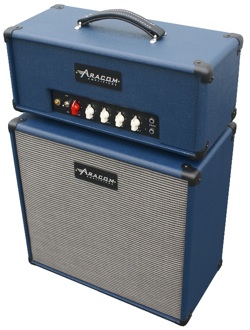
For this clip, I used two different 1 X 12 speaker cabinets: The rhythm track was recorded using a Fane Medusa 150 speaker to get a bigger bottom end. The lead was recorded with a Jensen Jet Falcon – that’s my favorite speaker at the moment. And of course, because even 6 Watts cranked is very loud, I ran the amp through my Aracom PRX150-Pro and recorded each track at about loud conversation level. It’s just loud enough to move the speaker cone a bit, but not so loud that I’d wake up the neighbors. 🙂
For both parts, I used my Les Paul R8. For the rhythm, I recorded in the middle selector switch biased towards the bridge, and for the lead, I recorded with the bridge pickup only. To make the guitar tone sound even bigger, I added just a tiny bit of compression to each track and added a touch of small room reverb to add some dimension. I didn’t EQ the guitar parts at all. That’s the natural sound of the amp through the speakers I used. The compression keeps the sound focused. At least to my ears, the guitar parts sound like they’re coming from a much bigger amp.
As far as the amp setting were concerned, I was plugged into the hi input with the amp set to high-power mode. Tone and volume were at 3pm, and I engaged the Boost. Even at these cranked settings, the amp will clean up very nicely! That’s how responsive this amp is!
Admittedly, if I were to rewind and go back to when I bought the amp, I’d probably go with the head. The stock speaker is great for practicing, but for gigging and recording, it just sounds much better with at least a 1 X 12. But hey! A handwired amp for $199? Geez! I can live with its shortcomings as what it brings to the table tonally is fabulous!
Before I got my Aracom PRX150-Pro, to get grind, I used a variety of overdrive pedals. But now that I have a great attenuator that allows me to get my amps in their sweet spots without stepping all over my band, I’ve been making lots of use of clean boost – namely, the Creation Audio Labs Mk.4.23 – to push my amp into overdrive, plus get a bit of a volume boost. I use overdrive pedals far less now, but I do use them when I want a different color to my overdrive tone. But I’m curious – especially after seeing Peter Frampton’s small board – what people prefer. So here’s a poll…
The Aracom VRX22 has been my primary amp for quite some time now – almost 2 years – and I’m still discovering the beauty of this wonder 22 Watt amp. It’s no small wonder that it has been my “Go-To” amp since I’ve gotten it. It sounds so killer both clean and dirty, and tonight, I realized just how great it is with pedals!
Since I’ve had the VRX22, I haven’t been using my overdrive pedals as much. I know, I used to be a real nut about overdrive pedals, and I have several. But this afternoon, I reconfigured my board, and placed my favorite drive pedals on it with the intention of using them. This included my Doodad Guitars Overdrive/Booster, Tone Freak Abunai 2, and my KASHA overdrive.
For my gig, I set the amp up in the clean channel, with the volume at a level where I’d have to dig in a bit with my Les Paul to get some grind. This would leave me with lots of headroom to work with, and not break into overdrive so early that all I get is more overdrive, and not volume.
Then I tweaked the overdrive pedals so I’d get different characters of overdrive, depending upon what I was after. I set the Doodad up for Tube Screamer like overdrive, at just over unity gain, but with the drive knocked up a bit so I’d get lots of sustain. I set the Kasha on “Classic” at just above unity gain for a more biting, trebly tone. Then I set up the Abunai 2 for a more thick, compressed overdrive.
The one thing I love about overdrive pedals is that as opposed to providing all the distortion as with a distortion pedal, they are meant to interact with the amp so what you get is a combination of distortion characteristics from both the pedal and the amp. This combination doesn’t always work so well. I’ve played many amps and some just want to overdrive by themselves. Using an overdrive pedal with those amps just muddies the tone. It’s not pretty.
Not so with the VRX22. I’ve thrown all sorts of pedals at it, and it handles them all without a hitch. It’s especially good with overdrive pedals, and in my gig, I just kept smiling because it sounded so damn great with them! And with second channel on the VRX22 that has another gain stage that acts as a built-in overdrive, I had yet another overdrive voicing to use, and I used all four either individually, or in many cases, I’d stack two or more together. And that’s a key thing with the VRX22. It can deal very well with stacked overdrives, retaining its touch sensitivity and note separation. Other amps I’ve used when stacking just can’t deal with the stacked overdrives very well.
In any case, this kick-ass amp is something you should consider. At $895, it’s simply tough to beat for a true hand-wired, boutique amp. And for those of you who already have Jeff’s PRX150-Pro or -DAG attenuator, you already know the build quality that goes into Aracom gear. It’s simply killer!
“Guitar Player” mag took a recent poll asking: If you could only have a single pedal in your rig, what would it be? Overwhelmingly, and actually not too surprising to me, most pollsters chose an overdrive pedal. I personally didn’t take the poll, but I would definitely fall into the majority. You know me, I just can’t enough of overdrive pedals!
So much to my great pleasure, Maxon has released the new ST-9 Pro+ Super Tube Screamer Overdrive. Based upon Maxon’s classic “808” circuit, and building upon the original Ibanez ST-9 and its ability to control the amount of “midrange hump,” this “reissue” adds features that have the potential of making this a truly great Tube Screamer-class pedal.
First of all, the ST-9 Pro+ sports 9V or 18V operation. 18V mode adds more headroom and warmth. This is controlled by a slider switch in the battery compartment.
In addition to the Drive, Level, and Tone Knobs, the ST-9 Pro+ also has a “Mid-Enhance” knob which controls where the mids are boosted. Clockwise moves the boost towards the high mids, while counter-clockwise moves the boost to the lower mids. To me, this is probably the most useful feature, as you can dial in the mid boost to adapt the pedal to different amps.
The ST-9 Pro+ also has a switch that selects either “Classic” or “Low Boost.” Low Boost gives a 12dB boost at 100Hz and a 4dB boost a 500Hz. This can be quite useful for fattening up single coil guitars!
Finally, the ST-9 Pro+ has true-bypass switching.
OMG!!! I love the features on this pedal! Were I to consider getting another pedal in the Tube Screamer lineage, this pedal would be at the top of my list! However, with a street price of around $206, it’s not a cheap proposition. But with it’s features, it certainly warrants a close look; and based upon my experience with Maxon pedals, their build and sound quality is undeniable. While I don’t use it much any longer, my CP-9 Pro+ compressor is a testament to that quality (I paid $250 used for that pedal), and it’s a pedal I’ll always have. As for the ST-9 Pro+, I’ll see if I can find a place where I can audition it.
Finally, here’s a great demo video that shows off the ST-9 Pro+ quite nicely:
Dynamics. It’s what separates a mechanical and boring piece from something that can move an audience to tears. In this episode, Doug talks about the incredible dynamics of the Dumble Overdrive Special.
This is the last video in the series of Doug Doppler on the Dumble Overdrive Special, but it’s not the last. I’ve got many more “Doppler on…” videos to come, so stay tuned!!!
Summary: Two independent, true-bypass pedals in a single “bastard-proof” enclosure that can be used standalone or together. Overdrive is based upon the classic Tube Screamer, but has a voice all its own, and the booster is nice and transparent.
Pros: Fantastic overdrive tone! The overdrive is super responsive, and the sustain at high drive settings is killer!
Cons: I just keep the tone pot wide open. But the cut can be dramatic when you want to reduce some highs. Just a nit.
Features:
Both overdrive and booster are true-bypass.
Runs on a single 9V battery
Overdrive controls: Drive, Tone, and Volume
Booster controls: Boost (gain)
Price: $139 street
Tone Bone Score: 5.0 ~ I admit it, I’m partial to overdrive pedals, and while I love every single one that I have, I just never get tired of them. This pedal is going on my board! I’m buying the eval unit!
Holland Produces More than Just the Dire Straits
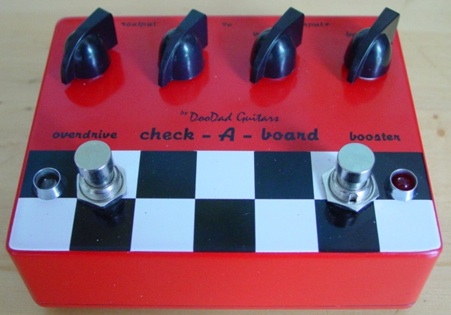
I’ve been wanting to review gear from European companies for awhile; that is, European companies that don’t have much of a US presence, so TC Electronics was kind of out. So when I discovered Doodad Guitars by accident through some research on Marble amps – another Dutch company – I knew I had to find a way to check out their gear. So hooking up with Mal Stich of the The Alternative Guitar and Amplifier Company in Southern California got me the Check-A-Board RED overdrive/booster. I’ve been having TONS of fun with this pedal since I got it for review. So much fun that I’ve decided to keep the pedal. 🙂
Gig Report
Not wanting to lug my full rig to the church this past Sunday – which usually includes an amp head, cabinet, PRX150-Pro attenuator, my pedal board, plus a couple of guitars – I opted to go a bit more sparse. This time, I loaded up my Champ 600, a 1 X 12 cab, my Squier CV Tele; then threw the Check-A-Board RED pedal and my TU-2 tuner in a gig bag. Setup time: Less than five minutes. 🙂
This past Sunday, my drummer was traveling on business, but even without a drummer, I like to have a little dirt at my fingertips. And since I wasn’t using an attenuator, an overdrive pedal was my only option, so what better way to test the RED pedal?
I needed to pop in a 9V battery, and I have to say that I dig the battery compartment in this pedal! As opposed to many pedals that have a separate lead wire that you have to attach the battery to, then place into the battery housing, the RED pedal’s housing actually swings out completely! You just slide the battery into the compartment, swing the housing back into the pedal, and you’re off to the races! Nice and convenient!
For volume setup, I first adjusted the Champ’s volume to my normal gig volume which, in a church as most worship players will attest, isn’t very loud; especially when you’re sans a drum kit. By the way, my guitar was also set to just above half-way on its volume knob, so I’d have some wiggle room. Once I had that dialed in, I set the RED pedal’s drive to about 2pm, tone wide open, and set volume at just above unity. That gave me a nice rhythm grind, and with the drive set where it was, if I added more volume on the guitar, it wouldn’t produce too much more volume – just more dirt, which is what I wanted.
At those pedal settings, the RED pedal really sustains. That’s what you’d expect from a Tube Screamer-like pedal. But as I mentioned in my “first impressions article,” it has a voice all its own, foregoing the huge mid-range hump, and presenting a much flatter EQ response that brings out the highs and lows a bit more (just so long as you keep the tone wide open as it is a high-cut filter).
While it responds dynamically much like a Tube Screamer, its voicing is darker and has more “balls.” That’s a great combination, especially when you’re playing through a naturally bright amp like the Champ 600. It provides an overall tonal balance, and that’s very pleasing to me. 🙂
There were two things that struck me during the service about the RED pedal: First of all, even when I was wailing on the strings, the string separation was phenomenal! This pedal doesn’t know how to get mushy! Even on our closing song where I cranked the Drive – and we could play with more stage volume because the congregation gets LOUD 🙂 – my sound never turned to mush, and I was able to weave in and out of power chords and little fills and not worry about producing just a wall of sound. KILLER!
Secondly, where I had the pedal set up for most of the service, the RED pedal’s dynamic response was much like an amplifier’s, and it responded incredibly well to volume and knob and pick attack. For instance, there was one song near the beginning of the service where I stepped into the aisle to egg on the congregation to sing with the band. When I stepped out, we were in the middle of a nice, driving section of the song. I kind of got a bit carried away 🙂 and lingered there a bit too long and couldn’t get back to the RED pedal to switch off the overdrive before the softer verse section. So I turned my guitar volume down just a bit, and used some light hybrid picking for the verse section. The pedal cleaned right up, and had just a tad bit of dirt on the high-end which served as some shimmer. Needless to say, I pretty much kept the pedal on for each song we did, with the exception of a meditative, prayerful song where I had to play absolutely clean.
Funny thing, while I set up the booster, I didn’t even use it this past service. I’ll definitely use it when I use my regular rig, as I’ll have my attenuator and can set my amp to its sweet spot. Then I can take advantage of slamming the front end with some gain. 🙂
I DIG THIS PEDAL!!! At $139 from The Alternative Guitar and Amplifier Company – and I don’t say this often – but this is a must-have pedal for me! Looks like I’m going to have to buy the evaluation unit! Yeah, I know, I’m adding yet another overdrive pedal to my collection, but as Tony Stark said in “Iron Man,” “I gotta have it.” But unlike Stark, I won’t box it up and put it in storage. This pedal is going on my board!
How It Sounds
I’m using the clips I recorded for my first impressions article again. I’m actually working on a video review of the pedal, so I didn’t want to record more clips. But here’s a sampling for your listening pleasure. For this, I’m using my Aracom PLX18BB 18-Watt Plexi clone.
Wow! I’m having A LOT of fun editing this series because I’m just blown away by Doug’s incredible talent! What a gift! In any case, this part of the series has Doug discussing tone shaping with the ODS pre-amp section, and talking about playing a Strat through the amp. Plus, there’s a little surprise at the end. 🙂 Cheers!
You know me… I LOVE overdrive pedals! I have several, and amazingly use them all, depending upon the voicing that I want, as I don’t think I’ve ever come across any two that sound exactly alike. But since I’ve been playing through really nice tube amps, I’ve come to really appreciate a great booster pedal as well. So it was very pleasant surprise to discover Doodad Guitars’ Check-A-Board RED overdrive-booster pedal that combines both OD and boost in a single pedal.
You might be thinking, “So what?” I certainly did, until I found out that you could operate either one separately or both in tandem to not only add some clipping before your amp, but to also slam the front end with more gain. That really piqued my interest!
I discovered this pedal through Mal Stich over at The Alternative Guitar and Amplifier Company (“Alternative” for this discussion) as I was searching for more information about Marble Amps, a Dutch company that makes vintage Fender clones. “Alternative” is their US dealer. I called up Mal to get info about the amps, and we had a great conversation. He shared that the amps were fantastic, but it was tough to sell them here in the states because shipping and duties are so high for such heavy gear that it makes it hard for Marble to compete in the boutique amp marketplace in the States. Then he mentioned that he was working with another Dutch company that had just released a brand-new overdrive-booster combo pedal. That got my ears up! So he graciously offered to send one to me for review.
So as a first impression, what do I think? This is a killer pedal, folks! I love both sides of the RED pedal. While the overdrive is supposedly based upon the classic TS-808 circuit, it doesn’t sound at all like a Tube Screamer (remember, I have one), but that’s a good thing, as it has it’s own voice. It can go from slightly gritty to super saturated and sustaining. But the coolest thing I dig about it is that it doesn’t compress your signal much with the drive set high. But like the Tube Screamer, at high drive settings, it sustains for days!
With respect to the booster, I dig it. It doesn’t give me as much boost as my Creation Audio Labs Mk.4.23, but very importantly, it doesn’t add any artifacts either; in other words, it boosts as expected, and does it transparently. And it comes in handy when I need a slight volume jump for a lead. I guess you might compare it to the VOX Satchurator’s “More” toggle, but with this booster, the gain is adjustable. Nice! While I really love the overdrive side of the pedal, I’ve found myself using the booster a lot more because my amps just loved to be slammed with gain on the front-end! 🙂 The booster really brings out the best in these low-wattage amps!
For controls, the RED pedal has four knobs: Three (Drive, Tone, and Volume) control the overdrive section, while the four controls the amount of boost the pedal produces when the boost is engaged. The Tone control is more of a high-cut filter than a true EQ, but that’s okay. I prefer that with overdrive pedals as I usually want all my tone, so I normally have it all the way up, or if I’m playing a naturally bright amp, like my 18-Watt Plexi clone, I just dial out a tiny bit of the highs. One thing that I noticed immediately with the overdrive besides its sustain, is the incredible note separation, even at higher drive settings. That makes it a no-brainer to use when I want singing lead tones! As I mentioned, the signal doesn’t compress that much, so having that note separation is killer!
In my short time using the pedal, I’ve actually preferred to use the overdrive and booster separately. My little low-wattage amps provide enough dirt that slamming them with overdrive AND boost is just overkill. If I had higher-wattage, high-gain amps, it probably would make more sense to use both. In any case, I have some clips of the pedal. I’m using my Squier CV Tele plugged straight into the RED pedal then into my Aracom PLX18BB Plexi-clone.
PLX18BB By Itself
Overdrive Engaged
Booster Engaged
I have some more playing to do with it before I do my full review, but I will be giving this pedal a pretty high rating!



 Guitar Gear