Feeds:
Posts
Comments

Posts Tagged ‘overdrive’


For the last couple of years, there has seemingly been a glut of new overdrives that enter the market on a weekly basis. I’ve been like a kid in a candy store as overdrive pedals are my favorite pedals. Though I’ve played through tons of ’em, I haven’t written about many mainly because there’s just so much gear out there, and I’ve got a limited amount of time I can spend reviewing and writing.

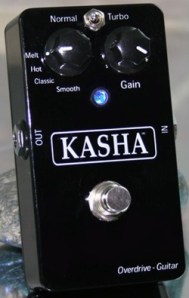
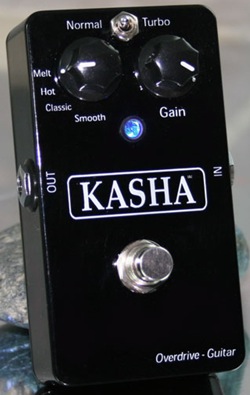
But I’ve noticed that in the past few weeks, there have been just a couple of new overdrives to enter the market; one of which I purchased (the KASHA Overdrive), and the Skull Crusher overdrive, both made by the same company. Since then, I haven’t seen anything new come out – at least no one is putting out press releases…

Are we at a saturation point now? Has all the overdrive territory been covered? Perhaps it is, or perhaps people are just waiting to release their pedals. One thing’s for sure, the overdrive tap has dried up.

Read Full Post »

A friend of mine asked me to recommend a pedal that would push his amp into overdrive so it would just be his amp distorting. Naturally, I recommended a transparent clean boost that would slam the front-end of his amp and make his pre-amp tubes clip. So I lent him my Creation Audio Labs Mk.4.23 clean boost (best I’ve ever used, btw). He hooked it up, turned on his amp, slung his axe, strummed a chord, immediately muted and turned to me saying, “Dude, this doesn’t sound right.”

“What do you mean?” I replied,  “It sounds fine to me.”

“It’s too bright!” he exclaimed.

“Dude,” I replied, “That’s how your amp sounds when you overdrive the tubes. Actually, that sounds killer. Lemme try…”

So I took his guitar, and did a couple of riffs, and bent and held a note to get some feedback. The tone was rockin’!

“That was cool, dude, but it’s still really bright,” he said.

“Oh brother, bleed off some highs from your tone knob, for chrissake,” I said, obviously getting a little exasperated.

He did, I played a bit more, then gave the guitar back to him.

“That was better,” he said, “but it doesn’t sound quite right.”

“Ha! That’s because you’ve been using a Tube Screamer for so f$&kin’ long for your overdrive sound, that you’ve never really known what your amp really sounds like when it’s overdriving without any help,” I quipped.

“You know, you’re probably right,” he said, “but it’s what I like, so I think I’ll stick with it. Sorry dude…”

“Hey! Not a problem, you just gave me the material for my next article! Thanks!” I exclaimed.

The point of that story is that for some, transparency isn’t pleasing to them at all. With my friend above, he was used to the Tube Screamer’s mid-range hump, and when he heard his amp overdriving with the full spectrum of the EQ, he didn’t like it all. I also met a dude who uses a compressor that’s always on to fatten his tone and punch through the crowd noise when he’s playing (he plays a lot of open, public spaces). In either of these cases, it’s all good because as the old saying goes, beauty is in the eyes of the beholder.

The reason why I brought this is up is because there’s a lot of talk among gear freaks about transparency; that is, the natural sound of our guitar(s) and amp(s) without any coloration. By convention, transparent tone sets the baseline for our sound, which we then color with effect pedals. That seems to be the convention. For some however, that baseline includes some coloration; like my friend who always has his Tube Screamer on. Again, beauty is in the eyes of the beholder.

Admittedly, for myself, before I started using attenuators to get the natural cranked tone of my amps, I was someone who used a Tube Screamer or OCD to get my grind. Once I started using attenuators, it actually took me awhile to get used to not only the transparent, natural, cranked sound of my amp but also the dynamics as the pedals I used added sustain and compression. But now, and for the last few years, transparency is where it’s at for me, and it has really opened up a whole world of tone for me. More importantly, it has helped me understand how different types of amps, especially tube amps, sound in their natural states.

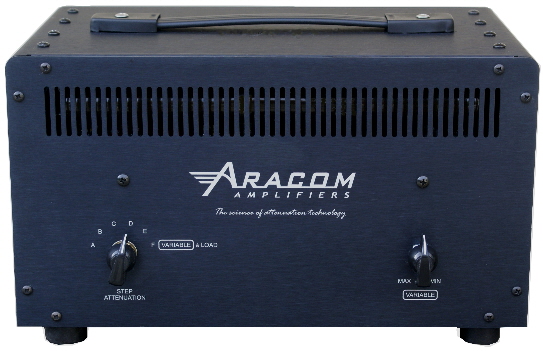
Please don’t get me wrong, there is absolutely nothing wrong with using pedals to form your baseline at all! But if you do turn on a dime, as it were, and decide to go for transparency, be prepared for a little surprise. When you suddenly experience the full spectrum of EQ from your gear – especially with the case of a great attenuator like the Aracom PRX150-Pro that enables you to get the cranked tone of your amp at reasonable volume levels, you may not like it as your ears are used to the altered tone from your pedals or other devices you’ve had in your signal chain to achieve your baseline tone.

But I will say this: I do argue for creating your baseline tone as transparent as possible. As celebrity chef Emeril Legacie says about cooking, “It’s very easy to add ingredients, but it’s a lot more difficult to take them away.” With respect to your rig, if you build on a good base of transparent tone, it’ll have some very good effects on how you approach your tone. I’ll share with you a few points of what I discovered:

  • I’ve come to appreciate the natural character of my amps. I use four amps (though I normally gig with only two of them). These are all based on different power tubes: 6L6, 6V6, EL84, and 6AQ5. These all have different characters when cranked. When I’m recording, I can pick an amp that fits the type of response I’m after.
  • A fallout of the the first point is that I’ve found that I’m using effect pedals a lot less; especially overdrives, which I still love, but I use only to provide a different character. For instance, while I totally dig the sound of my main gigging amps, Aracom VRX22 and VRX18, the drive channels are on the  bright side when pushed. But if I want a little low-end oomph for some rhythms, I switch to the rich clean channels of these amps, and get my grind from one of my overdrives, like my Tone Freak Effects Abunai2, that has a clipping circuit, plus adds both compression and sustain (this pedal rocks, by the way).
  • Going more barebones in my approach has also made me a better player – especially with respect to sustain and vibrato. Where I used lean on my pedals as a bit of crutch to get sustain, I’ve had to learn how to eek out as much sustain from my guitar using just my fingers. Once I started getting that down, it was a whole new ballgame for me.

Whew! I didn’t mean to write an entire treatise! 🙂 But to close this out, if you’ve never really experienced the natural tone of your gear, I encourage you to do so. It might just blow you away. Then again, you might not like what you hear, and that may give you pause to research getting another amp – that’s never a bad thing…

Read Full Post »

I ordered a couple of NOS 1959 GE long plate 12AX7’s a few days ago – they were a great deal – and looks like I’m going to buy several more. NOS tubes is where it’s at for me. What’s the big deal? Well, for one thing, they were made during a time when almost all electronics were run by vacuum tubes, so they’re incredibly reliable. But more importantly, they just plain sound better than any new tube. Not that new tubes are bad – far from it – I’m a big fan of JJ’s and Tung-Sol’s, but they can at times be a bit harsh, and in the case of the Tung-Sols, don’t last very long. For instance, I had a set of JJ’s in my custom Aracom VRX18, an incredible amp powered by two EL84’s. They sounded great in that amp, but the highs could get really fizzy.

When I got the GE’s today, I immediately installed them into the VRX18, and lo and behold, that top-end fizz was tamed! You get that fizz from EL84’s anyway, which happen to power this amp, but those NOS tubes really mellowed out the fizz, and provided a richness in the tone of that amp that I had not ever heard come from it! I was so amazed, that I used that amp on a new song I’ve been working on called, “Strutter.” I may actually call it “Stratter,” as I recorded it with my Strat, but I’m still undecided… Give it a listen:

I probably should’ve had a before and after clip, but what those tubes did was to take the naturally bright tone of the amp, and add a bit of bottom end to it. The amp is still on the bright side, but with that little bit of extra bottom end, it sounds so much richer. Here’s  the amp totally clean, played with Goldie, then into a Hardwire reverb, then into the amp. The tones are simply lush!

Who knows? I might be hearing things, but I’m not alone in feeling this way about NOS tubes. Lots of people will attest to the same thing: NOS tubes just sound better. Whether or not it’s due to their construction or the manufacturing technology of the time. Good NOS tubes sound and feel so much fuller than their modern counterparts. As I eluded to above, it could all be imagination coming into play, but if hundreds of people are saying the same thing, there’s got to be something to it…

Read Full Post »

I love my Strat. It’s a cheapo MIM version, but it has a great sound. But ever since I started using it with the KASHA Overdrive pedal, it sounds even more like a Strat to me! I know, that sounds a little cuckoo, but that Classic channel on the KASHA Overdrive really brings out that jangly tone that defines the Strat tone; that’s to my ears, at least…

The other day, I was messing around with a dominant seventh ditty in A as I was trying to pick up some improv techniques from Chuck D’Aloia’s Blues with Brains video. I originally just recorded my Strat running through a reverb, then into my amp. It sounded pretty good, but I wanted to get a bit more top-end bite, but not a lot of drive. So I switched my KASHA Overdrive on and my jaw dropped! Here’s what I came up with…

That pedal just brings out the best in a Strat. I swear, now that I’ve been using it with my Strat for the last couple of days, I think it’ll always be on when I perform with my Strat. It really sounds great!

BTW, both rhythm and lead parts were played with the Kasha overdrive pedal. For the rhythm part, I was in the Classic channel to get that jangly Strat sound from position 2, while I was in the Hot channel for the lead in the neck pickup. So sweet sounding!

Read Full Post »

To date, this is the most popular article on this site, having held the top hits spot for the past several years now. My feeling is that it addresses the murkiness of the debate between overdrive vs. distortion. And despite many people like myself who constantly say they’re two, mutually exclusive things, it remains a subject that needs clarification. I’m glad this has been a -hopefully good – resource for people! 

Remember: Distortion Is What You Hear! Overdrive Produces It!

I had an interesting conversation with a friend today regarding the difference between overdrive and distortion. Talk about two terms that are bandied about interchangeably in the guitar world! If you ask ten different guitarists the difference between them you’ll get ten different answers. But a common theme you’ll hear is what each sounds like; in other words, you’ll get a much more qualitative description as opposed to a quantitative description. What I’ve been after is a much more objective, quantitative description of each, but not necessarily too technical. So after talking about one versus the other, I decided to write down what we discussed, and throw my two-cents into the mix.

First, let’s look at the two terms, but from the perspective of an amplifier. The simplest explanation I could come up with is that overdrive, or in audiophile terms, over-powering, occurs when input gain exceeds the capacity of a device to handle the amount of gain thrown at it; in our case, a tube. What happens is that the smooth waveform that goes into the device gets “clipped” because the device’s input capacity is less than what is being thrown at it. Sonically, we perceive the result of this clipping as distortion. The higher the amplitude of the wave, the greater amount of distortion we hear.

But what about pedals? I’ll get to that in a bit, but I wanted to take the time to clarify these terms. There’s been a lot of confusion about these two terms because they’re used so loosely, and oftentimes interchangeably. For me, I’ll stick with the audiophile’s perspective of overdrive in that distortion is the result of overdrive or over-powering an amplification device. A way to think about overdrive vs. distortion is that overdrive happens in the front-end (what you put in), while distortion happens on the back-end (what you hear).


Related Articles


But here’s where we get into a bit of murky territory, especially with pedals. Strictly speaking, if we’re talking about overdrive as simply overpowering the front-end of an amp to make the tubes clip, the only pedal that is technically an overdrive is a boost pedal that takes your guitar’s signal and ups its voltage. But lots of manufacturers call their pedals overdrive pedals. In reality, all of those are distortion pedals as they include an internal clipping circuit which is overdriven into distortion – this includes the venerable Tube Screamer. OMG! Sacrilege!

So how do you tell the difference? That’s why I said we get into murky territory with respect to pedals. But as a rule of thumb, a distortion pedal will create a distorted sound irrespective of the amp. In other words, it’ll clip on its own. Put it front of the clean channel of an amp, switch it on, and it’ll create distortion. However, many, if not most, “distortion” pedals also provide a bit of gain boost to overdrive an amp. That’s where it gets murky, as most of the pedals termed “overdrive pedal” function as a combination of both overdrive AND distortion.

There are no real hard and fast rules, but in general, pedals that are commonly known as overdrive pedals (Tube Screamer, etc.) employ what’s called a “soft-clipping” circuit or transistor, where only a small portion of the input signal is clipped. Most distortion pedals employ a “hard-clipping” device to severely clip the input signal to get that “square wave” tone. But as I said, there are no hard and fast rules. Here’s an image that nicely describes the differences in the waveforms between soft-clipping and hard-clipping devices:

Picture courtesy of GM Arts

Sonic Differences Between Overdrive and Distortion Pedals

Many people have asked me over the years if there is a sonic difference between overdrive and distortion pedals. Having tested several of these pedals over the years, I hate to sound ambiguous, but from a practical standpoint, in some cases, it’s simply too hard to tell. For instance, if I crank up my Timmy’s gain then add a bunch of volume to slam the front-end of my amp, I get a lot of crunchy distortion out of my speaker as the signal squares off. Moreover, I get a bit of compression and sustain and it “feels” like I’m playing through a distortion box. On the other hand, if I take my EWS Little Brute Drive and turn the gain knob to about 10 am, I get a similar sounding distortion with a similar feel – even though it’s a hard clipping device! They’re tonally a little different as the EWS adds a bit of low-end punch, but nevertheless, sonically and feel-wise, they’re extremely close.

But there does exist a difference, and that is in output volume. When I do what I do with my Timmy to get that hard distortion sound, I have to use an attenuator because all the input gain creates A LOT of volume, so I attenuate the output so I can keep the volume at a manageable level. But with my EWS Little Brute Drive, because it’s a distortion pedal, it will clip irrespective of the amp, plus I set its output volume to unity. I can set my amp to any volume, then switch the pedal on to get my overdrive-like sound.  I actually do this with the Little Brute Drive a lot when I don’t want to lug my attenuator to a gig.

So yes, you can set up an overdrive or a distortion pedal to make it difficult to tell the difference, but in general terms, with a hard-clipping device, you’ll experience a lot more compression than with a soft-clipping device. The tone will feel “squishy” with very little dynamics. That’s not a bad thing, mind you, because sometimes that’s what you want. Overdrive pedals, on the other hand, because they don’t produce a square wave, will feel a lot more “open” and dynamic. There will be a bit of compression at higher gain levels, but rarely will you get to the order of compression that a distortion box will make.

Gain vs. Volume
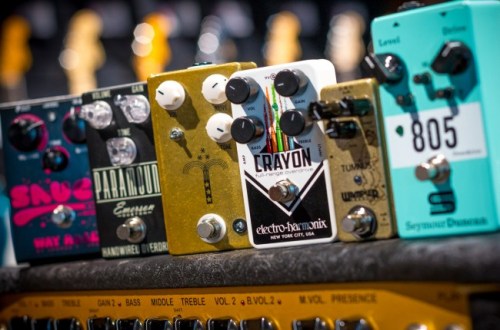
Image courtesy of Sweetwater.com

Unfortunately, this is yet another area where we get into murky territory, and where a lot of people confuse the two. So to start out, let’s just put it simply: Gain is input; volume is output.

To provide a bit more clarity, think about the function of an amp as a two-stage device. The first stage takes the relatively weak signal from your instrument, then passes it on to the second stage and amplifies the signal to produce the sound.

The first stage of an amp is called the preamp. The signal passed through the preamp is called Gain. The level of gain will have a direct effect on the volume of your amp. Typically, the more gain you introduce, the higher your volume. BUT, that said, higher and higher levels of gain will have a lesser and lesser effect on volume, as the pre-amp reaches its capacity to handle the amount of signal passed to it (commonly called saturation) and will max out sending all it can handle to the second stage or power amp.

Think of the power amp as the stage that controls the output strength of your sound, or volume, if you will. It works similarly to the pre-amp in that the more signal you throw at it, the louder your volume. Some amps come with a Master Volume. Think of it as a valve mechanism that controls the amount of signal that is allowed to pass into the power amp. When it’s wide open, all the preamp signal will pass through to the power amp. For amps without a master volume, the amount of preamp signal allowed to pass to the power amp is set by the builder.

So what does this have to do with pedals? If you look at the picture above, whether labeled or not, all come equipped with both a Gain (or Drive) and a Volume (or Level) knob. These work pretty much the same way as Gain and Master knobs on an amp. The Volume knob controls how much pedal signal will be sent to your amp’s preamp. That could be enough signal to saturate your preamp which will overdrive it into clipping and create distortion. Combined with a distorted sound from the pedal, this could – and in many cases does – create a very pleasing mix of distortion sounds.

So which kind of pedal to choose?

The pat answer is it depends on what you’re after with respect to your distorted tone. I know that this is a rather ambiguous statement, but again, there are no hard and fast rules. In the end, you should choose a pedal based on what sounds good to you. But here are a couple of guidelines:

  • If you have a tube amp and just want distortion purely from overdriving the tubes, then a booster makes sense. There are several kinds of boosters. Some boost only a certain frequency range, like a Fat boost that boosts the lower frequencies. I personally prefer a clean, transparent boost that has a flat frequency response so that the distortion that occurs is my amp’s tone. I typically use a booster in conjunction with my amp set just at the edge of breakup, so when I switch it on, not only will I get a volume boost, I’ll overdrive the pre-amp tubes; and depending on how much gain I throw at the amp, I’ll get the power tubes working as well. Here’s a trick to try: If you have an effects loop, place the booster as the last pedal in your effects loop. When switched on, it will boost the gain going into your power tubes to saturate them. You don’t get a huge volume boost, especially if the power tubes are close to saturation, but you do get a bit of a kick. I learned that from Gene Baker, who does that in his rig.
  • If you want to add a bit of color and overdrive your amp, then a soft-clipping pedal like a Tube Screamer works quite well. Tube Screamer-type pedals typically give you a mid-range boost that results in a much warmer and smoother distortion. Many also add sustain and a bit of compression to simulate power tube saturation at any volume. My Tone Freak Effects Abunai 2 is exceptional in this department. Then there are others, like the EHX Soul Food that add a bit color but interact well with the front-end of an amp. But that said, there are some like my beloved Timmy Overdrive that are transparent. They’ll give you the gain and boost but will not color your sound (Note: that you’ll still have to set up the pedal’s EQ). I will add though, that in general, an overdrive pedal sounds and performs best when the amp is already clipping a bit. The mixture of the two creates a more complex signal that is quite pleasing to the ears.
  • If you want to get a distorted tone at any volume, then a distortion pedal is the way to go. There are lots of these on the market. My personal favorite (and the one I own) is the EWS Little Brute Drive. It’s a half-size pedal with a single knob, but it will give you TONS of distortion at any volume. I normally use it for leads, as it gives just a few dB of gain, but gives me all the distortion I need to get a great screaming tone! It also colors with a fat bottom end which makes leads sound beefy. Typically, you’ll use a distortion pedal against a clean amp. But then again, there are no hard and fast rules.
  • Then if a distortion pedal still doesn’t provide enough gain for you and you need to get a hard-clipped, super-squishy, compressed distortion, then the fuzz will get you there. I call fuzz “ugly dog” distortion. To me it’s like an ugly dog that you look at and say, “holy s$%t,” but it has personality, so you can’t help but love it. Can’t say I’ve ever been into fuzz, but I’ve spoken to lots of players who use it all the time, and they love it!

You can also chain overdrive and distortion effects to great success (aka “stacking”). I do this quite a bit because you get colors that you can’t get with just your amp. One thing that I do regularly is to use an overdrive pedal to push my amp hard, then when I want to get more tube compression and sustain, I slam the front-end with a booster (which is the last pedal in my chain). This doesn’t result in a volume boost because the tubes are already saturated, but you do get much more high-gain sound, and that can really work with solos.

Again, there are no hard and fast rules. You have to play a lot of them to find your sweet spot. But that’s half the fun of it!

More Overdrive Murkiness…

I referred to my Timmy above as a “transparent” overdrive. There’s a lot of debate about transparency, but suffice it to say that while technically distortion is color, transparent overdrives are those that once their EQ is set up to match the EQ setting on your amp, they will not add any other “color” than distortion. On the other hand, once you set up a non-transparent pedal’s EQ, it will still add its own tonal characteristics to color your tone. In practical terms though, transparent overdrives fall more into the booster arena, but it’s the EQ and internal soft-clipping circuits that still define it as an overdrive.

But further exacerbating the overdrive murkiness is that many overdrive pedals are actually purpose-built to mimic the sound of a specific overdriven amplifier. These are meant to be played through a clean channel with lots of headroom. A good example of this is the Caitlinbread Dirty Little Secret that produces classic Marshall Plexi to Super Lead tones. With a pedal like that, you just set your clean channel to purely clean and let the pedal do the overdrive work.

Note: Several articles I’ve read on this topic use the generic “overdriven amp” explanation to describe all overdrive pedals. It would be okay if they described them with respect to how the pedal responds, but more often than not, they use the term to describe the sound. Unfortunately, they completely miss the pedals that are built to be transparent. I’m not saying they’re entirely wrong, but just a little narrow in scope when you consider the overall landscape of overdrive pedals available.

Now… let’s add even more murkiness to the overdrive issue, shall we? There are some overdrives like the EHX Soul Food, which is a Klon Centaur clone, that at first blush, fall into the transparent overdrive category. So one would think that you’d set your amp at the edge of breakup, then use the pedal to push it over the edge and add its own clipping. This is a common way of using an overdrive, and it’s exactly how I use my Timmy. But even though the Soul Food wasn’t purpose-built to mimic a particular amp, I use it almost exclusively as a standalone soft-clipping device played through a clean channel. Its distortion sound is so damn sweet that I don’t want to taint it by adding clipping from my amp.

So… what you choose will be wholly dependent upon what pleases you.

Update: November 26, 2012

I ended the article three years ago with the statement that you have to play a lot of pedals for find your sweet spot. Three years later, that statement remains true. You see, in a recent article where I asked if new overdrives are relevant with so many on the market, there are some pedals that work with certain rig configurations, and some that just do not. There are also some rig configurations that work great on stage that sound absolutely horrible in the studio. I’ve been in the studio for the last few weeks (grabbing studio time where I can), and when we worked on a song where I needed some high-gain sounds, my rig just did not work! I was using my trusty DV Mark Little 40 clean, with my Timmy and the Little Brute Drive for distortion. Sounded like crap when recorded. I ended up bringing in my VHT Special 6, cranking it up all the way, and slamming it with a booster! Worked like a charm, with all the high-gain character that I wanted out of that tone. So I learned a valuable lesson there.

Read Full Post »
PRX-front-543Ever since I started this blog, I’ve talked about attenuators, and how they’ve enabled me to get tones out of my amp at reasonable volume levels that I could only previously get at super-high volumes. But before I get into the discussion part of this article, take a listen to this clip (it’s the same clip I recorded with my previous article on the Mullard ECC83):

Here are some details about the recording:

  • I plugged directly into my Aracom VRX22, which then fed into my Aracom PRX150-Pro, then out to a custom 1 X 12 with a Jensen P12N
  • The amp was in the drive channel with master at 6, volume (gain) at 6, and tone at 6 (the tone on this amp adds a little gain as well as an edge)
  • The PRX150-Pro was set at maximum attenuation
  • Volume-wise, this was talking conversation level!!!
  • No EQ was applied to the guitar – what you’re hearing is the raw tone.

With respect to “maximum attenuation,” I was in variable mode with the variable sweep pot all the way to its left extent. I shared my amp and PRX settings with Jeff Aragaki this morning, and he estimated that the output power was approximately 0.04 Watt!

Many people are apt to talk about how the speaker needs to move air, and that an attenuator doesn’t allow that to happen. But that clip simply demonstrates that with the right combination of equipment – and in my case, also a great set of tubes – you don’t necessarily need that speaker cone breakup to get great tone for recording purposes. Yes, SPL’s do play a big role in your overall tone, but to be able to achieve the kind of tone I was able to get at that very low volume level is nothing short of amazing!

So what about an attenuator being life-changing?

Maybe that’s a bit strong of a phrase, but ever since I’ve been using attenuators, and especially since I’ve gotten my Aracom PRX150-Pro, I’ve been able to explore tonal territory that I could previously only achieve using pedals – and only simulating at that! Take overdrive pedals for instance. If you’re a regular reader of this blog, you know I’m crazy about them. I probably will still be nuts about overdrive pedals, but there’s one thing an overdrive pedal can’t do that an attenuator allows me to do, and that’s to get the thick, natural overdrive tone of my amp. Don’t get me wrong, I still use them, but I use them now more for tonal accents to my drive tone rather than giving me my drive tone. That’s very profound; especially for an overdrive pedal freak like me!

Here’s a good example that I just recorded. This clip is part of a new song idea I’ve been playing around with. Setup is pretty much the same as above, but for the rhythm, I’m running Strat into my Kasha overdrive pedal to get a jangly, crisp tone. The lead is Goldie plugged straight into my VRX22. I did mix and do a simple master on the recording, but the guitars were all recorded raw, with no EQ. In my DAW, I added some reverb to both parts and a touch of delay to the lead, but that’s it.

Speaking of pedals, since I’ve started using a high-end attenuator (there are others such as Alex’s and the Faustine Phantom), I’ve actually started using pedals in general much less. I’ve really relying on the natural tone and sustain of my amp. For instance, I’ve found that I’ve only been using reverb in the studio. When I play out, I just don’t bother. In fact, for the last few weeks, I’ve only been taking two pedals to gigs with me: My BOSS TU-2 Tuner and my VRX22’s channel switcher. Same goes with my Reason Bambino.

Life-changing? Probably not, but definitely approach-changing. I may personally endorse the PRX150-Pro, but there are others out there. If you really want to hear what your amp has to offer when it’s fully cranked with the power tubes glowing, then you owe it to yourself to get a good attenuator!

Read Full Post »

Aracom Amps VRX18 18 Watt Head

Aracom Amps VRX18 18 Watt Head

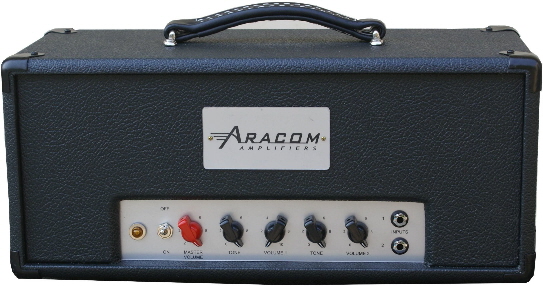
I’m falling in love again with my Aracom VRX18. This was the amp that first got me introduced to Aracom and my good friend Jeff Aragaki. My amp is actually a tweaked version of the stock VRX18 as it sports an EZ81 tube rectifier, plus a tweaked circuit that adds a bit more sag and sustain. The result is just a gorgeous overdriven tone that really brings out the best of the EL84 power tubes.

One thing about EL84 amps is that if they’re done right, they have a distinctive overdrive tone that creates a subtle top-end fizz when they’re overdriven. I’ve played others that drive the power tubes too much, and they sound very harsh and incredibly compressed. Jeff did this amp right, and while the power tubes do indeed compress a bit, the overdrive tone retains its open character, while adding that nice top-end fizziness that EL84 amp lovers have come to appreciate.

The clip below is an excerpt from a slow blues song I wrote. It features my beloved Goldie plugged straight into the Aracom VRX18, and it also features the insane Aracom PRX150-Pro attenuator! Believe it or not, the amp was recorded at just above loud conversation levels! We’re talking less than 1/10 of a Watt, and the amp still retains its tone and dynamics! Anyway, here’s the clip:

Read Full Post »

KASHA KA-ODP-A
I finally got some time to record a couple of clips of the absolutely wonderful KASHA Overdrive tonight, and I am just so blown away by how it sounds! This little box is like having 4 differently voiced amps in a little box! I’m not going to spend too much time praising it because I’ve already done that a couple of time here, so let’s get into the clips, shall we?

The first clip is slow, slow blues clip in Am. The chord progression is actually adapted from one of Chuck D’Aloia’s “Blues With Brains” video lessons. If you’re looking to get more into the blues, I highly recommend this set of lessons. It’s the best $40 bucks you’ll ever spend! In any case, I used the chord progression to test out the KASHA Overdrive, and to practice some of the concepts I learned tonight.

Anyway, there are two parts to the clip. The rhythm part was recorded with the KASHA Overdrive in Smooth with the gain set at 12 o’clock. This acts just like a clean boost, and at 12 o’clock it’s at unity gain. The first part features the Classic “channel,” and the second part features the Hot channel. Give it a listen:

The second clip has no backing track, and features the Melt channel with a simple chord riff. Excuse the sloppy playing, but instead, focus on the articulation of the notes. I had the Gain pushed up to about 3pm, which is almost all the way up. But even at a really high gain setting, you can still hear the individual notes. THIS IS AMAZING! And man, the touch sensitivity in this channel is to die for!

By the way, both clips were played through the clean channel of my Aracom VRX22, and recorded at conversation levels using the incredible Aracom PRX150-Pro attenuator. To me, this is the absolute king of attenuators. Oh! Almost forgot that I used my beloved Goldie to record the clips.

Read Full Post »

tonebox

When I wrote my original announcement of the Skull Crusher, it was absolutely brand new, and not surprising at all, it was met with a mixed response. But as I mentioned in my announcement, get beyond the looks, and this pedal is a KASHA overdrive with an EQ knob, and I LOVE how that sounds. Apparently, so do the guys from Ratt, as shown in this video taken over the weekend at the Jack FM 2009 concert in southern California this past weekend:

And here’s a video of the VERY talented PhilX playing the Skull Crusher live and doing a demo in the studio:

Lots of guys panned the look of the pedal, but I think it looks incredible! And knowing that it has the absolutely wonderful KASHA overdrive guts makes this pedal a winner in my book.

Read Full Post »

KASHA KA-ODP-A

OMG!!! Just gigged with my brand-new KASHA Overdrive last night, and I was in tonal heaven! Even though I’d done a pretty good test on it in my original review, there’s nothing like using gear in a live situation. So here are my observations:

  • Incredible Dynamics – The one thing that is readily apparent is how this pedal responds to pick attack and volume knob changes. It is so amp-like, it’s uncanny! I set the pedal up in unity gain with just normal strums on my guitar. But if I dug in a bit more, the pedal responded just like an amp with a bit more punch and volume. Frankly, the volume swell surprised the hell out of me. It’s not huge, mind you, but the response is so amp-like, it really does take you by surprise. I totally dug that while gigging last night!
  • Plays Well With Other Overdrive Pedals – I love stacking overdrives, and the KASHA OD performs beautifully in this role. I set it up as a based OD pedal, then stack it with my Tone Freak Effects Abunai 2. Those two together are an awesome combination!
  • Lots of Tonal Variety – While my favorite channel on this is the Classic channel that adds a chimey mote to your tone, I also played in the Hot channel as well, and the grit and grind was super-sweet. But add to that the dynamic response of the pedal, and what you’ve got is a pedal that has a lot of inherent tonal variety. Last night, I ran it mostly through the clean channel of my amp. But later, I screwed around with it a bit more in my studio, with my amp set at the very edge of breakup. This is where the pedal just warms my heart! With its touch sensitivity, when my amp is set up at the edge of breakup, I can take my tone from gritty and grimy to sweet and chimey with just a touch of dirt simply by modifying my attack or adjusting my volume knob.
  • Open Distortion Characteristics – No matter what channel you use with the KASHA Overdrive, the overdrive never gets compressed. It just gets dirtier. The cool thing about that is that any kind of compression will then come from your power tubes. I’ve rarely liked that compression in pedals, save for my Abunai 2, which compresses in a very pleasing way, but for most overdrive pedals, I don’t want that at all, and thankfully, the KASHA Overdrive remains very open, no matter how hot you go on the channels.
  • Simple Design – Probably one of the best features of this pedal that I appreciate is its straight-forward design. Notice that it doesn’t have an EQ control. It doesn’t need it. It takes your signal, adds a voice to it, and that’s it! Set your EQ on your guitar and/or amp to where you want it, then set the gain knob on the pedal, and just play. What could be more simple?

All in all, I’m pretty much done with my search for an overdrive pedal. I knew it from the first time I played this; and combined with my other OD’s, I can pretty much say – at least for quite awhile – I’m set in the overdrive department!

I’m an overdrive pedal freak, and I can safely say that this is the best overdrive pedal that I have ever played! It’s hard to believe that this little black monster does what it does. I’m totally blown away by it, and I’ve only gigged with it once! I can’t wait to really start using it in all its modes!

For more information, go to the KASHA web site!

Read Full Post »

« Newer Posts - Older Posts »