Feeds:
Posts
Comments

Archive for the ‘gear announcements’ Category

In my quest for gear to review, I literally spend hours each week poring over the Internet and trade rags, looking for cool, new stuff, and I get especially excited when I come across familiar gear that’s expressed in completely new ways, such as the Quantum Drive from Acoustic Imaginearing that uses quantum tunneling to provide distortion. But a couple of weeks ago, I ran across a brand-new guitar company up in Washington called “Woody B Internal Combustion Guitars,” that is doing something so totally unique it has the potential of completely changing how we as guitarists approach tone. I don’t say this lightly. What Woody has invented is nothing short of amazing, and I am extremely excited to have run across this new guitar.

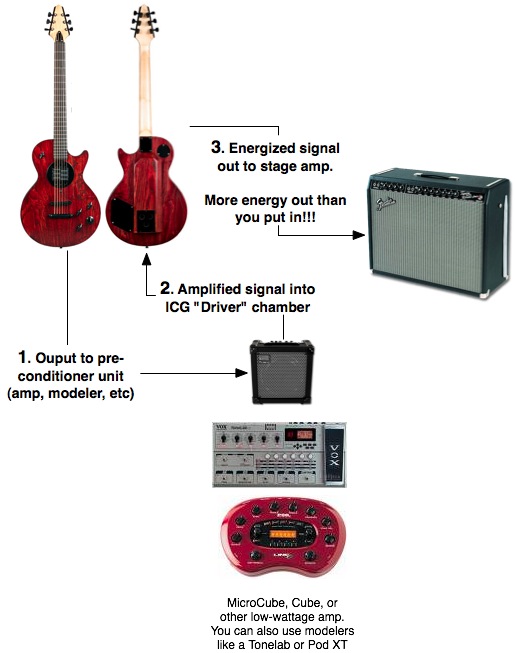
What makes these guitars so revolutionary is Woody’s invention: The Internal Combustion Drive System. This consists of a speaker transducer and special baffles and tone ports that direct added resonance to the strings and body. Essentially, the Drive System is a resonance chamber that builds up the guitar signal (with the help of a pre-conditioner that I’ll get into later) before it goes out to your main amp. According to Woody, whom I had the pleasure of speaking with for quite awhile yesterday, this is a guitar where you can feel your tone resonating throughout the guitar’s body.

So how does it work? Here’s a diagram. I’ll discuss it below:

internalcombustion

That signal is returned via a special plug that Woody provides that I assume returns the “conditioned” signal as a line-level output (though with a Cube, you should be able to use the Recording Out). The signal then passes into the Drive System, where it’s run through the speaker transducer and allowed to resonated withing the chamber. The signal is buffered, then sent out to your main stage amp.The way it works in principle is actually quite simple. You first send your output to a pre-conditioning unit. This could be a low-wattage solid state amp, or even a valve amp. This is also where you add effects, so you could run this into your pedal board, then into the low wattage amp. The net result is that the guitar outputs more energy than was put in, providing for what Woody calls a much fatter, fuller tone than you would get from other guitars.

In addition, adding to the natural resonance are copper bars that run through the body to the neck, creating a direct coupling between the neck and the guitar. Very cool. Woody B also uses very high-grade woods with four to choose from: Swamp Ash, Alder, Mahogany, and African Black Limba (I dig the Black Limba, myself).

For those of you “in the know,” you might ask, “Moog already did something like this.” Yes and no. Yes, from the perspective that the Moog guitar uses a pre-conditioner. But no from the perspective that Woody has taken a completely different approach to the electronics in the Drive System. First of all, where the Moog has around 3000 parts to produce its sound, and I believe requires external power, the ICG Drive System has only twelve parts. Furthermore, the Drive System is completely passive, not requiring any external power source. Finally, the Moog guitar costs in the neighborhood of $6000, whereas you can get into an Internal Combustion Guitar for as low as $1700. Woody is really trying to keep the price below or as close to $2000 so his guitars are attainable by a wider audience.

Here are some videos that Woody has put together:

Folks, this stuff is so awesome! I can’t wait to try one out! For more information, go to Woody B Internal Combustion Guitars.

Read Full Post »

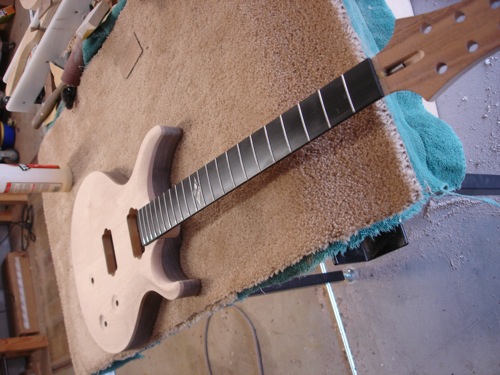
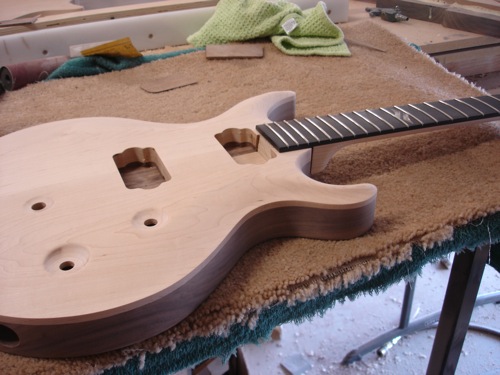
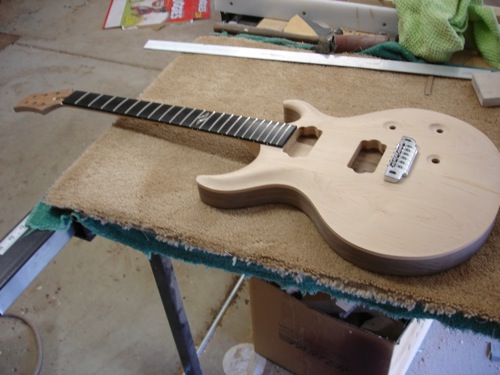
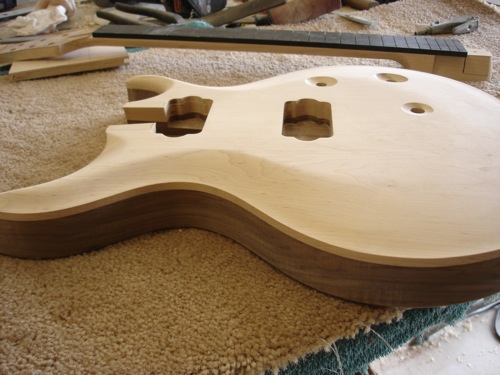
Talk about being blown away! I talked to Adam Hernandez of Saint Guitars the other day just to shoot the breeze and let him know I posted an announcement about his new web site. He in turn thanked me, then absolutely blew me away saying that Goldie was ready for finishing and would be done before the weekend! OMG!!! He sent me some progress pictures from just before finishing. BTW, the finish is vintage Les Paul gold…. Again, OMG!!!

In any case, here are pictures of my guitar right before it went into finishing. I just can’t wait to play her!

I know I probably sound like a broken record and maybe a walking billboard for Saint Gutiars, but these are special guitars. Anyone who has played one of these will attest to that. And to have one of my own is just incredible. Adam and Jon just rock the house with their guitars!

They are also coming up with a new “Vintage” model. I don’t know all the details, but it looks like a semi-hollowbody with a trapeze-style bridge. Very retro!

I just have to say this…

I know there are a lot of people out there who have lots of gear, and who trade their axes after a certain amount of time. That’s totally cool. I’ve spoken to some folks who are concerned about the resale value of these guitars. Because this is such a small company, there aren’t a lot of Saints out there, so there’s no price precedence. But in reply to that all I have to say is that from my perspective, Goldie isn’t a guitar that I’d ever consider trading away or selling. Why would I when she was made to my exact specifications?

For sure, Goldie won’t be the last guitar I ever buy. I’m way too much of a gear freak, slut, maniac, what-have-you, to settle with my collection; it’s a living breathing thing. But Goldie will always be special because she’s the very first custom guitar I’ve ever had, but also she’s the very first Saint Guitar I’ve owned.

Read Full Post »

Saint Guitar Company

The guys at Saint Guitar have been busy, and just this week did a “soft” release of their brand new web site, and the introduction of their new domain name (saintguitarco.com). “stguitars.com” still works, but they will be going with the new domain name going forward.

I’m so happy for these guys! Adam Hernandez has got to be one of the most talented young luthiers in the market today. Jon Peterson, who runs company operations is a great front-man. But as a company, and what really endears me to Saint Guitars is that this is something that started out as a dream between best friends, and they’re making it a reality. They’re doing it organically without investors or bank loans, spending all their available time and extra resources (read: money) building the company up, and producing what I think are the finest guitars on the planet. And guess what? Not too many people know about them!

I’m hoping that will change, and I, as a passionate supporter and customer will do my best to get the word out.

What’s so special about these guitars?

Like many other old-school style boutique guitars, these are completely handmade, built from a series of custom jigs and templates that Adam has designed and perfected over the last ten or so years. But that’s not differentiating at all. What is differentiating is the tone of these guitars. They’re on the bright side, but sustain for days. A lot of that sustain has to do with the neck joint that Adam has invented. These are the first guitars I’ve ever played where I can physically feel the sound waves resonate through the body. It’s subtle for sure, but it’s the first time I could really feel it.

As Vinni Smith of V-Picks put it, “[These guitars] have just about the best bridge pickup in the business.” Before I played a Saint Guitar, I was never big on the bridge pickup. But with Saint Guitars, I just love the bridge pickup. Adam really found a sweet spot with its positioning.

Other than that, there is a certain magic about the guitars from Saint Guitar Company. I’ve played some very high-end guitars that cost three to four times as much, and they’ve not really impressed me quite as much as what these guys are producing. Just think about this: The highest price you’ll pay for a Saint Guitar is around $4800. That’s full-gloss, nitro finish with top-of-the-line EVERYTHING. But they start at around $1800 for an open-pore, stain finish (which sounds just as good). That’s simply amazing to me. I’ve shared with Adam that his guitars are almost too affordable considering the quality compared to other custom guitars. I’d pit a Saint head-to-head with a high-end PRS any day. To me, it’ll play and sound just as well or even better and it’ll cost half as much. That’s a no-brainer for me.

In any case, I encourage you to check out their new site at: http://www.saintguitarco.com

Read Full Post »

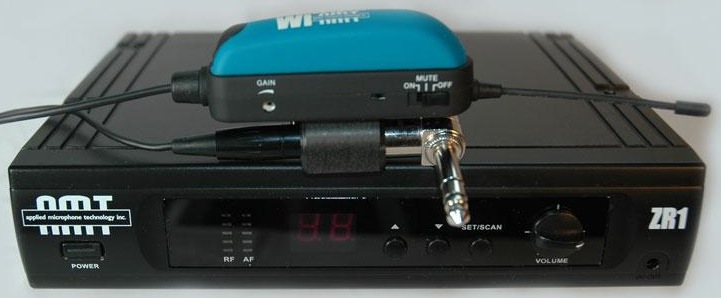
Applied Microphone Technology Wi5GI’ve been in the market for a wireless system for awhile, and there are lots of options out there. But one thing that has kept me from going completely wireless is that most wireless systems out there require the use of a beltpack. The AKG WMS40 is an exception to the rule, and from what I can tell, it’s a great solution for a great price (I have yet to try this unit out).

But the Wi5G shows a lot more promise in that not only can it be used with an electric guitar, you can attach it to an AMT micro-equipped unit on your acoustic guitar. So in terms of versatility, this unit sound pretty cool. Here’s the press release:

The AMT Wi5G — Guitar Wireless System is a removable 16 selectable channel wireless setup. The Wi5G is intended to work with all types of electric guitars. The system allows players to perform wireless without being tied down to a belt pack or wires of any type. The Wi5G features a plug in play style transmitter that is very light in weight. The sound clarity and wireless reception are very high. AMT’s philosophy is to develop the highest sonic quality in there products, and the guitar system stays right in line.

The most impressive feature of the Wi5G Guitar Wireless System is its ability to convert / adapt to all AMT microphones as well. The Wi5G transmitter, by unplugging the included ¼ in adapter, can then plug directly into any AMT microphone with D.C.T. (AMT’s disconnect cable technology). This feature allows the player to use the Wi5G system with there electric guitar, unplug the transmitter from there electric guitar and plug it into an AMT S15G acoustic guitar microphone setup already in place on an acoustic rig. The Wi5G is the only system on the market with the ability to switch from an electric pickup to a high quality acoustic instrument microphone. Along with the ability to switch between 16 channels, this makes the Wi5G and a S15G a valuable set of tools for all guitar players.

The Wi5G wireless system has changed the way a guitarist can perform. By allowing total freedom from wires, a belt pack, and / or a preamp the performers are able to move freely around the performance area. This concept frees up the artist from standing in front of a guitar amp tied down with a cable. The Wi5G assures that every nuance of the performance is heard as the artist intended it to be heard without changing the sonic quality of there instrument rig. AMT has developed there name on this high quality hand made philosophy.

The Wi5G transmitter features an on / off and a mute switch along with a gain adjustment. An LED is featured to show on / off as well as a low battery indicator. One AAA battery is needed to power the transmitter. Designed to be used with either pedals or an acoustic guitar, the ZR series receiver comes with both a ¼ inch and XLR output. The receiver, with an optional rack mount kit, can be mounted in a rack, set freely next to your pedals, amp, or any where close by.

The Wi5G works with all types of electric guitars with the included ¼” jack, as well as AMT microphone models: LS, WS, TA2, Z1, P800, M40, S15G, VS, S25B, and the S18C. Microphones sold separately.

Sound interesting? I think so…

Read Full Post »

5 Tone Bones - Gear has stellar performance, value, and quality. This is definitely top of the class, best of breed, and it's a no-brainer to add this to your gear lineup!

IK Multimedia Stealth Pedal

IK Multimedia Stealth Pedal

Summary: It’s official, IK Multimedia’s StealthPedal has just been released! The new StealthPedal is a lesson in packaging up familiar components to produce something totally unique. This is the first of its kind: A USB-powered guitar audio interface/software controller that you can use for recording or playing live as well as controlling any “Powered By Amplitube” software (or any MIDI-controllable software). With the StealthPedal, IK Multimedia completes the picture in providing an end-to-end computer-based guitar performance and recording solution.

Pros: Truly plug and play, it is automatically recognized by “Powered By Amplitube” software, and requires very little configuration.

Cons: None

Price: $199 Standard Bundle / $399 Deluxe Bundle

Specs:

• USB powered audio interface and pedal controller
• 2 balanced / unbalanced audio inputs (hi-Z or line level)
• 24 bit A/D and D/A conversion
• 44.1/48 kHz operation
• 2 balanced audio outputs
• Headphones output
• Volume control
• Built-in expression pedal and MIDI foot-switch
• Multiple LEDs can operate as Tuner or Level indicators with AmpliTube
• External double switch and expression pedal inputs
• Classic, rugged metal Wah-style construction
• High-quality, low-noise input stage (109dBA /104dB RMS S/N ratio)
• Control all “Powered by AmpliTube” software/plug-ins

• Control any MIDI controllable software/plug-ins

• Standard Bundle includes AmpliTube 2 Live standalone and plug-in, AmpliTube X-GEAR, Ampeg® SVX UNO standalone and plug-in, Sonoma WireWorks Riffworks™ T4, and AmpliGrooves Loops by Sonic Reality
• Deluxe Bundle: AmpliTube 2, Ampeg SVX, AmpliTube X-GEAR, Sonoma WireWorks RiffWorks t4, AmpliGrooves
• Compatible with all the most popular DAW software supporting ASIO and Core Audio drivers on PC and Mac
• Endless software expandability with AmpliTube modules

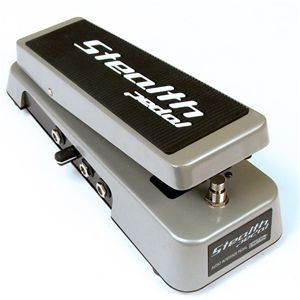
Tone Bone Score: 5.0 – I love enabling technologies that make anything that I do easier, but also add a ton of value. That can definitely be said of the new StealthPedal from IK Multimedia. A quick glance at picture of the unit, and you may think: Okay, just another pedal-style software controller. It is that, but it is also so very much more!

The StealthPedal is also an extremely easy-to-use, full-functioning analog-digital audio interface that you can use for recording or running modeling software live through your computer. And with 24-bit analog-digital, digital-analog conversion, and 44.1/48 kHz operation, you can count on the SteathPedal to produce high-fidelity sound in the studio an on the stage.

The StealthPedal looks just like a mere expression pedal from the top view. But look at the sides and the input and output jacks belie its humble appearance. On the left side of the pedal are ¼” jacks for right and left output, an 1/8” for headphones, another ¼” jack for a dual-switch external switching unit (extra), and the USB jack. On the right side of the pedal are ¼” jacks for inputs, a volume control knob, and a ¼” jack for plugging in another expression pedal. In other words, this “pedal” packs a punch and is so much more than what it appears!

Wah, wah, wah

It took me awhile to figure out that I had too early versions of X-Gear / Amplitube Fender to be automatically recognized the StealthPedal. My bad entirely. But once I had the right versions installed, adding software stomp effects and controlling them via the StealthPedal was a total breeze! The software automatically assigns the StealthPedal to control the first effect with some default behavior. For instance, with a wah effect plugin, the foot pedal is assigned to the wah effect and the switch is assigned to bypass. But you can change behavior simply by clicking the “setup” button at the top-right of the application window. It can’t get much simpler than that!

In the Studio

But before I even tried using it to control the included Amplitube software, I wanted to see how it performed as an audio interface. In this usage, I was totally blown away! Whereas other audio units such as those from DigiDesign require a software driver to operate (yes, even on the Mac), at least on the Mac, the StealthPedal follows Apple’s lead in design: Plug it in and it just works! So in a very real way the StealthPedal is aptly named as it just does what it does without you knowing how – or having to know how it works! Note that you do need a driver for Windows. But on my Mac, the process to be up and running took less than 5 minutes! That’s incredible!

Launching GarageBand, I just went into the preferences, and selected the StealthPedal as my input and output devices. I ran an unbalanced line from my mic pre-amp into the first input jack of the StealthPedal, added and setup a new track, hit record and started jamming on my guitar that was plugged into my amp. The StealthPedal worked as expected – actually a lot better than I expected because I was expecting only “okay” signal quality, considering the price point of this unit. Boy, was I wrong. The recorded signal was just as clean as my MBox 2, with no apparent shading of any kind. That put a smile on my face. And another thing that really blew me away was that lag was virtually non-existent. There was tiny bit, but nowhere in the realm of the lag that I normally get with my MBox 2. Amazing!

Then plugging my guitar directly into the StealthPedal, I fired up the Amplitube Fender plug-in, selected an amp, and started playing. This was truly the first time I could switch on track monitoring and not get thrown off from the lag!

What’s Not Obvious Is Usually Where the True Power Lays

Think about this carefully because it’s important: The real impact of the StealthPedal is not necessarily in its features, but in what it provides as a solution. As I mentioned above, the StealthPedal completes the picture for IK Multimedia to provide an end-to-end computer-based guitar performance and recording solution. I don’t say this lightly. Not only do they have totally kickass amp and effects modeling, with the StealthPedal, they now have a high-quality, high-fidelity guitar audio interface and software controller! Add to the fact that the StealthPedal requires ZERO setup to use (Mac only, sorry folks), and you’ve got a complete solution for all your computer-based guitar audio. And because the StealthPedal was built to work specifically for “Powered By Amplitube” products, you never have to worry about compatibility problems! I don’t know about you, but that’s just incredible to me. But wait there’s more!

Because it is a MIDI controller, the StealthPedal can also be used with other amp sim software via MIDI. So this just isn’t a solution for the AmpliTube user, it can be used by virtually all recording guitarists, and other musicians as well!

Overall Impressions

What can I say? I dig the StealthPedal! In the next couple of weeks, I’m going on a trip. Guess what’s coming with me? A guitar, the StealthPedal, a mic pre-amp, a mic, and a couple of cords. That’ll be enough to record any song, and besides the guitar, all that will fit into my computer bag!

Read Full Post »
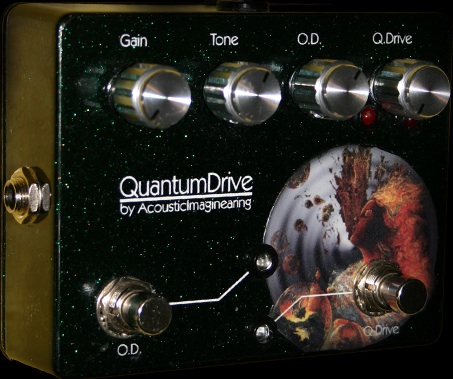
Acoustic Imaginearing Quantum DriveBrand-new from what appears to be a brand-new kind of overdrive/distortion, Acoustic Imaginearing has just released its new QuantumDrive, overdrive/distortion pedal. Folks, this appears to be totally new technology; the first and only that employs quantum mechanics tunneling to produce its distortion sound!

I’m no physicist, so I’ll let you do your own research on what quantum tunneling is. But this is a totally new twist on distortion! Here’s the press release:

The QuantumDrive, A.I.’s flagship product, is a versatile and unique overdrive and distortion unit that uses a patent pending process to dynamically shape the sound of the guitar by means of a quantum tunneling device. Quantum tunneling is a curious physics principle which allows matter to “pass through” other matter which would normally be impenetrable. A.I. has developed a means of using this effect to modify a guitar signal in unique and previously unheard of ways. The quantum distortion appears to add a vowel sound to the signal as well as emphasizing the consonant, fricative guitar distinctiveness. Affecting the edge of the waveform and not just the peaks, the result is a very expressive tone when played “in the zone.” Of course the pedal is also capable of wild and quirky, outside the norm distortions — each distinctive to the instrument processed by the Quantum Drive.

The effect is well suited for both guitar and bass, as bass frequencies are retained without becoming muddy. It has been used by Tony Levin on the latest King Crimson tour.

In addition to the distortion channel, the pedal has a solid overdrive channel, also uniquely designed, that can be used independently or chained together with the quantum channel.

I gotta tell you, I love this kind of stuff! And the fact that this is an overdrive/distortion pedal (you know OD is my favorite kind of pedal) is even better! I’m very excited when inventors add a new twist to something familiar. It just goes to show that there’s no shortage of creativity and innovation in the world!

How It Sounds

There are very limited sound clips available on the site, but the interface to listen to them is a bit screwy. I was able to do a debug trace to figure out the sound clip file names. The following clips were done with a Les Paul with the rhythm pickup into the QuantumDrive and output through a Peavey Classic 30. The clips actually aren’t that good, as the massive amounts of reverb kind of mask what could really be a great sounding pedal. But from what I could here, this is a real open sounding distortion, with just a little fizz. What I like is how the signal tails off.

Light Quantum Drive

Medium Quantum Drive

High Quantum Drive

Note that this pedal also has an overdrive that you can mix with the quantum drive as well.

Where to Buy

You can get this pedal on EBay for $165 as a “Buy It Now” or bid on it for $160 starting bid/$225 Buy It Now (in another auction).

This pedal is so new, they only have two dealers. This is a great find!

Read Full Post »

Was just perusing Musician’s Friend and ZZounds, and noticed that prices on Fender guitars have dropped a bit. Is this a temporary price reduction, or is it a sale? Who knows? Amps are still at the same higher price (a Hot Rod Deluxe is still $800+), but the guitars have dropped anywhere from $50 to $100 from previous prices.

Who knows if this is just a marketing ploy or not, or maybe Fender realized that the severe price hike only served to piss people off and sales got hurt. For me, this slight drop isn’t going to make me run out and go buy a new Strat or Tele. There are enough very good used Strats and Teles that go for a great price that these new prices just don’t provide enough motivation for me to buy.

But there it is, prices are lower, however slightly, and that’s never a bad thing!

Read Full Post »

IK Multimedia Stealth Pedal

For those computer-based DAW jockeys, you know about IK Multimedia’s Amplitube software. I recently wrote a review of Amplitube Fender Edition, and loved it. Now I have an even bigger reason to love it, and that’s IK Multimedia’s StealthPedal which looks like an expression pedal but is actually a fully-functional, USB-powered audio interface WITH a built-in expression pedal. How friggin’ cool is that?

Folks, this thing works, and it works well, as my full review, which will be released in a few days will bear out. As an audio interface, it may not have a lot of bells and whistles, but for the home recording studio buff, this is a great, affordable, high-res audio device that can take a direct in from your guitar or pedal board, or a line out from a pre-amp to use for layering tracks.

But because the pedal has the ability to act as a controller for any “Powered by Amplitube” software or plug-in, you may not even need an amp to record your guitar parts! There are enough fantastic-sounding amp models packed into the various Amplitube packages that you’ll be sure to find a model that works for you. Plus the software effect plug-ins that the StealthPedal can control give you added tone shaping abilities.

In my impending review, I’ll have more clips to share, but here’s a “torch song” that I’ve been working on that features the StealthPedal in action as an audio interface:

Except for the drum loop, all the instruments were recorded using the StealthPedal as the audio interface. I did a line-in directly for the electric piano. For the guitar parts, the amps are both software amps! For the rhythm part I used a Fender Champ 600 with a virtual compressor rack plug-in and my Strat plugged directly into the StealthPedal. For the lead part, I plugged into my pedal board and used my Tone Freak Effects Abunai 2 overdrive, and a Hardwire RV-7 Reverb. For the amp, I used a ’59 Bassman model. Imagine that! Software that sounds this good!

I know, nothing sounds like or feels like a real amp, but the convenience and the general sound quality of these models, plus the high-fidelity of the StealthPedal isn’t lost on me. It’s a nice, compact audio solution that combined with the software, will definitely make a difference in how you approach recording guitars.

Stay tuned for my full review!

Read Full Post »

Tone Freak Effects Abunai 2 In my ever-constant search for new gear, I accidentally stumbled upon Tone Freak Effects, a little boutique effects shop in Southern California. And you know me, I DIG OVERDRIVE pedals!!! I know, I say that a lot, but I really do. When I listened to sound clips of the Abunai 2, I knew it was a pedal that I had to check out, so I contacted Tone Freak, and asked to do a review on one of their pedals. Dereck Tabata, maker of the effects, emailed me back and offered to have me review the Abunai 2. That was exactly the pedal I wanted to try out because based upon the sound clips of the Abunai 2 Dereck had on his site, it sounded absolutely killer.

Well after a moderate wait for Dereck to set up his new company and for him to create enough stock to send one out, I finally got my review pedal. I just got done playing with it for the last hour, and was so excited by its tone, that I had to release a first impressions article.

So I’ll just say this: After many years, my Tube Screamer is going to get retired for awhile. Mind you, I didn’t say I’d get rid of it. There is something about that Tube Screamer tone that I will always love. But even after just an hour of playing with the Abunai 2 and discovering just a fraction of the plethora of tones it can produce, I think I’ve found an overdrive pedal that I love as much or perhaps even more than the Tube Screamer. I know… I never thought I’d say that.

Let me give you a quick rundown of the Abunai 2…

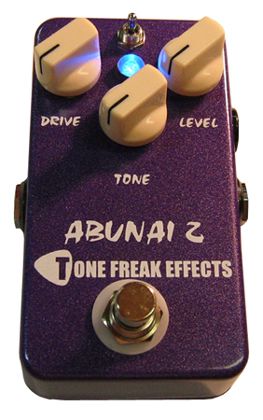
When you first look at this pedal, you’re totally taken in by the absolutely cool purple, sparkly paint job. The picture here doesn’t do the pedal justice at all. Then you notice that it has a three knob setup, just like most overdrive pedals. Then you plug the pedal in, and that’s where the magic starts. That magic comes from the three-position mini toggle that gives you overdrive tone-shaping possibilities you never thought possible. These three positions give you very different overdrive characteristics. No matter what position you’re in, the tones this diminutive pedal produce are about the most incredible tones I’ve ever heard in an overdrive! Freakin’ awesome! Let me quickly go over each different position.

Middle

I’m starting with the middle position because that position provides that classic overdrive tone. It’s not a mid-range hump like a tube screamer. Like the Creation Audio Labs Holy Fire, the full spectrum of the EQ is represented. The distortion characteristics are pretty open in this position, and the pedal reacts very much like an overdriven tube amp.

Left

This position seems to simulate distortion when the power tubes start saturating and you get just a tiny bit of compression. This lowers the volume just a tad, but it increases the sustain. But the distortion is still open – so far this is my favorite toggle position.

Right

Metal rockers will love this toggle position. This position simulates fully saturated power tubes adding tons of compression, tons of sustain, and the expected drop in volume as a result. I compensated for this by adding some clean boost to get the volume back to unity gain. This is a VERY fun position to play in (that sounds kinda kinky…). Notes just sing and sing and sing in this toggle. But the cool thing is that despite the incredible amount of compression, the pedal maintains a lot of clarity in individually picked notes.

What a great first impression! This pedal totally kicks ass, as I’m sure Dereck’s other pedals do! It’s no small wonder why Greg Howe uses a Tone Freak Buff Puff! When I do my full review, I’ll have sound clips to demonstrate the differences in the tones between the different toggle positions! Rock on!

For more information on this and other Tone Freak Effects pedals, go to their web site!

Read Full Post »

Ran across this blog that had some cool guitar designs – actually  more off the wall. Check it out!

http://ibored.com/2009/05/coolest-guitars/

Read Full Post »

« Newer Posts - Older Posts »