Feeds:
Posts
Comments

Archive for the ‘gear find’ Category

In my quest for gear to review, I literally spend hours each week poring over the Internet and trade rags, looking for cool, new stuff, and I get especially excited when I come across familiar gear that’s expressed in completely new ways, such as the Quantum Drive from Acoustic Imaginearing that uses quantum tunneling to provide distortion. But a couple of weeks ago, I ran across a brand-new guitar company up in Washington called “Woody B Internal Combustion Guitars,” that is doing something so totally unique it has the potential of completely changing how we as guitarists approach tone. I don’t say this lightly. What Woody has invented is nothing short of amazing, and I am extremely excited to have run across this new guitar.

What makes these guitars so revolutionary is Woody’s invention: The Internal Combustion Drive System. This consists of a speaker transducer and special baffles and tone ports that direct added resonance to the strings and body. Essentially, the Drive System is a resonance chamber that builds up the guitar signal (with the help of a pre-conditioner that I’ll get into later) before it goes out to your main amp. According to Woody, whom I had the pleasure of speaking with for quite awhile yesterday, this is a guitar where you can feel your tone resonating throughout the guitar’s body.

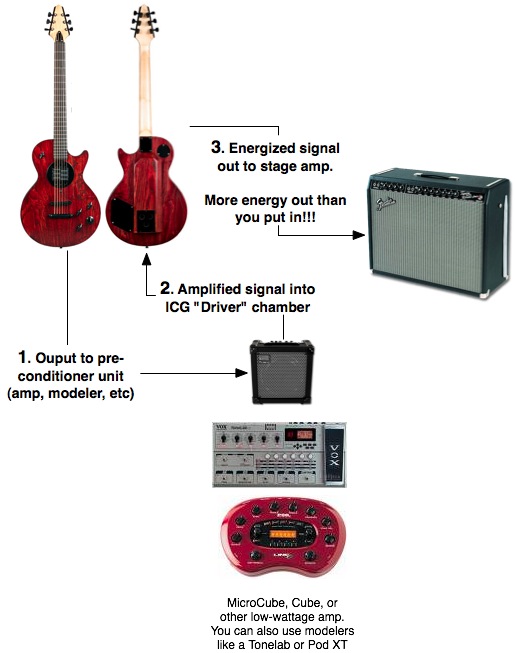
So how does it work? Here’s a diagram. I’ll discuss it below:
internalcombustion

That signal is returned via a special plug that Woody provides that I assume returns the “conditioned” signal as a line-level output (though with a Cube, you should be able to use the Recording Out). The signal then passes into the Drive System, where it’s run through the speaker transducer and allowed to resonated withing the chamber. The signal is buffered, then sent out to your main stage amp.The way it works in principle is actually quite simple. You first send your output to a pre-conditioning unit. This could be a low-wattage solid state amp, or even a valve amp. This is also where you add effects, so you could run this into your pedal board, then into the low wattage amp. The net result is that the guitar outputs more energy than was put in, providing for what Woody calls a much fatter, fuller tone than you would get from other guitars.

In addition, adding to the natural resonance are copper bars that run through the body to the neck, creating a direct coupling between the neck and the guitar. Very cool. Woody B also uses very high-grade woods with four to choose from: Swamp Ash, Alder, Mahogany, and African Black Limba (I dig the Black Limba, myself).

For those of you “in the know,” you might ask, “Moog already did something like this.” Yes and no. Yes, from the perspective that the Moog guitar uses a pre-conditioner. But no from the perspective that Woody has taken a completely different approach to the electronics in the Drive System. First of all, where the Moog has around 3000 parts to produce its sound, and I believe requires external power, the ICG Drive System has only twelve parts. Furthermore, the Drive System is completely passive, not requiring any external power source. Finally, the Moog guitar costs in the neighborhood of $6000, whereas you can get into an Internal Combustion Guitar for as low as $1700. Woody is really trying to keep the price below or as close to $2000 so his guitars are attainable by a wider audience.

Here are some videos that Woody has put together:

Folks, this stuff is so awesome! I can’t wait to try one out! For more information, go to Woody B Internal Combustion Guitars.
Read Full Post »

Applied Microphone Technology Wi5GI’ve been in the market for a wireless system for awhile, and there are lots of options out there. But one thing that has kept me from going completely wireless is that most wireless systems out there require the use of a beltpack. The AKG WMS40 is an exception to the rule, and from what I can tell, it’s a great solution for a great price (I have yet to try this unit out).

But the Wi5G shows a lot more promise in that not only can it be used with an electric guitar, you can attach it to an AMT micro-equipped unit on your acoustic guitar. So in terms of versatility, this unit sound pretty cool. Here’s the press release:

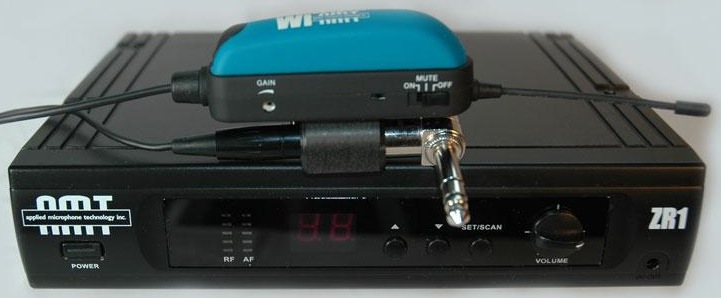
The AMT Wi5G — Guitar Wireless System is a removable 16 selectable channel wireless setup. The Wi5G is intended to work with all types of electric guitars. The system allows players to perform wireless without being tied down to a belt pack or wires of any type. The Wi5G features a plug in play style transmitter that is very light in weight. The sound clarity and wireless reception are very high. AMT’s philosophy is to develop the highest sonic quality in there products, and the guitar system stays right in line.

The most impressive feature of the Wi5G Guitar Wireless System is its ability to convert / adapt to all AMT microphones as well. The Wi5G transmitter, by unplugging the included ¼ in adapter, can then plug directly into any AMT microphone with D.C.T. (AMT’s disconnect cable technology). This feature allows the player to use the Wi5G system with there electric guitar, unplug the transmitter from there electric guitar and plug it into an AMT S15G acoustic guitar microphone setup already in place on an acoustic rig. The Wi5G is the only system on the market with the ability to switch from an electric pickup to a high quality acoustic instrument microphone. Along with the ability to switch between 16 channels, this makes the Wi5G and a S15G a valuable set of tools for all guitar players.

The Wi5G wireless system has changed the way a guitarist can perform. By allowing total freedom from wires, a belt pack, and / or a preamp the performers are able to move freely around the performance area. This concept frees up the artist from standing in front of a guitar amp tied down with a cable. The Wi5G assures that every nuance of the performance is heard as the artist intended it to be heard without changing the sonic quality of there instrument rig. AMT has developed there name on this high quality hand made philosophy.

The Wi5G transmitter features an on / off and a mute switch along with a gain adjustment. An LED is featured to show on / off as well as a low battery indicator. One AAA battery is needed to power the transmitter. Designed to be used with either pedals or an acoustic guitar, the ZR series receiver comes with both a ¼ inch and XLR output. The receiver, with an optional rack mount kit, can be mounted in a rack, set freely next to your pedals, amp, or any where close by.

The Wi5G works with all types of electric guitars with the included ¼” jack, as well as AMT microphone models: LS, WS, TA2, Z1, P800, M40, S15G, VS, S25B, and the S18C. Microphones sold separately.

Sound interesting? I think so…

Read Full Post »

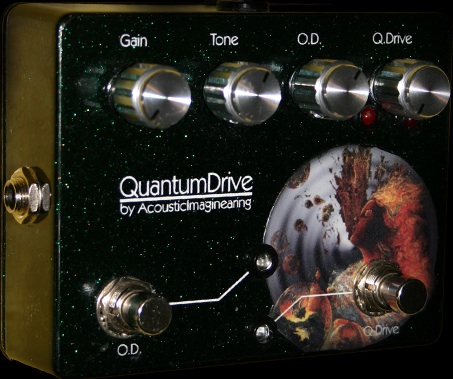
Acoustic Imaginearing Quantum DriveBrand-new from what appears to be a brand-new kind of overdrive/distortion, Acoustic Imaginearing has just released its new QuantumDrive, overdrive/distortion pedal. Folks, this appears to be totally new technology; the first and only that employs quantum mechanics tunneling to produce its distortion sound!

I’m no physicist, so I’ll let you do your own research on what quantum tunneling is. But this is a totally new twist on distortion! Here’s the press release:

The QuantumDrive, A.I.’s flagship product, is a versatile and unique overdrive and distortion unit that uses a patent pending process to dynamically shape the sound of the guitar by means of a quantum tunneling device. Quantum tunneling is a curious physics principle which allows matter to “pass through” other matter which would normally be impenetrable. A.I. has developed a means of using this effect to modify a guitar signal in unique and previously unheard of ways. The quantum distortion appears to add a vowel sound to the signal as well as emphasizing the consonant, fricative guitar distinctiveness. Affecting the edge of the waveform and not just the peaks, the result is a very expressive tone when played “in the zone.” Of course the pedal is also capable of wild and quirky, outside the norm distortions — each distinctive to the instrument processed by the Quantum Drive.

The effect is well suited for both guitar and bass, as bass frequencies are retained without becoming muddy. It has been used by Tony Levin on the latest King Crimson tour.

In addition to the distortion channel, the pedal has a solid overdrive channel, also uniquely designed, that can be used independently or chained together with the quantum channel.

I gotta tell you, I love this kind of stuff! And the fact that this is an overdrive/distortion pedal (you know OD is my favorite kind of pedal) is even better! I’m very excited when inventors add a new twist to something familiar. It just goes to show that there’s no shortage of creativity and innovation in the world!

How It Sounds

There are very limited sound clips available on the site, but the interface to listen to them is a bit screwy. I was able to do a debug trace to figure out the sound clip file names. The following clips were done with a Les Paul with the rhythm pickup into the QuantumDrive and output through a Peavey Classic 30. The clips actually aren’t that good, as the massive amounts of reverb kind of mask what could really be a great sounding pedal. But from what I could here, this is a real open sounding distortion, with just a little fizz. What I like is how the signal tails off.

Light Quantum Drive

Medium Quantum Drive

High Quantum Drive

Note that this pedal also has an overdrive that you can mix with the quantum drive as well.

Where to Buy

You can get this pedal on EBay for $165 as a “Buy It Now” or bid on it for $160 starting bid/$225 Buy It Now (in another auction).

This pedal is so new, they only have two dealers. This is a great find!

Read Full Post »

Wyres Strings

5 Tone Bones - Gear has stellar performance, value, and quality. This is definitely top of the class, best of breed, and it's a no-brainer to add this to your gear lineup!Up until recently, I had never heard of Wyres Strings until I was in a nostaligic mood, and looked up the great French acoustic guitarist, Pierre Bensusan, went to his site, and saw this page, where he was endorsing Wyres Strings. Intrigued, I looked up the Wyres string company on the web, and looked at the various pros who are using them to get an idea of what kind of musicians have used these strings. What I discovered is that the range of musical styles where these strings are used is very wide, ranging from acoustic to hard rock. That was a good sign. I’ve found other “specialized” string companies who only have appeal in a specific genre of music. Not so with Wyres.
Emboldened with this knowledge (and my incessant curiosity), I contacted Nick Walton, owner of Wyres strings to get his story and to see if I could review some strings. I already believed them to be great strings if the great Pierre Bensusan was endorsing them (and according to Nick, this wasn’t due to some “pay me and I’ll endorse your strings” type of deal. Here’s Pierre’s testimony:

Dealing with strings has generally been for me a source of compromise and often frustration. For more than 30 years, I have been waiting for the right medium, embracing top quality but also longevity, fluidity, touch and beauty of-sound. I came across Wyres Strings and found the answers to all my concerns. These strings are just phenomenal, they are handmade, sound extremely well, feel great under the fingers, allow for an extensive use of their sustain to “work” the touch, the tone and the history of the note, they do not break and, icing on the cake, thanks to a very subtle coating which doesn’t not take any harmonics away, they last for ever ! I feel completely relieved and will always remain really impressed with this performance.

Wyres Strings surpass any other brand on the market today! I am proud and honored to collaborate to a Signature set with Nick Walton and his company. A dream came true.

Note that Pierre wasn’t prompted or coached to say what he said. Coming from a master composer and guitarist such as Bensusan, that is quite and endorsement! Okay, let’s get into details, but first, let me say this:

These are hands-down the best guitar strings I have ever played!!! The sound, feel, and playability are amazing! Like Bensusan, I will never use another string manufacturer. I love these! I know, people swear by pure nickel, and admittedly, they are fine strings, but they are also expensive. As a gigging musician with a family to feed, pure nickels are a luxury I can’t afford, but I can afford to spend a few bucks more on high performance strings. And the fact that they’re coated and will last longer than a normal string makes them even more economical. But that’s not my main motivation. These strings sustain for days, and they have tons of tone – but I’m getting ahead of myself.

Handmade and Coated, And They Feel FANTASTIC!!!

All Wyres strings are handmade and hand-wound by skilled craftsmen. They come in both coated and uncoated versions, but the coated are by far their best sellers. Coating is done with a special process that actually lubricates the string as you play, which apparently results in a longer lasting string from both a mechanical and tonal perspective.

Personally, I’ve never been a fan of coated strings. I’ve always found them to be very brittle feeling and over-bright. I tried Elixirs a few times, and couldn’t stand the sound, plus, I felt as if they were cutting into my fingertips because they feel sticky. Wyres feel that way at first, but after a just a short while, the coating starts working into the pores of the strings, and your fingers just glide.

I gigged with these strings last night for the first time, actually playing a bit of roulette by stringing up with these never-before-played strings right before I left for my gig. As expected, when I first put them on, they were as bright-sounding as any new string. But the thing I immediately noticed was that they were very full-sounding as well. I knew that these were very special strings. I was very excited to play with them.

I strung the strings tighter than standard tuning so they’d be stretched by the time I started my gig. By the way, the strings I played are the 12 – 54 version, hence the model TP1254 – they’re equivalent to “lights”). And once I got to my gig and tuned up, and struck my first chord, a huge smile just formed on my face. They sounded absolutely incredible (which I’ll get into), but almost more importantly, they had a great feel, despite the fact that I could still feel the coating. After a few numbers – I set up my opening set list so that I’d play songs that ensured I’d play up and down the fretboard, either with a capo or barre chords – the strings started to settle, and feel really good. I found that I didn’t have to dig in hardly at all to get notes to resound, and doing little runs with subtle microtonal bends was a breeze! The strings felt almost like electric guitar strings. They were pliable and incredibly resonant – the feel of these strings really got me into a groove!

How They Sound

I guess the proof is in the pudding. I’ve played great feeling strings that just sounded dead. But these strings produce gorgeous tones, and as I mentioned they’re incredibly resonant. The sustain from these strings is like nothing I’ve experienced, short of really expensive sets I’ve tried in the past that cost an arm and a leg. In my solo gig, I play a variety of styles from jazz standards to claw-and-hammer fingerstyle songs. No matter what style I played, these Wyres were the best sounding guitar strings I’ve ever played. It’s no small wonder why Pierre Bensusan endorses these strings (though he plays with a set of 13’s, which I’ll review once I wear this current set of 12’s out).

Overall Impression

Obviously, the 5 Tone Bones I assigned to these strings speaks to how much I love them! For me, I won’t be using any other strings from now on. Like Bensusan, I’ve found my string of choice. Now get this: These strings go for $14.95 to $17.95; about the same as what you can get a set of Elixirs for. But these strings kick the shit out of Elixirs, hands down – at least for me. And considering that these strings are nowhere near the brittleness of Elixirs, and they’re handmade, I’ll go with these, thank you. No more machined strings for me!

Read Full Post »

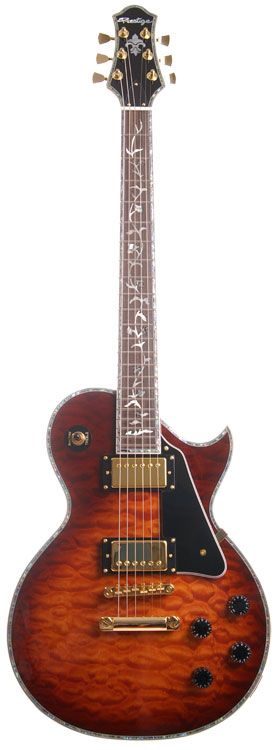
Prestige Heritage Elite - Lite Sunburst

Prestige Heritage Elite - Lite Sunburst

Pictured to the left is “Sugar,” my beloved Prestige Heritage Elite. It lists for $1800 Canadian (~$1450 US). But amazingly enough, you can get this guitar for $700-$800 on EBay!!! Click on this link to see items up for sale on EBay.

I’m absolutely amazed by this pricing! This is a guitar that has workmanship and features, not to mention sound and playability that rival boutique guitars five times its price! I’m so blown away by the prices that these are going for on the street, and it’s another reason to consider getting one of these guitars! Here are some sample clips:

Clean or dirty, this guitar sounds amazing!

Prestige Amps

Prestige also carries two tube amps, the VT-10 and VT-30. Here’s an EBay link to a VT-10 for $160!!! That’s absolutely ridiculous! Based on the price alone, I’m going to pick one of these up!!!

Read Full Post »

Line 6 JM4 Looper

I suppose in a response to the VOX’s JamVOX, Line 6 recently released the JM4 Looper. This is one cool box. All the included recordings were done by actual session musicians, so you’re playing to real instruments. You can even record and store up to 24 minutes of loops, and with an SD card, you can store up to 2 GB extra of loops. I’ve used Line 6 gear in the past, and it’s top notch. Click here to check out the specs.

With a street price of $329.99, it’s not cheap, but you get A LOT of bang for the buck. I guess this is Line 6’s answer to the JamVOX, which is also very cool – and a bit more versatile with respect to being able to play all sorts of media. But the JM4 seems to concentrate on musical styles as opposed to just jamming to songs, and with their Endless JamTM technology, Line 6 has added a great twist on jamming. Here’s their explanation:

The Endless Jam Engine is a simple arrangement system that we developed to get great mileage out of the jam tracks. It breaks each jam track into sections, arranging everything between the intro and outro into an Endless Jam, creating jam tracks that can go on forever without getting boring or overly repetitive.

How cool is that? Very, in my opinion…

For more information, go to the Line 6 JM4 Looper page.

For an absolutely great demo of this pedal, I found a YouTube video of this excellent guitarist showing off the various styles of music included in this box. The dude’s a great guitarist to boot, and gives a fantastic demo of the JM4 Looper. Check it out!

Read Full Post »

breadwinner

As I’ve mentioned in the past, I dig writing this blog because I meet a lot of cool people; one of them is Phil Vickman of Fat Tone Guitars. I call him occasionally to hook him up with information on various gear manufacturers, and we end up talking about some kind of gear. Yesterday’s conversation ended with Phil mentioning that he just got the Eastwood Breadwinner in, and is really digging it! So I did a bit of poking around…

Since Eastwood Guitars opened their doors, they’ve created faithful reproductions of vintage guitars of yesteryear at a fraction of the cost of the actual vintage gear. That’s been their shtik from day one. Even though I have yet to purchase an Eastwood guitar, I have played a few, and the thing that I dig about that company is that their replicas aren’t of classic, mainstream guitars (can you say “Les Paul” and “Stratocaster”); rather, they’ve placed their focus on the more avant garde styles of vintage guitars.

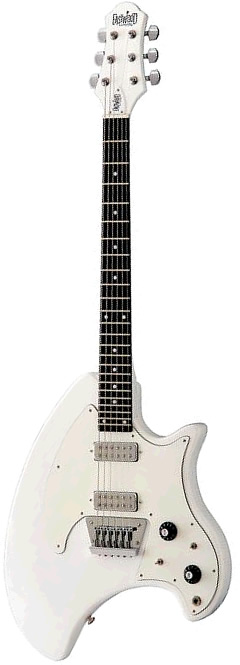
Among them is their latest offering, the Breadwinner, introduced at the 2009 NAMM show. I’m usually not moved by avant garde guitar styles, but there’s something about this guitar that really speaks to me. The Breadwinner was originally produced by Ovation, and was their first foray into a solid body guitar. From what I’ve been able to glean about its history, this guitar’s shape was both for form and function, its ergonomic design shaped specifically for playing comfort. That’s totally cool!

This replica and update features some pretty cool things, among them switchable active/passive humbuckers, which give this guitar lots of tonal possibilities. The body is solid mahogany, with a bolt-on maple neck, and uses Gotoh hardware. Very nice.

For more information, check out the Eastwood Guitars web site! If you’re interested in buying the guitar, go to Fat Tone Guitars. Phil’s great to work with, and he’s really knowledgeable about the gear he carries!

Here’s a video demo of the guitar that I found. The guitar is played clean, and the sound quality of the demo is only okay, so I suggest you go to a local Eastwood dealer to see if you can play one of these bad boys…

[youtubehttp://www.youtube.com/watch?v=CZFoP8zQOnQ]

Read Full Post »

ValveTrain Amps Concord 6 Watt In addition to drive pedals, I love low wattage, single-ended amps, and there are lots of ’em out there. For instance, one of my favorite amps is my Fender Champ 600. I use it in my studio, but also gig with it in small venues – to be clear, I have to hook it up to an external cab to get some volume.
Just recently, I discovered the Concord from ValveTrain Amplification. This is a little 5 Watt amp based on a classic Fender 5 Watt design (I believe this is what Valve Train specializes in). It is a single-ended amp with a single 12AX7 and a 6V6 power tube; pretty similar to a Fender Champ 600. However, there is a difference… a huge difference between the Concord and the Champ.  The Concord is completely hand-wired. Not only that, this little hand-wired amp only costs $499 street!

That’s an incredible price, and something I definitely have to consider…

Here’s video of how it sounds:

[youtubehttp://www.youtube.com/watch?v=TkprPwSz7YY]

I’ve heard of some people buying this amp sight unseen, and not being satisfied with its overdrive tone. But make no mistake about an amp like this: The design was never made for tons of high-gain distortion. For instance, my Champ breaks up nicely when I have the amp open all the way, but it never gets over-the-top with the breakup. It’s just not meant to do that, and I suspect that it’s the same thing with the Concord. Furthermore, you just can’t expect to get that high-gain distortion with an 8″ speaker. 🙂

Anyway, for more information go to the Valve Train site.

Read Full Post »

Lovepedal has been around awhile, and has been known for creating some killer pedals; among them the awesome “Church of Tone,” Plexi-in-a-box drive box, and the Eternity drive, an incredibly versatile overdrive pedal. Just recently, Lovepedal released a line of four pedals that while diminutive in size, create huge tone. These are the Echo Baby, a nice straight-forward delay; the Amp 50, which is a miniaturized version of the Church of Tone pedal; the Pickle Vibe, a VERY nice vibe pedal; and finally, the Mini Buffer, a signal buffer to live on your pedal board to bolster and condition your signal chain. Each pedal measures 3 5/8″ long X 1 1/2″ wide X 1 1/4″ high. As Lovepedal puts it, these are small enough to fit on a keychain. 🙂 Of course, that’s a bit of an exaggeration, but that’s pretty small nonetheless. Check ’em out at lovepedal.com! Here’s a cool video to make you salivate a bit…

Read Full Post »

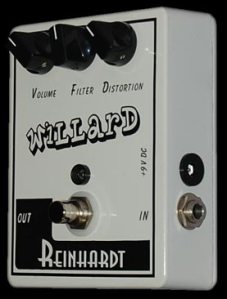
Reinhardt Amps Willard Distortion Pedal

Just ran across this brand-new fuzz pedal from Reinhardt Amps, called the "Willard" distortion pedal. This pedal is pure 80’s fuzz, a sound that I came to love! From the video, it’s clear that this pedal is capable of producing some serious hair, but it also retains a lot of clarity. Built around a true NOS LM308N op-amp chip and based around a big-box Rat of that era, this is a very nice-sounding distortion box. Check out the video below:

Read Full Post »

« Newer Posts - Older Posts »