Feeds:
Posts
Comments

Archive for the ‘guitar’ Category

Reason Amps BambinoCruising the forums this morning, I came upon a statistic that just blew me away; probably more so because I completely missed it when it first came out. But better late than never… Anyway, the guys at Creation Audio Labs did a loudness comparison of various amplifiers in different wattage ranges at the recent Nashville Amps Show. For the 1 – 20 Watt category, the Reason Bambino had a loudness of 120.2 dB through a Greenback!

That’s moving some serious air for an 8 Watt amp, and just goes to show you that’s it’s not necessarily wattage that determines how loud something is. Power handling is the key, and Obeid Kahn of Reason Amps is wizard with power handling.

I’ve been extolling the Bambino not only for it’s great tone, but also for how loud it can go. Friends have said an amp this small will never move enough air to gig with; I’ve proven them wrong time and again, but mostly through verbal argument. But now, with a number to back up the argument, I can confidently say that this amp can do it! I regularly use it for gigging with my 1 X 12 cabinet, and have absolutely no problem hearing myself over the drums. But let’s be clear: I’m not using the amp to project my sound out to the audience. I’m using it more as a direct stage monitor, of which it is PERFECTLY suited. I get my sound out to the audience by plugging directly into the PA board from the balanced line out, or miking my cabinet.

I’ve mentioned this before, but I’ll say it again. Going lower wattage with your amp(s) is really a change in performance setup philosophy. Those who’ve embraced this understand that you really only need stage volume nowadays with the much better PA system technology that’s out there. Even moderately sized PA’s work better than stuff twenty to thirty years ago. The important thing to them is to be able to get their cranked up tones without peeling the skin off their faces and turning their eardrums into a liquid mess. Take for instance Matthew Followill of the Kings of Leon, a band that is really gaining popularity and starting to play a lot of arenas. I was amazed to read in an interview that he plays through a 50 Watt Ampeg Reverb Rocket. As he said in his interview, “I’m a big fan of smaller amps turned all the way up, instead of big amps turned up halfway…”

Circling back to the Bambino, it is a great, versatile amp that is really starting to turn heads; not just from its tone, but how well it can project its voice!

Read Full Post »

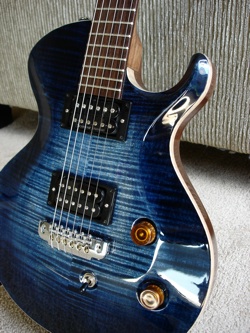
SAINT Guitar Company - Faded Blue Jean Benchmark Guitar

SAINT Guitar Company - Faded Blue Jean Benchmark Guitar

…but it will also make you a better player!

Pictured to the left is the very first Saint Guitar that I ever played. Even though she wasn’t mine, I nicknamed her “Baby Blue” and the name kind of stuck; she’s technically called the Faded Blue Jean Benchmark. But to me, she’ll always be Baby Blue because I spec’d her out, and it will always be a special guitar to me. But that’s not the point of this article. The point is that Baby Blue is a great guitar, and when I first got it to test, I will finally admit that it scared the livin’ shit out of me!

Why? The answer is simple: Great guitars make you play well; no, not from the standpoint that by just playing them you immediately start playing better. It’s actually the converse: More likely than not, when you pick up a great guitar, you may find yourself flailing!

I’ve seen several good players pick up a great guitar such as this and flail away. Most, like me, don’t want to burst their bubble of pride, and simply say that it’s because the guitar is just not easy to play. But in my case, and I’m willing to bet in other players’ cases, what happens is that a great guitar takes your bad habits, emphasizes them, then throws them back in your face.

But let me qualify that a bit: What a great guitar does is pretty much emphasize everything you do. The good things you do feel and sound better, but the bad things you do well… they’ll scare the shit out of you. πŸ™‚ That was my experience with the Saint Guitars Baby Blue and recently – but not as bad, thank God – a PRS McCarty that I had the chance to play.

I remember the first time I picked up the Baby Blue. She felt so nice to hold. The D-shape neck was a bit foreign to me, but not unpleasant, and the weight and shape were just perfect. I plugged her in, did a few chords and some standard licks, then turned on a jam track to start playing. Again, I started out with some pretty standard stuff that I normally do like bending and vibrato to listen for the inherent sustain (which Saint Guitars are known for). But when I started to do some faster runs – OUCH!!! It was like getting my ass completely kicked.

Even though I was alone in my studio, I was embarrassed and humbled. But being as hard-headed as I am, I wouldn’t let that deter me. I knew I had to swallow my pride and take some time to get used to playing the guitar – properly. The problem stemmed from my being used to playing a Strat for so long. With its narrow neck radius, wrapping your entire hand – even as small as mine – around the neck and still maintaining speed and control is easy. But with the Saint, while the neck radius is bigger, it’s the D-shape that doesn’t really facilitate wrapping. Oh I could do it, but it seriously hampered my ability to move, and seriously hampered my ability to correctly articulate the strings.

So I had to go back to fundamentals and learn to place the pad of my thumb right on the neck – like you’re supposed to do… It took me about a week of hours-long practice every day to adjust to playing with a correct left hand position. But the great thing about it is that I now play in a good position without thinking about it. I do have my lapses, but once I catch myself, it’s all good.

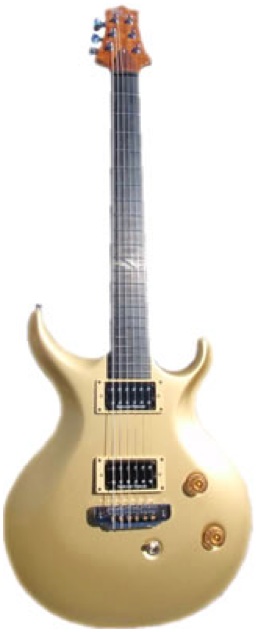
goldie_full

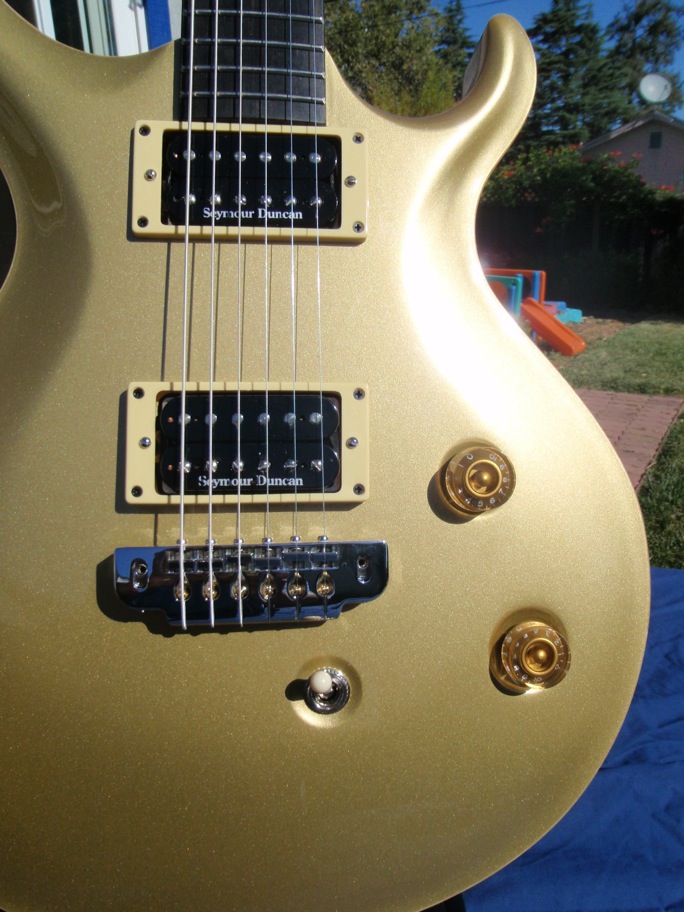
Once I got Goldie (shown at right), the initial experience wasn’t nearly as acute as with Baby Blue since I’ve spent A LOT of time working on my technique, but I wasn’t exempted from an ass-kickin – even though it may have beenΒ  just a little. I ordered Goldie with medium-jumbo frets because I wanted deeper frets to aid in producing more pronounced vibrato when I was sustaining notes, and also making it easy to do those little microtonal bends.

I thought I had developed a much lighter touch through all the practicing that I’ve been doing over the last couple of years, but with the jumbo frets, I REALLY had to lighten my touch. This is a great thing because playing with relaxed hands ultimately makes you faster. But nevertheless, it’s still a little unsettling. The positive thing is that I’m spending every bit of spare time I have learning her every subtle nuance; and I have to tell you, this guitar is capable of producing A LOT of different tones from Strat-like chime to full-on, thick, rich, and chocolate overdrive tones.

Sometimes a good ass-kickin’ is a good thing…

Read Full Post »

goldie41I spoke about Tone with a capital “T” the other day and how your Tone is the combination of your gear plus what’s in your heart. One thing that I didn’t discuss is that when your heart and your gear are in alignment, the visceral effect it has on you borders on a religious experience. Put simply, you become truly inspired. I got Goldie back from Saint Guitars a few days ago to correct some wiring and action issues, and plugging her into my amp, I was immediately floored by her tone. I already was in the first place, but with everything working right, the effect it had on my spirit was tremendous!

So I decided to completely re-write and re-track a song that I had recorded earlier as a demo of the Reason Bambino – turn it into a real composition. But I also wanted to demonstrate the wonderful voice she has. Here’s the song. It’s called “Sunset By the Bay” because it reminded me of sipping a mojito on the beach at sunset:

The opening of the song and the first “verse” demonstrate Goldie’s neck pickup in single-coil configuration. Man, it’s chimey like a Strat! The second part of the song stays in the neck pickup but with both coils working, and adding a bit of crunch in the second channel of my Aracom VRX22. I recently had a mod done to the amp to add channel switching, and remove the Master Volume control from the first channel so it acts more like a Class A amp in channel 1. Continuing on, in the bridge of the song, I switch both pickups and remain in channel 2, then I finally finish up back on the neck pickup.

I can’t believe the sounds that come from this guitar, and my VRX22 just sounds so sweet with it!

By the way, as far as the recording of the melody goes, I recorded Goldie completely dry, just plugged right into my amp. I then added some reverb and a tiny bit of delay to give the melody an airy feel. The rhythm part was recorded using my Strat directly plugged into my Reason Bambino and played entirely in the Bambino’s Normal Channel. I love the natural presence of the Bambino – it was if it was made for a Strat!

I also recorded the entire song at bedroom level using my Aracom PRX150-Pro attenuator. I just love the purity of my tone at any volume level!

Read Full Post »

5 Tone Bones - Gear has stellar performance, value, and quality. This is definitely top of the class, best of breed, and it's a no-brainer to add this to your gear lineup!Kasha KA-ODP-A KASHA Overdrive

Summary: Just about the most amazing overdrive pedal I’ve ever had the privilege to play!

Pros: 4 “channels” provide different and amazing overdrive voices that add “spice” to your tone. No line noise from this pedal at all! Super simple operation.

Cons: None.

Features:

  • 4 channels with separate voicing and gain structure
  • Analog design
  • 10 dB clear boost
  • True bypass switching
  • Very low power consumption (3mA and runs on a single 9V battery)
  • No tone change, only enhances sound
  • Compact standard aluminum chassis (4 3/8″x2 1/4″ x 1 1/4″)
  • AC power jack (uses standard Boss DC power supplies)
  • High gloss mirror black powder coat
  • Hand made in the USA
  • Low noise
  • Crystal Blue LED (high intensity)
  • Weight: 1.5lb

Price: $200 direct from KASHA Amplifiers

Tone Bone Score: 5.0 – I’ve played through enough overdrive pedals to fill a large trunk, and the KASHA Overdrive is simply one of the best I’ve every played!

If you’ve read this blog with any regularity – and I know I’ve said this in the past – I just can’t get enough of overdrive pedals. I just love ’em! But over time, and as there are so many overdrive pedals being released on a regular basis, I’ve started to limit what I take a deep dive into researching. Lately, I’ve only focused on overdrive pedals that offer a “twist” on the overdrive, and not clones. One such pedal that I recently discovered (and now has a permanent place on my board) was the GeekDriver, that while based upon the classic ColorSound Overdriver, has a sound all its own!

And wouldn’t you know it, I came across the KASHA Overdrive, and its simplicity intrigued me so much that I just had to check it out! Here was an overdrive pedal that required no EQ control! For me, that’s a HUGE thing because the implication is that the pedal’s circuit doesn’t require you to compensate for tonal changes that often get introduced with other pedals.

In any case, if you don’t want to read any further, let me just say this, and have it done with:

The KASHA Overdrive kicks ass, and I will be adding it to my pedal board! Even if you’re not in the market for a new overdrive, you owe it to yourself to give this pedal a serious look!

Four channels, Two Knobs, One Switch and a TON of Ways to Enhance Your Tone

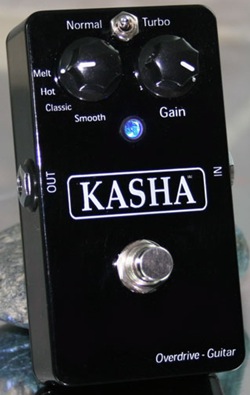
Notice I didn’t say, “tweak” or something similar that would imply that your tone changes once the KASHA OD is engaged. The reason for this is that KASHA built the pedal from the perspective of “voicing” much like an amplifier. Each “channel” on the pedal represents a different “voice.” It’s almost as if you have four amps in a box. In light of that, your input EQ remains the same; but just like plugging into different amps, the KASHA OD offers different kinds of “voicings.”

But it doesn’t just end there with the channels. The gain knob is incredibly expressive and just like an amplifier, provides different characteristics depending upon where you set the sweep. It’s f-in incredible! It’s also really difficult to verbally describe the effect. The closest I can get to an explanation of turning up the gain knob is that it is very similar to turning up the master volume on your amp and the effect that has as more juice is fed into the power tubes. Like I said, it’s hard to articulate…

And then if you didn’t think that the standard gain profile is enough, the “Turbo” switch will kick your amp’s ass even more by giving you a 10dB boost! 10dB may not seem like much, but sonically, it’s HUGE!

How It Sounds

So how does the pedal sound? In a word AMAZING, even when it’s on and you’re not playing anything, because unlike a lot of overdrive pedals, the KASHA Overdrive is dead quiet electronically. No hums, no buzzes, not a single electronic tick. The only noise it makes is when you play your axe through it.

I’ll let you read the documentation on the KASHA web site that describes the different channels – it’s pretty accurate. In lieu of that, I’ll write about my own perceptions of each channel as I experienced them. By the way, I played the pedal through a Fender DRRI and a Fender Princeton Studio, using my Saint Guitars Goldtop Messenger.

Smooth Channel

This channel is a simple boost stage, which ups your gain about 3dB. It’s an ideal channel to use if your amp is already at the edge of breakup, and you want to push it just over the edge to get a little extra bite. Of course, if you add the Turbo, then you get a full 13dB to start really working your pre-amp tubes. The impressive thing about this channel is that it demonstrates the pedal’s transparency. Setting the gain to unity, and switching the pedal on and off, there is absolutely no tonal change whatsoever. Quite nice.

Classic Channel

I loved this channel most of all, and as soon as I made my first strum on this channel, I was completely sold on the pedal. I didn’t have to hear any more. This channel is voiced brightly, and sounds like a friggin’ low-wattage EL-84 amp with all the chimey goodness that kind of amp has to offer. But at the same time, you don’t lose your lows. In fact, the full spectrum of your EQ is retained, but you get this incredibly dreamy, top-end chime that just works its way through your entire body! When I was playing through this channel, I just closed my eyes to listen to that sweet chime.

Hot Channel

Need even more grind? Now you have it. This channel slams your front-end with 11dB of gain, and gives you an added bass shelf. The tone from this channel is absolutely HUGE! And even with the big bass, you never lose any clarity at any time. Do a big power chord, and you’ll rip right through any mix. Pluck a single note and dig in, and that note will sustain – like Santana sustain, baby! And the cool thing is that at no time does your signal compress as often happens with other pedals, and we’re talking starting to get into some serious-ass gain when you’ve got the gain knob and guitar volume completely cranked! Then you hit the Turbo button, and WHOA! Singing sustain that just floats in the air and doesn’t come down!

Melt Channel

Here we’re getting into metal territory as the voicing gets a big, but tight bottom end plus a few more dB’s of gain. And just as with the Hot channel, you don’t lose any tonal clarity at all – you hear every single note, which is all the more amazing in this channel because you’re absolutely slamming the front-end of your amp! You just get a beefy, hairy balls sound that’ll shake the rafters when you’ve got it cranked up! Yeah, “melt” is an appropriate term to be used here because the thick, liquid metal tone in this channel will certainly melt you; of course, in a very good way!

Overall Impressions

Dammit! I wish I had more time to play with the pedal to really take it through its paces, but the store was closing up, and we were playing a bit too loud for the tender ears of the senior citizen sales people, though gracious as they were to let us bring in our own gear. What amazed me the most was how absolutely HUGE the Fender Princeton sounded with this pedal. This is a little 15 watt amp that combined with the KASHA overdrive could be used in a club. No problem cutting through with the KASHA overdrive engaged!

Yeah, I was sold on the Classic channel alone, but I’m just completely twitterpated and ga-ga over this pedal. KASHA claims that not a single person to date has had a bad opinion or offered “improvements” to it, and this includes some very big names in the music business (sorry, not allowed to mention them yet by request of KASHA). Based on even my brief experience with the KASHA Overdrive, I totally believe the claim. THE KASHA OVERDRIVE WILL KICK YOUR ASS!

By the way, I hate KASHA Amplifiers!!! I thought I was temporarily cured of my recent case of GAS, and now the KASHA Overdrive has me salivating, slobbering, and frothing at the mouth with an f-in’ GAS attack!

Read Full Post »
dylan_brock Just went to see a fantastic SF Bay Area band called LUCE (pr. “loose”) last night at the Little Fox Theatre in Redwood City. This is a medium sized club with a decent sized stage. Their music is in the Alt-Pop realms, even close to Folk Punk, but who cares? They make great music!

In any case, I had a chance to rap with Dylan Brock, LUCE’s guitarist. That dude can PLAY! He was playing through a Hiwatt Custom 20 through a matching Hiwatt 2 X 12 cab (didn’t get what speakers he had). Granted, the venue wasn’t an arena, but he was plenty loud with just 20 Watts! The sound guy used what looked like a Senheiser e609 amp mic on his cab to run through the PA, and his tone was simply killer!

It just goes to show that you don’t need a lot of wattage to get your sound out. He just needed stage volume, and the sound guy did the rest! I always speak about the virtues of playing with low wattage amps. The thinking is that when you can work your power tubes into your tone equation, very good things happen. Dylan totally proved that point last night!

If you want to hear more about them, check out LUCE on iTunes!

Read Full Post »

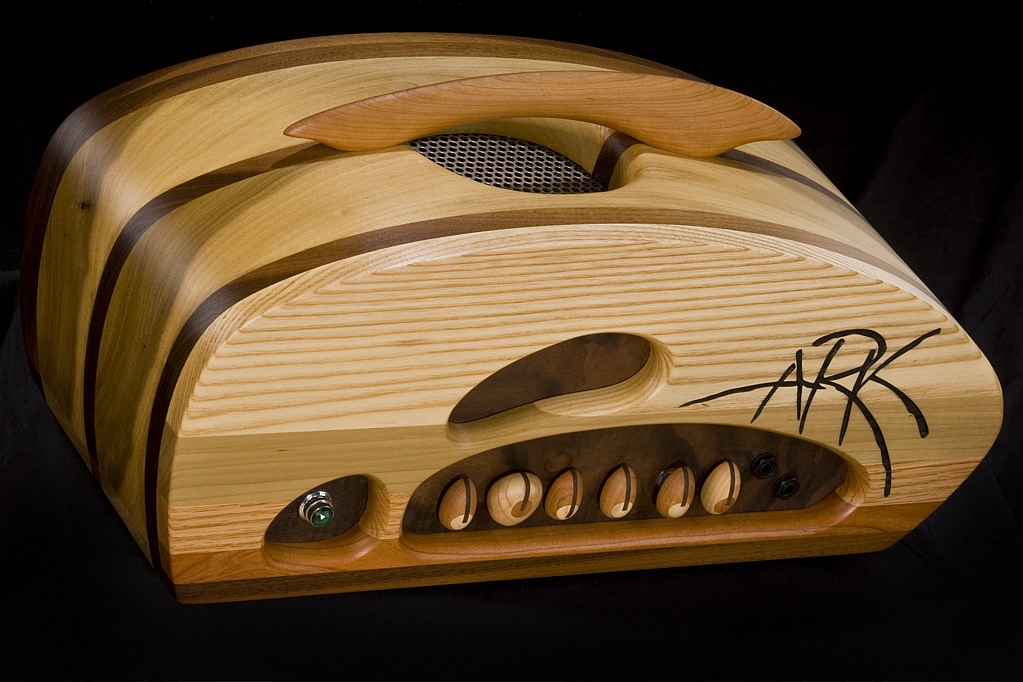
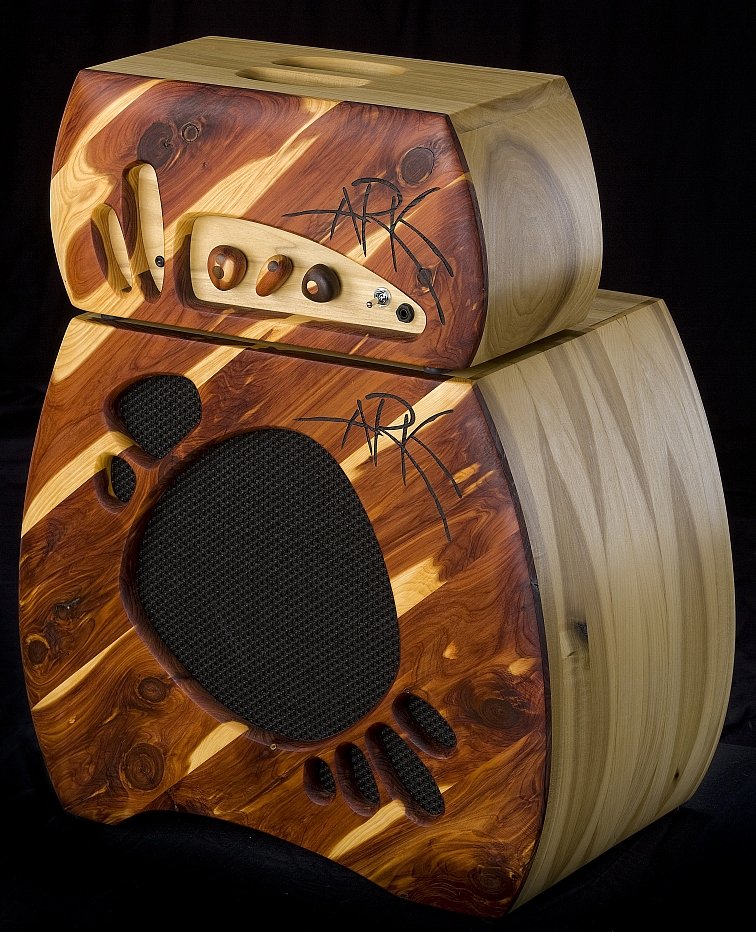
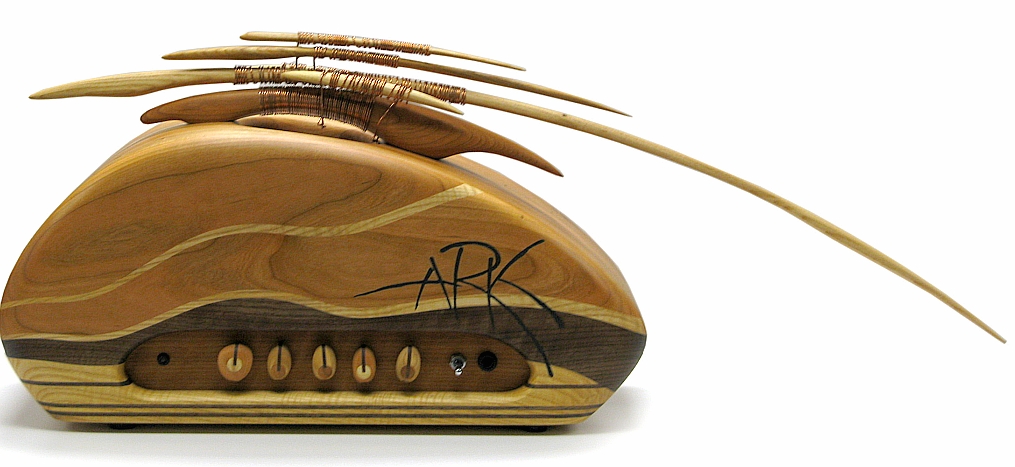
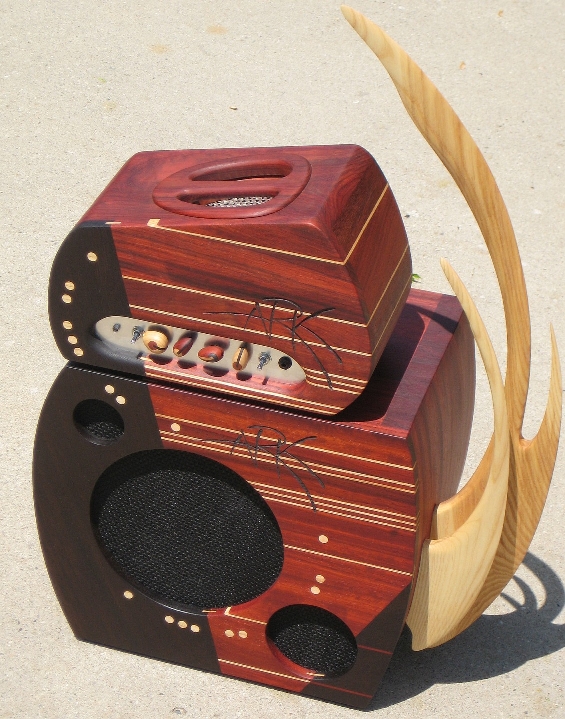
arkDid I ever say, “I love my job?” Well… GuitarGear.org isn’t exactly a job, but even it were, I’d still love it because I get to sniff around the Internet for different kinds of gear. Recently, through The Gear Page forums, I ran across this great amp company called Ark Amps. I had heard the name in passing but didn’t know much about them. Still don’t, but they make some gorgeous amps! The designs are really out of this world with incredible woodwork! And from what I can gather from the audio clips, these are nice-sounding amps as well.

To give you an idea of just how awesome these designs are check out these pictures! Talk about combining art with function! I’ve never seen amp cabinet designs like this – ever! Check ’em out for yourself at Ark Amps!

Read Full Post »

I’ve often extolled the virtues of a cranked amp here at GuitarGear.org and elsewhere. My belief is that when you’ve got both your pre-amp and power tubes working, you get the real character out of your amp. There’s something that happens to your tone once you get juice into your power tubes that adds a certain dynamicism and complexity that you just can’t get with just your pre-amp tubes. Unfortunately, most mere mortals, like myself, don’t normally play venues that that will allow us to crank our amps to the point where the power tubes of our amp come into play.

Take, for instance, my good buddy Phil. He’s the lead singer of a bar band called Phil ‘N The Blanks. Up until recently he was playing through a Marshall DSL100 JCM2000 100 Watt head into a Marshall 1936 2 X 12 cab. Talk about too much amp for his gigs! I ran sound for him at a gig a couple of months ago, and could only turn his volume and gain controls to about 3 each before he stepped on the band entirely; not to mention peeling faces off! Since he’d owned the DSL100, he’d never played above 5 because it was way too loud.

Recently, I lent him my Aracom PRX150-Pro attenuator so he could squelched down the volume but crank up his amp. He couldn’t believe his ears! He was finally able to get the gain up in his amp where his power tubes would break up. It was like a completely different amp once he heard the cranked up tone. I had been telling him for months that there’s really nothing quite like a cranked up amp, and for the first time since he owned the amp he was able to hear for himself what I had been talking about. Before that, he was on tonal training wheels! πŸ™‚

Ultimately, he decided against going with an attenuator, but he did a very smart thing: He purchased a low-wattage amp, the Marshall Haze MHZ15 15 Watt amp. It hasn’t arrived yet, but I’m excited for him because he’ll be able to crank that amp at a reasonable volume level, as the lower wattage amp will break up a lot earlier, and he’ll be able to reap the benefits of the response of his cranked amp!

1 Watt is LOUD!

But here’s the funny thing: 15 Watts can still be freakin’ loud when cranked! The following chart shows SPL at 1 meter vs. Wattage (I got this from the Aracom site where Jeff discusses understanding attenuation).

POWER VS. LOUDNESS CHART

Watts

SPL (db)

Loudness

0.0078

79

Passenger car at 10 (60-80dB)

0.0156

82

0.0312

85

Vacuum cleaner

0.0625

88

Major Road Noise (80-90dB)

0.125

91

Noisy factory

0.25

94

0.5

97

1

100

Jack hammer at 1m

2

103

4

106

8

109

Accelerating motorcycle at 5m

16

112

32

115

Hearing Damage (short term exposure)

64

118

Rock concert

128

121

256

124

512

127

Jet at 100 meters (110-140 dB)

1024

130

Threshold of pain

What’s amazing from the table is how loud 1 Watt is at 1 meter! It’s as loud as a jack hammer! And 0.0312 Watt is as loud a vacuum cleaner! Jeff got this information from a well-known study done in 1933 by Harvey Fletcher and W A Munson about human hearing response. For those people who say, “P-shah” to low wattage amps, just reference this chart.

Granted, there is a certain mojo about a 100 Watt amp cranked up – even a 50 Watt amp. But most people other than those playing large venues can crank their amps to experience that mojo. But in spite of that, there’s been a movement in the industry these past few years towards lower wattage amps. I think a big part of the reason for this is the improvement in PA gear over the years. Want to get your sound out there? Mic your amp. After all, all you need is stage volume so you can hear yourself. Let the sound guys project your sound out.

My buddy Vinni Smith of V-Picks does exactly that. As amazing as he is with a guitar, he gigs with a Roland Cube 30! He just gets his stage volume, then has his amp miked to get his guitar out to the audience. This dude gigs alot, and he’s living proof that you don’t need a lot of power to get perform. As long as you can get your tone, you’re golden!

Circling back to the title of this article, there really isn’t anything like the sound and feeling of a cranked amp. Especially with tube amps, when the power tubes have juice, they add all sorts of things to your tone such as compression, a different kind of breakup and even more touch sensitivity. You can get that in a couple of ways:

  1. Get an attenuator. There are several on the market, including the increasingly popular Faustine Phantom, but my bet is on the Aracom PRX150-Pro, as it takes a completely different approach to attenuation than all others. I’ve never played an attenuator as transparent is this.
  2. Get a lower wattage amp. I’m not even going to list what amps to buy as there are tons of fantastic amps – both boutique and mainstream – on the market. Just make sure you give them a listen.

Read Full Post »


Kasha KA-ODP-A

Awhile ago, I was perusing a forum where one of the members mentioned in a reply that it’s a good time to be a guitarist. There’s so much varied gear out there that guitarists have all sorts of options to choose from. One area of guitar gear that certainly seems to get regular entries is the overdrive pedal.

The OD pedal is something of which I never tire. There are so many great ones out there – I just can’t get enough of ’em. One such pedal that has just recently caught my eye is the KA-ODP-A 4-Channel Overdrive Pedal from Kasha amps. This pedal promises to be something special. Check out its features:

– 4 channels with separate voicing and gain structure
– Analog design
– 10 dB clear boost
– True bypass switching
– Very low power consumption (3mA and runs on a single 9V battery)
– No tone change, only enhances sound
– Compact standard aluminum chassis (4 3/8″x2 1/4″ x 1 1/4″)
– AC power jack (uses standard Boss DC power supplies)
– High gloss mirror black powder coat
– Hand made in the USA
– Low noise
– Crystal Blue LED (high intensity)
– Weight: 1.5lb

Built By an Amp Builder

There’s something about gear that’s built by an amp builder, especially when it comes to pedals or other peripheral devices. Amp builders have an innate understanding of the electronics behind tone, and how peripheral devices interact with their amps. A great example of this is Jeff Aragaki from Aracom Amps and his brand-new attenuatore, the Power Rox PRX150-Pro. Jeff totally gets it with how an amp interacts with a speaker, and the Power Rox is a testament to that. The same may be said of the Kasha overdrive in front of an amp. I had a chance to speak with John (Kasha’s owner and builder) this afternoon about the pedal, and it was clear from our conversation that this guy really understands the interplay between effects and an amp – especially with respect to overdrive.

Kasha has been around awhile, having been building the famous ROCKMOD line of amps since the 80’s, so they know something about amps, and their tone is well-known. Guitarists such as George Lynch and Davey Johnstone (Elton John), and tons of session guitarists have been playing ROCKMODS for years. So when John decided to build an overdrive pedal, he didn’t want to model it off of traditional circuits, so he created his own. The result is the 4-Channel Kasha Overdrive.

What’s very intriguing about this pedal is that it doesn’t have an EQ. John designed the pedal in such a way that it preserves the tone going in and outputs it with some OD “flavor” as John puts it. The thinking is that you don’t need an EQ if you’re not doing anything to the EQ of the signal. Smart.

The Kasha overdrive is a lesson in simplicity, having only two knobs: An overdrive selection knob to choose from one of the four different overdrives, and a gain knob. Very simple. But it also sports a “Turbo” switch at the top which will add a 10db clean boost to slam your pre-amp tubes with even more gain. But despite all that, this thing operates on 3 milliamps and only requires a standard 9V power source! That is incredible! My beloved Holy Fire requires a special 48V power supply! So what John has created is definitely special.

I’m going to be trying this pedal out in the next coming weeks, and I’m excited! I’ll keep you posted!

For more information, go to the Kasha product page (scroll down to the end to see the overdrive)

Read Full Post »

5 Tone Bones - Gear has stellar performance, value, and quality. This is definitely top of the class, best of breed, and it's a no-brainer to add this to your gear lineup!

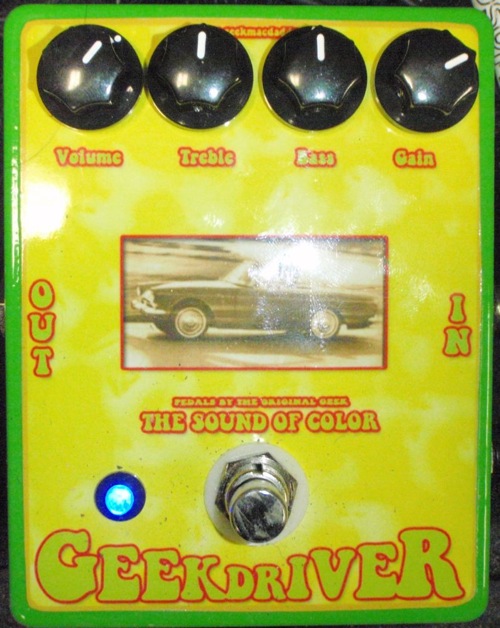
GeekDriver by the Original Geek

The GeekDriver by the Original Geek

Summary: Is it a booster? Is it an overdrive? No! It’s the GeekDriver.

Pros: From gorgeous, slightly fat boost to searing, face peeling overdrive with tons of overtones and harmonics, this pedal does it!

Cons: None.

Features:

  • Hand-wired and soldered in the US
  • Volume, Treble, Bass and Gain Controls
  • Neutrik and Switchcraft jacks
  • True Bypass

Price: $205 direct

Tone Bone Score: 5.0. I’m absolutely blown away by this pedal! I can’t say for sure, but this is a pedal that I’d almost always have on.

I don’t give 5 Tone Bones away lightly. I have to be so totally blown away by some gear that I have to give it my highest rating. When I first heard the GeekDriver on Geek’s Premier Guitar Video, I immediately became intrigued. Then when I finally met the Geek himself at the shop he shares with Tonic Amps, and he demonstrated the GeekDriver in person, I knew I had to have one, so I told him I wanted one, and tonight I picked it up.

What exactly is the GeekDriver?

As the Geek will tell you, the GeekDriver is based upon the ColorSound Overdriver that was popularized by Jeff Beck. At its core, it’s a clean booster, but the Gain knob changes the game significantly, giving you anywhere from mild breakup to ugly, snarling dog overdrive, replete with tons of overtones and harmonics. At high gain levels, it’s like the ugly dog that’s so ugly you can’t help but love it, if you catch my drift.

One thing’s for sure, it’s not transparent, nor is it meant to be. When active it adds a slight compressive fat boost at all volume levels. The effect is incredibly subtle, almost visceral, in thatΒ  you “feel” that coloration more than you hear it. This aspect alone made me give this pedal the 5 Tone Bones. The effect is so sensual and appealing. I know I’m using a lot of flowery adjectives here, but it’s because it’s so hard to articulate the emotional effect that compressive boost has on me. When I get that feeling, I know I’m onto something good.

Then you turn the gain up, and in addition to that colored boost, you get layers of overdrive which become this ugly fuzz as you increase the gain that’s total ear candy. But despite the cacophony of distorted signals, the tone is still incredibly defined and articulate. Unlike a pedal like the OCD which can get pretty muddy when you crank the gain, the GeekDriver just oozes thick fuzz, but never gets muddy. Nice.

How it sounds…

In a word, it sounds awesome. It is very hard to describe what it actually sounds like. It’s like a colored overdrive with fuzz attached. In any case here are a couple of clips (BTW, both clips were recorded at bedroom level using my Aracom PRX150-Pro attenuator. That thing ROCKS, retaining all my tone and dynamics):

In this first clip, I was just noodling, switching back and forth a couple times between the clean tone of my amp and the GeekDriver. Note that I set the Gain pretty high on the GeekDriver on the first section to show how ugly it can get – I love that sound!

In this next clip, I start the solo out only with the GeekDriver, with a very light pick attack. In the second part of the solo, I add my Abunai 2 to the chain to demonstrate how delicious the GeekDriver sounds when another overdrive pedal is stacked on top of it.

I believe the GeekDriver was meant to be stacked. I placed it first on my board, then ran my Tone Freak Effects Abunai 2, and my Creation Audio Labs Holy Fire after it. With both pedals, the GeekDriver just FREAKIN’ ROCKED THE HOUSE!!! Oh, it’s sounds f-in’ awesome by itself, but used as a “base” pedal in front of another OD or distortion pedal, and the mix is like nothing you’ve experienced!

Overall Impressions

As you can tell, I freakin’ love this pedal! I’m not surprise why Jeff Beck dug the original ColorSound Overdriver. This is definitely Geek’s unique take on that classic pedal, and what a unique take that is! It may not be for everyone, especially if you’re looking for a transparent boost. But if you’re looking for something totally different from your typical boost or drive pedal, the GeekDriver has a voice all its own. Like I said, it freakin’ rocks the house!

About the Original Geek

Meeting Geek was pure serendipity. I originally was going to Tonic Amps to meet Darin Elingson about his cabs and Fane speakers. I didn’t know the Original Geek shared a shop space with him. That’s serendipity for you.

For those who are familiar with Jeff and his creations, he is known as “GeekMacDaddy,” and for years, his pedals have been by GeekMacDaddy. But his company has gone through a recent name change, and is now known as the “The Original Geek.” But who cares about the name? I certainly don’t. I just know his pedals kick f-in’ ass!

For more information, and to order one, go to http://www.geekmacdaddy.com.

Read Full Post »

5 Tone Bones - Gear has stellar performance, value, and quality. This is definitely top of the class, best of breed, and it's a no-brainer to add this to your gear lineup!
Aracom Amps PRX150-Pro Attenuator
Aracom Power Rox PRX150-Pro Attenuator

Summary: This is hands-down the best attenuator on the market! I’ve played a lot of attenuators, and no other has been able to retain tone and dynamics at high attenuation levels as the Power Rox!

Pros: The Power Rox isn’t just an attenuator. It packs extra features that’ll just blow you away, making a it versatile part of your stage or studio rig!

Cons: None.

Features:

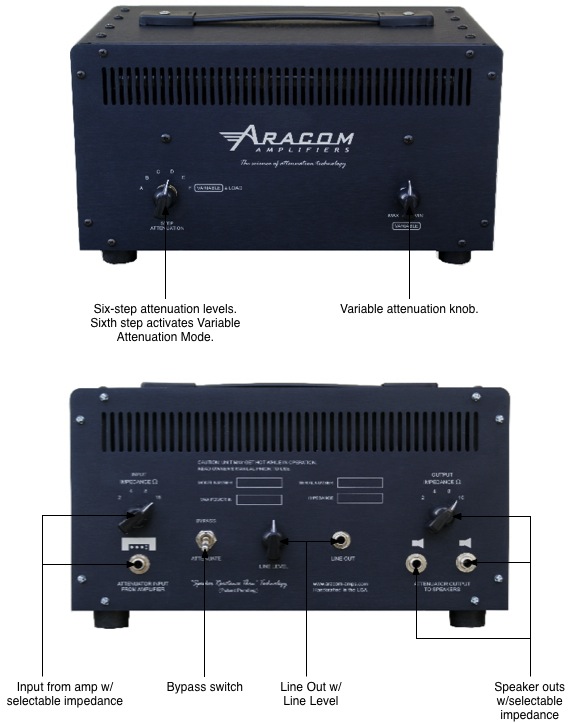
  • Rotary Switch provides (6) Step Attenuation Levels, plus
    the Variable Mode allows continuous variable control of “bedroom” level adjustment
  • 33dB attenuation range
    * Attenuates 100 watts down to well under 1 watt (0.05 watt).
  • 150 watt (continuous average) power rating
  • Independent Input Impedance Switch: 2, 4, 8, 16 ohm
  • Independent Output Impedance Switch: 2, 4, 8, 16 ohm
    * Uniquely allows mismatched amplifier and speaker impedances to be used.
  • Attenuator Bypass Switch
  • Load Mode
  • Line Out with Level Control
  • 2 Speaker Jacks (wired in parallel)
  • Passive design, does not require AC power
  • Rugged, black anodized aluminum housing
  • Heavy duty, steel reinforced handle
  • Handwired and Handcrafted in the USA.

Price: $649 direct

Tone Bone Score: 5.0. Jeff Aragaki of Aracom Amps never ceases to amaze me with the stuff he comes up with! This time, it’s an attenuator invention that blows away the competition in safety and tone and dynamics with its patent-pending Speaker Reactance Thru (SRT) technology, plus extra features that make it unmatched in versatility and usability.

I’ll admit it: As much of gear nut that I am, I’m also a huge techno-geek. I dig new technologies and the engineering behind them; and when someone comes up with some new approach to something, with completely awesome engineering, it’s hard to control my GAS. I just have to have it.

I recently took delivery of a brand new attenuator invented by Jeff Aragaki of Aracom Amps, called the Power Rox PRX150-Pro. This, by far, is the best attenuator I have ever used, and will be a fixture in my rig for years to come. That’s right. This will always be in my chain. But not just because of its ability to transparently attenuate an amp signal. This attenuator has features that no other attenuator has such as two speaker outs, and a Line Out that you can use to go direct into a DAW, or even another amp! Talk about versatility. Not only that, because you can match impedance in both the input AND the output, combined with Jeff’s patent-pending Speaker Reactance Thru (SRT) technology, you can squelch down the power of your amp and not worry about ever blowing our your tubes and ruining your amp. The SRT technology just kicks ass!

Talking the Talk AND Walking the Walk: Speaker Reactance Thru Technology

Jeff is a very humble man, so he’d never say anything like this, but I’m not nearly as humble, so I will say it: There’s not a better attenuator than the PRX150-Pro. Even if Jeff didn’t include all the extra features you get with the Power Rox, this attenuator simply kicks the shit out of all the attenuators I’ve ever tried – and I’ve tested several, including the Ultimate Attenuator that seems to be the most popular attenuator; and with respect to safety, tone and dynamics, all others simply pale by comparison.

Where other manufacturers make bold claims (read: brag) about their attenuators’ transparency, not only can Jeff Aragaki make the claim (in his quiet and humble way), he backs it up with detailed discussions of his SRT technology and the engineering behind it and what makes it so transparent. Jeff’s SRT technology is absolutely incredible. At any level of attenuation, the Power Rox retains your tone and dynamics. This is because instead of just dealing with amp power reduction through a series of resistors or a dummy load, which also have the added effect of flattening out the impedance curve and changing tone, the SRT technology ensures that reactance between the amp is maintained throughout the entire spectrum of attenuation; hence, the name “Speaker Reactance Thru.” This means that the impedance curve is kept intact so that the continuity of reactance between the speaker and the amp are maintained. Jeff discusses this in a detailed article about the advantages of the PRX150-Pro.

Let’s talk a bit about safety…

As I mentioned, the PRX150-Pro will not burn out your amp. You can crank your amp up all the way, getting that wonderful power tube drive, and not worry about your amp blowing a tube, or worse yet, frying some circuits from flyback voltage. We’ve all heard the horror stories about people using attenuators, cranking their amps, and blowing power tubes. A lot of this has to do with impedance mismatching. Some manufacturers have added options to match impedance from one direction, but the Power Rox has impedance matching in both the input and output jacks! But the point of this is that with impedance matching on both sides, you don’t have to deal with any type of mismatch. That is very comforting to know.

I’ve actually been playing with the Power Rox for the last couple of months regularly before it hit the shelves, and to date, I haven’t had any power tube problems. And we’re talking running my amps down to less than a watt for a few hours straight. I could never do that even with my Dr. Z, which is one of the more safe products out there. I’ve burned out power tubes using my Dr. Z by cranking power too much. It’s not pretty, and I’ve been lucky so far that only my tubes got burned out. It could’ve been a lot worse.

This ain’t yer Daddy’s Buick…

When Jeff first spoke to me about the Power Rox, I thought, “Okay, it’s another attenuator. I’m sure it’ll be great considering what a whiz Jeff is…” But when he delivered the unit, I couldn’t believe what he had added! I was already impressed that it had both input and output impedance matching. That was simply awesome. But he added some awesome features that I was not at all prepared for:

  • Bypass Switch – This is a mechanical bypass that completely bypasses the attenuation circuit.
  • Line Out – This one thing is just so cool! I used it to go both direct into my DAW, and also used it to re-amp into my Hot Rod Deluxe! Talk about versatility! For a test, I ran a cable to my 1 X 12 cab, then ran another cable to my Hot Rod. I could’ve easily just run direct into my Hot Rod without going out to another speaker as well, but you can see how useful this is. I could get my amp’s tone and combine it with the Hot Rod’s tone. So cool!
  • Two Speaker Outs – This is yet another cool thing. You have multiple cabs that you want to drive with a single amp? This makes it easy.
  • Input AND Output Impedance Matching – No other attenuator matches impedance in both input and output, but the Power Rox has it. It’s all part of the package to ensure continuous reactance between the amp and the speaker.

So as you can see, the added features make this oh so much more than just an attenuator, and it’s a testament to Jeff’s creativity!

The proof is in the pudding…

Unfortunately, doing sound clips of an attenuator’s effect is fruitless, because it is difficult to hear the changes, and moreover, it is difficult to describe the change in dynamics on a recording. However, the Power Rox was tested side-by-side to a number of popular attenuators, and even at low levels of attenuation, compared to Power Rox, all the other attenuators had an effect on tone and dynamics. To date, several people have performed head-to-head comparisons between different attenuators and the Power Rox, and they all come to the same conclusion: The Power Rox is truly transparent; not just the most transparent of the lot, but truly transparent. To me, this box sets the standard by which all others must be measured now.

I used my own transparency test procedure to compare attenuators, but Jeff has also provided a very detailed, and in-depth transparency test that you can view on his site.

I know, I must sound like a twitterpated schoolgirl with how I’m raving about this product, but for the very first time, I’ve been able to record my amps fully cranked without pissing off my family and neighbors, and more importantly, without having to worry that I’m going to blow a tube. Even with my Dr. Z, I’ve had to settle with less drive on my recordings for fear of burning out my amps. But with the Power Rox, I can crank my amps and get that wonderful power tube drive! And even better yet: I can trust that my tone and dynamics will not change, no matter the volume!

For more information on the Power Rox PRX150-Pro attenuator, go the Power Rox Product Page!

Read Full Post »

« Newer Posts - Older Posts »