Feeds:
Posts
Comments

Archive for the ‘guitarists’ Category

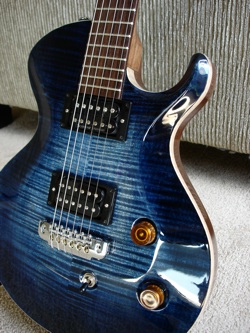
SAINT Guitar Company - Faded Blue Jean Benchmark Guitar

Saint Guitar Company Faded Blue Jean Benchmark Guitar

Saint Guitar Company Benchmark

Summary: Introducing a pure tone machine, with sultry, sexy lines to boot!

Pros: Dense walnut body and maple top give this guitar a natural brightness without sounding “tinny.” Coil tapped humbuckers enable you to serve up a huge tonal palette.

Cons: Nit: Volume and tone knobs are a bit too easy to turn. High-gloss finish on the neck was a little sticky until I got some body oils on it – my personal preference is a satin finish on the neck – this is just a nit as well.

Price: ?

Specs:

  • Reserve Stock Curly Maple Top (“Faded Blue Jean” stain)
  • Walnut Neck and Back (Medium natural stain)
  • High-gloss Finish
  • Koa Headstock Plate
  • High, Wide Frets
  • Handmade Rosewood Nut
  • Rosewood Fretboard
  • Gotoh 510 Tuners
  • Gotoh 510 Bridge
  • Neck Pickup: Seymour Duncan SH-2 Jazz (coil tapped via Volume)
  • Bridge Pickup: Seymour Duncan SH-12 Alnico II Pro (coil tapped via Tone)
  • Master Volume/Tone knobs.
  • 25 1/4″ Scale

Now I know how a guitar made to my specifications plays and sounds! If you’ve read this blog for any length of time, you’ve known about my relationship with Saint Guitar Company, a little manufacturer in Fresno, California. A couple of months back, Adam Hernandez (luthier) contacted me and asked me to spec out a guitar he was making for inventory. The body and neck woods were already picked out, but he said I could spec the rest. I finally got the guitar this past Sunday, and have had a hard time pulling myself away from it!

This is simply a pure tone machine. Unplugged, the resonance and sustain are simply incredible. All the pieces are pressure fit together (Adam claims the fit is so tight, he doesn’t even need glue – though, of course he uses it). 🙂 The net effect is that the sound waves just resonate through the tone woods, and produce a wonderfully rich tone that you can get lost in for days. Then you plug the guitar into an amp, and you have to catch yourself for fear of fainting – the sound is so incredible. But enough flowery phraseology. Let’s get into some particulars!

Playability

Adam likes to make his fretboards wide, but he compensates for this by not making the neck cut too deep. The end result is an extremely fast neck. In fact, when I gigged with it, I was able to move around the neck so easily that I was messing up! Mind you, this was not a bad thing because I was able to relax my left hand a lot, and play with ease. Add to that the tactile feel and feedback of a rosewood fretboard, and you’ve got one playable guitar.

The fretboard also features wider and higher fretwire, with nice, wide frets. Talk about being able to dig in and create ballsy vibrato! OMG! It’s simply insane!

From the standpoint of the right hand, controls are super easy to reach, and I just love the position of the pick selector! Switching pickups was literally as simple as reaching out with my pinkie – the same with the volume knob; though I did mention in the summary the volume knob is a bit too easy to turn. In the middle of a fast riff, volume adjustments are not easy when they’re that easy to turn. You almost always adjust too much!

An interesting thing I discovered with the guitar is that pinch harmonics were extremely easy to generate on any string – even the first and second strings. While I don’t use them much, I was amazed at how easy I was able to generate them.

Finally with respect to playability, I was afraid that with the walnut body and neck that the guitar would weigh a ton. To my overwhelming surprise, this was not the case. It wasn’t as light as my Korina Explorer, but it was way lighter than my Strat. Just a real comfort hanging from my shoulder strap!

Sound

As I mentioned above, this guitar is a pure tone machine. The tone was a bit brighter than I originally expected, but it was bright without being too trebly. The SH-2 Jazz in the neck position produces rich, deep cleans, and amazingly gritty, growly grind, while the APTL-1 Alnico II Pro in the bridge position can produce ringing cleans to gnarly drive. My favorite position is the middle position, which produces a gorgeous, complex, chimey clean tone, and serves up a nice, smooth drive when you have the master volume dimed. Speaking of the volume knob, this guitar is extremely responsive to volume knob changes, cleaning up nicely around 3 or 4, then adding progressively more grit as you turn up.

Interestingly enough, played through my Fender Hot Rod Deluxe, this is the first guitar I’ve played with that amp that really sounded great in my drive channel. Normally, I just keep the amp in its clean section and add grind via my Tube Screamer and OCD. But for some reason, the guitar played through my clean channel sounded kind of hollow. Once I switched over to my drive channel, my power tubes just sang!

As far as pedals are concerned, the guitar produces enough grit so I only had to use my Tube Screamer set to about the 12 o’clock position for the drive once I reached unity gain (around 9 to 10 o’clock). If I chained my OCD, the tone became way too dirty, so I just used my OCD as a booster for when a song went into a lead break.

I mentioned above the copious amounts of sustain the guitar produces. With the Tube Screamer, I was able to achieve practically over-the-top sustain; especially in the upper registers where it really counts. In one lead break, I did a bend/vibrato at the 18th fret, and leaned back with pure joy from how the guitar just sang as I bent and wiggled the string. It really was an ecstatic moment.

October 22, 2008 Follow-up: As Chris pointed out, the bridge pickup is an Alnico II, not a Screamin’ Demon as I originally worte, so I wanted to refine the sound section above. This guitar is definitely NOT a guitar made for heavy metal. When I spec’d the guitar, I had a blues/classic rock guitar in mind, as that is the style of music I write and play. I was a bit surprised when he told me it was Screamin’ Demon, because that is a fairly high-gain pickup, but hey, it’s all about tone, and to my ears, it really didn’t matter what pickup was in there: It sounded GREAT! But I do want to be accurate… In any case, my original description still stands.

As a pickup for doing the style of solos I play, the Alnico II Pro is simply amazing. I have to admit that I’ve never been one to use the bridge pickup by itself for leads because almost all the guitars I’ve had just sounded way too thin for my preferences. And while in the bridge position the Alnico II Pro does register a more trebly sound, it’s not thin sounding; it’s VERY complex, and it sustains for days! I just loved digging in and letting a note wail away!

As for the SH-2 Jazz, it’s hard to describe the sound it produces. The clean tone is simply magnificent; rich and thick and well-balanced between all the frequencies; almost like a cup of pure Kona coffee: Not light, not dark, and not even right in the middle. It’s really a conglomeration of different flavors all served up at the same time. Nice.

Wrapping It Up

Granted, a guitar like this isn’t for everyone – even for me. I just can’t afford the money to pay for something like this. But to have the honor to test it, along with having a guitar that was made to my specifications, what can I say? It looks like I’ve got to mortgage my house to get this friggin’ axe! 🙂 Seriously though, there’s nothing like playing a custom-made guitar, and if you’re in the market for one, Adam Hernandez and the Saint Guitar Company will make your guitar dreams come true.

Read Full Post »


Like most people, I’m intrigued by controversy – especially when it has to do with our beloved instrument, the guitar…

Les Paul is generally credited with creating the first solid-body electric guitar he called “The Log,” though it was Leo Fender who made the solid-body electric guitar available to the masses through mass production with the “Fender Broadcaster.”

Interestingly enough, there’s a lot of controversy that surrounds just who actually invented the solid-body electric guitar, some documented, and a lot of it not. I’m going to stir the pot a bit here, and share something that I just heard this morning from a friend of mine.

Every morning before heading off to the office, I go to a local coffee house to go through e-mails and review my day’s calendar. By the time I finish that, a couple of friends usually join me and we shoot the breeze before we all head into our respective places of work. This morning, I brought along the guitar I spec’d out for Saint Guitar Company (don’t worry, I’ll have pictures and a full review in the next couple of days…) to show my friend Phil from Phil ‘N The Blanks, a local cover band here in the Sillycon Valley.

Phil and I were discussing the guitar, when our friend Kim sat down with us. She noted the beauty of the guitar, and said, “Hey! You wanna know a cool story?” And she then recounted a tale of how her grandfather, Kenneth Clark, had known Les Paul back in the day, and had shared with him his ideas behind building a solid-body electric guitar. Soon after, Kenneth contracted a disease that left him in quarantine for five years! Yikes! But during that time, Les apparently ran with the idea, and successfully created what is generally recognized as the first solid-body electric guitar.

Who knows whether or not this is true? None of this is documented, but it sure stirs the pot, doesn’t it? Of course, let’s not take anything away from the venerable LP. Without him, we wouldn’t have multi-track recording or reverb. Even Leo Fender is accused of stealing ideas for creating the Broadcaster, but he created an industry where none had existed. Is this an apologia? Not really. But it does go to show that the people who are attributed with inventing something usually are the ones who’ve gotten their invention to the public first.

Read Full Post »

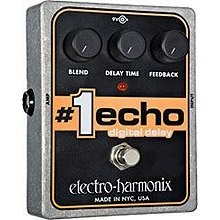
Electro-Harmonix #1 Echo

Electro-Harmonix #1 Echo

Over the years, I’ve had a love-hate relationship with delay pedals. My first taste of delay was an analog EchoPlex in the early 80’s. But focusing on acoustic guitar – actually only able to afford an acoustic guitar – at that time, I didn’t see the need for a contraption like that. Then U2 and The Edge entered my musical radar a couple of years later in the early eighties, and I of course had to get a rig where I could use a delay. So with what little money I had, I purchased a 25 Watt Roland amp, a Boss CE-2 Chorus, and a Boss DD-3 Digital Delay.

Little did I know that you had to have some technique to play like The Edge, and I quickly became disenchanted with trying to play like him. I just didn’t have the technique nor experience! So I held onto the amp, kept the CE-2, and sold the DD-3. I’m kicking myself now for getting rid of the DD-3 as it was a “Made in Japan” model that still had some hand-wired circuitry that makes it much-sought-after delay. Oh well…

Fast-forward to today, and I’ve owned several delay pedals. Again, the operative word is “owned,” because I don’t have one now. But I do have the technique, and I’m thinking that some of the stuff I’m writing could actually use some delay. Enter the Electro-Harmonix #1 Echo.

I’m normally a little leary of EH pedals, but this one seems promising, at least from the reviews I’ve read and the sound bites I’ve heard. Reviews are generally pretty good, but one thing’s for certain: All this thing does is delay. It doesn’t do any modulation or phasing. It just delays, and that’s exactly what I’m looking for! I’m going to have take one out for a spin, but it certainly seems like it will serve the purpose. And for a $99, it’s certainly not a huge investment. Let’s look at features:

  • True bypass (Yowza! that’s cool)
  • up to 2 second delay
  • Wet/Dry Blend for blending the amount of dry and wet signal – very cool
  • Feeback control – kind of like decay

Check out the videos

Read Full Post »

I’ve spent the last 30 years or so learning how to play guitar – and I’m still learning. Over time, I’ve acquired, or I might say, stumbled upon various techniques that I made part of my playing, and I’ve recently started to share what I’ve learned; that is, I’ve started teaching guitar. I’ve been informally teaching guitar for a number of years, showing various folks how to do this and that, but just recently started doing formalized lessons (read: I’m getting paid now… 🙂 ). Admittedly, it has been a bit of a scary thing. Not having taken a single guitar lesson in my life, I didn’t know if my approach to teaching guitar was going to work. But to my overwhelming surprise, I’ve found that I’m not too bad at it, and my students seem to respond well to what I have to share.

Mind you, this isn’t a plug for taking me on as a teacher by no means; especially if you’re already an accomplished guitar player. I’m only taking on beginning to intermediate guitar players. Besides, my approach might seem a bit cockeyed as I focus less on technique and more on developing musicality. But I digress. The point of me sharing this is that I’m really jazzed at the prospect of teaching! To me, it’s incredible to see the progress people make and it makes me feel good that I can play a part in that. It’s not an ego thing: I truly want my students to develop the same kind of love (or some might call it obsession) I have for the guitar, and it’s very cool to see them gain that as they learn new things.

I can now understand why teachers love what they do. There really is nothing like the satisfaction of sharing what you know, and having people delight in that knowledge. If you’re an accomplished player, I highly recommend sharing your knowledge if you have it in you to teach!

Read Full Post »

SAINT Guitar Company - Faded Blue Jean Benchmark Guitar

SAINT Guitar Company - Faded Blue Jean Benchmark Guitar

I’m honored. I’m awed. Completely dumbstruck. Adam Hernandez from Saint Guitar Company e-mailed me yesterday with the news that he finished the guitar that I spec’d out for him. It’s not my guitar, but most everything I specified is on there. I’ll have a full update on the guitar, replete with pictures in the next day or so, but I just couldn’t wait to talk about it!

In any case, look at the finish! It’s absolutely gorgeous. Real quick though, this is a solid walnut body with a flame maple top. It has a rosewood fretboard and a koa headstock. Like I said, I’ll have complete specs in the next day or so. I’d list them all out here, but I’ve only got a limited amount of time. For more info on Saint Guitar Company, visit the web site.

BTW, I’m working on a new look for the Saint Guitar Company site. I’d love your feedback!

Read Full Post »

Jacques Overtube Vintage Pro Overdrive Effects Pedal

Jacques Overtube Vintage Pro Overdrive

The Dawg likes to sniff around for new and interesting gear all the time. Unfortunately, I don’t always have time to write or test stuff out. But I do love it when I come across some potentially awesome gear, and I take the time to share it here. The Jacques Overtube Vintage Pro Overdrive most definitely fits the bill in that department. By the way, think “Jacques Cousteau” when pronouncing the name… 🙂

The Overtube is supposedly a faithful reproduction of the original TS-808 Tube Screamer circuit. Now you might be thinking, as did I, that that is nothing special. But what is special about this pedal is that little toggle labeled “CASC” between the Tone and Drive knobs. “CASC” stands for “cascade” and it’s meant to simulate running two TS-808 pedals simultaneously ala SRV!

Check out this video on Guitar Player TV. I’ll be damned if that pedal doesn’t do a Tube Screamer exceptionally well! And with the cascade on, this pedal sounds sweet as can be with lots of thick mid-range wail!

As many of my readers know, I’m a big fan of the mid-rangy kind of drive distortion, so I’m gonna be hard-pressed not to give this pedal a whirl.

It’s a steal at $139!!! Check it out!

Read Full Post »

Sorry, but sometimes I just have to vent. I know lots of dudes who call themselves guitar players who are just wankers in disguise. They’re wankers because they have some kickass and expensive gear, which they don’t hesitate to let you know how much they spent, but they couldn’t play it if their life depended on it! Sorry, but it kind of grates on my nerves because when I run across a wanker, I find myself thinking, “Damn! If I had that guitar, I could make that bad-boy SING!” Maybe I’m crossing the line here of being the supportive web site host, into a petulant and honory SOB, but even though I realize that I’m not the greatest guitar player in the world, at least I can play my friggin’ axes and make some decent sounding music!

To me, a great guitar or amp will just help inspire me to explore tonal landscapes I haven’t been to before; and help me express my music to an even greater degree. And a great piece of gear is like having an expensive screwdriver from Mac or Snap-on Tools. Functionally, it’s no different from the cheap one you can buy for a buck ninety-nine at the corner drugstore’s hardware department. But that good screwdriver makes work so much easier because so much care and consideration were put into making that tool work so much better for the job, with high-grade materials, and ergonomic design. But wankers really don’t know the difference. They just think that expensive must be better. But so many great players have proven you don’t need the expensive gear to create a good tone (think Eddie Van Halen, Willie Nelson, etc). With a wanker, it doesn’t matter what they play: They still sound bad!

I know, I’m being really harsh and probably incredibly arrogant, but I get sick and tired of wankers who insist on playing the “my dick is bigger than yours” game with their bankrolls. Show me you can play that thing, and maybe I’ll show you some respect. In the meantime, keep your mouth shut, and learn how to use your gear!

Read Full Post »

I got so inspired by the Greg Howe video I posted here the other day, that I recorded a Jam Track to Sunny that I could jam to… I had A LOT of fun with this one… Check it out!

http://www.icompositions.com/music/song.php?sid=96867

Read Full Post »

Ibanez Jemini Distortion Pedal

Ibanez Jemini Distortion Pedal

Does the guitar playing world need yet another distortion pedal? That’s almost like asking if your town needs another Starbucks. Hmmm… maybe that’s a bad analogy because while we could probably do without yet another coffee commodity, I for one don’t ever mind seeing another distortion pedal hit the market.

And just when I thought I’d heard all the variations of distortion around, and that not much else could be done, along comes Ibanez with yet another mind-blowing distortion box, designed by none other than one of my guitar heroes, Steve Vai. I gotta admit it: I’m really impressed with this latest offering from Ibanez – at least as much as I was impressed with the Vox Satchurator. Don’t get me wrong; it’s not because of Steve Vai, or because I’m a Vai wannabe. It’s because there’s something about a great distortion sound that evokes a visceral response inside of me. It’s hard to explain. So I’m more than pleasantly surprised about the Jemini because it produces a GREAT distortion sound; at least from what I could tell from this video starring Steve Vai and Steve Vai – you’ll get the joke once you watch it:

Leave it to Steve Vai to not only demonstrate his mastery over the guitar, but the eternal showman manages to make the video a joy to watch. I was laughing my ass off at his antics! He’s so likeable!

Okay… now for a reality check… I really would like to get this pedal, but at $199, it’s a bit out of my price range right now. But being two distortion pedals in one for that price, it’s a hundred bucks a pedal. That’s actually not bad at all. But I have to admit, I have my sights set on a Satchurator right now. I kind of go for the more mid-rangy type of distortion. But I’m not going to let that keep me from taking one out for a spin.

On a final note, what’s been really great as of late is that big-name gear manufacturers are finally producing what could be considered boutique-type pedals. Having played with the Satchurator, that thing is built like a tank, and it just kicks ass. The Jemini appears to follow suit of well-made, gig-worthy quality. That’s very pleasing to me, because I’m a big proponent of getting great sound without breaking the bank.

Read Full Post »

I don’t plug other web sites often, mainly because there are so many out there, it’s difficult to keep up. But a new site, called TonePedia is so interesting in its concept, I just had to share it! The basis of the site is for members to share the tone of their rigs through sound bites they share with the community. Want to know what an LP sounds like through a Crate amp? It’s there on the site.

What a cool idea! Check it out! I’m going to post a few samples myself! Er… Once I find some time… 🙂

Read Full Post »

« Newer Posts - Older Posts »