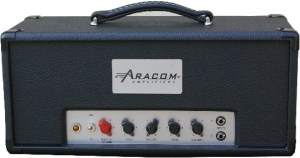
This morning, the guy who’s painting my house came into my garage/studio to ask me a question, and being a guitar player himself said, “Dude… you have a great setup.” So the conversation turned to my favorite topic, and of course, that involves talking about guitar gear. 🙂 During the course of our discussion he talked about how he loves Vox amps, and so I demonstrated my Aracom VRX18, which is actually based upon a classic Marshall 18 Plexi, but it had EL84’s. I wanted to give him a reference tone. He just smiled and said, “That’s yummy.”
He had to get back to work, but after not playing that amp for awhile (probably a couple of months), I forgot how much I love its tone. My VRX18 is quite special in that it’s a custom VRX18 that has a tube rectifier, which is an option when you get one of the VRX series amps. Jeff has it tweaked quite nicely, and the amp has tons of sustain, and gorgeous sag without getting mushy and compressed when driven. That’s probably a reason why I haven’t really used EL84 amps that much. My experience has been that they compress a lot when they’re driven hard.
But not this one… Jeff also adjusted the extra gain channel so it wouldn’t compress the power tubes too much. You get lots of dirt, but you maintain the clarity of your notes. This is a great little amp! In any case, I recorded a clip where I have the Master at 3 o’clock, and the Volume at 2 o’clock. That produces some serious grind, but as you’ll hear in the clip, there’s very little compression.
The drive tone the VRX18 produces is absolutely magnificent! When I recorded the clip, I couldn’t believe all the overtones and subtle harmonics that the amp was producing! Jeff really got the tone nailed with this amp!
In addition to the amp, I played through Goldie, running her straight into the amp, then through the insanely transparent PRX150-Pro attenuator set at variable attenuation mode at about 3 o’clock, then into a custom Aracom 1 X 12. Output volume was just yelling level. 🙂
Here’s a list of the Aracom VRX18’s features as a review:
– Channel 1: Volume and Tone Controls
– Channel 2: Volume and Tone Controls
– Master Volume Control (PPIMV)
– On/Off Switch
– Indicator Lamp
– Hi/Low B+ voltage switch (18/9 watts)
– (2) EL84 Power Tubes
– (2) 12AX7 & (1) 12AT7 Preamp Tubes
– Cathode Biased Power Tubes
– S.S. Rectifier with “sag” circuit
* EZ81 Tube Rectifier – Optional
– Custom Heavy Duty Aluminum Chassis
– Custom “Black” Plexi Front and Back Panels
– ARACOM Power Transformer: hand-wound and interleaved
– ARACOM Output Transformer: hand-wound, interleaved on a paper bobbin
– 4, 8, 16 ohm Speaker Jacks
– Detachable Power Cord (IEC320-C13 Socket)
– External Fuse Holder
– Custom Turret Board (G-10/FR4 Flame Resistant)
– Handwired and Handcrafted in the USA.
This little tone beast is such a value as well! At $895 for the head, it’s an absolute steal, and a real hidden gem in the boutique market, as is the VRX22, which is based on 6V6’s.
Last Friday before I left for work, I went to my garage/studio to fetch my trusty acoustic guitar for my weekly solo acoustic gig, and I couldn’t find it! After a bit of searching, I finally found my guitar – buried under a pile of stuff my wife had taken out of her van! OMG! I unpiled the stuff rather unceremoniously, picked up my gig bag, opened it up, and pulled out my acoustic. Upon initial inspection, nothing seemed amiss. But when I strummed a chord, I could hear a slight buzz issuing from inside the guitar. I shook it to see if something was loose, but nothing rattled inside the body, which led me to believe that the weight of the stuff on the top of my guitar was sufficient enough to loosen up the glue to one of the bracing spans. That’s fixable. I could live with the buzzing if it didn’t show up when I plugged in the guitar. So much for my rationale. The buzzing was even worse when I plugged it in, as the vibrations from the top were transmitted to the under-the-saddle pickup.
Surprisingly enough, I didn’t freak or get pissed off at my wife, partially because the fault was mine for placing it in an area where that could happen. But I had a gig that night, and I had to figure out something – and fast! To make a long story short, I ended up buying what has turned out to be a surprisingly versatile value-priced guitar from Fender, the Stratacoustic Deluxe. I recently wrote a review of this guitar, so I won’t go into details. But after I bought it, the thought occurred to me…
Is it really a case of GAS, when you have an obvious need?
Part of me says that I just acquired more gear, so it’s technically GAS. But the other part of me says that I was replacing a critical component, so it’s not GAS.
In any case, I’m very satisfied, but thought I try to get some feedback. Your thoughts?
I’ve spoken about him before, but Mark Wein of Mark Wein Guitar Lessons really knows his stuff, and I’ve gotten a lot mileage from his free video tutorials. One set of tutorials that I found as a real useful review, plus learning some new stuff as well, is his series on Partial Chord Shapes. Really great stuff!
I’ve been on this blues thing lately with my music; not going all out with the blues, but definitely having a huge blues influence on the music I write. But one thing that I was sure of was that I didn’t want to just learn blues licks – the same licks practically everyone plays. I suppose you could say I want to play with a blues style, and I’ve been searching far and wide to learn the blues. In my search to learn the blues, I’ve come across several instructional series and video tutorials, but many focus on playing blues licks, without really getting into learning or more importantly, acquiring a vocabulary to express the blues. Technique I can learn, but really what I want to acquire is an intellectual “sense” for what works in a particular phrase, if you catch my drift, then learn technique as a secondary thing.
I know, a bit confusing, and I’m having a hard time articulating what I’m after, so I supposed the best way to explain it is that I want to intellectualize my playing, then practice the hell out of what I learn. The only problem with this approach is that once I’ve mentioned that to teachers or others, they jump right into modal theory. Sure, that’s really useful, but in many ways, it’s also really abstract. Enter Chuck D’Aloia, who has come up with a wonderful series called “Blues with Brains.”
Blues with Brains is a two volume set. I’ve only gotten through half of the first volume so far, but what I’ve learned in just this short amount of time has really made me leap light years ahead in how I approach doing solos. I’ve always played by feel, and have fallen back a lot on the minor blues scale – mainly because it’s easy. But after I wrote my last song, I realized that while it sounds pretty good, and I have some interesting ideas, there was part of me that knew I could do so much more with it.
And by pure chance, I happened to read a thread on a popular guitar forum where this dude was demonstrating his new MIM Strat. His technique was absolutely flawless, and his presentation and tone were simply to die for! So I clicked on one of the links in his signature, and came to this site: Chuck D’Aloia Music. I read through the explanation, and saw that he also did Skype lessons, so I immediately contacted him about taking his lessons. In my email I explained about how I felt I could do more with my music and attached my latest song. He replied back several days later with exactly what I was thinking that ideas and tone were good, BUT rather than jump into lessons, I’d get a lot more out of his Blues With Brains series. It would be stuff that I could learn at my leisure, and once I digested the material, then we could explore the Skype lessons.
How cool was that? Rather than taking the higher money route, he just pushed his video series. So I downloaded both volumes for $40. When I got home that evening, I launched the first volume, and within the FIRST FIVE MINUTES, Chuck had effectively changed the way I looked at playing solos! That’s all it took! Obviously, I’ve had to apply and practice those concepts as I don’t have the fingering down completely, but the mere fact that I was able to attain a sense of what to do in a relatively short amount of time was just amazing to me!
Chuck’s approach is simple. He plays over a chord progression first. Then he takes apart the progression, and discusses and demonstrates what is possible to do at that particular point. The cool thing is that he also intersperses modal theory into the explanation, but doesn’t make the central to the discussion. It’s like, “Here are the notes you can play, and here’s what you can do with these notes…” It’s a very straight-forward approach, and while I realize I have a lot of practicing to do, I’ve gotten more out of the 40 minutes I’ve spent so far in these lessons than I have poring over books of scales and modes. The most important thing that I’ve gotten out of these lessons is that Chuck doesn’t teach licks. What he teaches is possibilities. He leaves it up to the student to express themselves! That is EXACTLY what I have been after all these years!
Without a doubt, I’m a total believer in Chuck’s series! If you want to learn the blues, and not just blues licks, and you want to really understand what you’re playing, you owe it to yourself to get this series. You will not be disappointed in the slightest!
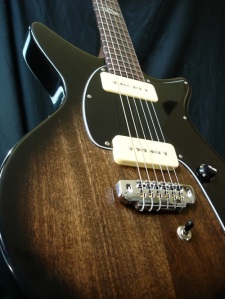
A few days ago, I announced the new Vintage Series model from Saint Guitar Company. At the time, Adam sent me pictures, but few details, so there wasn’t much to report on. However, I’ve since spoken with Adam, and was able to get some juicy details on this guitar and his vision for the Vintage Series.
This first guitar sports a solid mahogany body and neck.
The pickups are Seymour Duncan Vintage p-90 Soapbars.
Rosewood fretboard with Saint Logo on the 12th fret.
Volume and Tone knobs, and a Three-way pickup selector switch.
Dark burst finish (natural stain to black)
Custom, flush pick guard.
Here’s the best thing about this guitar: It will range in price between $1300 and $2300, significantly less than Adam’s Benchmark and Messenger models which start at $3300 and go up from there. That in no way means lower quality. Said Adam of the price, “I still make the guitars by hand with custom templates and jigs, but the difference is the flat top. Because I don’t have to shape a carved top, the guitar is a lot less labor-intensive to build. Also the dark burst finish is a lot less time-consuming as well. So because I’m saving on time and labor, I want to pass that savings on to my customers.”
Since I already have a Saint Guitar, I know this will be special. I should be getting a test drive of this baby in the next few weeks. I’ll keep you posted!
Fridays are solo gig days for me where I play at a restaurant doing a variety of tunes on both piano and guitar from the Beatles to Puccini (opera, that is). My shtick has been the ability to perform a variety of styles and genres of music, and for the classic rock, folk and country stuff I do, the guitar has been an integral part of my act.
As you might now, if you’ve been to my rig page, you’ll see that my acoustic has been an Ovation Celebrity Elite. I’ve been playing that guitar pretty much continuously for the past 16 years. That guitar’s been on the road with me and in the studio, and has always had a special place in my heart… until yesterday…
I won’t go into the particular details about exactly what happened to “Sunset,” but suffice it to say that she got a crack somewhere under her top that didn’t have a bad effect with her unplugged, but became very magnified once I plugged her in. Not good. I found her in this state yesterday morning (Friday), and while I didn’t freak, I knew I had to solve the problem! So I called the wife to explain the situation, and since I had to own up to putting the guitar in a place where she could get a crack – however inadvertently – I shared that I’d pay half for a new guitar out of my gig money.
I wasn’t too hopeful about finding a new guitar yesterday, considering the acoustic guitar store that I was originally going to go to mainly dealt with high-end acoustics; right, big money. But a chance call to B Street Music in San Mateo, CA where I work as I was leaving changed all that. I called them up to see if they carried Ovations, thinking that I’d just replace Sunset with another Ovation, and they said they carried them! Yippee!
Anyway, I got to the shop and started pulling guitars that looked pretty cool off the racks, and lining them up on guitar stands so I could do evals. Among them were a couple of Ovations Celebrities, a Godin (very nice looking), and the Fender Stratacoustic that I ended up buying. Mind you, I wasn’t at all interested in how the guitars sounded unplugged, though I love the Ovation acoustic sound. Since I use practically all my guitars in gigging situations, I really needed a guitar that sounded great plugged in.
As expected, the Ovations performed incredibly well. There’s something that Ovation has down with their electronics. After I tested the Ovations, I plugged in the Stratacoustic – it didn’t work. Luckily, it was just the battery that was out. Once I had it all set up, I took a few minutes to familiarize myself with the guitar. It really didn’t take that long because what I felt I was holding was an acoustic Strat! The Stratacoustic features a shallow acoustic body with a Strat neck, so from a feel standpoint, it felt completely familiar. I closed my eyes and felt as if I was playing my trusty “Pearl!”
The dude at the shop was helpful, and explained that the guitar was equipped with a Tele single coil, and a Fishman acoustic which you could blend with the Blend slider on the control panel; speaking of which, the control panel features independent controls for Bass, Mid, and Treble, a Volume slider, and a Blend slider. It also has a pretty decent built-in tuner. Nice features for sure!
Mind you, I was still a bit dubious of the acoustic sound of the guitar. It was flat and tinny, and was something I’d never play unplugged. Here are the sales guy’s own words, “Don’t be fooled by the acoustic, unplugged sound. It sounds like shit. Just wait till you plug it in. Fender’s done something really special with this guitar.” Yeah, right, I thought. It’s production line Fender after all! But I’ve learned to keep an open mind with respect to new gear.
Anyway, after I got familiarized with the controls, it was time to plug her in. So I plugged her in and WAS IMMEDIATELY FLOORED BY THE TONE! I had the Blend set dead in the middle, with both pickups contributing to the overall sound. Kind of hard to describe what I was hearing but it truly was a mix between an acoustic and electric; rich in mids, and not too much bass, but with a chimey, top-end finish. The Fishman provided a nice, organic acoustic tone, while the ring and chime I was hearing had to be coming from the Tele pickup. I proved that out by isolating each pickup.
I played through it for a couple of more minutes, and then turned to the guy and said, “Sold.” He just smiled… Not because he got a sale, but because he shared that as a Strat player himself, this was a total unsung hero in the shop. I commented that the guitar had a bunch of fingerprints all over it, and there was a tiny, tiny scratch on the top near the bridge, so would he give me a deal for it? And he did! I got the guitar for $499 plus a gig bag and a nice 3.5″ wide leather strap! The guitar normally retails for $629! Was I jazzed or what?
So now I am the proud and exceedingly happy owner of a very weird, but full of Strat mojo guitar, the Stratacoustic!
Gig Report
Of course, as I started today’s story, I had a gig last night. The real test for any device is playing it in a live situation. So how did it do? In a word, FANTASTIC!!! As I mentioned, each pickup contributes to the blend, and even though the guitar sports a Tele pickup, with the Tele pick isolated, the guitar still retains its acoustic qualities. So the gig for me last night was utter heaven! Plugged into my DigiTech Vocalists Live 4 then right into the PA, I was amazed at the incredible tones this guitar produces.
How It Sounds
I was going to end this article with my gig report, but I got inspired to record the guitar and provide a clip. This is a short song that I quickly put together that features the Stratacoustic. The left channel is a fingerpicked rhythm. Then in the right channel, I layer the same riff but strumming – it almost sounds like a piano! Nice. I used a light reverb effect on both rhythm parts using my Hardwire reverb. Then I do a solo dead center with the guitar in the Tele position, and playing it through my KASHA Overdrive in the Classic channel to get a real nice, slightly dirty Strat tone. Almost forgot to mention: I played all the parts through a regular amp, my Aracom VRX22! It is absolutely amazing how natural and organic this guitar sounds through a regular amp! I’m in heaven! Anyway here’s the clip:
Excuse the 60Hz hum from the single coil in the solo… 🙂 I wasn’t turned the right way to eliminate it while I played… 🙂 The guitar was recorded through a miked amp! The rhythm sounds are unlike anything I’ve ever heard plugged in! At least to me, it sounds as if I miked the guitar, then added reverb in production. But in reality the guitar was plugged into my board! I just can’t get over the plugged in tone of this guitar! And the Tele pickup is just to die for!
If you’re looking for a stage acoustic that sounds absolutely KILLER plugged in, look no further. You get all the benefits of the feel of a Strat, but in an acoustic, but you can also use this thing as a straight electric as well by just using the Tele pickup! Simply amazing!
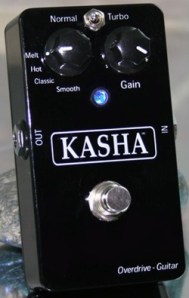
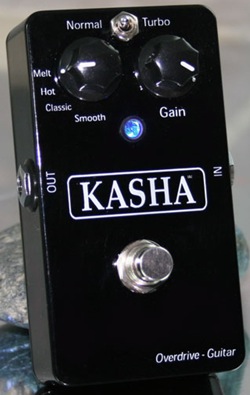
I finally got some time to record a couple of clips of the absolutely wonderful KASHA Overdrive tonight, and I am just so blown away by how it sounds! This little box is like having 4 differently voiced amps in a little box! I’m not going to spend too much time praising it because I’ve already done that a couple of time here, so let’s get into the clips, shall we?
The first clip is slow, slow blues clip in Am. The chord progression is actually adapted from one of Chuck D’Aloia’s “Blues With Brains” video lessons. If you’re looking to get more into the blues, I highly recommend this set of lessons. It’s the best $40 bucks you’ll ever spend! In any case, I used the chord progression to test out the KASHA Overdrive, and to practice some of the concepts I learned tonight.
Anyway, there are two parts to the clip. The rhythm part was recorded with the KASHA Overdrive in Smooth with the gain set at 12 o’clock. This acts just like a clean boost, and at 12 o’clock it’s at unity gain. The first part features the Classic “channel,” and the second part features the Hot channel. Give it a listen:
The second clip has no backing track, and features the Melt channel with a simple chord riff. Excuse the sloppy playing, but instead, focus on the articulation of the notes. I had the Gain pushed up to about 3pm, which is almost all the way up. But even at a really high gain setting, you can still hear the individual notes. THIS IS AMAZING! And man, the touch sensitivity in this channel is to die for!
By the way, both clips were played through the clean channel of my Aracom VRX22, and recorded at conversation levels using the incredible Aracom PRX150-Pro attenuator. To me, this is the absolute king of attenuators. Oh! Almost forgot that I used my beloved Goldie to record the clips.
It is totally weird not having a case of GAS right now. Since 2007, when I first started this blog, I’ve been GAS-ing. Not a week would go by without me getting some kind of gear. But since I purchased my KASHA Overdrive a couple of weeks ago, and finally started using it, I haven’t had any serious case of GAS.
Mind you, that doesn’t mean that there’s not gear that I don’t want to get. For instance, I’m still going to get a TC Electronic Nova Repeater, and I’m working on the design of a new amp that I would like to have built for me. But I don’t have that uncontrollable urge to reach into my pocket and pull out my bank card to get some gear. I’m much more calm, and for the first time in a long time, I’m not in a rush to get that other gear.
But I think that’s the disturbing thing. I’ve had this GASeous urge for so long that I’m in kind of unfamiliar territory. F&$k!!! It’s like having nicotine withdrawal symptoms! I’m not used to this. But I can tell you, my bank account is thanking me right now…
When I wrote my original announcement of the Skull Crusher, it was absolutely brand new, and not surprising at all, it was met with a mixed response. But as I mentioned in my announcement, get beyond the looks, and this pedal is a KASHA overdrive with an EQ knob, and I LOVE how that sounds. Apparently, so do the guys from Ratt, as shown in this video taken over the weekend at the Jack FM 2009 concert in southern California this past weekend:
And here’s a video of the VERY talented PhilX playing the Skull Crusher live and doing a demo in the studio:
Lots of guys panned the look of the pedal, but I think it looks incredible! And knowing that it has the absolutely wonderful KASHA overdrive guts makes this pedal a winner in my book.
OMG!!! Just gigged with my brand-new KASHA Overdrive last night, and I was in tonal heaven! Even though I’d done a pretty good test on it in my original review, there’s nothing like using gear in a live situation. So here are my observations:
Incredible Dynamics – The one thing that is readily apparent is how this pedal responds to pick attack and volume knob changes. It is so amp-like, it’s uncanny! I set the pedal up in unity gain with just normal strums on my guitar. But if I dug in a bit more, the pedal responded just like an amp with a bit more punch and volume. Frankly, the volume swell surprised the hell out of me. It’s not huge, mind you, but the response is so amp-like, it really does take you by surprise. I totally dug that while gigging last night!
Plays Well With Other Overdrive Pedals – I love stacking overdrives, and the KASHA OD performs beautifully in this role. I set it up as a based OD pedal, then stack it with my Tone Freak Effects Abunai 2. Those two together are an awesome combination!
Lots of Tonal Variety – While my favorite channel on this is the Classic channel that adds a chimey mote to your tone, I also played in the Hot channel as well, and the grit and grind was super-sweet. But add to that the dynamic response of the pedal, and what you’ve got is a pedal that has a lot of inherent tonal variety. Last night, I ran it mostly through the clean channel of my amp. But later, I screwed around with it a bit more in my studio, with my amp set at the very edge of breakup. This is where the pedal just warms my heart! With its touch sensitivity, when my amp is set up at the edge of breakup, I can take my tone from gritty and grimy to sweet and chimey with just a touch of dirt simply by modifying my attack or adjusting my volume knob.
Open Distortion Characteristics – No matter what channel you use with the KASHA Overdrive, the overdrive never gets compressed. It just gets dirtier. The cool thing about that is that any kind of compression will then come from your power tubes. I’ve rarely liked that compression in pedals, save for my Abunai 2, which compresses in a very pleasing way, but for most overdrive pedals, I don’t want that at all, and thankfully, the KASHA Overdrive remains very open, no matter how hot you go on the channels.
Simple Design – Probably one of the best features of this pedal that I appreciate is its straight-forward design. Notice that it doesn’t have an EQ control. It doesn’t need it. It takes your signal, adds a voice to it, and that’s it! Set your EQ on your guitar and/or amp to where you want it, then set the gain knob on the pedal, and just play. What could be more simple?
All in all, I’m pretty much done with my search for an overdrive pedal. I knew it from the first time I played this; and combined with my other OD’s, I can pretty much say – at least for quite awhile – I’m set in the overdrive department!
I’m an overdrive pedal freak, and I can safely say that this is the best overdrive pedal that I have ever played! It’s hard to believe that this little black monster does what it does. I’m totally blown away by it, and I’ve only gigged with it once! I can’t wait to really start using it in all its modes!

 A few days ago, I announced the new Vintage Series model from Saint Guitar Company. At the time, Adam sent me pictures, but few details, so there wasn’t much to report on. However, I’ve since spoken with Adam, and was able to get some juicy details on this guitar and his vision for the Vintage Series.

 Guitar Gear