Feeds:
Posts
Comments

Archive for the ‘Music’ Category

Why? Because every time I satisfy my GAS, they come out with new stuff that gets me GAS-ing all over again, dammit! 🙂 Here I was innocently reading my e-mail this morning when I got Prestige’s latest newsletter that said they were about to release a line of acoustic guitars! Knowing the fantastic stuff they produce, and given that they didn’t release anything more than announcement that they were releasing a new line, I had to give them a call to get more information. I shouldn’t’ve done that. I’m now GAS-ing so damn bad that it’s killing me!

But I got the scoop on these guitars, and before you start thinking, “Yeah, here we go, another import guitar… How good could it be?” Well, let me just say that a major publication already reviewed it and gave their top-of-the-line model a very – excuse the pun – prestigious award. And after I heard the details of these guitars, it’s not a surprise that even before their official release, they already won an award. So here’s at least some preliminary information that I found out…

They will have three guitars in various price ranges. I didn’t get model names, but I did get the makes of each model:

  • The top-of-the-line model has a koa body and koa top
  • The intermediate features a rosewood body and Adirondack spruce top
  • The lowest tier (and only by materials) features a mahogany body and Adirondack spruce top

Though not set, the guitars will range in price from about $1000 to $2100 street, so even the lowest-tier model isn’t anything to shake a stick at; and before you balk at the price, there’s a good reason for the pricing. Prestige didn’t skimp on the features that all three models share:

  • Adirondack spruce X-bracing designed in partnership with Balaz Prohaszka, a well-known European luthier
  • 12″ radius
  • 25.35″ scale length
  • 1 3/4″ nut width
  • D-shape neck
  • Split Bridge Saddles
  • Bone nut, Bone Saddles
  • Ebony Fingerboard, Ebony Bridge, Ebony Bridge Pins, Ebony Strap Pin.
  • Ebony Headstock face
  • Satin Mahogany Neck, Laser Etched Logo and Serial Number behind the headstock.
  • Beveled Cutaway with Paduck inlay, Mother of Pearl Logo, Mother of
  • Pearl Eclipse Fingerboard Inlay, Abalone Rosette
  • Gotoh 501 21:1 Tuners with Ebony Buttons.
  • Paduck/Abalone Body Binding, Paduck/Maple fingerboard binding.

An option for each guitar is the Fishman Ellipse Matrix Blend pickup system. This is a very non-invasive soundhole pickup system that combines an undersaddle pickup with a gooseneck condenser mic. I’ve heard one of these installed in a Taylor acoustic, and it sounds marvelous!

So the pricing is really a reflection in the difference in tone woods used; otherwise, they’re all the same. That is incredibly COOL!

I’d be remiss if I didn’t have pictures, so here are a couple of the Koa/Koa model. These aren’t the pro pics as you can see the reflections of background objects – that’s how glossy the bodies are! Freakin’ awesome!!!

This slideshow requires JavaScript.

These are serious guitars, folks. Can’t you just DIG that beveled cutaway? Damn! I dig little things like that, and the outer bracing is absolutely superb! And another nice touch is the satin finish on the neck. I always prefer that because it allows me to polish it with my own body oils after time. For me, the ebony fretboard is a HUGE selling item! There is absolutely nothing like the feel of ebony; it’s smooth as silk and feels so nice to the touch!

I can’t wait to get a demo into my studio to give it a whirl! I TOTALLY DIG the Koa/Koa! Now do you see why I hate Prestige Guitars?!!! 🙂

For more information, please go to the Prestige Guitar web site!

Read Full Post »

That’s right! As I mentioned in episode 1 of the series, the Dumble can shred, and it sound unbelievable. In this part, Doug talks in-depth of the tonal capabilities of the Dumble amp and demonstrates it versatility by shredding on it!

Read Full Post »

Wow! I didn’t realize how fun doing videos would be! Expect to see more video reviews in the future! In any case, here are some key points:

Tone Bone Rating 5.0
Notes I LOVE this stand! I’m going to get a couple more! Very well built and lightweight, it’s a perfect stand not just for the stage, but also in the studio where its small footprint won’t take up much space!
Price $34.95
Pros Very easy to fold up and lug around
Cons May not work for bass – it works for mine, but fat basses may not fit (this is not really a negative, just a warning)

Read Full Post »

This is a hotly debated topic, and there are great arguments for or against using one. I’m of the former group and have used attenuators to great success over the years. To demonstrate how useful an attenuator can be, I put together a quick video. Here you go:

I wanted to be as non-technical about the usage of an attenuator because there are so many attenuator designs on the market. So I kept this video at a fairly high level. I’ll get into more detail in the next video when I discuss the Aracom PRX150-Pro.

Read Full Post »

Yup, you guessed it… yet another overdrive pedal. I came across this pedal while perusing the forums over at Mark Wein Guitar Lessons. Mark occasionally posts “Pedal of the Day” entries, and this was his latest. I know, lots of people complain about “yet another OD pedal.” But if you stop to think about it, there’s probably a great reason why there are so many OD’s on the market. What comes to mind for me is that no one overdrive can cover everything. Let’s face it, a Tube Screamer or TS-like OD can only take you so far tonally.

Don’t get me wrong: Not all OD’s are created equally. Admittedly, there’s lots of crap out there, which is a fallout of the boutique gear movement. I’ve suspected several boutique gear “manufacturers” of simply building gear based on kits, putting a nice paint job on them, then selling the pedal for hundreds of dollars; which is why I’ve always stressed to folks – try before you buy!

The LovePedal Kalamazoo is no exception to this rule. While it has some very cool features (I’ll list them below), you really never know how a pedal will work with your rig until you put it in your chain. But despite that, I’m really intrigued by LovePedal’s twist on the overdrive with the Kalamazoo.

So what’s to like? As you can see, there are two little knobs called Tone and Glass under the common Level and Drive knobs. I believe this is where the magic of the pedal lies. Tone is a treble content roll-off, while glass is a treble booster that doesn’t affect the lows. These are wired in series, so they interact with each other. From what I could gather from the demo from ProGuitarShops I’ve seen, these two knobs offer up a world of tonal possibilities.

Another thing that appeals to me is that I prefer a more “open” kind of overdrive to let my power tubes do the compression. To me, it sounds more natural that way. The Kalamazoo was designed to create an “open” type overdrive tone. With it, you can slam the front-end of your amp, and make that gain push the power tubes into compression.

And from what I could gather, the Kalamazoo is VERY responsive to input gain, which is demonstrated in the ProGuitarShops video.

Here are the pedal’s features (from the Love Pedal site):

9VDC Input
True Bypass LED Status
Compact Die cast Aluminum Case 4.37″ X 2.37″ X 1.07″

Controls:
DRIVE – Sets the amount of overdrive
LEVEL – Master volume control
TONE – Softens the treble content
GLASS – Increases treble without cutting bass response
STOMPSWITCH – Turns effect ON or OFF

Cost: $199

To top it off, the pedal has a mirror finish! I really dig that! My Creation Audio Labs Mk.4.23 booster has a mirror finish as well. Sweet! And at $199, this is a pedal that will not break the bank!

Here’s LovePedal’s Intro Video:

And here’s ProGuitarShop’s Demo:

For more information, visit the LovePedal site!

Read Full Post »


Click on the picture to see an enlarged view.

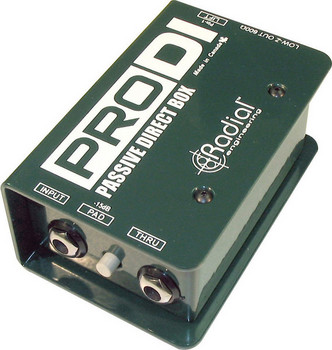
Radial Engineering ProDI Direct Box

Summary: Need to plug your acoustic guitar or bass directly into your mixer or DAW? Don’t do it without one of these units.

Pros: Completely passive DI, requires no internal or external power sources. Super-transparent, the ProDI adds no artifacts to your tone. Used with an acoustic guitar, it makes your guitar come alive!

Cons: None

Features (from the Radial web site):

  • Full range passive direct boxes
  • Isolation transformer eliminates noise
  • Very low harmonic and phase distortion
  • Compact and rugged design
  • Ideal for live sound and studio
  • Mono (ProDI) or stereo (ProD2) models

Price: $99 street

Tone Bone Score: 5.0 ~ Talk about having my acoustic guitar just come alive! If you’re not using a DI when plugging into a board, you need to get this!

For my solo acoustic gigs, I’ve been using my DigiTech Vocalist Live 4 for the last couple of years, and it has been terrific. But back when my Ovation got damaged (which I’ve since fixed with a little wood glue), I’ve been using my Fender Stratacoustic with the Vocalist. Unfortunately, the Vocalist doesn’t like input gain of the Stratacoustic, and driving hard on the strings would cause the Vocalist to overdrive, and cause a pop in the PA system. Not good. Luckily, the Vocalist Live has a Guitar Thru jack, so I could route the signal to another channel on the board.

But that meant that I was going to be plugging direct, and I knew that plugging an acoustic directly into a board doesn’t sound very good at all. Not only is the sound muddy with way too much midrange “goop,” there’s also a huge loss in dynamics, ultimately making the guitar tone flat and lifeless. While I don’t completely understand the electronics, the problem apparently lies in the impedance mismatch between guitar and board; and if I’ve learned anything impedance mismatches from working with attenuators, impedance mismatch is a big culprit for loss of tone and transparency. Enter the DI, or direct input box.

The main purpose of a DI box is to take one type of electronic signal, convert it to a magnetic signal, then convert it back to an electronic signal again. The  device used for this is a transformer. With a DI, the unbalanced, high-impedance signal coming from the guitar goes into the transformer, which “transforms” the signal into a balanced, low-impedance signal on the other end. The net result is that impedances are properly matched on both ends, theoretically retaining your tone. Now, enter the Radial ProDI.

I knew I had to get a DI, but wasn’t sure about which one to get, as there are many to choose from. But a quick call to Jordan at Gelb Music got me on track right away. I’ve been buying gear from him for years, and he knows my rig. So when I explained what I wanted to do, he had an immediate recommendation: The Radial Engineering ProDI.

Jordan told me, “I just recorded some acoustic tracks directly into a board, and used the ProDI. I was blown away by the tone. It totally made my guitar come to life – even plugged in! And at $99, it’s totally worth it.”

That was enough of an endorsement for me. Yeah, you could say it’s just another sales guy trying to make a sale, but I’ve been dealing with Jordan for awhile, and not only is he knowledgeable, everything he recommends, he plays. That’s Gelb’s shtick. They have an unsaid policy that their sales guys can’t make recommendations on anything they haven’t played, so you can be assured that their recommendations are reliable. I’ve been buying gear from them for years, so I’ve experienced that first-hand, AND benefited from that policy!

How It Sounds

I put together a couple of quick audio clips to demonstrate the difference between going direct into my DAW vs going through the ProDI.

Guitar straight into the DAW

Guitar into the ProID then into the DAW

One of the reasons I chose the Stratacoustic was because of the fantastic Fishman pre-amp and dual pickup system it uses. Plugged in, it sounds incredible. But even plugged in, there’s a detectable (at least to my ears) muffling of the tone, whereas with the ProDI, the guitar sounds richer.

I realize that with these recordings the differences are subtle at best. However, the difference was far greater plugged into the board at the restaurant I played at on Friday. I did an A/B test during sound check, and I couldn’t believe the difference in clarity between going direct into the board, and going through the ProDI first.

Overall Impressions

This is yet another piece of gear that I cannot live without for going direct. It’s a simple box for sure, but at $99, what it brings to the table is so much! For more information, check out the Radial Engineering ProDI page!

Read Full Post »


Click on the picture to see an enlarged view.

Yamaha APX900 Thinline Acoustic-Electric Guitar

Summary: Yamaha got it right with its Acoustic Resonance Technology (ART) pickup system. Plugged in, the tone shaping possibilities are amazing. If you’re looking for a mid-range performance guitar, this is a guitar you have to consider.

Pros: ART pickup system rocks the house! Incredibly playable guitar with a great-feeling neck. Action out of the box was just right.

Cons: A little bright and thin-sounding unplugged, but this is a thinline, so that’s expected. But despite that, it has a nice, rich tone.

Features (from the Yamaha web site):

Top Solid Spruce
Back & Sides Flamed Maple
Neck Nato
Fingerboard Rosewood
Bridge Rosewood
Tuners Die-cast Gold
Body Style Thinline with Cutaway
String Scale 25 9/16″
Body Depth 3 1/8″ – 3 9/16″
Nut Width 1 11/16″
Colors Natural, Mocha Black, Ultramarine, Crimson Red Burst
Finish Hi-Gloss
Preamp System57 (3-way A.R.T.)

Price: $699 street

Tone Bone Score: 5.0 ~ This guitar offers the best of both worlds: Fantastic plugged in tone, and rich (though bright) unplugged tone.

My very first brand-new guitar was an old Yamaha FG335 that my dad gave me for my birthday. Up to that point,  I had been playing hand-me-downs from my cousins. Not complaining about those old guitars, but getting a brand-new guitar is always special. That FG served me well for 15 years before it had a bit of an accident, and I had to retire her (I had named her “Betsy”).Since owning “Betsy,” I’ve always been partial to Yamaha acoustics, though the FG was the only one I’ve ever owned. They make great-sounding and -playing guitars at an affordable price. What’s to complain about that? 🙂

As you may know, I just purchased a BOSS RV-5 Digital Reverb that I recently reviewed. At the shop where I did my evaluation, I just happened to do the evaluation with an APX900; hence, this review that you’re reading. But before I continue with the review, this is my next acoustic guitar! For what you get for the retail price, you just can’t beat it!

Fit and Finish

Even with the “cheap” product lines, I’ve always been impressed with Yamaha’s build quality. No errant coating, nice and straight joints, and well-dressed frets. The APX900 was no exception in this department. The frets ends were rounded off nicely, the action was perfect – not too low, not too high. I dig the “bookend” triangular mother-of-pearl inlays on the neck. It’s a real nice touch; and the binding about the sound hole and body add nice definition to the look of the guitar.

Playability

With a nice “C” shape neck, the APX is a very comfortable guitar to play. Cutouts are must for me to play high up on the neck and the action is such that high notes are easy to fret. I detected no buzz at all anywhere on the neck, and the intonation was perfect – at least from what I could tell. The neck is a bit on a narrow side, much like an electric guitar, but that’s the way I personally like it, so whether playing chords or picking individual notes, the key word with the APX900’s playability is “comfort.”

How It Sounds

As I mentioned above, as a thinline guitar, its natural, unplugged tone is a bit thin. But that doesn’t mean it’s tinny. It just happens to sit a bit higher up in the mids, which could actually be very useful when playing with larger acoustics. And despite its thinner body, the solid spruce top really helps to project the sound out, so it produces more natural volume than you’d expect.

Plugged in is a completely different matter, and this is where the ART pickup system comes into play. As I understand it, the ART system isn’t your traditional EQ. It is a system of three individual pickups placed at specific points in the body that produce or emphasize different EQ frequencies. Unlike traditional tone controls that act as frequency cut or boost, each slider for low, mid and high is a volume control, and your output signal is a mix of the three pickups.

How does it work? In a word, AWESOME! I took several minutes to play around with the controls, and just fell in love with the system! Where traditional EQ controls may muffle or muzzle the tone if you turn down, this doesn’t happen with the ART system. Clarity is retained, no matter what you do because after all, all you’re doing is adjusting a volume control. I have to admit that it was a little unsettling at first because I was expecting the tone to muffle, especially as I bled off some highs. But that didn’t happen at all. For instance, when I first started playing, I thought the tone had a bit too much high-end. So I adjusted it down. The cool thing was that the high-end was still there, it just wasn’t as prominent as it was before I made the adjustment. I found that to be incredibly cool! I also set up the ART so I could play an arrangement of Sting’s “It’s Probably Me” where I play sort of a bass line on the 5th and 6th strings. With that, I brought down the mid and high, and turned up the bass. I was rewarded with a rich, bassy tone that was not boomy at all.

Overall Impressions

The ART system makes this guitar a winner in my opinion. If it worked this well with the APX line, I can only imagine how well it works with the top-of-the-line LX series. I’m duly impressed!

Read Full Post »


Click on the picture to see an enlarged view.

BOSS RV-5 Digital Reverb

Summary: No, it isn’t the be-all end-all in reverb pedals, but for what it offers as a nice, subtle reverb to add some spaciousness to your sound, then the RV-5 really excels.

Pros: Plate reverb is excellent on this pedal – especially with an acoustic guitar. Amazingly enough, the RV-5 is transparent to my ears and doesn’t suck tone. The RV-5 is also super-quiet, and makes no line noise at all; pleasantly surprising qualities.

Cons: The Spring reverb is a little funky on this pedal. At higher Decay settings, there’s a bit of an intended artifact in the tail of the signal. Not too pleasing to my ears.

Features (from the BOSS web site):

  • Stereo input/output for compatibility with other stereo pedals
  • 6 high-quality reverb modes on par with rackmount processors
  • First-of-its-kind Modulate mode detunes the reverb sound for added spaciousness
  • New spring reverb emulation offers realistic spring reverb sounds
  • New gate reverb taken from high-end Roland studio gear

Price: $149 street

Tone Bone Score: 4.5 ~ As I mentioned above, for what this pedal offers, it’s great! To me, its strong suit is to use it as a subtle effect to add some spaciousness to your sound. As long as you don’t overdo it, this pedal will work great. The Plate reverb is particularly fantastic with acoustic.

With all the great boutique pedals out there, BOSS tends to be a bit too run-of-the-mill for many tone connoisseurs. Even I’ve thought of BOSS as somewhat of an afterthought considering some of the great boutique pedals I have, and from my participation in various online forums. Like, “Oh yeah… BOSS has “xxx” pedal. But it’s BOSS, and that means cheap, production line stuff.” But after I purchased the BOSS RV-5, one of my first thoughts was: “Have I become such a boutique gear snob that I can so easily dismiss production line pedals like BOSS because they’re not hand-made, boutique, and cost far less than boutique stuff that’s SUPPOSED to be better. ‘Cause here I am walking out the store with a BOSS pedal!”

Admittedly, it was a sobering thought. It wasn’t that I was experiencing buyer’s remorse. I truly like this pedal. But I founded this blog to share gear I’ve either purchased or come across, and most importantly, with the premise that it’s tone that matters and not the price or who made it; that is, if it sounds good, who the hell cares who made it or how much it costs? The BOSS RV-5 is a perfect example of this. Yeah, it’s made by a company that is generally equated with “cheap” pedals. But who the hell cares? I like how it sounds. If it wasn’t for the Spring Reverb, which I don’t particularly like on this pedal, it would’ve gotten a higher rating.

My intent with getting yet another reverb pedal was to get a journeyman pedal that would just do the job for my solo acoustic gigs. I wasn’t looking for a reverb where I’d layer on tons of the effect; just something subtle. After all, I was plugging into a PA board, and just wanted a touch of spaciousness, not have the reverb be the primary tone. In my experience, at low levels, even “cheap” stuff works pretty well, so I took the RV-5 for a spin, and was rewarded with a very nice-sounding reverb. As with any digital reverb that I’ve used, using them judiciously and in moderation is the key, and that was how I did my evaluation in the shop.

The net result is that I purchased the pedal. It does the job of providing a subtle, background reverb VERY well. Someone commented in my Gig Report that they’d take the RV-3 over this. I think this was motivated by the fact that the RV-3 is great for ambient stuff, as it is both reverb AND delay. But the RV-5 is really a different animal. Heavy, ambient reverb is not its strong suit. But for adding a slight spacious texture to your tone, it clearly excels in my opinion.

How It Sounds

For what it provides for me, I think this reverb sounds great. It’s not the be-all, end-all in reverbs, and it’s definitely not something I’d use for ambient stuff, but frankly, I never use a reverb pedal for that anyway, which is why I have a delay pedal. I put together samples of the same chord progression to give you an idea of what it sounds like in its various modes. The pedal is set with Level and Tone at noon, and Decay at 2pm. All clips were played with my Gibson Nighthawk, and running into the reverb pedal and into my Aracom VRX22.

Modulate

This mode adds an ever-so-slight slight chorus modulation to the tone. It’s nice.

Gate

Gate is interesting. Both pre-delay and decay are very short. This is actually kind of cool when you want a reverb tone that doesn’t tail.

Room

This setting really started growing on me when I was doing my tests. This is really a small-room type of reverb.

Hall

Nice, expansive tone with this mode.

Plate

Probably the most subtle of the modes, it really shines with acoustic guitar, but is very useful with electric.

Spring

BOSS claims to have added real spring reverb effects to this mode. Well, it didn’t succeed. The little motes of slightly buzzing spring are absolutely annoying to me, and I would never use this mode. You can hear it a little in the clip. I wasn’t expecting it at all, so it’s out as far as I’m concerned.

Overall Impressions

Sans the Spring mode, I like the reverb this produces. Plate and Room are definitely my favorite modes on this pedal, and Modulate comes in a close third. All in all, if you’re looking for journeyman reverb where you just want to lay on some spacious texture, this is a great pedal to consider!

Read Full Post »

Click on the picture to see an enlarged view.

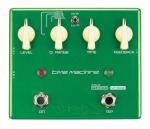
VOX Time Machine Delay Pedal


Summary: If you’re looking for a super-quiet, dynamic and versatile delay that will cover a lot of territory, look no further. The Time Machine rocks!

Pros: Absolutely quiet, with no line noise at all. It is so easy to dial in great delay sounds with the Time Machine, it’s almost scary. I like the fact that it has more features than a basic delay pedal, but not so many that you spend all your time tweaking. Oh yeah… It sounds absolutely fantastic!

Cons:None.

Features:

  • Controls:  Level, Delay Range, Time, Feedback, ON SW, Tap & Modern/Vintage SW, Hi-Fi/Lo-Fi SW
  • In/Outputs: 1 x  INPUT, 1 x OUTPUT, 1 x DRY OUT, 1 x DC9V
  • Max Delay Time: 5800 milliseconds via Tap-Tempo, 1000 milliseconds via Delay control
  • Input Impedance: 1M-ohms
  • Output Impedance : 1k-ohms
  • Power Supply:  9V alkaline battery(6LF22/6LR61) or AC adapter(sold separately)
  • Current Consumption: 60mA
  • Dimensions: 143(W) x 121(D) x 58(H) mm / 5.63”(W) x 4.76”(D) x 2.28”(H)
  • Weight: 600g /1.32 lbs (without batteries)
  • Included Items: 9V alkaline battery (included)
  • Options: 9V AC adapter (not included)

Price: $199 street

Tone Bone Score: 5.0 ~ This pedal has ended my search for a delay. It really is as good as it’s advertised.

I tend to be a little wary of “signature” pedals because I’m really not one who wants to sound like someone else; besides, I’m not nearly as capable on the guitar as said artists. But now and then, I come across signature gear that forces me to take a good, long look: Not just because of the name behind it, but simply because it’s just a great piece of gear! Such was the case with the VOX Time Machine. When it first came to market, I have to admit that I was excited because I know that Joe Satriani is a real tone freak, and I figured that any kind of gear in which he has design input is bound to be pretty good. But the flip side of that is that I’ve had experience with other signature pedals that were really geared towards the artist and their playing style specifically, and frankly, that stuff has left me frowning. Not so with the Time Machine, which took me completely by surprise!

I’ve been in the market for a delay for almost a couple of years, when I gave away my crappy Boss DD-5 that had such perfect and precise delay that it just felt processed. It was nothing like my former DD-3 that actually sounded pretty good, but I lost that pedal after playing in an orchestra for a musical theatre gig (I didn’t have a board at the time, and only carried a couple of pedals). Needless to say, during that time, I’ve evaluated several delays, but none have really caught my fancy. They were either too dark sounding, as in the case of most analog delays, or they sucked tone, as in the case of many digital delays I’ve tried. My surprise with the Time Machine is that in either mode, modern or vintage, my basic tone was retained! But I’m getting a bit ahead of myself.

In my search, I came up with some criteria that had to be fufilled 100% before I’d even consider buying one. Here they are:

  • First, I wanted Tap Tempo. I’ve always hated having to bend over to tweak knobs; but moreover, I wanted to be able to match tempos with my drummer on the fly.
  • Secondly – and I know this is purely subjective – I wanted a good balance between tweakable settings and ease-of use. In other words, I wanted to have the flexibility to dial in a number of delay settings but not have so many that I’d be spending all my time tweaking knobs.
  • Thirdly, I didn’t want to ever have to refer to a reference manual to make sure I was using the pedal correctly. The “don’t make me think” rule had to apply. I should be able to dial in great tones in a matter of a few minutes, if not earlier.
  • Finally, and most importantly, the pedal could not suck tone, and had to be reasonably transparent. In most cases, I don’t mind a pedal putting an emphasis on a particular EQ range (like my Kasha overdrive does), but it should never remove a range or “feel” like it narrows the bandwidth of the signal.

There are lots of delay pedals I’ve evaluated that were particularly good in most areas, but none until I played the Time Machine ever fulfilled all four criteria. That’s how great this pedal is!

It’s Mean When It’s Green

I love the shiny, green apple finish of the Time Machine. Of course, the paint job doesn’t make the pedal. But the Time Machine is built like a tank, and is certainly gig-worthy. I imagine that JS had that in mind when providing his design input. The chicken head knobs give the pedal a cool vintage vibe, but not only that make it very easy to see where you’re at with your settings. The stomp switches are nice and smooth, and the pedal engages without producing any noise.

How I Did My Evaluation

I didn’t just test the Time Machine in isolation. I’ve learned that one of the best ways to evaluate pedals is to do A/B tests against other pedals of like kind to make a comparison. So I compared the Time Machine against a Way Huge Aqua Puss and a TC Electronic Nova Repeater at my favorite shop, Gelb Music in Redwood City, CA. My thought was to compare it against an analog and another digital delay. Sorry, but no clips because I was in a shop.

All my tests in the shop were done with a Fender Custom Shop Tele, plugged into the pedals (hooked together so I could quickly make a comparison without swapping), and into an absolutely superb-sounding and -looking Dr. Z Maz 38 with draped in blonde tolex. Mm mm good. 🙂 I chose a midrange wattage amp because I wasn’t interested in creating grind. I’ve never been one to use delay with overdrive – maybe a little. But in this case, I wanted to have an ample amount of clean headroom to work with, and the Maz 38 worked perfectly for that (for the record I REALLY want a Dr. Z Remedy).

Aqua Puss and Nova Repeater

I will most likely have reviews on the Way Huge Aqua Puss and TC Electronic Nova Repeater in the near future, but I’ll give you a quick run-down of the pedals. If you’re looking for a dark, swampy, blues delay. The Aqua Puss delivers that in spades. It has this certain ethereal quality that made me think of drifting on a boat in the middle of the Everglades. I actually really liked the pedal, but I was after something else entirely with my delay search – much more versatility – and the Aqua Puss was a one-trick pony. It does what it does exceptionally well, but don’t ask for much in terms of usability in a variety of styles.

I was very sadly disappointed with the Nova Repeater. It packs a TON of features in its box, but for me, I was a little concerned that were just too many features. But despite that, it was easy to get a usable delay tone almost right away. The folks at TC Group certainly know how to pack in features, but they make them readily accessible, and very easy to understand. I actually had my heart set on getting this pedal after reading many reviews and listening to clips and watching video; and I almost purchased it a couple weeks ago. But I’m glad I compared it head-to-head with the Time Machine.

The Time Machine may not have all the features as the Nova Repeater, but out of the box, it wins hands-down in the tone department. The Nova Repeater sounded bland and dry – processed – when played in an A/B test between it and the Time Machine. And I detected a distinct loss in both highs and lows; in other words, bandwidth narrowing. That was not at all pleasing. That said though, the Repeater is still a great pedal, and apparently there’s an internal pot to calibrate the tone to your rig, so that’s a plus. But frankly, I’m not one to tweak that deeply. I probably would’ve still bought it if I didn’t do the A/B test. The tone is usable and really not as bad as I may have painted it, but it’s not as good as the Time Machine’s tone in my opinion.

Playability

If it’s any area where the Time Machine simply shined above the other pedals was how absolutely responsive it was to picking dynamics. Play lightly, and the delay is super-subtle; you almost feel as if it’s not there. Dig in a bit, and the pedal responds. I did a few lead lines to experiment with this, and was totally blown away. I set the Level control so I’d really have to dig in to get the delay effect, but for most runs, picked or legato, what I got was a more ambient effect – almost like reverb. Wow! That kind of pick response is probably what sold me the most.

In addition to dynamics, I just loved how easy it was to dial in various settings. The knobs are very nicely NOT over-sensitive, so moving a knob doesn’t result in dramatic changes in the effect. The net result is that you can get into a general area on the sweep of a particular knob, and make a couple of slight changes to zero in. How many pedals have we played where just turning a knob ever-so-slightly drastically changed the effect? It’s probably why I’ve liked my Boss CE-5 chorus for so long, and even though I’m currently bidding on a CE-2 on EBay, if I don’t win the auction, all won’t be lost because the CE-5 has a nice, consistent sweep on its knobs.

How It Sounds

Like I mentioned, the Time Machine is simply transparent. The Modern mode is truly transparent – at least to my ears – while the Vintage mode darkens the tone ever so slightly and adds some subtle modulation (it’s chorus-like) like you’d expect with an analog delay. But unlike many analog delays that I’ve played, the darkening with the Time Machine does more of a lower-mids EQ emphasis, whereas I’ve felt that analog delays cut highs. The Aqua Puss certainly felt like it was cutting highs, though it definitely compensated for it with some overall great tone. Back to the Time Machine, the net result is that in vintage mode, the tone becomes slightly more rich and lush.

I liked both modes equally well, though I’d probably tend to use the Vintage mode when playing absolutely clean, as it also adds a tiny bit of hair to the signal. It’s almost imperceptible, but it’s there. I loved doing some simple chord comps up on the neck in Vintage mode.

Modern mode, on the other hand, is like the Swiss Army Knife of the Time Machine, making it capable of fitting into any style of playing, from syncopated rhythms ala The Edge, to heavy chunk where you want to have a bit of slap-back.

The Time Machine also has a toggle switch for Lo-Fi and Hi-Fi modes, in addition to the Modern and Vintage modes. Hi-Fi apparently maintains tonal transparency, whereas Lo-Fi includes High- and Lo-cut filters. The difference between the two fidelity modes was subtle at best. I didn’t detect much of a cut in either highs or lows when engaging Lo-Fi; the EQ changes ever so slightly, but the bandwidth didn’t change at all. Again, I feel like it’s more of an EQ emphasis rather than a removal of portions.

Overall Impressions

I’m glad I took so much time to find a new delay pedal. As you can tell from my review, I love the Time Machine. It fulfilled all my criteria for what I wanted in a delay pedal. To me, it has enough adjustable settings to keep any tweaker happy, but it’s also super-easy to quickly dial in the right amount of effect. But not only that, it just sounds damn good!

Read Full Post »

Man! Haven’t written a full song with vocals in awhile. Life happens, and it’s not the easiest thing to get the time to write. So the other day, I came up with a funky groove. It started out as a simple blues in Em, bouncing back and forth between Em7 and Bm7. I knew I didn’t want to just stick to a 1-4-5 kind of pattern, so I added some altered chords to kind of “jazz” it up a bit. The title has nothing to do with the music. 🙂 It’s the subject matter of the lyrics, which is divorce. Don’t know how I got on that line of thinking; maybe it was from people around me who have gone through it. Anyway here’s the song:

Equipment Used:

Rhythm (left and right sides): Squier Classic Vibe Tele (50’s)

Lead: Gibson Limited Run Nighthawk 2009

Amp: Aracom PLX18 BB w/Trem

Notes:

  • I originally laid down the rhythm with Pearl, my MIM Strat. But those Tex Mex pickups were just too bright for an already bright vintage Plexi-style amp. Way too much high-end attack. So, I switched to Blondie. That Tele is just so damn versatile!
  • I just love that vintage Marshall tone. Funny thing, I was never into Marshalls until recently, but since I’ve been playing Aracom amps, that’s the tone I just love!
  • The Nighthawk is just awe-inspiring! The tones that guitar can produce are simply phenomenal. The mix between the P-90 and the Burstbucker is to die for! I love that guitar!

Read Full Post »

« Newer Posts - Older Posts »