I did a “What is it about…” regarding the tone of a 100-Watt amplifier recently, and while I’m now hooked on higher-wattage amps, and will probably sell off a few of my low wattage amps, I’ve got some other lower-wattage amps – namely, my Aracom amps – that I will never part with because of their insanely fantastic tone and dynamics. While not nearly as beefy-sounding or -feeling as a 100 Watt amp, they just ooze great tone, and when cranked to the hilt, just sustain for days!
For instance, this morning I played a church service at my kids’ school and had two of my fellow church band members to play a power trio. Since we didn’t have a lot of room (the 5th grade class shares our normal band space), I just brought my Aracom PLX18 BB Trem combo with me so I wouldn’t have to hook up a cab. This amp is based upon the popular Marshall 18-Watt Plexi circuit, which is absolutely simple, as all vintage Plexi circuits were. It has a single gain stage that feeds into an EQ (and on the PLX, it’s a single tone knob to bleed off highs), then straight into the power amp. I believe it’s this simplicity that gives the amp and its Marshall ancestors such pure tone.
With their single gain stage, obviously amps of this ilk will not do over-the-top overdrive, and have to be cranked (as in dimed) to deliver any overdrive. But when they do deliver it, it’s smooth as silk and incredibly dynamic and articulate. This has always been my experience with Plexi-style amps, be they 100 Watts or 18 Watts. For my own PLX, as I said, it may not have the beefy tone that a 100 Watt version may offer, but that smooth overdrive and dynamicism is all present.
Anyway, I set up my rig this morning and I warmed up the amp. Then I plugged in my Gibson 2009 Limited Run Nighthawk, and started playing some warm-up scales. I hadn’t played my PLX for awhile, and running through my warm-up, I was reminded about how damn good that amp sounds! As Jeff Aragaki (Aracom’s owner) puts it, “It doesn’t matter what wattage the amp is. You just know a great amp when you play and hear it. And Marshall got that circuit right.” At least to me, Jeff couldn’t be more right. The PLX is pretty much an exact copy of the classic 18 Watt Plexi circuit (with some slight mods that Jeff has made), and that amp was made to be hit hard. When you do that, you’re rewarded with a tone that, at least to me, is other-worldly! If you’re looking a great Plexi-style amp, this is an amp you have to check out!
Here’s a little treat. Gene Baker of B3 Guitars recorded a great clip that demonstrates the PLX18’s wonderful crunch tone. Check it out:
Over the years, I’ve tried and tested a lot of different amps, and several that cop Marshall designs. No doubt, there are some great amps out there, but Jeff at Aracom really “gets it” with respect to vintage Marshall-esque amps. The cool thing is that instead of making an exact replica of the circuits as many amp builders do, Jeff sees where he feels the designs may be weak, makes corrections or improvements, or creates new amps altogether from the base. For instance, my VRX22 started out as a Plexi 18, but Jeff wanted to add more gain with the second channel, so he added another gain stage that acts as a tube overdrive that’s always on, went from EL84’s to 6V6’s, and what he came up with is an absolutely superb amp that has vintage-style Marshall dynamics, but a sound all its own.
MXR Carbon Copy DelaySummary: Fantastic-sounding analog delay at an affordable price.
Pros: Out of the box, this baby oozes great tone, and creates warm, silky-smooth repeats as you’d expect from an analog and importantly it doesn’t turn your tone overly dark as analog delays are apt to do. The Mod button adds a cool and super-subtle modulation similar to chorus, to smooth out the tone even more.
Cons: The only nit I have with it is if I hit it hard with a lot of input gain. There’s almost a bit too much “flutter.” However, this is a small nit because this pedal sits on my acoustic board, and the input gain is low, so that flutter will never happen.
Features:
Bucket-brigade technology
600ms delay time
Modulation switch to add subtle chorus-like modulation
Regen (repeats), Mix, and Delay knobs
Two internal trim pots to adjust width and rate (doubt that I’ll ever open up the box to adjust these. Factory settings are just fine)
True hardwire bypass
Price: $105 -149 Street
Tone Bone Score: 5.0 ~I was really blown away by this delay. I was seriously considering getting another Mad Professor Deep Blue Delay – well, the PCB version, at least – to put on my acoustic board. But a friend showed me his Carbon Copy, and I was immediately sold. I’ll admit that if I’d gotten the Carbon Copy first, I probably wouldn’t have even considered the Deep Blue Delay, which is over double the price.
No, I’m not kicking myself…And yes, I paid over $300 for my hand-wired Mad Professor Deep Blue Delay. But that particular delay is seriously in a class all by itself. In my mind, there’s the Deep Blue Delay then all the rest of the analog delays. But near the top of that “other” list sits the MXR Carbon Copy. It never crossed my mind to even evaluate this pedal after I got my Deep Blue Delay, but when I wanted to get another analog delay for my acoustic rig, fortune had it that a good friend happened to get the Carbon Copy. I originally turned him on to the Deep Blue Delay, and instead of that (he couldn’t justify the price), he got the Carbon Copy for use on his acoustic board. Of course, I had to try it out, and fell in love with it immediately! Plus, at less than $150, this pedal would be a steal! So I got it a couple of Fridays ago to use at my weekly solo acoustic gig, and have been a happy camper.
Built like a tank
I still have an 80’s MXR Distortion pedal that I used for many years. One of the reasons I dug it was that it was super-durable. I gigged with a lot, and it got knocked around and stepped on, but I never had to change a knob or switch in all the time I’ve had it. Though MXR is now owned by Jim Dunlop, I have to give kudos to the new ownership for maintaining the solid feel of the MXR line.
It ain’t cheap…
Make no mistake, though MXR has been traditionally known for affordable pedals, don’t equate that with them being “cheap.” They’re affordable, yes, but they’ve also made their mark on Rock and Roll (can you say Phase 90?). The Carbon Copy is yet another example of an affordable pedal that produces killer tone.
How it sounds…
I was very surprised by the quality of the sound that this pedal produces, and the range of delay tones you can get. For instance, here’s a clip that cops a bit of “Edge” delay:
In this next clip, I combine two modulation effects – heavy chorus and delay. The Carbon Copy is set to a long delay time with Regen set to noon. To keep the delay effect subtle and ambient, Mix is at about 10am.
Finally, here’s a video from Guitar World that really demonstrates the Carbon Copy’s capabilities:
Overall impression
I totally dig this pedal! Once I got it dialed in for my acoustic gig a couple of Fridays ago, it stayed on almost the entire gig! I only switched it off when I needed a more “in your face” tone. This is just a super pedal, and I highly recommend it!
Summary: Super-convenient and super-portable, the NANO is a great board for those that only need to use a few pedals.
Pros: Included gig bag has straps that make it easy to attach to a guitar gig bag or case. Includes enough fuzz to cover both rails. Nice.
Cons: None.
Features:
Durable metal frame with rubber feet on bottom
Light weight at 2lbs including gig bag
Price: $49.95 Street
Tone Bone Score: 5.0 ~I recently decided to just use time-based effects (chorus, delay, and reverb) for my acoustic rig, and wanted a mini board that I could easily lug. The NANO totally comes through in this regard!
I’ve got lots of pedals. Truthfully, I’ve got a LOT of gear. 🙂 And for a long time, I used just a single board and swapped out pedals depending upon the type of gig I was performing. But then there were times when I played both electric AND acoustic during the same gig, and so I’d have to compromise on what pedals to put on my board. Then I got one of those Wicked Woody pedal boards which supplanted my old Gator board, and that meant I could put my acoustic pedals on the Gator board.
That Gator board has served me well for years, but I found myself using only three time-based effects for my acoustic rig, and that board, which can fit 8 full-size pedals, was way too big, and actually kind of heavy. But it’s what I used this past summer during my outdoor gigs, mainly because by the time I’d think about replacing it with something smaller, I was setting up for my gig. 🙂
So last week when I purchased my Homebrew Electronics THC chorus pedal, I asked my trusty sales rep, Jordan, over at Gelb Music in Redwood City, CA if he had a small board in stock. He first directed me to the Pedaltrain Mini. That was a cool board, but I remarked that I didn’t need all that space. Then he remembered that he had just gotten a NANO in stock. I picked up the box, looked at the picture and said, “Sold. This is EXACTLY what I’ve been looking for since I’m only using three pedals for my acoustic rig.” So that’s how I ended up with the NANO.
After having taken it to couple of gigs, I have to say that I just dig the convenience of this board! As you can see in the picture above, you can attach it to your guitar gig bag. The straps are actually long enough to wrap around the entire bag. This makes it so easy to lug around!
Now for some particulars…
There’s plenty of space underneath the board to run wires and do a neat job of it, as you can see in the picture I took of my board this morning.
The rubber feet are a god-send! This board will not slip, which is yet another convenient feature.
With the board itself weighing only 1 lb. it’s easy to lug.
I recommend using a 1-spot with this board – this is what I use, and it keeps things neat while giving you plenty of cord to run to an outlet.
Overall Impression
At $49.95, you just can’t go wrong with this board. I love it! Now a real cool thing would be to have a powered version of this, but I’m not complaining at all. Besides that would just add some weight, and it’s great that this is nice, lean board. So if you only use a few pedals at most, this is definitely a board you should consider!
To me, Mother Father is the quintessential Journey tune that showcases Steve Perry’s voice and Neal Schon’s composition and phrasing. I remember hearing that song when it first came out, and listened to it over and over – probably wearing out the grooves on my LP (ya, I’m dating myself). 🙂 And like him or not, no one can do that vocal like Steve Perry. Dean and Arnel can come close to Steve’s vocal range, but the soul and dynamics of his voice was truly unique.
If you look at later versions of the song with Dean Castronovo singing, you’ll see Neal playing his customized Les Paul Custom with the sustainer toggles. I actually prefer his Les Paul tone to his original “Schon” guitar tone, which is a bit thinner sounding.
So what inspired me to write this entry? I watched Journey Live in Manila on cable last night, and was in pure awe of Neal’s guitar tone – especially in Mother Father. Plus, that chord progression is classic Neal, who is the master of the rhythm riff.
You know me, I’m a low-wattage amp kind of guy. I find them really versatile and use them in a variety of venues and especially in the studio. But lately, I’ve been playing with a Sebago Sound 100 Watt Double Trouble – it’s a D-style amp – and I can say with confidence that I know what the big amp guys are talking about now. I have to use an attenuator with the amp, but even at lower volumes, there’s a certain thickness to the signal that a low wattage amp just can’t produce naturally.
Now, through the wonders of technology, I’ve been able to EQ low-wattage amps on recordings in such a way to make them sound a lot bigger than they are, but when an amp produces that fatness naturally, all I can say is “Wow!”
Tonight, I brought the amp to my church gig, and just couldn’t believe what I was hearing! The amp sounds great, yes (and I’ll have a full review of it soon), but the sheer power of 100 Watts – even attenuated – was something I hadn’t experienced before. It’s hard to describe what it was like, but there is definitely a certain dynamicism in the tone and – excuse the pun – a power that my low wattage amps just don’t produce.
Does this mean I’ll get rid of my low wattage amps? Absolutely not because they’re just great tools. But I’ll probably be gigging with something more powerful more often than not from now on… 🙂
————-
As kind of a follow-on to the original article, Jeff Aragaki of Aracom Amps and I spoke this morning, and the real difference-maker between the big amp and small amp – at least to me – is really evident when you have the power tubes in play. In my studio (read: garage), the amp at low gain sounded like any other amp – even my small amps – through a 1 X 12. But when I hooked up the Sebago to my attenuator, and opened up the master volume, all sorts of great things happened in terms of getting a much more complex tone; even clean. So yeah, the power tubes have A LOT to do with the thick tone of a high gain amp.
Summary: All-analog, thick and rich chorus capable of produce subtle to dripping wet chorus to organ-like leslie tones.
Pros: Warm, rich chorus tones – never gets bright, so it might not be for everyone, but I LOVE IT! Width knob is the “secret sauce” of the pedal that physically alters the width between the wave forms.
Cons: None.
Features:
Depth – Controls the depth or wetness of the signal
Speed – Connected to the LED indicator light which flashes with the rate of the chorus – very helpful.
Width – As mentioned above, controls the width between the wave forms. The effect is subtle, but provides another dimension for tweaking.
All Homebrew pedals feature true-bypass switching, heavy duty metal enclosures, chassis-mounted switches and pots.
All pedals are hand-built. Even the enclosures are drilled by an actual person, not a machine.
Lifetime warranty
Price: ~$189 – $200 Street
Tone Bone Score: 5.0 ~ I’m blown away by this chorus! It has such a beautiful tone! I was looking for a chorus to use with my acoustic rig, but this pedal has so much versatility, that I will be using it for a variety of settings (though it’ll mainly be used for my acoustic rig).
I Love Surprises…
Actually, saying I was surprised by the THC is actually an understatement. I needed a chorus pedal to go with my acoustic rig yesterday, because I was tired of using my BOSS CE-2 on both my electric and acoustic boards. Plus, the CE-2, at least for me, has always sounded better with electric because of the gain boost which I dig with my electric rig. But for acoustic, I just want something that turns on, doesn’t give me a jump in volume, and doesn’t add any brightness. So when I auditioned a couple of chorus pedals yesterday – the other was an MXR Micro Chorus – I could not believe how absolutely SWEET the THC sounded!
Mind you, the Micro Chorus sounded killer to me, but it was much closer in character to the CE-2 as it is a fairly bright chorus. For acoustic, I needed a much thicker tone, and I found that in the THC. I will mention that I was going to also audition the Red Witch Empress Chorus, which is hailed as just about the best chorus on the market today. But at $400, there was absolutely no way I was going to get it, so I didn’t bother auditioning it. Also, the Red Witch has 4 knobs and two toggles. I didn’t need that kind of tweak-ability. I know, it’s also a Vibrato, but I just wanted a chorus.
Fit and Finish
All Homebrew Electronics (HBE) pedals are hand-built: And this means all the components, drilling and even the painting are done at the Homebrew shop. But the cool thing is that HBE. My experience with them has been that they’re built like tanks, and the THC is no exception. The pedal feels solid. There’s nothing loose. I also absolutely dig the bright green paint job. Reminds me of a Granny Smith apple! 🙂
Ease of Use (read: How easy is it to dial in great tone)
This is where the THC really shines. What’s very helpful in this regard is the LED, which flashes with the according to how the Rate knob is set. I found myself setting this knob first, then setting the Depth knob for the wetness, then setting the width, which I mentioned is a very subtle feature, but it changes the character of the chorus, which is really cool. Note that it’s not something that I can’t really explain because at least to me, the change is more felt than heard.
How It Sounds
As with all gear that I give 5 Tone Bones, the THC sounds AMAZING! With a high rating like this, the tone really has to move me emotionally. Other gear that gets a lower rating, even gear with a 4.75 sounds great, but there’s something that “bugs” me. Not so with the THC. It’s one of those pedals where I can close my eyes, put a smile on my face, and just let my fingers do the talking. It’s that good!
I recorded a few clips of the pedal to demonstrate how it sounds. All clips were recorded with my trusty Squier CV Tele 50’s (middle pickup position) into my Aracom VRX22 and a 1 X 12 with a Jensen Jet Falcon:
All controls dead-center
Subtle: Depth at about 10am, Rate at 12pm, Width at 10am (added a touch of reverb)
Leslie: Depth at 2pm, Rate cranked, Width about 2pm
Heavy: Depth at 4pm, Rate at 1pm, Width 11am
With this clip I wanted to see how well it played with both delay and reverb, and it plays quite nicely. 🙂
Overall Impression
This is one of those pedals that I actually had never seen before. I’d heard of it, but went into the audition completely cold. If you have a dealer near you that carries these pedals, I encourage you to check it out. You won’t be disappointed.
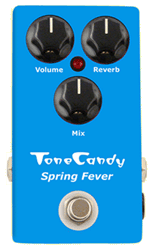
No, not the sexual kind – though we do like that – but the spring reverb kind. 🙂 Specifically, I’m talking about the Tone Candy Spring Fever. I reviewed the Spring Fever back in May, and gave it a 4.5 Tone Bones. But now that I’ve got it and after spending a few hours with it last night, I’m now giving it 5.0 Tone Bones! Here’s why:
As I said in my original review, the Spring Fever is just about the best spring reverb pedal I’ve ever played. It sounds incredibly realistic, and unlike many of the digital varieties I’ve played, while it’s jangly with some top-end, it also doesn’t lose bottom end, so your tone stays nice and rich. That’s a little disconcerting to some folks because they’re used to a brighter tone, but for me, the retention of the bottom end is really what sold me on its tone, plus with the Spring Fever, you can go from subtle spring ‘verb, to rich, spacious, swirling surf tones, so there’s lots of variety on tap.
What I didn’t get to test out in my original audition of the Spring Fever was its Volume knob which also acts as a clean boost if you turn the Reverb and Mix knobs all the way down. I’m not sure how much boost the pedal adds, but there’s enough boost on tap to slam the front end of your amp with loads of gain.
I particularly like the Volume knob because it solves a real problem for me when I play my acoustic gigs at venues where I have to plug directly into a PA board. My acoustics’ pickups don’t have much gain, and I usually have to crank up the volume faders on the board, which can be problematic as it makes it difficult to balance out the guitars’ volume with my vocals. I’ve solved this in the past by lugging my Presonus TUBEPre preamp with me, but that’s a bit of a pain to lug (read: extra gear, not because it’s heavy), and requires a separate 12V power supply. The Volume knob on the Spring Fever eliminates the need for me to bring a preamp with me. Nice.
If I have one complaint of the pedal, it has to be its finicky nature with power supplies, and will add some noise to the signal. Mike Marino explains this on the Spring Fever product page, and recommends some power supplies to use, such as the 1-Spot. I used the 1-Spot in my clips, and when the Spring Fever was activated, there was a slight, but noticeable hiss. This has to do with the power supply, and not the pedal. This also happens when I use my MXR Carbon Copy with the 1-Spot. When I hook it up to a regulated power supply like a Dunlop DC Brick, the pedal is as quiet as can be. So despite Mike’s recommendation about the 1-Spot, don’t use it. Get a regulated power supply like the DC Brick. Luckily, I have an extra DC Brick, so that will be powering my mini board.
How It Sounds
As I said, the Spring Fever is about the best spring reverb pedal I’ve ever played! Capable of producing a wide range of reverb, this pedal will be a permanent fixture on my board! I’ve still got to play around with it some more, but I recorded a few clips to give you an idea of what it can do. The clips below were all recorded using my 1958 Fender Champ output to a Jensen Jet Falcon 1 X 12. I start out each clip with a dry signal, then play it again with some “grease.” What that pedal adds with respect to spaciousness is amazing! All the clean clips were recorded at unity volume, while the dirty clips were played with the amp turned up to about 2pm, and the boost at 1pm with Mix and Reverb completely off. I wanted to demonstrate the clean boost and its effect on an overdriven amp.
Les Paul, Middle Pickup, Fingerstyle. Reverb: 11am, Mix:10 am
Left Channel: Les Paul Middle Pickup, Reverb and Mix same settings as above
Right Channel: Les Paul Neck Pickup, Reverb: Dimed, Mix: 8pm
I love the right channel track on this clip. Turned up all the way, you get this cavernous room sound, but with the Mix set real low, it becomes a much more subtle effect, providing almost a delay-like ambience without the echos.
Squier CV Tele Middle Pickup. Reverb: 10am, Mix 10am
MXR Carbon Copy with long delay time, Mix at about 10am
Les Paul Middle Pickup (biased toward bridge), Volume: 2pm, Mix/Reverb Off
Yeah, it’s pricey at $275, though you can find it at a lower price if you look. But I haven’t heard as a good a spring reverb pedal like this – ever. And the fact that it has a booster in it just rocks! For me, and especially for my acoustic gigs, this is a game changer!
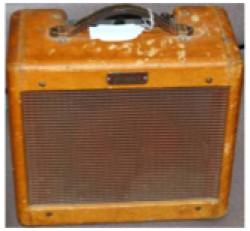
I was so excited to finally get one of these several months ago! I played it A LOT until the original caps finally wore out and started to leak both fluid and the amp started leaking electricity (i.e. I could feel current when I touched the amp – not good!
So I had my good friend and amp genius, Jeff Aragaki of Aracom Amps overhaul the amp. I just got it back a few days ago, and it totally kicks ass! Among Jeff’s mods were:
Replace the original two-prong cord with a grounded three-prong cord. For this, he had to make some adjustments to the heater.
Replace the original caps with new Sprague paper caps.
Replaced the original speaker with a new Weber 8″ speaker.
Provide a way for me to use either the internal speaker or an external cabinet. This was done by connecting the output wire to a jack and running that into a custom switch box that he constructed.
But Jeff actually did one better, and that was to put the amp chassis in a larger tweed cabinet that had a 10″ speaker. What a difference in volume and tone!
That amp is VERY special, and it’s not a small wonder why Jeff Beck is now using Champs. He can get great tones at lower volumes! For instance, here’s a new praise song I recorded using just the Champ for the guitar tracks. The rhythm track was recorded using the 10″ speaker with the mic at the rim of the speaker cone pointed along the angle of the paper so I could capture more of the low frequencies. The “lead,” overdriven guitar used a closed-back external 1 X 12 cabinet with a Jensen Jet Falcon. It sounds like it’s coming from a much bigger amp!
For guitars, I used my trusty Squier CV Tele for the clean rhythm, and used my Gibson R8 Les Paul for the “lead.”
The thing that struck me about playing the amp was how it really responded and felt like an amp 10X its size. The touch-sensitivity and dynamics, especially when cranked, are spectacular with lots of overtones and harmonics. Being naturally brightly voiced, this amp never gets muddy. It’s actually rather unsettling to play this amp at times because it sounds much bigger than it actually is. That’s VERY cool!
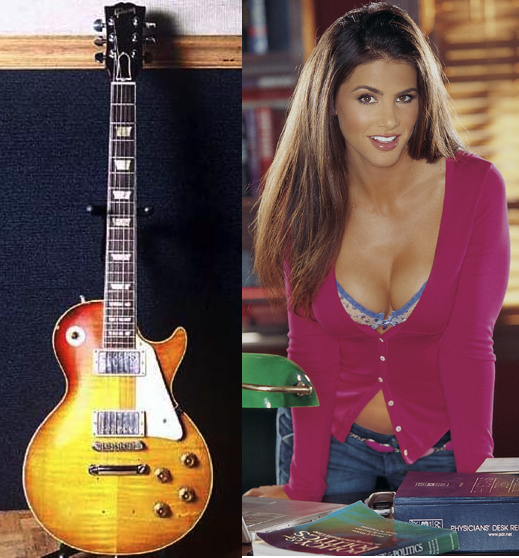
Pictured above are an original 1959 Les Paul and Allison Stokke. Don’t know about her? Look her up on Google. For this particular article, any hot chick will do…
So… you’re on a boat and the captain is taking you to a remote, desert island to strand you there. He says, “I might be mean, but I’m not cruel. So I will give you a chance to choose between two things to have on the island with you. First, you can have a rare, 1959 Gibson Les Paul in Sunburst. I’ll provide you with a Marshall JTM45, and a power supply that can recharge with solar power so you’ll be able to play any time. Or… I let you have [pointing towards the gorgeous young woman] her. What be yer choice matey?”
The captain goes on to say that you shouldn’t be hasty in your decision and that you should consider these important points:
Both are incredibly beautiful
Both will make your creativity soar when you touch them
Yeah, yeah, just about every guitar blog has one of these posts, which is why I haven’t done one of these in the almost four years that GuitarGear.org has been around. The main reason was that I didn’t just want to post a “hot babe” list. I wanted to post women guitarists who are – to me – beautiful and talented and successful, and they have to be able to really play the guitar; in other words, they’re also great musicians, and not just eye candy. In addition, to make my list, to me, they have to ooze their femininity without resorting to raunchiness. Finally, and very importantly, I have to like the music they play.
1. Nancy Wilson
Topping the list is Nancy Wilson. I’ve had the hots for her since the 70’s! The she’s played the role of “sidewoman,” for Heart, she’s never been one to just look pretty on stage. She’s a great rhythm and acoustic guitarist!
2. Ana Vidovic
Ana Vidovic comes in a close second to Nancy and only comes in second because I’ve been in love with Nancy longer. 🙂 I first heard her play on a recording before I ever saw her, and loved her playing. Then to finally see what she looked like – OMG!!! By far, she is the most beautiful woman on my list, and her playing equals her beauty.
3. Sheryl Crow
Say what you want about Sheryl Crow, she is one of my favorite songwriters. I love her musical ideas and voice, and those just add to her attractiveness.
4. Gabriela Quintero
The female half of Rodrigo y Gabriela, this dynamic duo started out as metal players then converted to classical guitars and play a sizzling flamenco style, with Gabriela providing the complex flamenco rhythms to back Rodgrio’s solos. I first saw them a few years ago on a late-night show, and couldn’t believe the energy they had! It was marvelous! Then to see this gorgeous, sexy Latina ripping it up on her classical guitar. I was in love!
5. Tal Wilkenfeld
Okay, okay. I know, she’s a bass player, but she did start out as a guitarist, and she’s so damn talented and so naturally beautiful that I would be remiss in not including her in my list. As Jeff Beck’s bassist, she’s absolutely amazing. I could only hope to play solos on guitar as well as she does on bass. Her musical sense and phrasing is purely amazing.
I first heard of her through Ignacio “Ig” Gonzales when he had his popular blog, “igblog.” He was in love with Tal, and he spread his “Tal Fever” to all of us who followed his blog. If you’re not familiar with her, search for her on YouTube, and you’ll see what I mean.
Well, that’s my Top 5 List. Though my musical passion is rock and roll, I do listen to a lot of different music, and these chicks cover that territory for me.
One that I didn’t put on the list is Nora Jones, whom I’ve had a crush on for a long time, and though she actually does play guitar, and I love her music, guitar’s not her primary instrument, so she didn’t make the list, but she definitely would be in my top three were I to expand the instrumentation.
 I did a “What is it about…” regarding the tone of a 100-Watt amplifier recently, and while I’m now hooked on higher-wattage amps, and will probably sell off a few of my low wattage amps, I’ve got some other lower-wattage amps – namely, my Aracom amps – that I will never part with because of their insanely fantastic tone and dynamics. While not nearly as beefy-sounding or -feeling as a 100 Watt amp, they just ooze great tone, and when cranked to the hilt, just sustain for days!






 Guitar Gear