I broke the guide post on one of the 6L6 tubes in my trust Fender Hot Rod Deluxe awhile back, and even though the tube still worked just fine, I used it as an excuse to get a new set of power tubes. So after doing a search around the Internet for a new set of 6L6’s, I found myself on Brent Jesse Recording’s (audiotubes.com) site, looking for some NOS replacements for the JJ’s I had in there.
Not knowing what to purchase, I called Brent up, and asked for his recommendation. Surprisingly enough, he recommended a set of Groove Tubes. I said, “Groove Tubes? I can’t stand ’em.” But Brent explained that these particular Groove Tubes were not the imported, relabeled stuff from Russia or China. They’re re-issues of RCA and GE black plates made from NOS materials and constructed here in the US. Intriguing. I’ve purchase a few sets of tubes from Brent in the past, and he has never steered me wrong, so I decided to take a chance and get a pair.
The tubes arrived yesterday so of course, I just had to install them. What’s the verdict? They sound absolutely KILLER! The big test for me – especially with NOS tubes – is to run them full out to see how they break up. The problem I’ve had with late model power tubes in general (but especially with 6L6’s) is that they feel stiff and the breakup can be a bit harsh.
To me, NOS tubes have always felt much more smooth and dynamic. These Groove Tubes tubes are a huge exception to late model tubes. I can’t believe just how nicely these re-issues break up! The distortion is creamy smooth and slightly compressed with nice bloom and sustain without being too squishy – just how I like it! Caveat: They’re not cheap. These tubes are $80 for a matched pair, but they’re worth every penny! I just ordered a second set for spares since these tubes are limited quantity. They may not necessarily be NOS tubes, but as they’re made with NOS materials, there is definitely a limit. So if you’re looking for new production tubes that sound absolutely fantastic, you gotta check these out!
A word on the Fender Hot Rod Deluxe
It’s my contention that the Fender Hot Rod Deluxe is one of the most underrated amps on the market. Okay, I admit it: Stock it doesn’t sound all that good. But with the right tubes and the right speaker, it can sound incredible! Granted, a year or two ago, I wouldn’t have even considered buying this amp because of the huge price hike. I got mine on special for something like $550 in a blowout sale a few years ago. But the prices aren’t all that bad now. They’ve come down significantly from their nearly $900 price tag, and you can find them for around $649. Admittedly, it’ll probably cost $300-$400 more in tubes and replacement speaker, but what you get is an AWESOME amp. I’ll have clips in a few days.
This is a “mini-review” only because I wanted to provide feedback on it after using it, and because I only used it in a limited way. The Mad Professor Deep Blue Delay is a digital/analog delay pedal meaning it is a digital delay with an analog direct signal path – or as Mad Professor puts it, the direct signal path is made of analog amplifiers with no filtering. In other words, it’s supposed to be transparent with no tone coloration.
Okay, I’ll just cut to the chase. This is about the sweetest delay pedal I’ve ever played through! It can do really subtle, ambient stuff, but also nicely textured “The Edge-” like delay. But no matter where you set it, the delay never turns to mush. It retains your tones, and is super-sweet.
At first glance, you might think this is a typical analog delay pedal, but it is a digital delay, and thus nowhere near as dark as I’ve heard analog delay pedals, which has kept me from getting an analog delay in the first place. I just don’t get into the really dark, brooding type of delay. But I’d easily consider the Deep Blue Delay. It’s simply killer!
I only used it with a Yamaha APX900 acoustic to add some subtle ambient textures to my finger picking. I was also running the signal into a nice little Genz-Benz Shenandoah JRLT. Level was at about 10 am, Delay about noon, and Repeat at about 11 am. I wanted to get just a subtle hall-like echo. All I can say was that it performed astounding well! Combined with that sweet ToneCandy Spring Fever reverb pedal, and I was awash in ambient heaven!
I did play with higher levels of each setting, and was amazed at the overall clarity of my tone. No mush or mud. My signal stayed nice and clean, and the note separation was always retained. And with this delay, smooth is the name of the game. There’s nothing harsh in the delay the Deep Blue produces.
Apparently – and I still have to corroborate this – the Deep Blue was designed to be place in front of or in the effects loop of an amp, and can be used either before or after distortion. Pretty amazing, as most time-based effects only work well in a loop and after distortion only. The folks at Mad Professor really put a lot of thought into this pedal. The guy at the shop where I tested it at – and someone whom I trust implicitly – plays the Deep Blue in front of an old Traynor amp, and loves it.
But there is a down side to this pedal, and that’s its price. At a street price between $325 and $350, it’s an expensive proposition, and like the Spring Fever, is probably the only thing that keeps me from getting this pedal. It’s tough to justify spending that much for a pedal, but that’s just me. Once a pedal gets in the $250 range, I start getting a bit antsy. But that said, if I had the scratch to get one, I’d run out right now and grab that pedal! It’s that good! (Damn! Knowing me, I’ll probably end up getting it… 🙂 ).
In any case, it gets 4.75 Tone Bones
Pros – Absolutely fantastic delay! Decay is perfect, and note clarity is like nothing I’ve heard.
Why? Because every time I satisfy my GAS, they come out with new stuff that gets me GAS-ing all over again, dammit! 🙂 Here I was innocently reading my e-mail this morning when I got Prestige’s latest newsletter that said they were about to release a line of acoustic guitars! Knowing the fantastic stuff they produce, and given that they didn’t release anything more than announcement that they were releasing a new line, I had to give them a call to get more information. I shouldn’t’ve done that. I’m now GAS-ing so damn bad that it’s killing me!
But I got the scoop on these guitars, and before you start thinking, “Yeah, here we go, another import guitar… How good could it be?” Well, let me just say that a major publication already reviewed it and gave their top-of-the-line model a very – excuse the pun – prestigious award. And after I heard the details of these guitars, it’s not a surprise that even before their official release, they already won an award. So here’s at least some preliminary information that I found out…
They will have three guitars in various price ranges. I didn’t get model names, but I did get the makes of each model:
The top-of-the-line model has a koa body and koa top
The intermediate features a rosewood body and Adirondack spruce top
The lowest tier (and only by materials) features a mahogany body and Adirondack spruce top
Though not set, the guitars will range in price from about $1000 to $2100 street, so even the lowest-tier model isn’t anything to shake a stick at; and before you balk at the price, there’s a good reason for the pricing. Prestige didn’t skimp on the features that all three models share:
Adirondack spruce X-bracing designed in partnership with Balaz Prohaszka, a well-known European luthier
Satin Mahogany Neck, Laser Etched Logo and Serial Number behind the headstock.
Beveled Cutaway with Paduck inlay, Mother of Pearl Logo, Mother of
Pearl Eclipse Fingerboard Inlay, Abalone Rosette
Gotoh 501 21:1 Tuners with Ebony Buttons.
Paduck/Abalone Body Binding, Paduck/Maple fingerboard binding.
An option for each guitar is the Fishman Ellipse Matrix Blend pickup system. This is a very non-invasive soundhole pickup system that combines an undersaddle pickup with a gooseneck condenser mic. I’ve heard one of these installed in a Taylor acoustic, and it sounds marvelous!
So the pricing is really a reflection in the difference in tone woods used; otherwise, they’re all the same. That is incredibly COOL!
I’d be remiss if I didn’t have pictures, so here are a couple of the Koa/Koa model. These aren’t the pro pics as you can see the reflections of background objects – that’s how glossy the bodies are! Freakin’ awesome!!!
This slideshow requires JavaScript.
These are serious guitars, folks. Can’t you just DIG that beveled cutaway? Damn! I dig little things like that, and the outer bracing is absolutely superb! And another nice touch is the satin finish on the neck. I always prefer that because it allows me to polish it with my own body oils after time. For me, the ebony fretboard is a HUGE selling item! There is absolutely nothing like the feel of ebony; it’s smooth as silk and feels so nice to the touch!
I can’t wait to get a demo into my studio to give it a whirl! I TOTALLY DIG the Koa/Koa! Now do you see why I hate Prestige Guitars?!!! 🙂
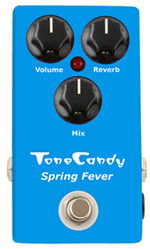
Summary: Just about the sweetest spring reverb pedal I’ve ever heard, plus the pedal sports a nice, transparent clean booster that you can even use on its own!
Pros: I’ve heard simulated spring reverbs before, and they’ve been nice, but not THIS nice! Supposedly modeled after the original BOSS spring reverb sound, but takes it way ahead!
Cons: Very very pricey for a just a reverb with boost. Also, doesn’t run on batteries
Features:
Volume knob acts as a transparent clean boost
Reverb knob acts as a “dwell.”
Mix knob controls the amount of wet/dry signal (this is a very nice feature)
True bypass
All analog except for the simulation chip
Can do the full range of spring reverb from adding a tinge of grease to heavy surf.
Price: $275 Street
Tone Bone Score: 4.5 ~ I was completely blown away by the sound of this pedal, but the price completely scared me away. If cost isn’t an in issue for you, you’ll find none better than this!
Being friends with guys at a music shop can be incredibly useful, since they’ll show off their new stock; plus, knowing that I may buy it if they show it to me, they don’t hesitate to show it off. 🙂 Luckily, I usually have enough self-control to not buy most of the stuff they demonstrate.
I have to admit, though, that I was VERY tempted to get this pedal because I haven’t heard one like it – ever! It can slather on the ‘verb quite nicely and note clarity is retained at any setting along the reverb knob sweep. Obviously ToneCandy figured out some great values for pre-delay and trail. I just couldn’t get over how great it sounded with chord progressions and single note picking!
In fact, A/B’ing it with a Fender Deluxe Reverb Reissue just blew me away! It sounded even better than an actual spring reverb! Fender spring reverb, at least to me, is the gold standard in spring reverb, and for a pedal to sound even better than that, well, needless to say, that made a compelling case to get this reverb pedal. Add to that a completely transparent boost, and you’ve got a great pedal that you can put at the end of your signal chain and get all sorts of usage out of it! I could feel the GAS really starting to build up.
Then I asked the price, and my eyes bulged! At $275 for the pedal, that made my GAS go away pretty quickly. If price wasn’t an issue for me, I’d totally go for this pedal, but unfortunately, at that price, I started thinking, “I could get a couple of decent pedals, or even a nice Squier for close to that price.”
Needless to say, I didn’t get the pedal, though I do have to applaud ToneCandy for coming up with a fantastic spring reverb tone. Maybe if I can find one used in the future for a lower price I’ll get it. But for now, I’ll just gaze at it in the glass case when I go to the shop…
I’ve been playing a solo acoustic gig for about 7 years now, and in all that time I’ve wanted to do lead breaks in various songs. But being a solo artist, and not having all that much time to spend on backing tracks, needless to say, lead breaks were out of the question – until now.
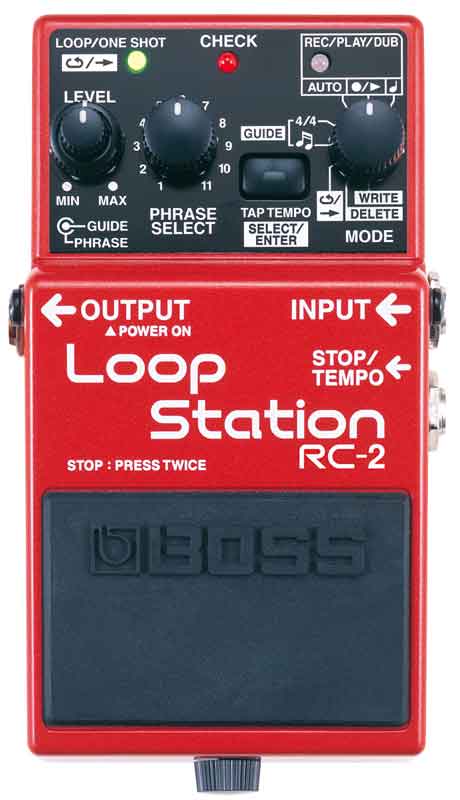
I just picked up a used Boss RC-2 the other day, and since playing with it, I just know that it is going to change the way I do my solo gigs forever. Even if I don’t keep this particular unit (which I probably will for quite awhile, as it does everything I need for now), I’m a total convert to using a looper!
Not that it hasn’t been challenging. Consistent tempo is tantamount to creating loops on the fly. Playing solo, I’ve gotten used to doing rhythmic embellishments, which don’t quite work all the time with a looper, and I’ve had to practice cutting off the record at just the right time. That has probably been the biggest challenge so far. But I’m starting to get the hang of it, and I’m just loving the possibilities it opens up for me!
As I mentioned in my review of the Yamaha APX900, I’ve had this thing for Yamaha acoustics for many years. Maybe it’s nostalgia or sentimentalism, as my first guitar was a Yamaha, but I’ve always liked their tone. In any case, I’ve full circle with the Yamaha APX900, and I just couldn’t be happier. This is one killer guitar! With its Mocha Black finish, mother-of-pearl “bookend” inlays, and gorgeous binding, it has stunning looks!
But of course, looks don’t tell the whole story. It plain sounds fantastic! Whether plugged in or unplugged, the APX900 has a magical, creamy tone that I’d easily put up against guitars three or four times its price which, at a mere $699 street, makes this an incredible value!
Unplugged, the tone is smooth and well-defined, and even as a thinline guitar, it’s not so thin that sustain is sacrificed. The body resonates and provides lots of sustain. In fact, it’s smaller size belies the big voice that the APX900 possesses. Here’s a clip:
There’s nothing subdued about that tone. For that recording, I used a Senheiser e609 pointed at the front edge of the sound hole about 4″ away from the guitar. The APX900 has an phenomenally even EQ response. When I played back the recording, I had to do a double-take! Make no mistake, that is the raw recording with no EQ or filtering! It’s amazing!
Plugged in, the APX900 shows even more magic. The first thing I noticed when I first played it – direct into a PA – was that it sounded natural; that is, it didn’t sound like an acoustic plugged into a board, where the tone is completely flattened out, and what you end up with is high, mid-rangy, and lifeless. It’s due to the APX900’s ART or Acoustic Resonance Transducer pickup system, which is a system of three pickups; strategically-placed to emphasize or de-emphasize certain EQ ranges. This lets you dial in all sorts of tones! I’m still discovering the possibilities!
Here’s the same progression I recorded unplugged, but with a solo played on top of it. For the “rhythm” part, I have the Low, Mid, and High faders, plus the under-the-saddle pickup’s EQ set to dead-center. With the solo, I added a touch of the mid, plus more highs to cut through. The result is spectacular!
Again, with this clip, I didn’t adjust any EQ on either track, though I did add some reverb for some ambience and to simulate what I’d do on a PA board anyway. The tone is different from the unplugged sound, but with a little playing around with the faders, I can get very close. But no matter, the tone is still killer, and most importantly, the dynamics are fully retained, and on stage, that’s absolutely critical!
So yeah, I really do dig this guitar. I’m looking forward to gigging with it!
Dynamics. It’s what separates a mechanical and boring piece from something that can move an audience to tears. In this episode, Doug talks about the incredible dynamics of the Dumble Overdrive Special.
This is the last video in the series of Doug Doppler on the Dumble Overdrive Special, but it’s not the last. I’ve got many more “Doppler on…” videos to come, so stay tuned!!!
That’s right! As I mentioned in episode 1 of the series, the Dumble can shred, and it sound unbelievable. In this part, Doug talks in-depth of the tonal capabilities of the Dumble amp and demonstrates it versatility by shredding on it!
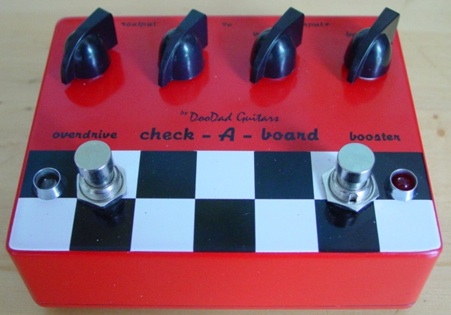
Summary: Two independent, true-bypass pedals in a single “bastard-proof” enclosure that can be used standalone or together. Overdrive is based upon the classic Tube Screamer, but has a voice all its own, and the booster is nice and transparent.
Pros: Fantastic overdrive tone! The overdrive is super responsive, and the sustain at high drive settings is killer!
Cons: I just keep the tone pot wide open. But the cut can be dramatic when you want to reduce some highs. Just a nit.
Features:
Both overdrive and booster are true-bypass.
Runs on a single 9V battery
Overdrive controls: Drive, Tone, and Volume
Booster controls: Boost (gain)
Price: $139 street
Tone Bone Score: 5.0 ~ I admit it, I’m partial to overdrive pedals, and while I love every single one that I have, I just never get tired of them. This pedal is going on my board! I’m buying the eval unit!
Holland Produces More than Just the Dire Straits
I’ve been wanting to review gear from European companies for awhile; that is, European companies that don’t have much of a US presence, so TC Electronics was kind of out. So when I discovered Doodad Guitars by accident through some research on Marble amps – another Dutch company – I knew I had to find a way to check out their gear. So hooking up with Mal Stich of the The Alternative Guitar and Amplifier Company in Southern California got me the Check-A-Board RED overdrive/booster. I’ve been having TONS of fun with this pedal since I got it for review. So much fun that I’ve decided to keep the pedal. 🙂
Gig Report
Not wanting to lug my full rig to the church this past Sunday – which usually includes an amp head, cabinet, PRX150-Pro attenuator, my pedal board, plus a couple of guitars – I opted to go a bit more sparse. This time, I loaded up my Champ 600, a 1 X 12 cab, my Squier CV Tele; then threw the Check-A-Board RED pedal and my TU-2 tuner in a gig bag. Setup time: Less than five minutes. 🙂
This past Sunday, my drummer was traveling on business, but even without a drummer, I like to have a little dirt at my fingertips. And since I wasn’t using an attenuator, an overdrive pedal was my only option, so what better way to test the RED pedal?
I needed to pop in a 9V battery, and I have to say that I dig the battery compartment in this pedal! As opposed to many pedals that have a separate lead wire that you have to attach the battery to, then place into the battery housing, the RED pedal’s housing actually swings out completely! You just slide the battery into the compartment, swing the housing back into the pedal, and you’re off to the races! Nice and convenient!
For volume setup, I first adjusted the Champ’s volume to my normal gig volume which, in a church as most worship players will attest, isn’t very loud; especially when you’re sans a drum kit. By the way, my guitar was also set to just above half-way on its volume knob, so I’d have some wiggle room. Once I had that dialed in, I set the RED pedal’s drive to about 2pm, tone wide open, and set volume at just above unity. That gave me a nice rhythm grind, and with the drive set where it was, if I added more volume on the guitar, it wouldn’t produce too much more volume – just more dirt, which is what I wanted.
At those pedal settings, the RED pedal really sustains. That’s what you’d expect from a Tube Screamer-like pedal. But as I mentioned in my “first impressions article,” it has a voice all its own, foregoing the huge mid-range hump, and presenting a much flatter EQ response that brings out the highs and lows a bit more (just so long as you keep the tone wide open as it is a high-cut filter).
While it responds dynamically much like a Tube Screamer, its voicing is darker and has more “balls.” That’s a great combination, especially when you’re playing through a naturally bright amp like the Champ 600. It provides an overall tonal balance, and that’s very pleasing to me. 🙂
There were two things that struck me during the service about the RED pedal: First of all, even when I was wailing on the strings, the string separation was phenomenal! This pedal doesn’t know how to get mushy! Even on our closing song where I cranked the Drive – and we could play with more stage volume because the congregation gets LOUD 🙂 – my sound never turned to mush, and I was able to weave in and out of power chords and little fills and not worry about producing just a wall of sound. KILLER!
Secondly, where I had the pedal set up for most of the service, the RED pedal’s dynamic response was much like an amplifier’s, and it responded incredibly well to volume and knob and pick attack. For instance, there was one song near the beginning of the service where I stepped into the aisle to egg on the congregation to sing with the band. When I stepped out, we were in the middle of a nice, driving section of the song. I kind of got a bit carried away 🙂 and lingered there a bit too long and couldn’t get back to the RED pedal to switch off the overdrive before the softer verse section. So I turned my guitar volume down just a bit, and used some light hybrid picking for the verse section. The pedal cleaned right up, and had just a tad bit of dirt on the high-end which served as some shimmer. Needless to say, I pretty much kept the pedal on for each song we did, with the exception of a meditative, prayerful song where I had to play absolutely clean.
Funny thing, while I set up the booster, I didn’t even use it this past service. I’ll definitely use it when I use my regular rig, as I’ll have my attenuator and can set my amp to its sweet spot. Then I can take advantage of slamming the front end with some gain. 🙂
I DIG THIS PEDAL!!! At $139 from The Alternative Guitar and Amplifier Company – and I don’t say this often – but this is a must-have pedal for me! Looks like I’m going to have to buy the evaluation unit! Yeah, I know, I’m adding yet another overdrive pedal to my collection, but as Tony Stark said in “Iron Man,” “I gotta have it.” But unlike Stark, I won’t box it up and put it in storage. This pedal is going on my board!
How It Sounds
I’m using the clips I recorded for my first impressions article again. I’m actually working on a video review of the pedal, so I didn’t want to record more clips. But here’s a sampling for your listening pleasure. For this, I’m using my Aracom PLX18BB 18-Watt Plexi clone.
Wow! I’m having A LOT of fun editing this series because I’m just blown away by Doug’s incredible talent! What a gift! In any case, this part of the series has Doug discussing tone shaping with the ODS pre-amp section, and talking about playing a Strat through the amp. Plus, there’s a little surprise at the end. 🙂 Cheers!
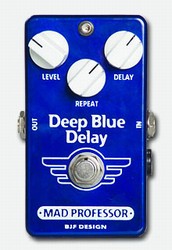 This is a “mini-review” only because I wanted to provide feedback on it after using it, and because I only used it in a limited way. The Mad Professor Deep Blue Delay is a digital/analog delay pedal meaning it is a digital delay with an analog direct signal path – or as Mad Professor puts it, the direct signal path is made of analog amplifiers with no filtering. In other words, it’s supposed to be transparent with no tone coloration.



 Guitar Gear
