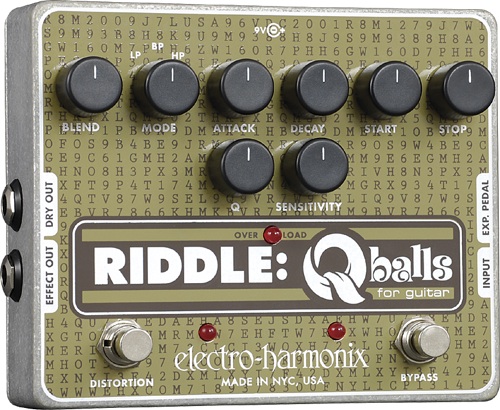
Q-Balls, that is… Introducing the new RIDDLE: Q-Balls from Electro-Harmonix, an envelope filter for guitar. The RIDDLE also has a brother for bass called the ENIGMA: Q-Balls.
So what exactly is the RIDDLE? As EHX put it, the RIDDLE is an “envelope controlled filter for guitar.” Synthesizer players have long known the beauty of adjusting a signal’s envelope or volume profile by emphasizing or limiting certain frequencies to create wholly unique sounds. Now, apparently, that is available for guitar with the RIDDLE. Check out this very cool demo video:
Damn! He did all that with an acoustic guitar!
I’ve grown to appreciate EHX over the last couple of years as they’ve come up with some really cool, thinking out-of-the-box pedals, like the Q-Tron, and of course, the POG. Yeah, they have your basic overdrive, distortion, delays, reverbs, etc., but stuff like the RIDDLE that open up the tonal possibilities of your guitar are quite commendable.
I’m not sure if the RIDDLE is something I’d use, but I’m writing about it here just because of its cool factor. Maybe I’ll take some time this weekend to see if I can’t check it out at a store.
I’ve had a love/hate relationship with Fender over the years. When I’ve loved Fender, I’ve really loved them, and when I’ve hated them, I’ve really hated them. Right now, I’m really hating them. I’m just aghast at the prices they’re charging for their new gear! This Champ ’57 Reissue from the Fender Custom Shop lists at $1295 with a street price of $999! This for a 5 Watt amp with a diminutive 8″ speaker.
Make no mistake: The parts for this cost less than $400! This pricing is absolutely outrageous. Yeah, I’m familiar with its history, blah, blah, blah. And even though I’m no electronics dude, and couldn’t possibly construct an amp myself, I know a few manufacturers who build hand-wired amps with more power and GREAT sound for even less!
Take for instance, the Aracom VRX22. This is a hand-wired, 22 Watt amp that simply kicks freakin’ ass, and the head sells for $895! Then, there’s the upcoming release of the Reason Bambino. This is an 8 Watt amp that will sport that distinctive Reason sound. This head costs $699! It’s my next amp.
I’m sorry folks, this is the same issue that I had with the Fender Roadworn series of guitars. I’m not really in to reliced guitars, but there’s no way I could justify paying $999 for a freakin’ MIM guitar, especially when I paid less than $400 a couple of years back for my MIM Strat.
MAYBE Fender’s production costs are much higher than the smaller run manufacturers (not likely), which is how they justify the price-point for this amp. But this amp is nothing special from my point of view, and as I mentioned above, the parts for this cost less than $400. Lots of people have built 5F1-based amps. Look at the Valve Train Amps Concord. This is a 6 Watt point-to-point, hand-wired combo with a 10″ speaker. It sells for less than $500.
Go ahead, you can argue all you want about the classic sound and history of the Fender ’57 Champ reissue. But to me, Fender’s just again trying to trade on nostalgia. If that’s what floats your boat, more power to you – and mind you – I’m not questioning the quality or the tone of this classic. It has done much to contribute to the sounds of rock and roll. I just want to make it very clear that there are clear alternatives out there that may not have the name but undoubtedly have great tone, and watt-for-watt, and dollar-for-dollar have A LOT more value.
Note that I have the Champ 600 and it is one of my all-time favorite amps. But it has limited usability outside of my home studio. And that’s another thing that bugs me about the ’57 re-issue. It’s a hefty price to pay for an amp that would see limited if any use outside of my studio.
Like I said, if this floats your boat, and the price of this classic reissue, more power to you. For me, I demand a lot more value for the money I pay.
Recent Update
I’m still not sold on this amp, even though I have indeed played it, and it has some real vintage mojo. The sounds it produces are fantastic, but I still can’t justify buying it for the price Fender wants for it. Besides, I’ve seen some late-50’s originals that sell for the same price on EBay! I would buy one of those before I’d buy the re-issue.
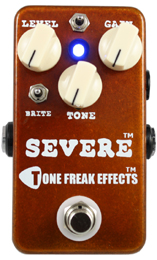
Released in May (how did I miss this?), the Severe is “Tone Freak Effects’ answer to high gain distortion.” Oh man… This looks like a incredibly mean pedal. Set up like the Abunai 2 with a 3-way clipping switch, with level, gain, and tone, the Severe also sports a 3-way bright switch so it can be used with different amps. Very cool.
As Derek Tabata mentions on his site, the Severe will never turn your tone into a compressed mushy mess. The distortion can be laid on thick but, remains open. I can attest to this with the Abunai 2. You can lay on thick overdrive with that pedal, but it’ll never turn super thick.
With the Severe, Derek has taken high-gain distortion to another level! I’m amazed at how it sounds in the sound clips! Check ’em out!
Severe Demo Clip
Les Paul
Les Paul
Tom Anderson
Personally, I’m not a high-gain type of player, however, as I’ve gotten more and more comfortable soloing, I’ve found that I’m pushing more and more into high-gain territory. The only problem is that to achieve that with an amp means it has to be LOUD. That’s why I love pedals like this! You get the effect you need at far lower sound levels.
The Nova Repeater news is a tad old, as it started shipping a couple of weeks ago, but retailers are still only taking pre-orders on it. I’ve been waiting for the Nova Repeater to come out for awhile, ever since I heard about it from Winter NAMM news. As TC Electronic puts it, this pedal is “No frills, with a sound that kills.” It truly is no-frills. There’s no programming of the pedal. It has a few features and that’s it. But what it has that I’ve not seen with other pedals is a feature TC calls, “Audio Tapping.” Essentially, you hold the tap tempo button down, then strum your guitar, and the delay is set based upon the strum. I can’t wait to try out this delay pedal! Here’s a demo video:
Nova Drive
Next up is the Nova Drive, which is an analog overdrive and distortion pedal that is controlled with a digital interface. Not sure how that works, but it does sound very cool. This is the same drive/distortion circuit that is in the Nova System, so if you know about that tone, you know it’s very nice. There are a couple of things that stand out about this pedal for me. First, you can change the order of the drive and distortion, making drive first, distortion second; and vice-versa. Second, you can also run the effects in parallel, which is totally – it provides a completely different dimension in the tone this pedal produces. It also has a MIDI input that you can hook up to a G Major system to program it. Not bad. Anyway, here’s another demo video:
There are some things in life that you just can’t pass up. About a week ago, my friend Jeff Aragaki of Aracom Amps mentioned people finding great vintage gear in pawn shops. I kind of stored that tidbit away for future reference, mainly because there aren’t any pawn shops really close to where I live. But today, I happened to park in front of a pawn shop (I work about 20 miles from where I live), and after lunch, on a whim, decided to go in. This was a little pawn shop that mostly specialized in jewelry, but they had a number of amps and guitars as well.
I wasn’t overwhelmed by the selection of gear; mostly no-name brands that I had never heard of, and as far amps were concerned, cheapo solid-state practice amps. But tucked in behind some guitars was a Fernandes Strat-copy that caught my eye. It had a nice, white finish with a maple neck (I LOVE maple necks), and it was obviously well-used from where I could see it. The shop owner walked up, and I asked to inspect the guitar. I was really impressed by the workmanship. I had heard of Fernandes guitars being very high-quality for a great price, but upon seeing the workmanship up close for the first time, I was very impressed. And even though this guitar was well-used, I could tell it was taken care of because of only minor scratches and dings on the body.
The tag on the guitar said it was for sale for $115 (sorry… if you came from the gear page, I mistakenly listed it at $125), and I asked if she’d take $100 including tax, and she agreed. Unfortunately, they didn’t take plastic in any form, so I had to decline on the guitar. But that was a good thing because it gave me some time to do some research. From what I could glean, this Strat-copy is a late-80’s (’86 and later) model of this guitar. What’s ultra-cool about this one is that it’s pure white. Almost all the pictures I saw today of late-80’s Fernandes Strat-copies were either tobacco burst or a solid that was other than white. This made the guitar a bit more unique. This was confirmed by a former Fernandes endorser that I hooked up with on The Gear Page.
In any case, I got this guitar for a steal!!! I’m going to fix it up, swap out pickups, give it a good cleaning and setup. Don’t know if I’m going to keep it, but no matter. It was a great deal!
So if you have a chance, take a peak into a pawn shop sometime. Oh wait! Another place you could look is at estate sales. A few years ago, I met an older gentleman and acoustic guitarist who SCORED a 1940’s Martin for a couple of hundred bucks at an estate sale, and had it appraised at around forty-grand! Amazing! Talk about a steal!
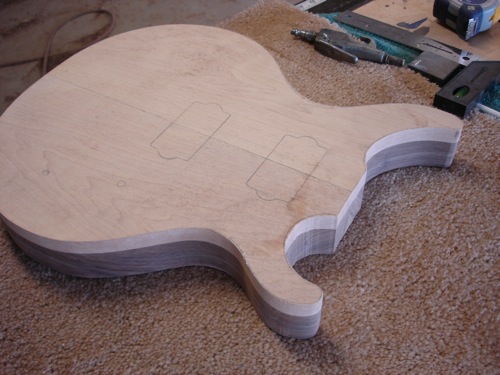
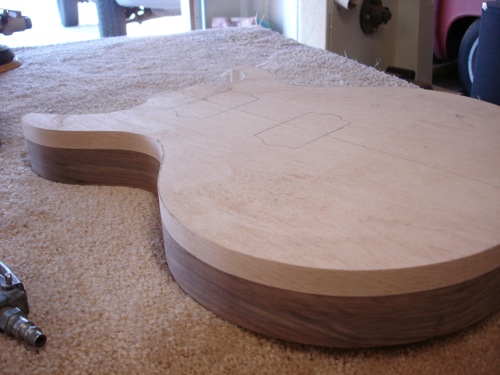
Talk about being blown away! I talked to Adam Hernandez of Saint Guitars the other day just to shoot the breeze and let him know I posted an announcement about his new web site. He in turn thanked me, then absolutely blew me away saying that Goldie was ready for finishing and would be done before the weekend! OMG!!! He sent me some progress pictures from just before finishing. BTW, the finish is vintage Les Paul gold…. Again, OMG!!!
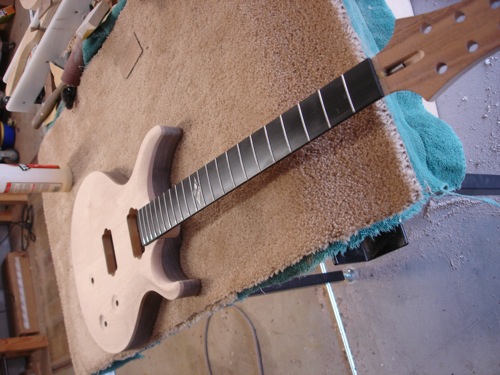
In any case, here are pictures of my guitar right before it went into finishing. I just can’t wait to play her!
I know I probably sound like a broken record and maybe a walking billboard for Saint Gutiars, but these are special guitars. Anyone who has played one of these will attest to that. And to have one of my own is just incredible. Adam and Jon just rock the house with their guitars!
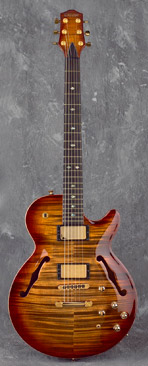
They are also coming up with a new “Vintage” model. I don’t know all the details, but it looks like a semi-hollowbody with a trapeze-style bridge. Very retro!
I just have to say this…
I know there are a lot of people out there who have lots of gear, and who trade their axes after a certain amount of time. That’s totally cool. I’ve spoken to some folks who are concerned about the resale value of these guitars. Because this is such a small company, there aren’t a lot of Saints out there, so there’s no price precedence. But in reply to that all I have to say is that from my perspective, Goldie isn’t a guitar that I’d ever consider trading away or selling. Why would I when she was made to my exact specifications?
For sure, Goldie won’t be the last guitar I ever buy. I’m way too much of a gear freak, slut, maniac, what-have-you, to settle with my collection; it’s a living breathing thing. But Goldie will always be special because she’s the very first custom guitar I’ve ever had, but also she’s the very first Saint Guitar I’ve owned.
I’ve been in the market for a wireless system for awhile, and there are lots of options out there. But one thing that has kept me from going completely wireless is that most wireless systems out there require the use of a beltpack. The AKG WMS40 is an exception to the rule, and from what I can tell, it’s a great solution for a great price (I have yet to try this unit out).
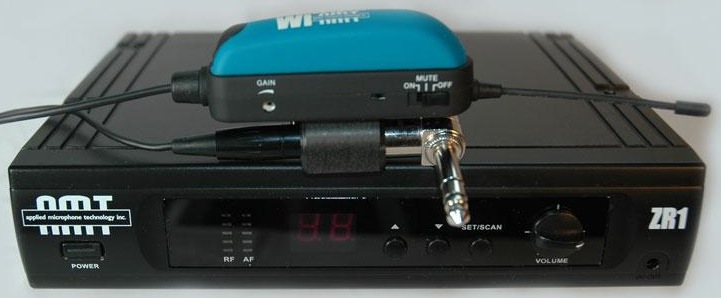
But the Wi5G shows a lot more promise in that not only can it be used with an electric guitar, you can attach it to an AMT micro-equipped unit on your acoustic guitar. So in terms of versatility, this unit sound pretty cool. Here’s the press release:
The AMT Wi5G — Guitar Wireless System is a removable 16 selectable channel wireless setup. The Wi5G is intended to work with all types of electric guitars. The system allows players to perform wireless without being tied down to a belt pack or wires of any type. The Wi5G features a plug in play style transmitter that is very light in weight. The sound clarity and wireless reception are very high. AMT’s philosophy is to develop the highest sonic quality in there products, and the guitar system stays right in line.
The most impressive feature of the Wi5G Guitar Wireless System is its ability to convert / adapt to all AMT microphones as well. The Wi5G transmitter, by unplugging the included ¼ in adapter, can then plug directly into any AMT microphone with D.C.T. (AMT’s disconnect cable technology). This feature allows the player to use the Wi5G system with there electric guitar, unplug the transmitter from there electric guitar and plug it into an AMT S15G acoustic guitar microphone setup already in place on an acoustic rig. The Wi5G is the only system on the market with the ability to switch from an electric pickup to a high quality acoustic instrument microphone. Along with the ability to switch between 16 channels, this makes the Wi5G and a S15G a valuable set of tools for all guitar players.
The Wi5G wireless system has changed the way a guitarist can perform. By allowing total freedom from wires, a belt pack, and / or a preamp the performers are able to move freely around the performance area. This concept frees up the artist from standing in front of a guitar amp tied down with a cable. The Wi5G assures that every nuance of the performance is heard as the artist intended it to be heard without changing the sonic quality of there instrument rig. AMT has developed there name on this high quality hand made philosophy.
The Wi5G transmitter features an on / off and a mute switch along with a gain adjustment. An LED is featured to show on / off as well as a low battery indicator. One AAA battery is needed to power the transmitter. Designed to be used with either pedals or an acoustic guitar, the ZR series receiver comes with both a ¼ inch and XLR output. The receiver, with an optional rack mount kit, can be mounted in a rack, set freely next to your pedals, amp, or any where close by.
The Wi5G works with all types of electric guitars with the included ¼” jack, as well as AMT microphone models: LS, WS, TA2, Z1, P800, M40, S15G, VS, S25B, and the S18C. Microphones sold separately.
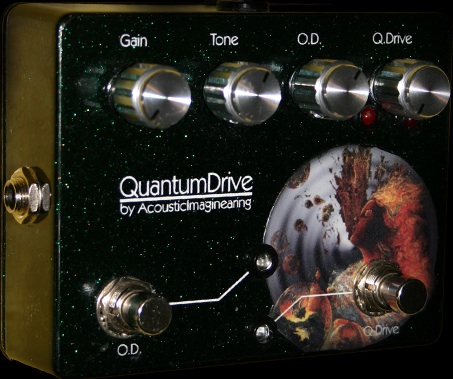
Brand-new from what appears to be a brand-new kind of overdrive/distortion, Acoustic Imaginearing has just released its new QuantumDrive, overdrive/distortion pedal. Folks, this appears to be totally new technology; the first and only that employs quantum mechanics tunneling to produce its distortion sound!
“The QuantumDrive, A.I.’s flagship product, is a versatile and unique overdrive and distortion unit that uses a patent pending process to dynamically shape the sound of the guitar by means of a quantum tunneling device. Quantum tunneling is a curious physics principle which allows matter to “pass through” other matter which would normally be impenetrable. A.I. has developed a means of using this effect to modify a guitar signal in unique and previously unheard of ways. The quantum distortion appears to add a vowel sound to the signal as well as emphasizing the consonant, fricative guitar distinctiveness. Affecting the edge of the waveform and not just the peaks, the result is a very expressive tone when played “in the zone.” Of course the pedal is also capable of wild and quirky, outside the norm distortions — each distinctive to the instrument processed by the Quantum Drive.
The effect is well suited for both guitar and bass, as bass frequencies are retained without becoming muddy. It has been used by Tony Levin on the latest King Crimson tour.
In addition to the distortion channel, the pedal has a solid overdrive channel, also uniquely designed, that can be used independently or chained together with the quantum channel.”
I gotta tell you, I love this kind of stuff! And the fact that this is an overdrive/distortion pedal (you know OD is my favorite kind of pedal) is even better! I’m very excited when inventors add a new twist to something familiar. It just goes to show that there’s no shortage of creativity and innovation in the world!
How It Sounds
There are very limited sound clips available on the site, but the interface to listen to them is a bit screwy. I was able to do a debug trace to figure out the sound clip file names. The following clips were done with a Les Paul with the rhythm pickup into the QuantumDrive and output through a Peavey Classic 30. The clips actually aren’t that good, as the massive amounts of reverb kind of mask what could really be a great sounding pedal. But from what I could here, this is a real open sounding distortion, with just a little fizz. What I like is how the signal tails off.
Light Quantum Drive
Medium Quantum Drive
High Quantum Drive
Note that this pedal also has an overdrive that you can mix with the quantum drive as well.
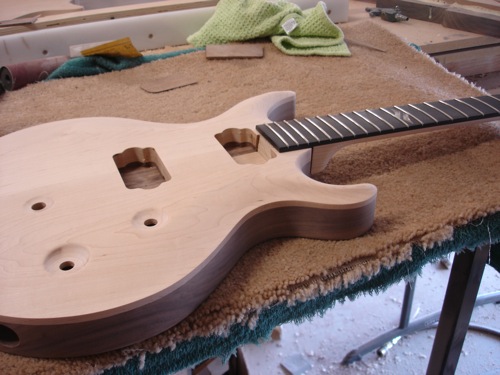
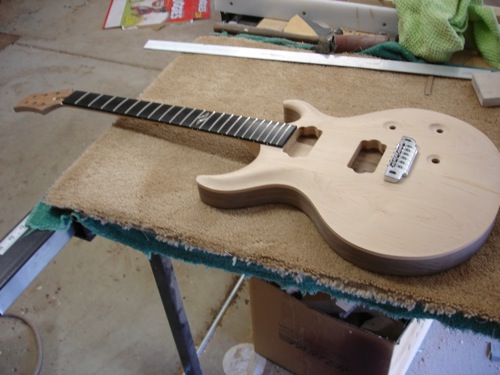
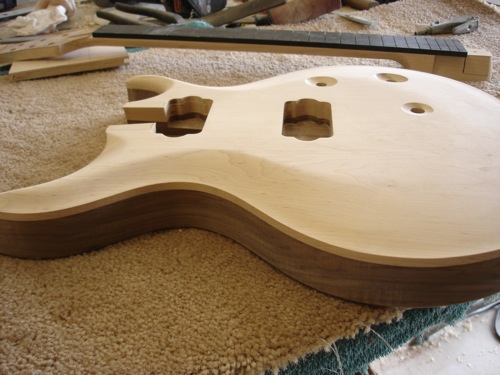
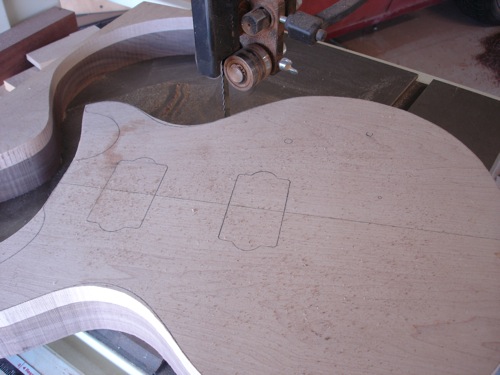
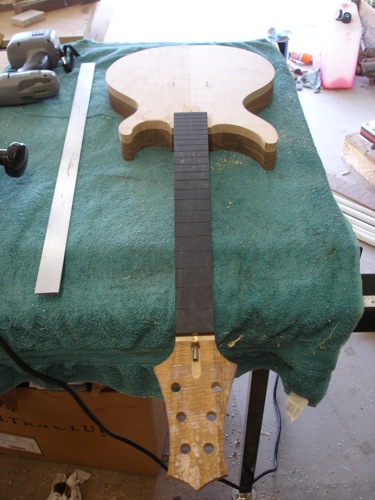
Just got these pics in. Goldie is really starting to take shape now. Adam took a couple of weeks for the glue to cure between the mohagany and maple top and the ebony fretboard and maple neck, which explains the temporary hiatus of pictures on the build progress. I am SO amazed about how it’s looking!
I really love the first shot where you can see how the body was cut from the mahogany and maple billets. I’m so stoked about this!
Note that I am not affiliated with Saint Guitar Compay, but I have gotten to know both Adam and Jon (who runs their ops), and they’re a great couple of guys who are totally passionate about what they do. Be sure to drop them a line!
Summary: One of the better synth guitars I’ve played to date. Great response time into the synth. Very well built and gorgeous looks. The one I played was a blue burst (not the one pictured).
Pros: Great looks and incredible acoustic sound, especially when plugged into an acoustic amp. Synth feature is VERY cool and the response is about the best I’ve played. Very light in weight – you could play this for hours and not get tired.
Cons: I was disappointed with the sustain, or lack thereof; especially in the top strings. Notes trailed off pretty quickly, no matter how hard I dug in and shook the strings. The driven sound of this guitar was a bit uninspiring, though the cleans are magnificent.
Price: ~$1900 direct
Specs: Visit site
Tone Bone Score: 4.5 – There’s a lot to like with this guitar, and if it weren’t for the lack of sustain and uninspiring drive sound, this would be a joy to play. In spite of my negatives, this is a very versatile instrument, and the mere fact that you have both guitar and synth going at the same time is simply awesome.
Several weeks ago, my good friend Dave shared with me that he had ordered a Carvin SH575 at the Carvin store while in Southern California on a trip. I had heard of this guitar from the Winter NAMM show, and was pretty excited about it. Dave finally got the guitar a couple of weeks ago, and let me borrow it so I could play around with it and do a review… so here it is! 🙂
Fit and Finish
Carvin makes some very pretty guitars, and this is no exception. A lot of care went into the details in building this instrument, and I have to say that I’m totally impressed with the build quality. The blue burst finish of the guitar I tested was quite magnificent, and everything down to the hardware was perfect.
Playability
Wow! I had never played a Carvin guitar before, and I have to say that I am incredibly impressed by how nice this guitar plays! The medium-jumbo frets are perfect, and moving around the neck is a real dream. Your fingers glide very easily over the strings (though I have to admit, I am NOT a fan of Elixir strings, which I think these come with stock). It’s no small wonder Steve Vai plays a Carvin. The SH575 is simply a dream to play, and this is really the saving grace of this guitar.
How It Sounds
I’m really conflicted in this area. Acoustically, this guitar rules. I love the acoustic sound of this guitar, especially when plugged into a good acoustic amp (Dave uses a Genz-Benz 150). But even plugged into my DAW from the synth unit, the acoustic tones were nothing short of amazing. Here’s an example:
In the clip above, I ran the 1/4″ out on the guitar into my pedalboard, and had the MIDI out go into the synth so I could have a nice background string pad to play over. Very neat! 🙂 In other words, I have two separate signals going into my DAW. As you can tell, the natural acoustic tone of the SH575 is gorgeous – it doesn’t sound like an acoustic plugged into an amp. It sounds like a big-body acoustic with a microphone in front of it! I love it!
In this next clip, I’m running only the MIDI out from the guitar into the synth, then into my DAW. I recorded two separate tracks: One for the guitar, then I overdubbed a “bamboo flute” patch over the guitar.
To play these parts individually, the volume knob is a combination volume knob with one volume “ring” around a central raised knob. The center knob controls the synth volume, while the outer ring controls the guitar volume. With the first clip, I had a mix of both guitar and synth. With this clip, for each individual part, I turned down the synth or the guitar to isolate the signal. Again, very cool.
In this final clip, I feature the guitar alone. I wanted to see how it sounded driven. The end result isn’t a bad sound at all, but I really had to work hard to get some sustain out of the guitar, and instead of just using the natural drive of my amp, I opted to run the guitar through my Tube Screamer and a touch of compression to add some sustain and give the signal some balls. Also, I played this clip with the neck pickup of the guitar, as the bridge pickup pretty much did nothing for me. Mixing the two was nice, but if this were my guitar, I’d lower the bridge pickup to reduce the treble just a tad. In any case, here’s the clip:
Overall Impressions
As I mentioned above, there’s a lot to like about this guitar from the synth access to the acoustic tones. I was thinking that perhaps a function of the lack of sustain might have to do with the Elixir strings that are put on at the factory. I’d probably string this guitar up with either pure nickel or nickel wound to get more resonance out of the strings. That might be the way to go to get a better electric guitar sound out of it. And as I mentioned, the electric guitar sound is not bad at all, and if I were to rate it just on tone, it would get really high marks. But the lack of sustain just kills me; truth be told, my Strat seems to have more inherent sustain than this guitar. Sad but true.
Don’t get me wrong. I like this guitar – a lot! I’d definitely use it for rhythm guitar and for acoustic simulation; and of course, for playing a synth along with it, which it is particularly great for.
 Q-Balls, that is… Introducing the new RIDDLE: Q-Balls from Electro-Harmonix, an envelope filter for guitar. The RIDDLE also has a brother for bass called the ENIGMA: Q-Balls.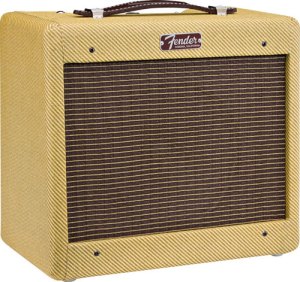
 Released in May (how did I miss this?), the Severe is “Tone Freak Effects’ answer to high gain distortion.” Oh man… This looks like a incredibly mean pedal. Set up like the Abunai 2 with a 3-way clipping switch, with level, gain, and tone, the Severe also sports a 3-way bright switch so it can be used with different amps. Very cool.



 Guitar Gear