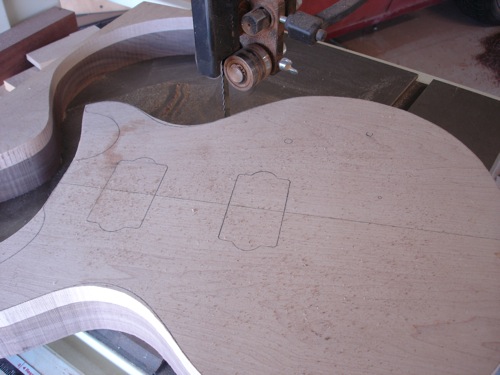
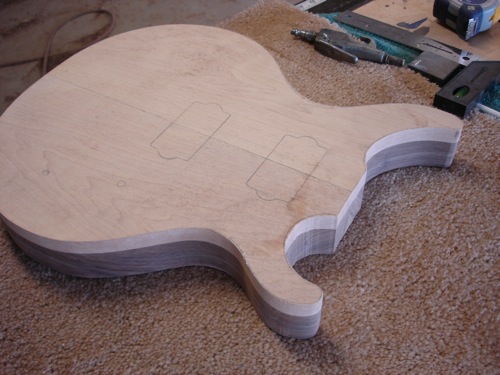
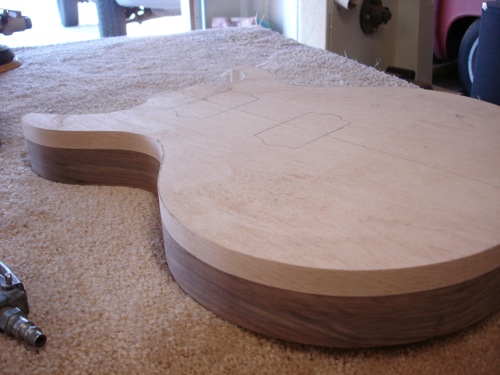
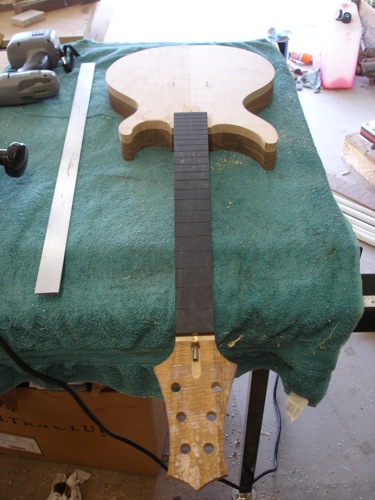
Just got these pics in. Goldie is really starting to take shape now. Adam took a couple of weeks for the glue to cure between the mohagany and maple top and the ebony fretboard and maple neck, which explains the temporary hiatus of pictures on the build progress. I am SO amazed about how it’s looking!
I really love the first shot where you can see how the body was cut from the mahogany and maple billets. I’m so stoked about this!
Note that I am not affiliated with Saint Guitar Compay, but I have gotten to know both Adam and Jon (who runs their ops), and they’re a great couple of guys who are totally passionate about what they do. Be sure to drop them a line!
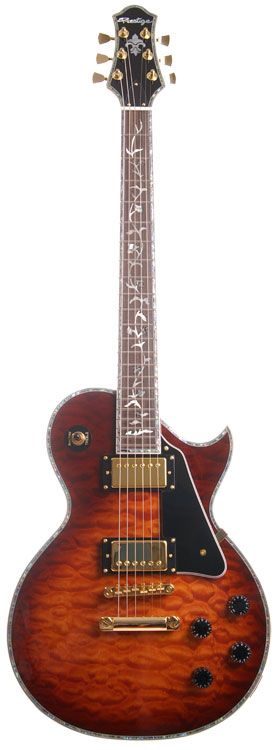
Pictured to the left is “Sugar,” my beloved Prestige Heritage Elite. It lists for $1800 Canadian (~$1450 US). But amazingly enough, you can get this guitar for $700-$800 on EBay!!! Click on this link to see items up for sale on EBay.
I’m absolutely amazed by this pricing! This is a guitar that has workmanship and features, not to mention sound and playability that rival boutique guitars five times its price! I’m so blown away by the prices that these are going for on the street, and it’s another reason to consider getting one of these guitars! Here are some sample clips:
Clean or dirty, this guitar sounds amazing!
Prestige Amps
Prestige also carries two tube amps, the VT-10 and VT-30. Here’s an EBay link to a VT-10 for $160!!! That’s absolutely ridiculous! Based on the price alone, I’m going to pick one of these up!!!
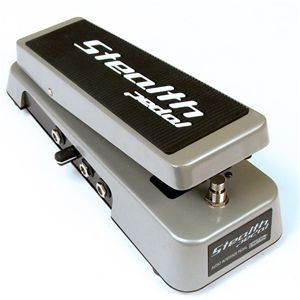
For those computer-based DAW jockeys, you know about IK Multimedia’s Amplitube software. I recently wrote a review of Amplitube Fender Edition, and loved it. Now I have an even bigger reason to love it, and that’s IK Multimedia’s StealthPedal which looks like an expression pedal but is actually a fully-functional, USB-powered audio interface WITH a built-in expression pedal. How friggin’ cool is that?
Folks, this thing works, and it works well, as my full review, which will be released in a few days will bear out. As an audio interface, it may not have a lot of bells and whistles, but for the home recording studio buff, this is a great, affordable, high-res audio device that can take a direct in from your guitar or pedal board, or a line out from a pre-amp to use for layering tracks.
But because the pedal has the ability to act as a controller for any “Powered by Amplitube” software or plug-in, you may not even need an amp to record your guitar parts! There are enough fantastic-sounding amp models packed into the various Amplitube packages that you’ll be sure to find a model that works for you. Plus the software effect plug-ins that the StealthPedal can control give you added tone shaping abilities.
In my impending review, I’ll have more clips to share, but here’s a “torch song” that I’ve been working on that features the StealthPedal in action as an audio interface:
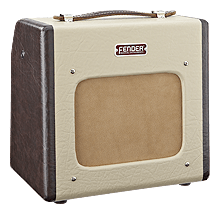
Except for the drum loop, all the instruments were recorded using the StealthPedal as the audio interface. I did a line-in directly for the electric piano. For the guitar parts, the amps are both software amps! For the rhythm part I used a Fender Champ 600 with a virtual compressor rack plug-in and my Strat plugged directly into the StealthPedal. For the lead part, I plugged into my pedal board and used my Tone Freak Effects Abunai 2 overdrive, and a Hardwire RV-7 Reverb. For the amp, I used a ’59 Bassman model. Imagine that! Software that sounds this good!
I know, nothing sounds like or feels like a real amp, but the convenience and the general sound quality of these models, plus the high-fidelity of the StealthPedal isn’t lost on me. It’s a nice, compact audio solution that combined with the software, will definitely make a difference in how you approach recording guitars.
My good friend Jeff recently lent me his Nash Tele – a T-52. He’s one of those guys who’s totally into that relic look. Me on the other hand? Give me a nice shiny guitar any day! And even if I found an old guitar at an estate sale, I’d have it cleaned and brightened – though to retain its value, I wouldn’t do anything other than to freshen it up). But as you can’t judge a book by its cover, so it goes with guitars. Just because a guitar looks beat up and old, in the end, it’s how it sounds and plays that really matters, and the Nash Tele I just got done playing with is a total joy to play, with very nice tones to boot!
One thing that really impresses me about the guitar is how fast the neck is. It is so easy to move around on the neck that I was making tons of mistakes at first because I was able to play with a lot of speed. A lot of that has to do with how easy it is to play a note. Just lightly press, and the guitar starts to sing! Of course, there’s not much sustain, but that’s to be expected out of a Tele or tele-like guitar.
Just in case you missed all the excitement, I had written an article about the Fender Roadworn series awhile back. I basically said in the article that I just really don’t get the relic thing, and that I’d rather to the “relicing” myself. If that’s your thing, more power to you – what inspires us is what makes us great. But cosmetics aside, it’s also how a guitar feels and it enables you to express yourself. So even though I don’t get the relic thing, just based on playability and sound, I could easily own one of these. They are very nice guitars!
Rating Summary:Surprisingly enough, my little ding didn’t come from my not “getting it” with the relic look. The guitar I tested had a weird buzz in the second string, and it wasn’t due to fret buzzing either. It didn’t really show up when the guitar was plugged into an amp, but it was really evident. Otherwise, the guitar played and sounded great!
I can just imagine the heat from the flames I’d get on the forums if I said this, but this is something I just can’t hold back any longer after reading so many threads on the Ultimate Attenuator. I’ve spent a lot of time studying how different attenuators work, and I’ve come to the conclusion that despite its popularity, this is not an attenuator that I’d even consider getting, even if it’s at a reasonable price – which it isn’t. I have a lot of different reasons for not liking this attenuator, but the biggest issue to me is the fact that with the UA, the amp is no longer reacting with the speaker and vice-versa. The UA has a cheap, solid-state amplifier built into its circuitry to re-amplify the amp’s signal after it has passed through the 32 ohm fixed resistor. At that point, the speaker is interacting with the solid-state amp. How that can pass for transparency is beyond me.
Then there’s the fixed resistor. Don’t even think about running a 2 or 4 ohm output into that attenuator. You’re risking serious damage to your amp if you do that. The impedance mismatch there is so high, it has the potential to fry your power tubes or worse. As an add-on, you can get the 16/32 ohm switch, or get one of Ted Webber’s impedance matchers. But then you’ve already spent $750 – that’s just nuts!
I use the Dr. Z Airbrake which uses a rheostat type of resistor to provide variable attenuation. People have complained that at high attenuation levels it sucks tone. It does indeed, but for normal usage, just above loud conversation volume, it is very transparent, and I would daresay that it’s much more transparent than the UA because the amp and speaker are still reacting to each other as there is no “middle-man” solid-state re-amplifier.
I’m probably going to piss people off with this little rant, but so be it. I freely admit that I’m no electronics expert, but I do have the intelligence to understand a thing or two about amps, and a re-amplified attenuated signal – at least to me – isn’t going to be transparent.
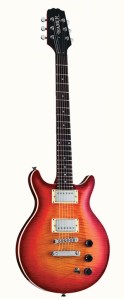
Summary: Modeled after the Hamer USA Studio, this Chinese-made axe is an affordable alternative to its American cousin. Featuring a solid mohagany body and neck with flame maple top and rosewood neck, the XT Sunburst has a naturally bright voice that’s both versatile and expressive. Very nice build quality.
Pros: Sweet, gorgeous voice at mild breakup levels, but is quite comfortable doing high-gain, which is probably where it’s best applied. This would be a great starter electric guitar!
Cons: Not much inherent sustain, especially in the upper registers where the guitar seems to lose gas. Hamer headstock is huge (that’s just a personal nit)!
Tone Bone Score: 4.0 – This is not a bad guitar, and it would definitely be something I’d consider as a starter instrument for one of my kids. It’s a nice-looking and with a little work, a nice playing guitar that would be perfect for which to start out a new guitarist.
In addition to being an incredible amp builder, Jeff Aragaki of Aracom Amps is as much a gear slut as I am, probably more so with guitars. Recently, he made the purchase of a Hamer XT Sunburst that he let me test. I had only played USA Hamer’s in the past, so this was to be my first experience with one of Hamer’s Chinese-made guitars.
Fit and Finish
Taking the XT Sunburst out of its gig bag, I was struck by its looks. It is a very beautiful guitar, and the burst finish really accentuates the flame maple top. It is also extremely light in weight, which is a huge point in its favor. Hamer calls it an “archtop,” but it’s more of a carved top, with gorgeous lines. The body wood is made of two pieces mahogany that look like they came from different parts of the tree. It’s not bad, it’s just kind of funky looking. Overall though, the finish is quite nice.
The neck is an extremely shallow C-shape neck. It felt pretty good in my fretting hand, and made it easy to get around the neck with ease. I love the short neck butt of this guitar, which allows you to reach real high notes without first having to do hand-stretching exercises.
Playability
Here’s where the poor setup that I mentioned above came into play. The action was set pretty high, and lowering the action just a fraction immediately caused some string buzz which means that there’s a bit of a bow in the neck. I confirmed this with a quick spot check. It’s not my guitar so I didn’t want to adjust the truss rod. The high action made it difficult to move with speed across the strings. But mind you, it’s not so bad that the guitar is unplayable. I would suspect that with a good setup, this guitar has the potential to play very nicely.
Sound
Tonally, this is a very nice-sounding guitar. I just wish there was more of it. The thin body and neck don’t provide enough resonance to hold notes for very long, so if you’re looking for a guitar that will sustain for a long time, this ain’t it. The saving grace is the very beautiful voice it does have. Here’s a clip I quickly recorded:
The guitar was plugged straight into the drive channel of my Aracom VRX22. Volume was set at just the edge of breakup. The guitar was recorded dry, and I added just a touch of reverb after the fact.
Like I said, the XT Sunburst has a sweet, bright voice.
Overall Impressions
For a sub-$500 guitar, it’s not bad at all, and as a start guitar, it would be perfect. And as long as you keep your expectations aligned with what this guitar has to offer, it’ll serve you well. I did get a chance to plug it into my pedal board, and playing it through a compressor/sustainer or an overdrive pedal that adds some sustain will work wonders with this guitar. It does play nice with pedals, which is a saving grace.
I’ve been playing my Prestige Heritage Elite so much lately that I forgot how fun it was to get funky with my Strat. So this morning, I plugged my Strat into my board, switched on the Abunai 2, and found a sweet spot that would give me just a bit of grind when I played single notes with nice grit when I dug in or played chords. Then I started playing this little funky riff that I just laid down.
I just can’t get over how good this pedal sounds with any guitar! With my Strat, I’ve always tended to play it much more clean than my other guitars. The ’57 Tex Mex pickups – at least to my ears – have never sounded very good with overdrive. I’ve always felt the drive was harsh. But the Abunai 2 really smoothens out the drive, and now I’m diggin’ playing with some real grit on my Strat.
By the way, if you missed the first clip I recorded using my Heritage Elite, here it is below:
My Aracom VRX22 just loves this pedal as well. Some might argue that with such a great amp that has a fantastic overdriven sound that I should be using the natural overdrive of the amp. In answer to that, sometimes I want a completely different overdrive character than what my amp has to offer, and an overdrive pedal through the clean channel of an amp has a totally different character than the drive channel.
Also, in a home studio environment where I have to keep the volume down, an overdrive pedal allows me to get some snarling-dog overdrive without having to crank my amp. And with a pedal like the Abunai 2 that simulates voltage sag and tube compression so well, I can get that cranked amp tone at bedroom levels!
There are lots of mods out there that are aimed at improving the performance of a Fender Champ 600. And if you’re a proud owner of one as I am, you’ll know some of those mods such as this one that replaces the output transformer with a much better one from Mercury Magnetics. From what I’ve heard, this is one very nice mod and creates a much better output. There are also various transistor and resistor mods available as well. But for one such as myself that is scared to death of working with electrical components, there are a couple of easy and safe ways to drastically improve your Champ’s tone – all without doing modifications on any electrical component.
First, replace the stock 12AX7 with a different tube. For me, I love the NOS JAN-Philips 12AX7. But if I want a bit earlier breakup, a JAN-Philips 5751 works awesome as well.
Run the amp into a larger cabinet. The stock speaker is diminutive, and keeps the amp from being used in any live situation – even with a small band. There’s just not enough volume. But plug into a 1 X 12, and now you’ve got some volume! Throw in a couple of pedals, and you’ve got yourself a killer little setup.
See? No smell, no mess, though I do have to say that replacing the stock pre-amp tube is a bit of a pain as the tube has a protector around it, and it’s not all that easy to remove. But once you’ve got the protector off, it’s a simple matter of plucking the old tube and putting in the new one.
My very close friend and fellow gear slut, Peter Jagielski, has just officially launched an interesting site called Guitaraholic.com, a place where you can keep track of your ever-growing inventory of guitars – down to the nitty-gritty details. Plus, you can hook up with other buyers and sellers of various axes through the site’s “marketplace.” What sets this particular marketplace apart from the buying/selling/trading on the forums is that Peter offers an escrow service for a small fee to add a bit of insurance that no one gets screwed, and to ensure that only serious players are involved. That’s definitely peace of mind for buyers and sellers.
Since the site is fairly new, there’s not much in the marketplace at the moment, but I do know that several people have been entering their information into the Guitaraholic database; unfortunately, at this time, you can’t see other members’ axes. That will hopefully be remedied soon. You never know, but you could be perusing the guitars that are on the site, come across a very cool guitar that doesn’t happen to be in the database, and make an offer to the buyer. That would add an interesting twist, wouldn’t it?
Peter’s a great guy, and I’ve had the priviledge of knowing him for many years. I think his idea is great, and with time, and perhaps a bit of luck, the site will evolve into a busy marketplace to find some real gems! In any case, here’s a copy of Peter’s press release:
CONTACT INFORMATION:
Peter M. Jagielski, Founder
Guitaraholic
Phone: 614-578-4374
peterj@guitaraholic.com http://www.guitaraholic.com
Guitaraholic Launches New Website for Guitar Collectors, Buyers & Sellers
Columbus, OH, 05/20/2009 – Guitaraholic™ announces the general availability of its web site http://www.guitaraholic.com. Guitaraholic is a web site dedicated to guitar collectors, sellers & buyers. Membership is free. The web site’s core function is to enable guitar owners to keep detailed track of their collection, from the color of the guitar down to the type of screws holding down the truss rod cover, and everything in between, including hardware and electronics. Guitarists may also upload pictures of their guitars, which can then be used with the web site’s other major feature, the Marketplace, where members can buy and sell guitars. Many of the relevant details that a member can specify about a guitar can then be included in the guitar’s listing, thereby making it quick & easy for sellers to list a guitar, and provide vital information to potential buyers about the guitar. To sell a guitar, members need only pay a listing fee of $4 USD. To facilitate a secure transaction between buyer & seller, Guitaraholic offers an escrow service for a fee of $20 USD.
About Guitaraholic – Guitaraholic launched on a limited basis at the end of 2008 to select members of the
guitar collecting community. The web site is now available to all guitarists. Numerous upgrades are planned
through the remainder of 2009. All major web browsers are supported, but Firefox™ is recommended.
Summary: In Japanese, “abunai” means dangerous, and this pedal’s overdrive tones are indeed dangerous – at least to your other overdrive pedals. With three switchable clipping configurations, you can dial in a myriad of overdrive characteristics that’ll suit any situation, be it live or in the studio.
Pros: The magic’s in the three-way clipping configuration switch. Super simple to use, and very easy to dial in the kind of overdrive character you want.
Tone Bone Score: 5.0 – As I shared with Dereck Tabata (maker of Tone Freak pedals), with the amount of gear that I run across, I’m rarely blown away by pedals. But I was completely blown away by the Abunai 2. Step aside Tube Screamer, there’s a new sherriff in town.
One rainy friday night several months ago, I was sitting in an Armadillo Willy’s eating my dinner and surfing the web, while waiting for my son’s hockey practice at the rink across the parking lot to end. I was doing what Internet geeks like myself occasionally do: Search for available domain names, and reserve them, just in case I want to build a site or point them to this blog. In this case, I did a google search on “tone freak.” The first listing was for Tone Freak Effects; an effects manufacturer I had not even heard of at that point.
Being the gear slut that I am, I just had to mosey on over to the Tone Freak site, and check out what they had to offer. And much to my extreme pleasure, they had a bunch of overdrive pedals, my favorite kind of effect! I immediately reached over to my laptop bag and pulled out my ear buds so I could listen to clips. The first set of clips I listened to were recorded with the Abunai 2. From the very first clip, I felt that this pedal was something special. It wasn’t a Tube Screamer tone – it was something altogether different. It had a much “ballsier” sound than a Tube Screamer, but seemed to clip very similarly – at least in the middle position.
Well I got one in for review just yesterday, and from the moment I hooked it up to my board and started noodling, I was in love!!! And by 2am this morning, I was spent, which accounts for why I’m doing a review of the Abunai 2 the very next day. I just couldn’t stop playing (though after the first hour I did stop to take a break and write a First Impressions article)! So today I’m a bit fuzzy and a little worse for wear, but grinning from ear-to-ear because I just spent the previous evening in absolute overdrive bliss! I know some gear is good when it can consume my attention for hours on end. This is the perfect overdrive pedal!
Features and Ease-of-Use
The features are listed in the summary section above, but the most special feature of this pedal is the three-way mini-toggle set between the drive and volume knobs. This controls the variable clipping section which gives you symmetrical, asymmetrical, and no clipping to open up lots of different overdrive tones. As far as ease-of-use is concerned, this pedal’s easy to use. Select the clipping configuration you want, adjust level, gain, and tone, and you’re off to the races!
Interestingly enough, I wanted to get some background information on the pedal before I received it, so I had a nice conversation with Rob at Tone Merchants about the Abunai 2. He indicated that I’d have to spend a lot of time dialing in just the right overdrive tone I wanted, but once I got it, I’d be totally happy. Call me lucky, but I set everything in the middle position to start with, spent maybe 20 seconds twiddling the knobs, and found a sweet spot. I suppose it also all depends on how discerning or nit-picky you are… I’ll just call it luck for my experience. 🙂
How It Sounds
Many words come to mind with respect to how the Abunai 2 sounds: Killer, Inspirational, Ballsy, F-in’ Incredible! All of the above. To date, this is the best-sounding overdrive pedal I’ve ever played, and I’ve played a lot. You know how taken I was with the OCD, but even that lost out to the Holy Fire, which is yet another killer overdrive/distortion that will never leave my board – actually I shouldn’t say “never” because that’s exactly what I said about my Tube Screamer. It’s not transparent – at least not nearly as transparent as the Holy Fire – but the tone it produces is so damn sweet, who the hell cares about transparency? But that said, the tone of your amp doesn’t really change a lot. It just takes on a slightly different character, and that difference is simply wonderful
No matter what toggle position you go with, the Abunai 2 serves up lots of sustain that gives the resultant tone a very 3-dimensional quality. It’s in your face, but at the same time it’s very spacious – even when it’s simulating tube compression!
In case you missed the previous article where I described how each position sounds, let me rehash it here. Note that I’m not going to try to identify which position refers to symmetrical, asymmetrical or no-clipping; only what it sounds like to my ears.
Middle
The middle position sounds much like a classic overdrive tone. It’s an open type of distortion tone with a nice grind that’s never harsh. This could be the closest you get to a Tube Screamer tone, but it’s significantly different from that tone. This is a great toggle position for playing dirty rhythm parts.
Left
To my ears, this position sounds much like the tone you get as your power tubes start to saturate. You get a bit more voltage sag, resulting in more sustain and compression, but the overdrive tone still remains fairly open. And like an amp whose power tubes are starting to saturate, you get a slight volume drop. So far, this has been my favorite toggle position for leads.
Right
This position simulates fully saturated power tubes adding tons of compression, tons of sustain, and the expected drop in volume as a result -it’s spongy. I compensated for this by adding some clean boost to get the volume back to unity gain. But despite that, notes are clear, and the dynamics are still incredible.
Here’s a sound clip I recorded at around 1am this morning. I played both parts using my Prestige Heritage Elite. For the rhythm part, I set the toggle in the middle position, rolled off the drive to about 10 am, set the gain to unity, and placed the tone dead-center. I had both my ‘buckers engaged for this part. For the lead, I used the left toggle position, upped volume to about 2pm, set the Tone wide open, and set the Drive to about 1pm. The lead was played through my bridge pickup.
I tracked the rhythm part in a single take, and then loop recorded the lead so I could just jam. I’m not sure what iteration the loop was in when I finally stopped. All I know was that it was about 2am, and I took the last “take” and exported the clip to an MP3.
Overall Impressions
As I mentioned above, my head’s fuzzy, I’m a little worse for wear, plus my fingertips hurt from playing so long last night. But what the hell! I was in complete tonal bliss! The Abunai 2 is an absolute dream come true in overdrive tone! This is a pedal that you just have to check out if you’re in the market!
 My good friend Jeff recently lent me his Nash Tele – a T-52. He’s one of those guys who’s totally into that relic look. Me on the other hand? Give me a nice shiny guitar any day! And even if I found an old guitar at an estate sale, I’d have it cleaned and brightened – though to retain its value, I wouldn’t do anything other than to freshen it up). But as you can’t judge a book by its cover, so it goes with guitars. Just because a guitar looks beat up and old, in the end, it’s how it sounds and plays that really matters, and the Nash Tele I just got done playing with is a total joy to play, with very nice tones to boot!


 My very close friend and fellow gear slut, Peter Jagielski, has just officially launched an interesting site called
 Guitar Gear