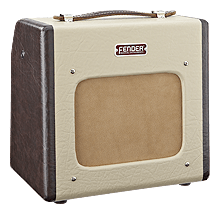
There are lots of mods out there that are aimed at improving the performance of a Fender Champ 600. And if you’re a proud owner of one as I am, you’ll know some of those mods such as this one that replaces the output transformer with a much better one from Mercury Magnetics. From what I’ve heard, this is one very nice mod and creates a much better output. There are also various transistor and resistor mods available as well. But for one such as myself that is scared to death of working with electrical components, there are a couple of easy and safe ways to drastically improve your Champ’s tone – all without doing modifications on any electrical component.
First, replace the stock 12AX7 with a different tube. For me, I love the NOS JAN-Philips 12AX7. But if I want a bit earlier breakup, a JAN-Philips 5751 works awesome as well.
Run the amp into a larger cabinet. The stock speaker is diminutive, and keeps the amp from being used in any live situation – even with a small band. There’s just not enough volume. But plug into a 1 X 12, and now you’ve got some volume! Throw in a couple of pedals, and you’ve got yourself a killer little setup.
See? No smell, no mess, though I do have to say that replacing the stock pre-amp tube is a bit of a pain as the tube has a protector around it, and it’s not all that easy to remove. But once you’ve got the protector off, it’s a simple matter of plucking the old tube and putting in the new one.
Summary: In Japanese, “abunai” means dangerous, and this pedal’s overdrive tones are indeed dangerous – at least to your other overdrive pedals. With three switchable clipping configurations, you can dial in a myriad of overdrive characteristics that’ll suit any situation, be it live or in the studio.
Pros: The magic’s in the three-way clipping configuration switch. Super simple to use, and very easy to dial in the kind of overdrive character you want.
Tone Bone Score: 5.0 – As I shared with Dereck Tabata (maker of Tone Freak pedals), with the amount of gear that I run across, I’m rarely blown away by pedals. But I was completely blown away by the Abunai 2. Step aside Tube Screamer, there’s a new sherriff in town.
One rainy friday night several months ago, I was sitting in an Armadillo Willy’s eating my dinner and surfing the web, while waiting for my son’s hockey practice at the rink across the parking lot to end. I was doing what Internet geeks like myself occasionally do: Search for available domain names, and reserve them, just in case I want to build a site or point them to this blog. In this case, I did a google search on “tone freak.” The first listing was for Tone Freak Effects; an effects manufacturer I had not even heard of at that point.
Being the gear slut that I am, I just had to mosey on over to the Tone Freak site, and check out what they had to offer. And much to my extreme pleasure, they had a bunch of overdrive pedals, my favorite kind of effect! I immediately reached over to my laptop bag and pulled out my ear buds so I could listen to clips. The first set of clips I listened to were recorded with the Abunai 2. From the very first clip, I felt that this pedal was something special. It wasn’t a Tube Screamer tone – it was something altogether different. It had a much “ballsier” sound than a Tube Screamer, but seemed to clip very similarly – at least in the middle position.
Well I got one in for review just yesterday, and from the moment I hooked it up to my board and started noodling, I was in love!!! And by 2am this morning, I was spent, which accounts for why I’m doing a review of the Abunai 2 the very next day. I just couldn’t stop playing (though after the first hour I did stop to take a break and write a First Impressions article)! So today I’m a bit fuzzy and a little worse for wear, but grinning from ear-to-ear because I just spent the previous evening in absolute overdrive bliss! I know some gear is good when it can consume my attention for hours on end. This is the perfect overdrive pedal!
Features and Ease-of-Use
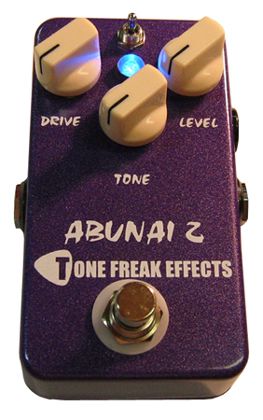
The features are listed in the summary section above, but the most special feature of this pedal is the three-way mini-toggle set between the drive and volume knobs. This controls the variable clipping section which gives you symmetrical, asymmetrical, and no clipping to open up lots of different overdrive tones. As far as ease-of-use is concerned, this pedal’s easy to use. Select the clipping configuration you want, adjust level, gain, and tone, and you’re off to the races!
Interestingly enough, I wanted to get some background information on the pedal before I received it, so I had a nice conversation with Rob at Tone Merchants about the Abunai 2. He indicated that I’d have to spend a lot of time dialing in just the right overdrive tone I wanted, but once I got it, I’d be totally happy. Call me lucky, but I set everything in the middle position to start with, spent maybe 20 seconds twiddling the knobs, and found a sweet spot. I suppose it also all depends on how discerning or nit-picky you are… I’ll just call it luck for my experience. 🙂
How It Sounds
Many words come to mind with respect to how the Abunai 2 sounds: Killer, Inspirational, Ballsy, F-in’ Incredible! All of the above. To date, this is the best-sounding overdrive pedal I’ve ever played, and I’ve played a lot. You know how taken I was with the OCD, but even that lost out to the Holy Fire, which is yet another killer overdrive/distortion that will never leave my board – actually I shouldn’t say “never” because that’s exactly what I said about my Tube Screamer. It’s not transparent – at least not nearly as transparent as the Holy Fire – but the tone it produces is so damn sweet, who the hell cares about transparency? But that said, the tone of your amp doesn’t really change a lot. It just takes on a slightly different character, and that difference is simply wonderful
No matter what toggle position you go with, the Abunai 2 serves up lots of sustain that gives the resultant tone a very 3-dimensional quality. It’s in your face, but at the same time it’s very spacious – even when it’s simulating tube compression!
In case you missed the previous article where I described how each position sounds, let me rehash it here. Note that I’m not going to try to identify which position refers to symmetrical, asymmetrical or no-clipping; only what it sounds like to my ears.
Middle
The middle position sounds much like a classic overdrive tone. It’s an open type of distortion tone with a nice grind that’s never harsh. This could be the closest you get to a Tube Screamer tone, but it’s significantly different from that tone. This is a great toggle position for playing dirty rhythm parts.
Left
To my ears, this position sounds much like the tone you get as your power tubes start to saturate. You get a bit more voltage sag, resulting in more sustain and compression, but the overdrive tone still remains fairly open. And like an amp whose power tubes are starting to saturate, you get a slight volume drop. So far, this has been my favorite toggle position for leads.
Right
This position simulates fully saturated power tubes adding tons of compression, tons of sustain, and the expected drop in volume as a result -it’s spongy. I compensated for this by adding some clean boost to get the volume back to unity gain. But despite that, notes are clear, and the dynamics are still incredible.
Here’s a sound clip I recorded at around 1am this morning. I played both parts using my Prestige Heritage Elite. For the rhythm part, I set the toggle in the middle position, rolled off the drive to about 10 am, set the gain to unity, and placed the tone dead-center. I had both my ‘buckers engaged for this part. For the lead, I used the left toggle position, upped volume to about 2pm, set the Tone wide open, and set the Drive to about 1pm. The lead was played through my bridge pickup.
I tracked the rhythm part in a single take, and then loop recorded the lead so I could just jam. I’m not sure what iteration the loop was in when I finally stopped. All I know was that it was about 2am, and I took the last “take” and exported the clip to an MP3.
Overall Impressions
As I mentioned above, my head’s fuzzy, I’m a little worse for wear, plus my fingertips hurt from playing so long last night. But what the hell! I was in complete tonal bliss! The Abunai 2 is an absolute dream come true in overdrive tone! This is a pedal that you just have to check out if you’re in the market!
In my ever-constant search for new gear, I accidentally stumbled upon Tone Freak Effects, a little boutique effects shop in Southern California. And you know me, I DIG OVERDRIVE pedals!!! I know, I say that a lot, but I really do. When I listened to sound clips of the Abunai 2, I knew it was a pedal that I had to check out, so I contacted Tone Freak, and asked to do a review on one of their pedals. Dereck Tabata, maker of the effects, emailed me back and offered to have me review the Abunai 2. That was exactly the pedal I wanted to try out because based upon the sound clips of the Abunai 2 Dereck had on his site, it sounded absolutely killer.
Well after a moderate wait for Dereck to set up his new company and for him to create enough stock to send one out, I finally got my review pedal. I just got done playing with it for the last hour, and was so excited by its tone, that I had to release a first impressions article.
So I’ll just say this: After many years, my Tube Screamer is going to get retired for awhile. Mind you, I didn’t say I’d get rid of it. There is something about that Tube Screamer tone that I will always love. But even after just an hour of playing with the Abunai 2 and discovering just a fraction of the plethora of tones it can produce, I think I’ve found an overdrive pedal that I love as much or perhaps even more than the Tube Screamer. I know… I never thought I’d say that.
Let me give you a quick rundown of the Abunai 2…
When you first look at this pedal, you’re totally taken in by the absolutely cool purple, sparkly paint job. The picture here doesn’t do the pedal justice at all. Then you notice that it has a three knob setup, just like most overdrive pedals. Then you plug the pedal in, and that’s where the magic starts. That magic comes from the three-position mini toggle that gives you overdrive tone-shaping possibilities you never thought possible. These three positions give you very different overdrive characteristics. No matter what position you’re in, the tones this diminutive pedal produce are about the most incredible tones I’ve ever heard in an overdrive! Freakin’ awesome! Let me quickly go over each different position.
Middle
I’m starting with the middle position because that position provides that classic overdrive tone. It’s not a mid-range hump like a tube screamer. Like the Creation Audio Labs Holy Fire, the full spectrum of the EQ is represented. The distortion characteristics are pretty open in this position, and the pedal reacts very much like an overdriven tube amp.
Left
This position seems to simulate distortion when the power tubes start saturating and you get just a tiny bit of compression. This lowers the volume just a tad, but it increases the sustain. But the distortion is still open – so far this is my favorite toggle position.
Right
Metal rockers will love this toggle position. This position simulates fully saturated power tubes adding tons of compression, tons of sustain, and the expected drop in volume as a result. I compensated for this by adding some clean boost to get the volume back to unity gain. This is a VERY fun position to play in (that sounds kinda kinky…). Notes just sing and sing and sing in this toggle. But the cool thing is that despite the incredible amount of compression, the pedal maintains a lot of clarity in individually picked notes.
What a great first impression! This pedal totally kicks ass, as I’m sure Dereck’s other pedals do! It’s no small wonder why Greg Howe uses a Tone Freak Buff Puff! When I do my full review, I’ll have sound clips to demonstrate the differences in the tones between the different toggle positions! Rock on!
Ever since I discovered this kid a couple of years ago, I’ve been absolutely blown away by the maturity of this guitar playing. This kid is AMAZING! It’s not just that he can play at the level he plays at such a young age – he’s simply a great player in his own right!
It’s funny, but a lot of people come to GuitarGear.org by doing a Google search for “Sungha Jung.” It’s great for me because I appreciate the traffic. But irrespective of that, this kid is someone I’m going to enjoy watching grow up.
I spent the last hour going through his videos on YouTube. His playing is so natural and his whole attitude is completely unassuming. You can tell that he plays for the pure joy of playing. That’s a lesson all we jaded musicians should remember.
I’m going to do something that I have never done before and that is to re-rate some gear that I’ve already rated. The SH575 now gets a Tone Bone rating of 4.75 instead of the 4.5 I gave her yesterday.
I should know better than to do a review after only a day of playing some new gear; especially when it’s something that is completely new. Maybe it was my vanity in thinking that since I play all sorts of guitars that I should be able to pick up a new guitar and just start playing – and play it well. So shame on me for not taking more time with the Carvin SH575 to get to know the guitar better before I reviewed it.
It bugged me that I gave it a 4.5, which is not a low score by any means – I was really hoping it would be higher. So this evening, I went back into my home studio, pulled the SH575 out of its case, and just started noodling around to find out where the sweet spot was with the guitar. I originally took off marks for the guitar not really sustaining all that well. For the most part, I was wrong. The SH575 has a lot of sustain – you just have to figure out how to get it.
What I discovered is that this guitar requires an extremely light touch to play. That’s not a bad thing because a lighter touch in general means that you can play faster. Once I lightened up my touch, I was able to get some really stinging sustain out of it, and for that, I decided to give it a higher rating. Here’s a quick clip I made that demonstrates the nice sustain:
I added some overdrive with my trusty Tube Screamer, but it was pretty light. I wanted the guitar to do most of the work, and I added just a touch of reverb to create a little ambiance in the tone. Excuse my little mistakes in playing… 🙂
So why not a 5.0? There are a couple of reasons. First off, a high B on the 12th fret is actually a little dead. Not sure what that was about, but no matter how lightly I played, the tone of that string was just flat. Secondly, to me, the bridge pickup is just not very inspiring to me. I dind’t like it yesterday, and even though I really tried to look past my opinion of it, I just couldn’t get to liking it. As I mentioned in my original review, if I owned one of these, I’d lower the bridge pickup a tad to bleed off some of the highs.
But despite those two nits, this guitar plays like a dream, and in either the neck or the middle pickup selector, the SH575 just sings! That’ll teach me to get a review out too fast. I’m glad I proved myself wrong. 🙂
Summary: One of the better synth guitars I’ve played to date. Great response time into the synth. Very well built and gorgeous looks. The one I played was a blue burst (not the one pictured).
Pros: Great looks and incredible acoustic sound, especially when plugged into an acoustic amp. Synth feature is VERY cool and the response is about the best I’ve played. Very light in weight – you could play this for hours and not get tired.
Cons: I was disappointed with the sustain, or lack thereof; especially in the top strings. Notes trailed off pretty quickly, no matter how hard I dug in and shook the strings. The driven sound of this guitar was a bit uninspiring, though the cleans are magnificent.
Price: ~$1900 direct
Specs: Visit site
Tone Bone Score: 4.5 – There’s a lot to like with this guitar, and if it weren’t for the lack of sustain and uninspiring drive sound, this would be a joy to play. In spite of my negatives, this is a very versatile instrument, and the mere fact that you have both guitar and synth going at the same time is simply awesome.
Several weeks ago, my good friend Dave shared with me that he had ordered a Carvin SH575 at the Carvin store while in Southern California on a trip. I had heard of this guitar from the Winter NAMM show, and was pretty excited about it. Dave finally got the guitar a couple of weeks ago, and let me borrow it so I could play around with it and do a review… so here it is! 🙂
Fit and Finish
Carvin makes some very pretty guitars, and this is no exception. A lot of care went into the details in building this instrument, and I have to say that I’m totally impressed with the build quality. The blue burst finish of the guitar I tested was quite magnificent, and everything down to the hardware was perfect.
Playability
Wow! I had never played a Carvin guitar before, and I have to say that I am incredibly impressed by how nice this guitar plays! The medium-jumbo frets are perfect, and moving around the neck is a real dream. Your fingers glide very easily over the strings (though I have to admit, I am NOT a fan of Elixir strings, which I think these come with stock). It’s no small wonder Steve Vai plays a Carvin. The SH575 is simply a dream to play, and this is really the saving grace of this guitar.
How It Sounds
I’m really conflicted in this area. Acoustically, this guitar rules. I love the acoustic sound of this guitar, especially when plugged into a good acoustic amp (Dave uses a Genz-Benz 150). But even plugged into my DAW from the synth unit, the acoustic tones were nothing short of amazing. Here’s an example:
In the clip above, I ran the 1/4″ out on the guitar into my pedalboard, and had the MIDI out go into the synth so I could have a nice background string pad to play over. Very neat! 🙂 In other words, I have two separate signals going into my DAW. As you can tell, the natural acoustic tone of the SH575 is gorgeous – it doesn’t sound like an acoustic plugged into an amp. It sounds like a big-body acoustic with a microphone in front of it! I love it!
In this next clip, I’m running only the MIDI out from the guitar into the synth, then into my DAW. I recorded two separate tracks: One for the guitar, then I overdubbed a “bamboo flute” patch over the guitar.
To play these parts individually, the volume knob is a combination volume knob with one volume “ring” around a central raised knob. The center knob controls the synth volume, while the outer ring controls the guitar volume. With the first clip, I had a mix of both guitar and synth. With this clip, for each individual part, I turned down the synth or the guitar to isolate the signal. Again, very cool.
In this final clip, I feature the guitar alone. I wanted to see how it sounded driven. The end result isn’t a bad sound at all, but I really had to work hard to get some sustain out of the guitar, and instead of just using the natural drive of my amp, I opted to run the guitar through my Tube Screamer and a touch of compression to add some sustain and give the signal some balls. Also, I played this clip with the neck pickup of the guitar, as the bridge pickup pretty much did nothing for me. Mixing the two was nice, but if this were my guitar, I’d lower the bridge pickup to reduce the treble just a tad. In any case, here’s the clip:
Overall Impressions
As I mentioned above, there’s a lot to like about this guitar from the synth access to the acoustic tones. I was thinking that perhaps a function of the lack of sustain might have to do with the Elixir strings that are put on at the factory. I’d probably string this guitar up with either pure nickel or nickel wound to get more resonance out of the strings. That might be the way to go to get a better electric guitar sound out of it. And as I mentioned, the electric guitar sound is not bad at all, and if I were to rate it just on tone, it would get really high marks. But the lack of sustain just kills me; truth be told, my Strat seems to have more inherent sustain than this guitar. Sad but true.
Don’t get me wrong. I like this guitar – a lot! I’d definitely use it for rhythm guitar and for acoustic simulation; and of course, for playing a synth along with it, which it is particularly great for.
I’ve talked about Guitar Affair before, announcing their arrival on the web a couple of months ago. After a few months of testing the service, Guitar Affair recently released a press release announcing the service’s general availability to the public. Folks, this is a VERY cool service in that it allows you to try out high-end mainstream and boutique guitars before you buy them. Or you can just use the service to rent these awesome guitars. Founded by Jim Basara of Guitar Jam Daily, the idea was to help guitarists have a chance to try high-end instruments to assist them in their evaluations, or be able to rent these high-end beauties for a time. The model is interesting because Guitar Affair really helps out business travelers who don’t want to lug a guitar while on trips, but still want to be able to play while away from home. In any case, here’s a copy of the press release:
An innovative online service that provides high-end guitars on a rental basis to customers in their homes or on business trips and vacations.
Dulles, Virginia (PRWEB) May 15, 2009 — Guitar Affair, an innovative online service that provides high-end guitars on a rental basis − shipped to wherever the customer happens to be − today announced general availability of its offering that has been in testing with select customers since January.
The new Guitar Affair service targets guitar enthusiasts who frequently travel for business as well as those who wish to demo limited availability guitars prior to purchasing them. Under the new program, customers can rent a variety of high-end and boutique guitars, and have them shipped to any location in the US; be it their residence, a hotel where they are residing for business, or a vacation location. In addition to well known guitars like Gibson and Fender Custom Shop guitars, Guitar Affair has struck dealer relationships with small and boutique manufacturers whose guitars are seldom seen in stores. For those who are trying a guitar prior to purchase, Guitar Affair rebates the rental fees when the customer elects to purchase a guitar. The new service allows guitar enthusiasts to enjoy high-end instruments wherever they are, and to demo boutique instruments that would often have to be purchased without trying them.
A new Guitar Affair customer recently related his experience with Guitar Affair, stating that “what I received was an exquisite instrument in mint condition, delivered quickly and with no question about its safety in shipping.” ‘It arrived humidity controlled with new strings, the best gig-bag I’ve ever seen and a strap so comfortable I’d like to make blankets out of it. I’m genuinely impressed and I suspect your other customers will be as well.’
‘This is a business that I sought for over 10 years, but could never find,’ states Guitar Affair owner and musician Jim Basara. ‘For over a decade, I managed small technology companies and was on the road constantly. Because of that travel, it was difficult to find time to practice and my playing suffered as a result. I always wanted to find a business that I could call to have a fine guitar waiting for me to get there, along with a headphone amp, cord, headphones and strap.’ This is essentially the business that Guitar Affair has launched, but with an added twist. Basara explains, “Especially in these economic times, it is incredibly challenging to drop $2,000 to $6,000 on a boutique instrument without having played one.” ‘You might have read about the Gigliotti that Joe Bonamassa plays, the Caleb Quaye signature guitar from Brazen, or that Saint Blues has released a line of hand-crafted USA made guitars, and you might hear people talking about how great they are. But pulling the trigger on a multi-thousand dollar order is still difficult because what people love about guitars is such a personal thing.’ With Guitar Affair, such a customer can demo one of their desired guitars in the privacy of their own home, on their own equipment, or try one during a business trip or vacation. ‘For some custom guitars, interested buyers can also get additional necks, each fretted differently with the most popular size fret wire, so that they can feel confident about their choice of neck profile and fret gauge.’
Manufacturers are also excited about the new Guitar Affair service. Brian Halley of St. Blues Guitar Workshop believes that Guitar Affair and its new business model is an invaluable partner for many reasons, most importantly it will allow the company to extend its reach for their new handcrafted Workshop Series guitars. ‘Although we are a brand with history going back 25 plus years, there are still players who will need to feel and hear the instrument prior to making a purchase. Guitar Affair allows interested players who may be on the fence about a brand they haven’t seen every day of their lives to try it for themselves in the comfort of their own home. Our target is the serious and committed player, and we know they take their investment in a new guitar seriously. Now in ’09, as the new St. Blues USA Workshop series guitars are available in very limited quantities, Guitar Affair allows us to reach out to these new St. Blues players by allowing them to play our high-end guitars wherever they want, at virtually no cost should they decide to purchase.’
The rental and demo service is currently available in the United States with plans to expand internationally in 2010.
About Guitar Affair
Founded in 2007, Guitar Affair offers high-end and boutique guitars on a rental basis to customers across the U.S. Using Guitar Affair’s online reservation system, customers can have a complete guitar package, including a top shelf guitar, headphone amp, headphones, cord, strap, and training DVD delivered to them while on business trips, vacations, or at home. Customers can also use the service to demo limited availability guitars before purchasing them, at which time rental fees are rebated.
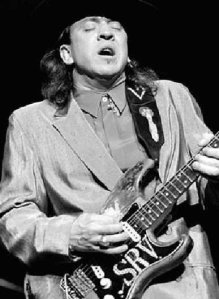
Ahhh… the venerable SRV in a classic guitarists pose. I used to think that was just something rock stars did for publicity shots, and that the poses were contrived. But then as I’ve delved more and more deeply into improvisation, I’ve realized it’s not contrived at all. That kind of pose or expression is all part of what can be called “gettin’ in the zone.” The Zen masters call the “the zone” the state of satori, where thought and action are one; where your consciousness is at a height where whatever enters your mind you do. From the perspective of playing guitar, the awareness of what your body is actually doing is lost. Your focus is entirely on expressing the music you’re playing.
For instance, have you ever been playing one day and just get into the groove of a song, close your eyes, and just let your fingers do the talking? You’re completely aware of the song, but that’s pretty much all you’re aware of; and when you play, it’s pure expression. I had recently had this experience. I was playing on top of a simple chord progression in D, and the song came to a part where I had a rather long lead break. A few years ago, I would’ve been terrified to do play such a long solo, but I’ve really started to get comfortable with my playing to handle something like this. Luckily for me, it was not a fast song. 🙂 But in any case, after the first few bars, I got into this groove where I didn’t worry about technique nor worry about how I was playing a phrase. I just played. It was pure expression.
After the gig, a few people came up to me and said that when I was playing, I had this look of pure rapture on my face. I replied, “Really? I thought I was just playing. Gawd, I hope I didn’t look like a poser weenie…” One of the folks was a guitarist and told me that it was genuine. He said, “Dude, you were in your own world.” I just chuckled because I was totally unaware of my posture or body language. I was completely focused on playing. I was really in the zone.
I think a lot of my latest inspiration is that I now have gear that gives me the tone that I’ve been after for awhile, and while I realize that 90% of your tone comes from your hands, having gear that facilitates your playing just adds to your inspiration. For me, I’m playing what I believe to be the absolutely perfect amp in my Aracom VRX22. The cleans are absolutely spectacular on any guitar I play with it, and that clean channel is the most pedal-friendly channel I’ve ever played. The drive channel on that just sings and sustains beautifully. I know, I know… I rave about this amp a lot, but I’ve searched high and low for an amp like this, and now that I’ve found it, it’s like I’ve died and gone to heaven!
I’d be interested in hearing your “in the zone” experiences. Feel free to share ’em!
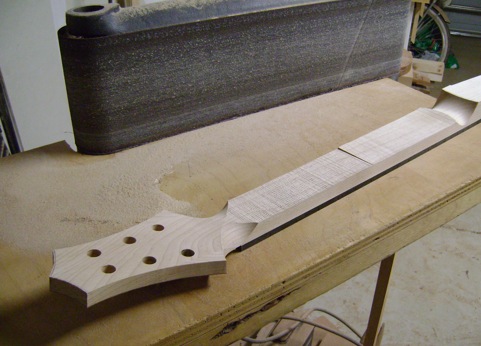
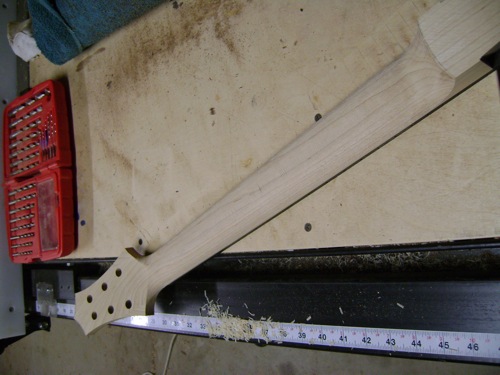
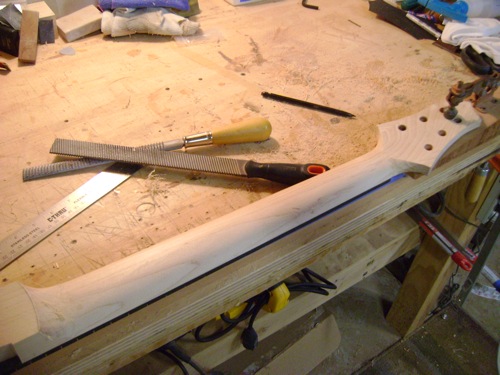
Wow! Goldie’s, my Saint Guitars Goldtop Messenger is really starting to take shape. In this next set of photos, Adam has cut and shaped the general profile for the Goldtop’s neck, and the neck is ready for final shaping. As the pictures progress, the neck curve is really becoming evident. As far as the neck profile is concerned, the radius at the nut is 12″. Adam typically uses a wide profile, but as my fingers are kind of short, playing up high on the neck can be difficult. So to compensate, Adam will gradually tapered the neck curve to be a flatter C near the body than at the nut. By the way, the wood here is rock maple.
Every time I see pictures of the progress of this guitar, I start to salivate in anticipation.


 In my ever-constant search for new gear, I accidentally stumbled upon



 Guitar Gear