I suppose in a response to the VOX’s JamVOX, Line 6 recently released the JM4 Looper. This is one cool box. All the included recordings were done by actual session musicians, so you’re playing to real instruments. You can even record and store up to 24 minutes of loops, and with an SD card, you can store up to 2 GB extra of loops. I’ve used Line 6 gear in the past, and it’s top notch. Click here to check out the specs.
With a street price of $329.99, it’s not cheap, but you get A LOT of bang for the buck. I guess this is Line 6’s answer to the JamVOX, which is also very cool – and a bit more versatile with respect to being able to play all sorts of media. But the JM4 seems to concentrate on musical styles as opposed to just jamming to songs, and with their Endless JamTM technology, Line 6 has added a great twist on jamming. Here’s their explanation:
The Endless Jam Engine is a simple arrangement system that we developed to get great mileage out of the jam tracks. It breaks each jam track into sections, arranging everything between the intro and outro into an Endless Jam, creating jam tracks that can go on forever without getting boring or overly repetitive.
For an absolutely great demo of this pedal, I found a YouTube video of this excellent guitarist showing off the various styles of music included in this box. The dude’s a great guitarist to boot, and gives a fantastic demo of the JM4 Looper. Check it out!
Summary: The Direct Drive is a nice, fairly transparent overdrive that maintains your amp’s tone that can produce mild grit to over-the-top, searing gain that sustains for days.
Pros: As overdrive pedals go, this pedal sounds great, and with internal trim pots you can adjust the bass response and presence. This ain’t a Tube Screamer clone by any stretch of the imagination. Plus, it’s handmade and at a GREAT price!
Cons: A little noisy with single coils and P-90’s.
Price: $119 direct
Specs:
Volume, Tone and Drive knobs
Internal Trim Pots to adjust bass response and presence
Tone Bone Score: 4.75 – I really like this pedal! It’s fairly transparent and clear, and except for a bit of noise with my Strat and PRS SE II Soapbar, this OD delivers great tones at any volume!
If you read this blog with any regularity, you know I have a thing for overdrive pedals; especially in a small home studio like my own, a good overdrive pedal really helps get that drive tone when you have to play at bedroom levels. Unfortunately, not all drive pedals behave well at low volumes. I would have to say that a lot of my overdrive purchasing decisions have been driven (excuse the pun) by how well they perform in low volume situations like a home studio. I’ve played several drive pedals over the years, and while almost all sound great when an amp is pushing some serious air, there’s only a select few that perform well at much lower volumes. So I’m happy to say that the Barber Direct Drive falls into the latter camp!
Ease of Use
What could be more easy? Three knobs for Volume, Tone and Gain. Just dial in the amount you desire of each, and you’re off to the races. But the Direct Drive also provides a cool push-pull pot with the Tone knob that engages what Barber calls “Fat Harmonics” mode for what they call the “Expensive California” amp tone. It’s another way of getting more high-end sparkle and emphasis on overtones and harmonics; much like the Fulltone OCD that has it on all the time. But wait! There’s more! 🙂 Inside the box are internal trim pots for adjusting bass response and
How It Sounds
It’s certainly fatter sounding than a Tube Screamer, even though Barber claims in their manual that a certain knob setting is an “808 killer.” I tried the Direct Drive at that setting, and it’s close, but sorry, no cigar. But that’s not a bad thing! The Direct Drive has a very distinct personality and definitely a sound and voice all its own! I did mention in the Summary that it’s fairly transparent. It is, but nowhere near as transparent as the Creation Audio Labs Holy Fire which is just about the most transparent overdrive I’ve ever played! But again, that’s not a bad thing. The overdrive characteristics are a bit tighter than a Fulltone OCD and much more even EQ-wise than a Tube Screamer; like I said, it has its own voice.
Here’s a clip I recorded. The rhythm part features a Strat. The Direct Drive’s volume is at unity, tone is dead-center, and Drive is about 10 am to get just a tiny bit of overdrive. The solo employs my Prestige Heritage Elite. The box’s volume is still at unity, tone is about 1 pm, and the drive is set to dead-center. This produces a nice, smooth grind, and lots of sustain.
By the way, the cool thing about that clip is that it was recorded at bedroom level, with my ribbon mic about 2 inches from the grille cloth! For the pedal to create that drive sound at that level is amazing!
Overall Impressions
This is a real kick-ass pedal, and I do have to say that in low-volume situations, this has got to be one of the best sounding drive pedals I’ve played. I dig it! This is not a pedal I’d just at high gain, gig volume situations. It’s not that the tone is bad, but even though Barber has removed some of the compression characteristics in the later models (the old ones were pretty thick in comparison, apparently), it’s a bit too tight at high gain, especially when you need to punch through a mix. Besides at that volume level, I tend to stay away from my overdrive pedals altogether and just use my Creation Audio Labs Mk.4.23 booster (the best, most transparent booster on the planet, IMO) to slam my pre-amp tubes.
But for general overdrive duties, this is a great pedal. I actually love its fatter tone when playing in low-volume venues, and for a street price of $119, and being hand-wired to boot, this is a pedal that I don’t think I can ignore! Neither should you! 🙂
I know, I know… I’ve been singing the praises of this amp and cab for the last couple of months since I got them. But folks, what Jeff Aragaki of Aracom Amps has put together in the VRX22 is simply magic. I just can’t say enough about how much I love this amp. It doesn’t matter what guitar I plug into it, the VRX22 delivers the goods.
A New Option for the VRX22
I have the standard production model, the first in the series. In its stock mode, I wouldn’t change a thing. But I know there are some vintage gear and tube amp buffs out there that would frown upon the fact that the VRX series in stock configuration has a solid state rectifier. For me, it makes not a bit of difference; I just love the tone.
But for those that require a tube rectifier, Jeff also offers an option of a GZ34 or 5AR4 tube rectifier in place of the solid state rectifier. An A/B test didn’t reveal a tonal difference, but for the purists out there (and by no means do I mean this derisively), this is certainly an option, and a reason why you should consider this amp in your amp evaluations. And here’s another consideration: All Aracom Amps are hand-wired, and cost FAR LESS than equivalent amps. For instance, the VRX line in stock configuration costs $895! That’s unheard of in the boutique market!
Have a Cab, Will Travel
But on top of all that, the 1 X 12 mini-cab that Jeff custom built for me is simply magical as well. Jeff went against the common wisdom of not using a cube shape and porting and such, and built a simple cube shape with a width that exactly matches the width of the amp (about 19″ wide). Amazingly, this cabinet is incredibly resonant. The reason for this is that instead of using 3/4″ board, Jeff opted with 1/2″ board. This resonates a lot more with the speaker, and provides a bass response that adds depth to the output. Granted, I also have an absolutely kick-ass Jensen P12N Alnico speaker, but that cabinet even sounds good with just about any speaker you put in it. Like I said, amazing.
To further demonstrate the versatility of the VRX22 and the Aracom 1 X 12 mini-cab, I recorded a short blues clip using three different guitars, all running straight into the VRX22 with no effects. There are to overlapping rhythm parts panned left and right, and a solo in the middle. For the left pan, I used my gorgeous Prestige Heritage Elite (“Sugar”) plugged into the VRX22. For the right pan, I used my Strat (“Pearl”) plugged into my Fender Champ 600 and ran the speaker out into the 1 X 12 (I didn’t think the Champ could sound this good wow!). For the lead, I used “Sharkie,” my PRS SE II Soapbar with P-90’s in the bridge position straight into the VRX22.
Sorry for the slight mistake in the solo; or as my buddy Phil calls it, a “clam.” But overall, I was just amazed how good Sharkie sounded on that clip. I added a touch of reverb to that track, but made no modifications to the guitar signal at all. It was the guitar plugged straight into the amp.
As I’ve said in the past, I’m not affiliated at all with Aracom. I’m just a faithful customer, and just can’t sing the praises enough for the job Jeff has done!
As I’ve mentioned in the past, I dig writing this blog because I meet a lot of cool people; one of them is Phil Vickman of Fat Tone Guitars. I call him occasionally to hook him up with information on various gear manufacturers, and we end up talking about some kind of gear. Yesterday’s conversation ended with Phil mentioning that he just got the Eastwood Breadwinner in, and is really digging it! So I did a bit of poking around…
Since Eastwood Guitars opened their doors, they’ve created faithful reproductions of vintage guitars of yesteryear at a fraction of the cost of the actual vintage gear. That’s been their shtik from day one. Even though I have yet to purchase an Eastwood guitar, I have played a few, and the thing that I dig about that company is that their replicas aren’t of classic, mainstream guitars (can you say “Les Paul” and “Stratocaster”); rather, they’ve placed their focus on the more avant garde styles of vintage guitars.
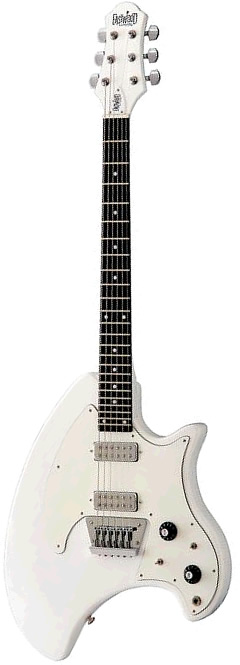
Among them is their latest offering, the Breadwinner, introduced at the 2009 NAMM show. I’m usually not moved by avant garde guitar styles, but there’s something about this guitar that really speaks to me. The Breadwinner was originally produced by Ovation, and was their first foray into a solid body guitar. From what I’ve been able to glean about its history, this guitar’s shape was both for form and function, its ergonomic design shaped specifically for playing comfort. That’s totally cool!
This replica and update features some pretty cool things, among them switchable active/passive humbuckers, which give this guitar lots of tonal possibilities. The body is solid mahogany, with a bolt-on maple neck, and uses Gotoh hardware. Very nice.
For more information, check out the Eastwood Guitars web site! If you’re interested in buying the guitar, go to Fat Tone Guitars. Phil’s great to work with, and he’s really knowledgeable about the gear he carries!
Here’s a video demo of the guitar that I found. The guitar is played clean, and the sound quality of the demo is only okay, so I suggest you go to a local Eastwood dealer to see if you can play one of these bad boys…
In addition to drive pedals, I love low wattage, single-ended amps, and there are lots of ’em out there. For instance, one of my favorite amps is my Fender Champ 600. I use it in my studio, but also gig with it in small venues – to be clear, I have to hook it up to an external cab to get some volume.
Just recently, I discovered the Concord from ValveTrain Amplification. This is a little 5 Watt amp based on a classic Fender 5 Watt design (I believe this is what Valve Train specializes in). It is a single-ended amp with a single 12AX7 and a 6V6 power tube; pretty similar to a Fender Champ 600. However, there is a difference… a huge difference between the Concord and the Champ. The Concord is completely hand-wired. Not only that, this little hand-wired amp only costs $499 street!
That’s an incredible price, and something I definitely have to consider…
I’ve heard of some people buying this amp sight unseen, and not being satisfied with its overdrive tone. But make no mistake about an amp like this: The design was never made for tons of high-gain distortion. For instance, my Champ breaks up nicely when I have the amp open all the way, but it never gets over-the-top with the breakup. It’s just not meant to do that, and I suspect that it’s the same thing with the Concord. Furthermore, you just can’t expect to get that high-gain distortion with an 8″ speaker. 🙂
Lovepedal has been around awhile, and has been known for creating some killer pedals; among them the awesome “Church of Tone,” Plexi-in-a-box drive box, and the Eternity drive, an incredibly versatile overdrive pedal. Just recently, Lovepedal released a line of four pedals that while diminutive in size, create huge tone. These are the Echo Baby, a nice straight-forward delay; the Amp 50, which is a miniaturized version of the Church of Tone pedal; the Pickle Vibe, a VERY nice vibe pedal; and finally, the Mini Buffer, a signal buffer to live on your pedal board to bolster and condition your signal chain. Each pedal measures 3 5/8″ long X 1 1/2″ wide X 1 1/4″ high. As Lovepedal puts it, these are small enough to fit on a keychain. 🙂 Of course, that’s a bit of an exaggeration, but that’s pretty small nonetheless. Check ’em out at lovepedal.com! Here’s a cool video to make you salivate a bit…
It’s hard to imagine that I’m actually having a guitar custom made for me from Saint Guitar Company, but it’s happening. This post will be a “sticky” post so you can follow the progress of the guitar with me. By the way, with this guitar, I’ve picked a fairly unconventional combination of woods: Walnut back, maple top, rock maple neck and ebony fretboard. Adam Hernandez and I are hoping the result will be a brightly voiced guitar that will have the incredible sustain Saint Guitars are known for.
Progress Report
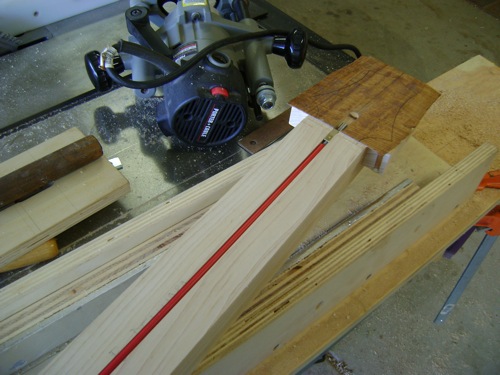
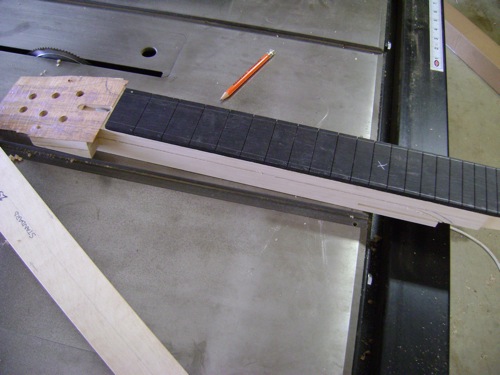
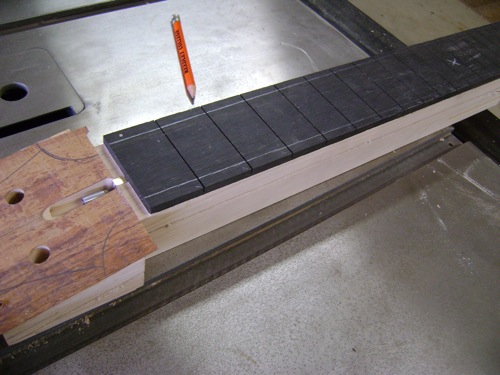
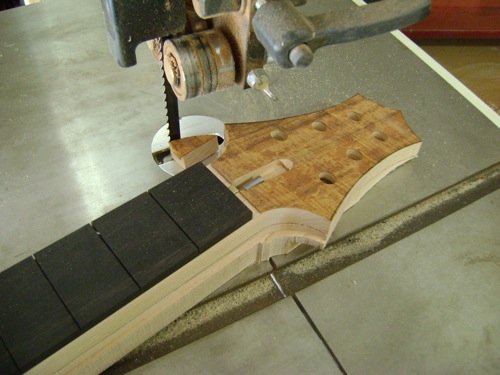
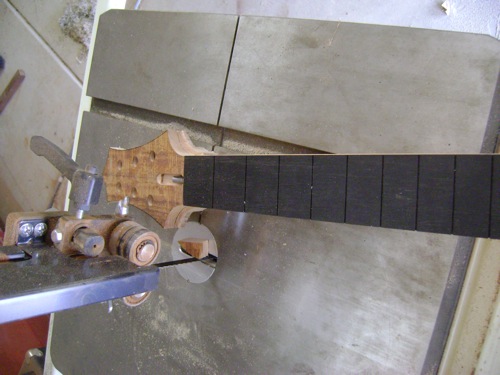
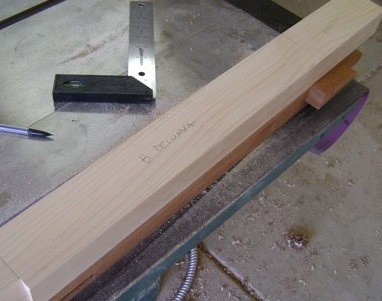
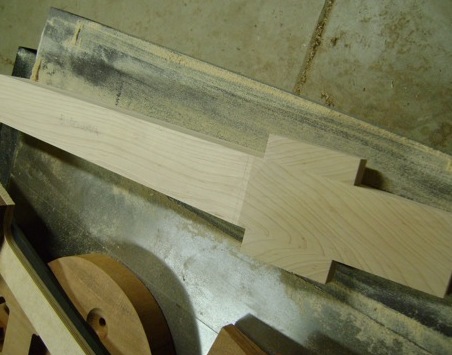
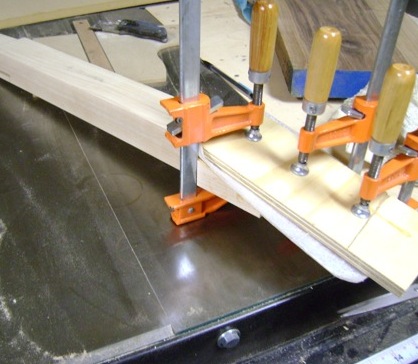
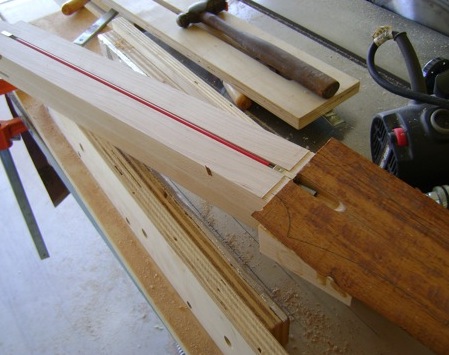
May 4, 2009 – With the first set of pictures, the billets have been selected and cut, and the neck is being shaped. Forgot to mention that the headstock plate is koa. I know that I chose a bunch of woods, but I chose each wood to achieve a specific tone profile that I’m hoping the woods will produce, and this was done with literally a couple of hours of discussion with Adam. Working with Adam is just so easy. The cool thing is that he’s so open to exploring different things at this point in his luthier career, so it has been really fun discussing the building of the guitar with him.
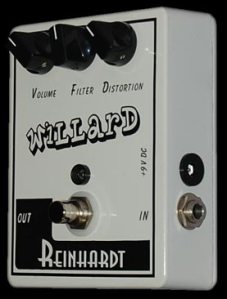
Just ran across this brand-new fuzz pedal from Reinhardt Amps, called the "Willard" distortion pedal. This pedal is pure 80’s fuzz, a sound that I came to love! From the video, it’s clear that this pedal is capable of producing some serious hair, but it also retains a lot of clarity. Built around a true NOS LM308N op-amp chip and based around a big-box Rat of that era, this is a very nice-sounding distortion box. Check out the video below:
This is a bit of a continuation of my previous article about not getting fooled by pedigree. While I was singing the praises of a Saint Guitar Goldtop Benchmark that I was testing, my buddy commented to me, “You sure about wanting to get one of these? It’s gorgeous, and it plays and sounds amazing, but the problem I have with most boutique guitars is I’m not sure how well they retain their value. What if I wanted to sell it later on? Would I get what I paid for it? Will it appreciate in value?”
All valid concerns, but I simply replied that it’s all about your perspective: Are you a collector or a trader?
If you’re a collector, chances are you obtain gear to keep it and use it for a lifetime, or even just hang it on a wall (I know of someone who has 300+ guitars, most of which he never plays). I consider myself a collector. And from that standpoint, I’m what’s called “brand blind.” All I care about is if the gear looks good, plays good, and sounds good, no matter what the brand.
On the other hand, there are those whom I call “traders.” They get gear, but are always open to trading for another type of gear that might be better from their point of view. From that standpoint, brand awareness is important as people will tend gravitate toward known entities, and the brand-names definitely attract more traffic.
Mind you, I’m not saying one is better than the other. It’s just a matter of perspective in making a purchasing decision. I used to be pretty brand-centric, but ever since I started writing this blog, I’ve come across some awesome gear that I don’t think I would’ve even considered evaluating had I focused on the brand-name stuff.
And let me say that it’s not that you’re either one or the other. It also depends on the gear. For instance, I swear by V-Picks and Red Bear Picks. I won’t use any others. But I’ll buy off-brand pedals and guitars and amps.
I admit it: I’m an incurable GEAR SLUT! I jones for vintage and vintage style gear, as the music I play leans toward the blues and classic rock. And to satisfy that never-ending craving, I pore over the Internet and various magazines in search of all sorts of gear; hence, the existence of GuitarGear.org where I share with you, dear reader, the things that I come across.
Now in my search for gear, I occasionally buy things. They tend to be vintage-style modern gear because I just don’t have the money to buy real vintage gear; and that usually means I gravitate towards boutique gear; but not just any boutique gear. Remember, I don’t usually have all that much money to afford the real high-end stuff, so I spend a lot of my scouring my information resources to find boutique gear that I can afford. That’s what gravitated me towards Aracom Amps.
When I saw the price of a VRX series amp, my jaw dropped! Here was a hand-wired, vintage-style tube amp for $895!!! When I finally hooked up with Jeff Aragaki (founder of Aracom), and got a chance to play the VRX18, he shared that one of the ways he was able to keep the cost down was by using a solid-state sag simulating rectifier circuit. When I heard the words “solid-state,” the purist in me started reeling a bit. But then that amp sounded so freakin’ good that I didn’t give a flying you-know-what about the rectifier!
And that’s the point of this article. When you’re looking for and buying gear, don’t let yourself be swayed by an instrument’s or equipment’s pedigree or “all-tubeness” or lack thereof. LISTEN to the fuckin’ thing, and see if it turns you on! If it sounds good, and it works for YOU, then that’s all that matters, in my not so humble opinion on the subject. 🙂 If I had let the purist in me take over, I would’ve never ended up with my VRX22! And for the record, I’ve listened to many, many, many amps, with and without tube rectifiers, and the circuit that Jeff Aragaki employs in the VRX series simulates the sag of a rectifier tube so well, I can’t tell the difference. And if there is one, it’s probably so minute that it doesn’t matter anyway. I’ll put that amp up against any other boutique amp in the same wattage range, and it’ll sound just as good, if not better. And I paid less than half the price of a similarly configured amp!
Give the following clip a listen. I’m playing my Strat plugged straight into the clean channel of the VRX22. In some sections you could swear that the amp has a reverb, but that’s the solid-state rectifier simulating the sag of a tube rectifier. Also, this is the raw recording of the amp: No EQ, no filtering. The master volume was flat out, with the gain control around midway. My mic was about about 10″ away pointed directly at the center of the speaker cone.
I originally recorded that clip with my Prestige Heritage Elite. But that guitar has so much inherent sustain, it would’ve been cheating. 🙂 A Strat on the other hand doesn’t have that much sustain, so it brings out the sustaining quality of the amp much better. The result is just amazing.
And as to the tube vs. solid state rectifier issue, at least in the Aracom VRX series, it doesn’t make one whit of difference, especially when you’re playing live at gig levels. When I’m gigging, I almost never use reverb unless it’s a song where I can really isolate my guitar. Sag gives the effect of reverb, but at loud gig levels, you’ll never hear it.
Another great example of buying what sounds good to you is my friend Vinni Smith of V-Picks. That dude is one of the best guitarists I’ve ever known, and he gigs all the time! You know what he plays through? A freakin’ Roland Cube 30 cranked all the way up and miked into the PA. When he told me that, I almost flipped. Here was a true pro guitarist, playing through a $200 amp!
So don’t be taken in by pedigree. Buy what sounds good to you, and what you can make sound good. After all, 90% of your tone is in your hands.




 In addition to drive pedals, I love low wattage, single-ended amps, and there are lots of ’em out there. For instance, one of my favorite amps is my Fender Champ 600. I use it in my studio, but also gig with it in small venues – to be clear, I have to hook it up to an external cab to get some volume.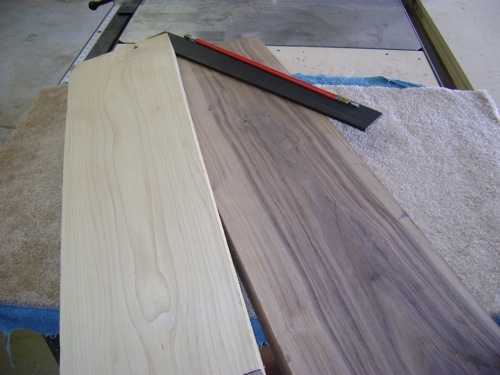
 Guitar Gear