Feeds:
Posts
Comments

Posts Tagged ‘amps’

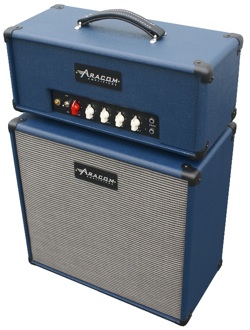
Aracom Amps VRX22 - First in the series

The Aracom VRX22 has been my primary amp for quite some time now – almost 2 years – and I’m still discovering the beauty of this wonder 22 Watt amp. It’s no small wonder that it has been my “Go-To” amp since I’ve gotten it. It sounds so killer both clean and dirty, and tonight, I realized just how great it is with pedals!

Since I’ve had the VRX22, I haven’t been using my overdrive pedals as much. I know, I used to be a real nut about overdrive pedals, and I have several. But this afternoon, I reconfigured my board, and placed my favorite drive pedals on it with the intention of using them. This included my Doodad Guitars Overdrive/Booster, Tone Freak Abunai 2, and my KASHA overdrive.

For my gig, I set the amp up in the clean channel, with the volume at a level where I’d have to dig in a bit with my Les Paul to get some grind. This would leave me with lots of headroom to work with, and not break into overdrive so early that all I get is more overdrive, and not volume.

Then I tweaked the overdrive pedals so I’d get different characters of overdrive, depending upon what I was after. I set the Doodad up for Tube Screamer like overdrive, at just over unity gain, but with the drive knocked up a bit so I’d get lots of sustain. I set the Kasha on “Classic” at just above unity gain for a more biting, trebly tone. Then I set up the Abunai 2 for a more thick, compressed overdrive.

The one thing I love about overdrive pedals is that as opposed to providing all the distortion as with a distortion pedal, they are meant to interact with the amp so what you get is a combination of distortion characteristics from both the pedal and the amp. This combination doesn’t always work so well. I’ve played many amps and some just want to overdrive by themselves. Using an overdrive pedal with those amps just muddies the tone. It’s not pretty.

Not so with the VRX22. I’ve thrown all sorts of pedals at it, and it handles them all without a hitch. It’s especially good with overdrive pedals, and in my gig, I just kept smiling because it sounded so damn great with them! And with second channel on the VRX22 that has another gain stage that acts as a built-in overdrive, I had yet another overdrive voicing to use, and I used all four either individually, or in many cases, I’d stack two or more together. And that’s a key thing with the VRX22. It can deal very well with stacked overdrives, retaining its touch sensitivity and note separation. Other amps I’ve used when stacking just can’t deal with the stacked overdrives very well.

In any case, this kick-ass amp is something you should consider. At $895, it’s simply tough to beat for a true hand-wired, boutique amp. And for those of you who already have Jeff’s PRX150-Pro or -DAG attenuator, you already know the build quality that goes into Aracom gear. It’s simply killer!

For more information on this wonderful amp, check out the VRX22 product page at Aracom’s web site!

Read Full Post »

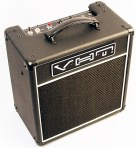
VHT Special 6 Combo
Summary: This is a hand-wired, solidly built tone machine that packs great features for an unbelievable price. The value proposition alone is enough to turn heads, but add superb tone to the equation and you have a winner!

Cons: None.

Features (as tested):

  • 6 Watts
  • One 6V6 Output Tube
  • One 12AX7 Preamp Tube
  • Volume and Tone Controls
  • Footswitchable Boost Mode
  • High/Low Power Switch (Pentode/Triode)
  • 10” VHT High-Sensitivity Speaker
  • 4, 8, and 16 Ohm Speaker Jacks
  • Mod-Friendly Eyelet-Type Board
  • Hand-wired In China

Price: $199 Street / $179 Street for Head

Tone Bone Score: 5.0 ~ Clean or dirty, this amp delivers the goods! The tone sweep is absolutely excellent giving you gorgeous, warm jazz cleans, to classic rock bite! Add the Hi/Lo power switch, and Push-Pull volume knob boost (also includes a footswitch), and you’ve got an amp that can live in a variety of musical genres.

About a week ago, I extolled virtues of the Marshall Class 5, and raved about how great it sounds. It’s a fantastic little amp, and I haven’t changed my opinion of it. But along came the VHT Special 6 and the game has completely changed. VHT raised the bar with Chinese-manufactured, low-cost, low-wattage amps by offering a hand-wired, super-well-built amp with fantastic features that can easily change the amp’s character for under $200 for a 1 X 10 combo.

I think the arrangements many gear manufacturers have made with overseas assemblers is great. Egnater is another example of a manufacturer doing it with great success. Design the gear here in the US, then partner with an overseas manufacturer to take advantage of their cheaper parts and labor, ensure that they meet a high standard of quality, then give the savings back to the customer. The top-of-the-line stuff can be saved for domestic production, but the stuff you want to get out to the masses can certainly be made elsewhere, and in much higher volumes and production rates. It’s a good model that many manufacturers have been following for years. I realize that I’m going to piss off some of the ultra-patriotic that will only buy stuff made in the USA; I myself prefer to buy US-made stuff, but it’s tough to argue with getting great tone for a great price, and that is EXACTLY what the VHT Special 6 and lots of other gear assembled overseas provide.

But enough toeing the political line. Let’s get into discussing the Special 6, shall we?

Fit and Finish and Features

The first thing I noticed when I first looked at the amp is how solid it looked. Picking it up revealed an amp that is no lightweight. I don’t know the exact weight, but the Special 6 is not lacking in heft. The cabinet is made of birch ply, and from what I could tell, fairly large transformers were used with the amp and those are heavy. Note that I’ve actually heard some conflicting information about the cabinet wood. Some say MDF, others say Baltic birch ply. Actually, it just doesn’t matter. The cabinet’s solid, and it works well as a resonance chamber for the speaker.

As far as cosmetics are concerned, the amp is covered in tolex with white piping around the front grille. The rear panel sports a partially open back that, like the Marshall Class 5, has a thin metal screen covering the opening. That’s a nice touch.

The control panel is super simple. You’ve got two chickenhead knobs for tone and volume, on/off switch, a three-way Hi/Lo Power / Standby switch (I dig that), and two input jacks for Lo and Hi input. The volume knob is a push-pull knob that when out, adds boost (sorry, not sure about the amount of boost). You can surmise just by these features that you can do a lot of tone shaping with this little beast. 🙂 The back panel has jacks for 4, 8, and 16 ohm speaker outs, plus a jack for switching between normal and boost.

Sound and Dynamics

Even with a 10″ speaker, the amp is capable of producing a variety of tones, from lush, Fender cleans, to ringing, AC15-like overdrive to gorgeous, smooth Plexi overdrive. I’m not kidding about this! Depending upon the pickup you’re using and where you set the tone knob, and other amp settings such as hi/lo input, pentode/triode mode, you can cover a wide range of tones! This is what is so SICK about this amp! It’s so damn versatile!

I played around with it in my studio this afternoon, getting ready to record some clips (which I’ll have in an upcoming article), and just for kicks, I unplugged the stock speaker and ran the amp out to my 2 X 12. Granted, there is a HUGE difference between a 2 X 12 and a little 10″ speaker, but in my experience, many low wattage amps still sound a little on the thin side even when going into a bigger cab; not so with the Special 6. It sounded big and ballsy; much more “big-amp-ish” than it’s diminutive power. That really came as a surprise, much like my surprise when I plugged the Reason Bambino into a big cab. It’s clear that just like the Reason guys, VHT didn’t want to just build a low-wattage amp. They wanted to build a great amp, period.

I also gigged with the amp in my weekly church gig yesterday afternoon, and it worked absolutely stellar! I kept the amp in high power mode, plugged into the high power input, set the tone and volume at 3pm each, then pulled the boost knob to activate the normal/boost footswitch. I didn’t use any effects at all as I just wanted the raw amp tones. I even tuned with my Peterson StroboClip so my signal from my guitar to the amp was completely direct. Note that even with a 10″ speaker, I still had to use an attenuator, and my trusty Aracom PRX150-Pro worked stellar with the amp.

During the gig, I mostly used the volume knob on my guitar to vary gain, whether in normal or boost mode. The amp responded so well to volume knob and pick attack. Even if I didn’t reduce the volume, and picked very lightly, I could clean up the sound. So sweet!

The only time I made any adjustments to the amp was when we did a song that I needed absolutely clean tones. I simply reduced the volume to around 11 am, then bypassed the attenuator. And the cleans were simply fantastic!

Made to Mod

Despite the fact that VHT says this amp is highly modifiable, I doubt that most people will do no more than swap tubes. I’ve seen some forum posts where people have made a couple of changes, but I’d say the majority of folks just won’t see a need to do that. But curious, for shits and giggles, I swapped out the stock 6V6 with a couple of different 50’s-era 6V6’s (GE and RCA). They each sounded beautiful as I expected, but quite frankly, they were just too smooth. The Chinese tube seems to be “hotter” and produces lots of harmonics; something my NOS tubes didn’t do. In my opinion, the Special 6 is meant to be a mini-rock machine. It won’t do really heavy stuff, but for 70’s and 80’s classic rock, it sits right in the sweet spot.

Overall Impression

I am thoroughly impressed with the VHT Special 6. Hand-wired, immensely versatile, plus fantastic tone for under $200? That’s tough to beat! And unlike other small, low-wattage amps that have only a volume and tone knob, the combination of inputs, low/hi power modes and boost make this an amp that can be used in a variety of ways. Big thumbs up, and 5 Tone Bones!

I’ll have clips in an upcoming article. Stay tuned!

Update: January 2, 2013

It has been awhile since I wrote the original article, and amazingly enough, I’m still using the Special 6. I did finally swap out tubes to 50’s era NOS for both pre-amp and power tubes, and I also swapped out the stock speaker and put in a Jensen Jet Electric Lightning. I use this amp frequently at my church gig where I don’t need a lot of volume since mic the amp and use the PA, and it is perfectly suited for that venue.

Even after all this time, I do have to say that I’m still thoroughly impressed with the tone of this little amp. When it’s cranked, and especially with the Electric Lightning speaker, the amp sounds SO much bigger than what its diminutive 6 watts would suggest. A lot of that has to do with how the speaker projects, but when cranked, that amp absolutely sings with tones of sustain and really sweet overtones. I love playing this amp with a Les Paul. The clean tones are gorgeous as well, and when I don’t hook it up to an attenuator, I just use pedals to get my distortion. From that perspective, the amp takes to pedals real well.

Finally, even with a simple, single EQ knob, the EQ works fantastically well with the amp. It’s kind of bright out of the box, so I normally just set the tone control to about 10 am. On some amps I’ve played, that muddies the tone a bit; but not with the Special 6. It simply makes the lower range stand out a bit more.

I’ve even been using the amp in the studio, over my DV Mark Little 4o and Aracom VRX’s (except where I need a heavier sound). It’s perfect for the studio.

Read Full Post »
Marshall Class 5 AmplifierSummary: Class A, Plexi goodness in a low wattage amp that packs a punch despite its smaller size.Pros: Great, ballsy tone that’ll just make you smile

Cons: None.

Features (as tested):

  • Power: 5 watts
  • Preamp tubes: 2 x ECC83
  • Power tubes: 1 x EL84
  • Controls: Volume, Treble, Middle, Bass
  • Speaker: 1 x 10″ 16ohm Celestion G10F-15
  • Headphone output
  • Extension speaker output
  • Dimensions: 19.48″ x 16.34″ x 9.05″
  • Weight: 26.46 lbs

Price: < $400 Street

Tone Bone Score: 5.0 ~ Even though I didn’t get to spend as much time as I’d like to play around with the amp, I was simply impressed by the tone that it delivers, and at a price point that makes it very difficult to ignore. While many low wattage amps can sound thin and tinny, the Class 5 with its generously-sized cabinet has a fantastic, rich tone.

On Low Wattage Amps

I love low wattage amps – those that are 10 Watts or less. I have a few. For years, people eschewed these super low wattage amps, and passed them off as mere practice tools. But I suspect they really didn’t understand what a super low wattage amp brings to the party. Low wattage amps such as the 5 Watt Fender Champ helped define the sound of rock and roll. Listen to classic rock tunes, and more likely than not, the venerable Fender Champ would be the amp providing the sound.

Today, more and more people are turning to low wattage amps – especially home recording enthusiasts, and even pros like Jeff Beck – to save their ears and to get crunch and grind at low volume levels. As a result of the increased demand, many manufacturers, boutique and mainstream alike, have responded and come up with a slew of low wattage amps. It’s a good thing and a bad thing. On the one hand, you have tons of selections, on the other hand; well, you have tons of selections. There are a lot of them out there and it’s tough to decide which way to go.

The shear amount of low wattage amps on the market is perhaps a big reason why Marshall waited so long to come out with its super own low wattage amp. Perhaps they were studying what the market responded to and what they could do to address what people might have fed back as improvements that could be made.

Enter the Marshall Class 5 amp. This amp was released in the UK near the middle of last year, and arrived here on our fair shores around November of last year. Amazingly enough, news about this amp has been relatively quiet. There hasn’t been all that much advertising that I’ve seen about this amp. The Marshall Haze amps have gotten lots of “rag” time, and the response to those amps has been generally positive. But I haven’t heard much about this amp other than user reviews. That’s too bad because after playing it, I have to say that I really dig it!

Classic, Killer Tone!

Is Marshall embarrassed about advertising such a low wattage amp? I certainly hope not, because I got a chance to play this amp today, and I just have two words to describe it: KICK ASS! Built upon the “Bluesbreaker”/Plexi pedigree, the Class 5 has all of that Plexi goodness in a low wattage combo. Make no mistake: The Class 5 packs a serious punch; maybe not maximum volume-wise (for a gig, this amp would need to be miked, but will provide plenty of stage volume), but if you’re looking for those classic Plexi tones in a low wattage solution, look no further!

Because I was in a shop, I only tested it with a single guitar: An Epiphone Les Paul Ultra. But the Class 5 delivered that cranked Les Paul through a cranked Marshall Plexi true to form. It was everything I expected to hear from a cranked Plexi, just at a lower volume. That really blew me away!

There’s really something special about that tone. My Aracom PLX18BB is a super-close replica of the Plexi 18, plus my good buddy has several Marshalls including an original JTM45 and Plexi 50, so I’m very familiar with that classic tone. While the Class 5 is just a tad grittier in its overdrive than its more powerful siblings (perhaps due to the new speaker), the rich harmonics and smooth overdrive delivered with “balls” with a gorgeous sustain is all there.

While it might seem from my description that this amp isn’t very loud, it’s plenty loud. You can even gig with it easily, even with the stock 10″ speaker which, by the way, has tons of volume and provides rich tone. I was actually expecting the amp to sound a bit thin due to the smaller speaker, but there was nothing thin-sounding about the amp.

Another reviewer mentioned turning the bass all the way down, because he thought it was flabby. I really didn’t detect a flabbiness to the bass, but I like a bright amp anyway so I had the bass EQ dialed down to about 8pm which is almost off.

All this tonal goodness is delivered by a 10″ speaker specially developed for the Class 5 by Celestion, the G10F-15. As expected, the 10″ really has an emphasis on the mid- to high-frequencies, but Marshall compensated for the lows by providing a spacious cabinet to act as a nice resonance chamber for the speaker. The result is a very balanced and smooth tone, if a little on the bright side. But bright is what Plexi’s are all about, and the Class 5 delivers on that swimmingly!

As far as my customary test clips go, sorry, this was a shop eval, so I didn’t record any. But if and when I get the amp, I’ll post some for sure!

Yikes! It’s Too Loud!

Hello… 5 Watts is loud. In fact the speaker’s SPL is rated at 97dB at 1 meter with a power rating of 15 Watts. People have complained that they can’t crank it up in the bedroom past 3 or 4. Yeah… welcome to the Non-Master-Volume club. But that’s the beauty of the Plexi in the first place! You need to saturate the power tubes as well as the preamp tubes to get that Plexi vibe. If you need to run this amp at bedroom levels, the best solution is to get an attenuator such as the Aracom PRX150-Pro.

I sincerely hope that Marshall doesn’t cave in to those complaining it’s too loud and add a master volume to the amp. To me, it doesn’t need and would take away from its vibe.

Made in the UK

This amp is constructed in the UK, amazingly enough. And what’s even more amazing is that it sells for less than $400! The shop I tested it at had it a retail price of $389! One would expect those kinds of prices to come from gear manufactured in Asia. But not this beauty. So to have a UK-made amp at this price point is truly remarkable! Then to get tone this good? OMG! Truly amazing!!!

Fit and Finish

This amp is extremely well made. The cabinet feels real solid, and nothing was loose. Apparently, earlier versions suffered from a buzz, but the unit I tested didn’t have that at all. In any case, I inspected the amp thoroughly – front and back-  and didn’t detect any finish flaws. The tolex was nicely molded down to the surface of the underlying wood, and there were no loose pieces of material. From what I could tell, 1/2″ ply was used for the cabinet, and that is good because I’ve found, at least from a purely qualitative perspective, that cabs built with 1/2″ thickness tend to resonate quite well. This obviously helps bolster the bottom end, and it does it nicely.

The rear of the cab is interesting in that it is partially closed with about a 4″ opening, covered by a metal grill. I suppose that this is so you don’t throw in the cable and accidentally puncture the speaker cone, but it may be purely aesthetic in nature. The rear grill is rather cool.

Overall Impression

I totally DIG this amp! It was fun cranking it up in the store this afternoon! Admittedly, the amp doesn’t really hit its sweet spot until the volume knob is about midway. But completely cranked up, it produces the tone I expect out of a Plexi! And even cranked up, it responds well to volume knob levels, so you can clean up the amp quite easily.

Compared to other super low wattage amps I’ve played, even my venerable ’58 Champ, this amp has tons of balls in stock configuration. With my Champ, I had to have an amp tech add a 1/4″ jack so I could run it into an external cab because the 8″ speaker really can be quite thin-sounding. But the Class 5 has enough balls and volume stock to not need any of that (though it’ll be fun to run this into an external cab anyway, which I plan to do).

Note that unlike other reviews, I really didn’t make mention of the amp being “Class A.” That’s a big deal with lots of folks, but to me, even though I understand the classification, it really doesn’t matter. What does matter to me is how the amp sounds, and it simply sounds killer. In my book, I couldn’t care less about an amp’s classification so long as I can get great tones out of it; and the Class 5 will certainly deliver on that!

As you might surmise, I’ll probably end up getting this amp. As if I need another! But it’s a great amp at a great price. That’s just plain tough to ignore! And note that this amp sounds so good stock to me that I really don’t see a need to swap out tubes unless they burn out (which they probably will considering I’ll be running the amp all out all the time 🙂 ).

Here are some cool video clips of the Class 5 in action:

Read Full Post »

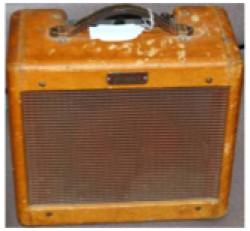
I know, not a very good picture, oh well…

In any case, I recently won this amp in an eBay auction. As soon as I got it, I turned it over to Jeff Aragaki of Aracom Amps for him to inspect it, clean it up, and make it “safe.” The amp was in excellent working condition, considering it’s 52 years old, but to be safe, I wanted to make sure there was nothing amiss.

One of the first things Jeff looked at were the capacitors. Visual inspection didn’t reveal any leaks, but they needed to be measured to ensure that they were still able to keep a charge. Amazingly enough, they were still measuring well within operational tolerances, and none had to be replaced, which Jeff said indicated that the amp was being used. With those old paper capacitors, if they sit for a long time without use, they’ll eventually leak acid. But these were in great shape!

The next thing Jeff checked was the speaker. Interestingly enough, the speaker was a replacement, and not only that, it was a 16 ohm speaker, which actually attenuated the amp a bit, so I had Jeff replace the 8″ speaker with a new ceramic speaker.

Since the amp used a two-prong electrical plug, I asked Jeff to upgrade it to a three-prong medical-grade plug. Unfortunately, the way the amp was designed, doing that would require playing with the heater voltages, and while that wouldn’t necessarily harm the amp, it may have had an effect on the tone – not a good idea. So I just had Jeff replace the cord, which was in decent physical condition, but according to him, wasn’t carrying a full load of current to the amp.

In addition to cleaning it up and making sure it was in good working order, Jeff wired up an A/B switch box to the amp, so I could flip between using the internal speaker and an external cabinet (which is how I’ll normally play this amp). Jeff did this to avoid having to install a 1/4″ jack which would alter the amp from its original condition. Being a vintage gear collector, Jeff thinks about that stuff… This amp is going to be a player, so that wasn’t much a concern to me, but he kind of insisted, just in case I decide to sell it later.

Finally, since the amp didn’t have a back plate (which accounts for the great price I got it for), Jeff cut a nice 1/2″ ply board to protect the chassis. We’ll do a proper back plate with a tweed cover later, but I wanted to start using the amp right away, so we’ll do that as a future project.

Gig Report

With the amp complete, I played it all week to get used to how it responded. Now that I have one of these, it’s no small wonder why these have been long-time residents in studios all around the world. Hooked up to my 2 X 12, loaded with a Celestion Blue and Gold, the amp’s voicing is super rich, if a little on the bright side. But no matter. The cleans are absolutely incredible! They ring with a vintage chime that at least to me, invokes a visceral response in me that’s hard to explain. It’s a classic Fender clean, and through my 2 X 12, the cleans resonate and float through the air! As far as dirty is concerned, the Champ is no high-gain amp. Overdriven, it’s a dirty grind, perfect for blues- or classic-rock tones.

The Champ is also incredibly pedal friendly. I hooked up my super-versatile Doodad Guitars Check-A-Board RED overdrive/booster up to it, and the amp just responded! The overdrive is wonderful on this pedal, adding great sustain without overly compressing the signal, but where the pedal really worked with the Champ was with the booster. Slamming the front-end of the amp, I was rewarded with a gorgeous, smooth overdrive tone. Again, I thought to myself, this is why this little monster has been on so many songs over the years!

Yesterday, I took the amp to my church gig. Being the 4th of July, we had a skeleton crew: Just one other guitar besides myself, but no matter, I wanted to play it live. For this gig, I just used my custom Aracom 1 X 12 with a Jensen P12N, and I played my “hybrid” Fender Stratacoustic Deluxe through it. Despite the fact that I was ostensibly playing an acoustic guitar through the amp, the tone was absolutely natural. I was like, “This really shouldn’t sound that good, but I’m amazed at how it sounds!” Granted, the Stratacoustic is more like a hollow-body electric than an acoustic, but the Champ just took its natural voice and amplified it beautifully.

Once I have my studio set up again (just finished construction on the house, so I lost my recording space temporarily), I’ll make some recordings!

If you live in the Silicon Valley area and need some amp work, though Jeff sells his own line of amps, three of which I own, with a fourth on the way, Jeff is one of the best amp techs I’ve ever worked with and he’ll hook you up! He thinks of things I would’ve never thought of! Check out his site at http://www.aracom-amps.com. Needless to say, he is also the creator of the best attenuator on the market, the Aracom PRX150-Pro.

Read Full Post »

I’ve always had an appreciation for vintage gear, though the most “vintage” that I’ve ever gone is purchasing several sets of NOS tubes over the years. And quite frankly, though I’ve appreciated vintage gear in general, I’ve never been compelled to be a vintage gear collector as I’m an active musician who uses his stuff all the time.

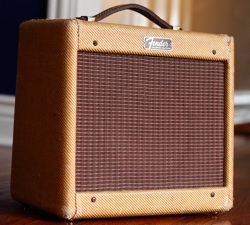
But despite that, I have wanted to get an 50’s tweed Champ for quite awhile. I love small, low-powered amps, and the tweed Champ from the 50’s has been on my list to get for quite some time. After all, that little amp has been used in studios around the world for recording hundreds, if not thousands of Rock ‘N Roll songs.

My only problem with ever getting a tweed Champ was that I didn’t want to spend upwards of $1500 for a mint-condition unit, which is what these puppies go for. And since I’d use it as a player, I’d have to make modifications to it as soon as I got it to make it safe and usable with different cabinets; thus immediately reducing its value.

But luckily there are tweed Champs out there that aren’t in pristine shape, and they’re low enough in cost to warrant consideration. My criteria was that the amp had to work. Period. As long as it did, I wouldn’t have to do too much once I got it. So I found a ’58 Tweed Champ on eBay for a decent price that was missing the back plate, but was still in great working condition, so I purchased it, knowing I’d have to do some mods to make it safe, plus add some longevity to it.

Right now, it’s on transit here, and should arrive tomorrow – I’m so excited! But I will not plug it in until I have a few things done to it, that my good friend Jeff Aragaki of Aracom Amps will be doing:

  1. First of all, it still has the original two-prong plug. Jeff will install a three-prong grounded plug in it – I’m probably going to go with medical grade on this just to be extra-safe.
  2. It was clear from the pictures that a couple of the original capacitors had leaked a little, so they will be replaced with Sprague caps.
  3. The speaker is also hard-soldered to the amp output, so I’m having Jeff install a 1/4″ female jack so I can use different cabinets with the amp.
  4. Finally, Jeff will create a simple backplate to provide some protection to the electronic components.

All of these “mods” will be reversible, so at least I can retain some value in the amp should I ever sell it. However, I probably will keep this amp forever. I don’t even have it yet, and it still holds some nostalgic value for me. Can’t wait until it arrives!

Read Full Post »

Being “GoofyDawg,” it’s always cool to find gear with the “dawg” moniker. 🙂 So when I came across Li’l Dawg Amps on one of the forums, I had to check out their web site. All I can say is, “Wow!!!” The reason for that is because I was completely blown away by the prices of these handmade amps! For instance, a 5F1 Champster (based on the 5F1 circuit) in a metal lunchbox enclosure is only $399! After seeing the prices of his amps, I had to get the low-down on the low prices, so I called Jim Nickelson up.

The story of how Li’l Dawg started is actually really cool, and Jim tells the story well in his Story page. What started out as a labor of love turned into a full-on amp business. What a way to retire! This was “supposed” to be a hobby. 🙂 Well personally, I’m glad he took up the hobby because many people have benefited from it.

Jim’s approach to Li’l Dawg is no-nonsense. He can keep the price down because he does all the work himself. He doesn’t advertise, which is another cost saver, and he’s worked out a product system where he turn around an order within 2-3 weeks! That’s amazing as most single man shops typically take months to complete an order.

But what about the amps? Well, I haven’t played one – yet. But Jim specializes in classic Tweed circuit amps, like the Champ and Deluxe. The model that I’m particularly interested in is a hybrid amp that has a 5E3 preamp (replete with jumperable inputs – nice) and a 5F1 power section, called “The Mutt.”

Now, Jim could probably just stop there and produce reproductions, but he has some nice added touches with his amps, such as Mercury Magnetics or Heyboer trannys, Sprague caps, and choices of steel or aluminum chassis.

As Jim shares, he wants to create a “candy store” experience when people choose an amp, and provide a basic foundation from which options can be added. So very nice, indeed! Then when you see the prices well, how could you not consider one of these amps?!!!

In any case, here are a few clips of the Mutt to whet your whistle:

Bright Rock Style

Clean, Chords

Jumpered

I don’t know about you, but that has TONS of classic rock mojo going on! Can’t wait to try one out! Or maybe I shouldn’t – I just may leave with an amp. 🙂 Well, that’s NEVER a bad thing. 🙂

Read Full Post »

Dynamics. It’s what separates a mechanical  and boring piece from something that can move an audience to tears. In this episode, Doug talks about the incredible dynamics of the Dumble Overdrive Special.

This is the last video in the series of Doug Doppler on the Dumble Overdrive Special, but it’s not the last. I’ve got many more “Doppler on…” videos to come, so stay tuned!!!

Read Full Post »

That’s right! As I mentioned in episode 1 of the series, the Dumble can shred, and it sound unbelievable. In this part, Doug talks in-depth of the tonal capabilities of the Dumble amp and demonstrates it versatility by shredding on it!

Read Full Post »

Welcome to GuitarGear.org!

Welcome to GuitarGear.org! Established in January of 2007, we’re still going strong and growing! I want to personally thank everyone for their support! You’ve made this site what it is today, and that’s a major destination for finding out about gear. I invite you to explore the site! There are over 900 articles and discussion on gear and the number grows each day. If you want to keep up to date, please use the subscription area to your right! Cheers!

~GoofyDawg

Most Popular Articles

Useful Information

Miscellaneous Fun Stuff

Other popular posts

From my stats page…

The Hottest Attenuator: Aracom PRX150-Pro

Looking for the “Doppler on the Dumble” series?

Read Full Post »

Wow! I’m having A LOT of fun editing this series because I’m just blown away by Doug’s incredible talent! What a gift! In any case, this part of the series has Doug discussing tone shaping with the ODS pre-amp section, and talking about playing a Strat through the amp. Plus, there’s a little surprise at the end. 🙂 Cheers!

Read Full Post »

« Newer Posts - Older Posts »